Campaign Mastery helps tabletop RPG GMs knock their players' socks off through tips, how-to articles, and GMing tricks that build memorable campaigns from start to finish.

Like sand through the fingers: Time waste and Campaign Prep


Image courtesy Pixabay.com/annca

I’m writing and uploading this week’s article in advance because right in the middle of the time when I’m supposed to be writing, I have a medical treatment scheduled.

This article isn’t my first choice to fill the breach – I planned to present something on politics within RPG settings- but it bogged down, mostly because I started doing all the things that I said I wasn’t going to do within it; despite my spending most of Saturday on it, there was no way that it was going to be finished.

I’ve been holding on to the article below for quite a while, actually. It was written eight or nine years ago and held to be modified into the introduction of a book series that Johnn and I were planning at the time.

Well, the book series didn’t happen. And the subject seems appropriate given the circumstances described above. Enjoy.

It’s always a little annoying when people tell me they don’t have time to do things. There are only a couple of simple rules to follow in order to have more than enough time.

Rule 1

The first rule is time management. When I take on a new task, I work out how much time it is likely to consume in total (or in a given period of time, for an ongoing task). Then I look at how much free time I have to devote to the task. Dividing one by another tells me whether or not I can commit to the task, and how far in advance I need to start work in order to have it finished in time.

Rule 2

The second rule is to multitask whenever possible. While watching the TV, I will have my computer up and running so that I can write during the ad breaks. On Australian TV, that generally means that 12 minutes an hour can be spent on something while ostensibly doing something else – but because I’m able to devote a little thought to the writing task, and work out more or less what I am going to write during the next ad break before I actually get there, this work is actually done at a higher efficiency standard than would be the case if I were just doing nothing else. I think faster than I can type, so let’s say that this gives me an extra 15 minutes of time in each hour.

Rule 3

The third and most important rule is to do a little each day, at each opportunity.

If I can devote 30 minutes a day to something – which I can achieve by watching 2 hours of TV a day! – that’s 3 1/2 hours a week spent on it. Since there are roughly 52 weeks in a year, that comes to 182 hours a year, equivalent to more than 4 1/2 weeks of working a 40-hour week on the task!

If I can sneak an extra hour a week into my schedule, that alone is worth 52 hours a year, or more than a week of normal time spent working exclusively on a project.

Game Prep Scheduling

So let’s look at Game Prep. I spend more time – an average of 6 hours a week – on Game prep – than I do on most other specific activities. In general, that’s one 3-hour block of time (an evening) and 6 half-hour blocks (each other day) – the 30 minutes on game day being last minute revision. So let’s call it 5 1/2 hours a week. If I work a 40 hour week, spend 2 1/2 hours a day on other things, sleep 9 hours every night, spent 6 hours a week actually playing, and do nothing else, how many campaigns could I actually (in theory) run?

Well, the total cost in time of running a game is 11 1/2 hours/week, including actual playing time. Work is 40 hours/week, sleep adds up to 63 hours, and miscellany consumes 17.5 hours/week. Each week is 24×7=168 hours – so that’s 168 – 40 – 68 – 17.5 hours of time available for gaming, or 42.5 hours. Divide that by 11.5 and you get 3.7 campaigns. So I could run one game on Friday Night, one on Saturday, and one on Sunday, and still have a little time left over each day – while matching every hour of play time with an equal hour of game prep.

That requires campaign prep while traveling to work, and while eating, and – well – while doing just about anything else. So it’s a fairly extreme example.

Assumption Validity Breakdown

Most people don’t need 9 hours of sleep, but they do shower and talk to friends and family on the phone, and so on – activities which almost certainly add up to an hour a day, possibly more. So as rules of thumb go, this is not a bad one.

Three-point-seven games a week. If you take up another activity – perhaps you like going out to the movies once a week, or going to a restaurant, or whatever – you might have to drop one. If you have kids, you might have to drop another 1-point-6 – that is the equivalent of more than 2½ hours each and every day spent doing nothing but being with the kids, something most families don’t even come close to! That STILL leaves time to run 1 game a week, matching game prep and playing time hour for hour!

What most people mean when they say they don’t have enough time is that they don’t have enough time available in a contiguous block – they can’t spend 6 hours at a stretch on the game. That’s fine – make it an afternoon, and play for 3 hours. It also cuts your prep time in half, from 6 to 3 hours – half an hour a day on the days you aren’t playing.

Lost Time

And the other thing that most people will say when they claim not to have enough time is that they don’t know where the time goes. Well, I do: If you waste 5 minutes an hour for the 16 hours a day that most people are awake, that’s 80 minutes a day, or 9 1/3 hours each week, or about 485 hours a year. that’s 12 working weeks at 40-hours-a-week! Twelve Working Weeks a Year! How much could you do with Twelve extra working weeks each year!? Well, run an extra 4.5-hour-a-week playing time campaign, for a start…

The good news is that the power of geometric expansion also comes to your rescue on the other side of the coin. If you can find ways to waste just 2 minutes less each hour – by being better organized, or better prepared – that’s 194 hours a year more in your pocket, or almost an extra 5 working weeks of free time!

Practical Solutions

So, let’s look for a few practical ways to find you two minutes an hour over the course of a 16-hour day.

  1. Plan things. I try to plan everything – from what I’ll watch on TV and when, to when I’ll do grocery shopping and how long it should take and what I want to buy. I’ll even include an allowance for treats and specials so that if something catches my eye, I don’t have to think about it, just add it to the shopping cart. This also saves me money in the long run – my last shop was A$252, but I had A$290 budgeted for it. That $38 isn’t a lot, but it’s WAY more than my usual disposable income – and will add up to about A$440 if perpetuated over a year. Not enough for a new refridgerator should I need one, but enough for a new 29-inch TV with money left over should one be needed, to put that into perspective. In terms of time, this has to save me at least 5 minutes a day, more probably ten.
  2. Don’t waste time deciding what to eat at mealtimes – have a list prepared in advance for the week. That saves me two minutes a meal, or eight minutes a day (I’m on a four-meal-a-day diet regimen). It might only save you six minutes a day, though.
  3. Take regular breaks from whatever you’re doing – 5 minutes an hour is a reasonable minimum. Then think about what you have to do in the next hour during that break – break it down, plan how to use your time, etc. While this won’t help if you’re serving customers all day, because your time is responsive to their demands, in most lines of work the savings through efficiency will be more than double the time lost. But, let’s be pessimistic and say that only saves you 2.5 minutes per working hour, and that since you’re obligated to stay at work from time X to time Y each day, that half of that gets chewed up by the clock. That’s still 1.25 minutes an hour for 8 hours, or 10 minutes a day.
  4. If you use PT to get to work, let’s talk about what you do while waiting for the bus or train, or travelling on it. If you can do that for 5 minutes less per trip, and spend that time thinking about your game and coming up with ideas for your next session or next adventure, then invest 2 minutes at the end of it making some quick reminder notes, that’s 10 minutes per day (less 4 minutes) equals 6 minutes a day. And your prep will be more efficient when you get to it, which has to be worth at least another couple of minutes per prep hour, or a minute a day.
  5. Do you read books? Silly question for most people reading this, I guess. So here’s a harder one: do you wait until you’ve finished your current book before deciding what to read next? Blair does. If he reads three books a week, and takes five minutes each time for this selection, that’s 15 minutes a week. If, instead, he planned his entire week’s reading at once, i.e. what his next three books were going to be, that’s maybe an eight minute task – leaving 7 minutes a week gained, or a minute per day. (If it takes him ten minutes instead of five, and three-books was a 12-minute task, that’s 18 minutes a week saved, or about 2.5 minutes a day).

Let’s run some totals: 5+6+10+6+1+1 = 29 minutes a day, a shade under the 32-minute target. 10+8+10+6+1+2.5 = 37.5 minutes a day. Likely average: 33 minutes a day or so. Target achieved.

These are trivial changes to make, with just a little effort, and I’ve done my best to be conservative in estimating time savings. These measures could easily save double or triple these conservative estimates – but I’m assuming that some people will drive to work and those savings won’t be applicable to them, so the average should come out about right.

So don’t tell me you don’t have the time, unless you mean it. Tell me you can’t manage your time, or that interrupted routines make planning impossible, or that your time is already over-committed to something to which you give a higher priority: those I can believe, and respect. Those are what I mean when I say I don’t have the time.

Health Considerations

One additional impacting factor that I didn’t take into account in the preceding article is health. There was a time, about a decade ago, when I could easily do twice as much in a week as I do now, if not three or four times as much. At one point, I was able to invest 80 hours a week into game prep and rules writing, on top of a 40-hour a week job and watching at least 4 hrs of TV a day!

The losses are in little bits here and there – things that I would previously have categorized as wasted time. The need to get up and walk around for a minute or so, regularly. Taking a little longer to get from task A to task B. Not being able to walk as fast or as far. Struggling to do basic things at times like washing clothes and cooking a meal or even making a sandwich. Sleep Disruptions and consequent mental fog.

I rarely if ever say it, but sometimes when I say I don’t have the time these days, I mean that I don’t have the health.

Comments Off on Like sand through the fingers: Time waste and Campaign Prep

Speaking In Tongues: Writing Dialogue & Oratory


Image courtesy pixabay.com/GregReese

In the course of compiling the Blogdex – an ongoing task at this point! – I became aware of a category that had never been dealt with properly at Campaign Mastery at any point of our ten-year history, that is at the same time, a vital skill for a GM to have up his sleeve.

I am, of course, referring to Writing Dialogue and Oratory.

Dialogue Vs Oratory: The Difference

Dialogue is an exchange between the speaker and the target or targets, generally with back and forth. between the two. When one of the two is a PC, which is most of the time, you need to be flexible and responsive to whatever the player inputs into the conversation; but it’s still helpful to pre-script your side of things for reasons that will become apparent as we go along.

Oratory is a prepared speech; while a PC may interrupt it, the speaker can choose whether or not to ignore the interruption. Generally, you are simulating the combination of an expert speaker and a professional speechwriter, while being neither of these things yourself.

In general, though, the process of writing the two is the same; the differences are of objective and degree, not of kind.

The Mutual Objective

From a meta perspective, from the GM’s point-of-view in other words, both have a single objective that must be achieved and several secondary objectives that are nice to achieve – and these priorities are the same in both cases.

I’ll get specific in terms of what those objectives are a little later. Right now, they would be an unnecessary distraction.

The Process In Common

What’s more important is that this commonality means that the writing process can be the same for both.

As usual, I have broken the process down as precisely as possible. In most real-world usage, many of these steps would be paid little more than lip service, and a scant minimum of that; I often blow through these steps in a mere second or two. In particular, steps 3-5 frequently get blown aside, and steps 7-10 can often be compressed into a single treatment.

But there are exceptions; sometimes, one of steps 3-5 will be rather more important than is usually the case, and require a considerable effort and time investment; and the depth of engagement in steps 7-10 depends entirely on the importance, from a plot/game point of view, of the content to be conveyed.

Significantly, this means that the process when improvising is the same, if even more abbreviated and truncated and run on instinct. I might only spend a few seconds doing so before the character I’m playing starts to speak, but I’ll cover essentially the same mental territory in this period, however superficially.

    1. Know The Speaker

    Step 1 is always to know who is doing the speaking. That simple statement carries a huge amount by implication: we’re talking personality, attitude, opinions, race and place of residency, speaking style, and more besides. In the real world, I often cheat by using the time spent describing the speaker (before they say a word) in fixing this overall image in mind

    2. The Deliverable Content

    Step 2 is always to know what you want to convey. Every vocal performance in a game by the GM has, or should have, a purpose – even if that purpose is to stall or obfuscate for as long as possible without saying anything of significance.

    3. The Content To Be Implied

    There is usually content that you would like to deliver by implication if you can convey it. Step three is to identify what that content is in this particular case. Such content falls into four sub-categories: Emotional Context, Contrary Content, Private Opinions, & Party Lines.

  • Emotional Context conveys the mood of the speaker. Particular intensity may or may not convey the reason for the emotional context if the cause is some element or aspect of the primary content.
  • Contrary Content is difficult to convey, but oh-so-meaningful when you pull it off – it’s when the speaker is conveying a contradictory message at the same time as they are making the “official position” clear.
  • Private Opinions are unofficial opinions that are conveyed in addition to the “official line” being delivered. These can be more sophisticated than a simple contradiction – it could be “I’d like to go further, but it’s not up to me,” for example.
  • Party Lines – Even harder is conveying the impression that there is a different personal opinion on the part of the speaker to that expressed by the primary content while not indicating what the point of difference is, but that the speaker is functioning as the good little soldier and doing his exact duty regardless of any personal opinion.

    As you can tell, reading these descriptions, they are in order of increasing difficulty, with Contrary Content and Private Opinions pretty equal in trickiness.

    4. English? Foreign? Or Not So Much Of Either?

    When the speaker uses English or Common like a native, it takes virtually no time to tick this box. When that’s not the case, it can take a little longer. You have multiple options, and need to use your knowledge of the character to select between them, then consider changing your answer if the language issue is going to get in the way of providing the primary content.
    Choices are: straight English, accented English, straight English with some foreign words, accented English with some foreign words, or fully foreign language with or without a translation opportunity.

    If the PC being spoken to also speaks the foreign tongue, I tend to rule out all but the straight English options, though the occasional foreign term that is unfamiliar to the PC might still appear (for more on how I handle accents, see The Secret Arsenal Of Accents).

    Note that the choice isn’t being applied just yet. We’re still making decisions about how we’re going to achieve our objectives.

    5. Modes Of Expression

    Many languages have specific ways of expressing various thoughts. These are often just the ticket to signify the native language of the speaker even if the main message is delivered in perfect English. If the first thing a speaker says is “Mon Dieu!”, there are only a limited number of places he can come from. “Gott In Hiemel” is even more specific, as is “Boy Howdey!” When one of these can be inserted into the delivery, it permits a greater use of English for the rest of the message, easing the burden.

    6. Choosing A Voice

    This is the really vital step. Most of the preceding steps are signposts to help in this selection.

    Choose an appropriate character from the many that you know well to be your “vocal coach”, the voice that you are going to try and replicate in your writing style and possibly in your delivery as well.

    Quite often, those characters will have characteristics or added content that is immediately associated with them.

    This is a vitally-important shortcut to embedding style and personality in dialogue, and even more important to getting your oratory to flow properly.

    Of course, there is heavy emphasis on the word “appropriate” in relation to the choice. I would love to be able to outline a sequence of logic for this, but there are simply too many variables.

    All I can say is that “appropriate” is defined as being someone who will deliver the message you want to convey in a style that is appropriate to the character that is delivering the message under the circumstances that will apply at the time. Actually choosing who that might be is largely a matter of instinct and artistry.

    IF I have time (and sometimes that’s a very big “If”), and the passage to be written is important enough to get right, I will review a specific example of the vocal coach in action – an episode of a TV show or a chapter from a movie on DVD..

    7. First Draft: ‘Soft’ and ‘Hard’ Content

    Okay, it’s time for a little technical stuff and then we start writing. There are three types of content to any written dialogue or oratory – “Soft” content, “Hard” content, and stage direction. The GM needs to be able to identify one from another at a glance.

    Exactly how you do this will depend on the technology that you employ for your writing, and what it’s capable of. Different fonts, different font weights, different font sizes, highlighting, text boxes – I’ve seen them all, used them all, and found most of them to be equally effective after a little tweaking and getting used to the presentation method.

    The key is to be as consistent as possible so that translating words on a page into utterances from the GM is as smooth and successful and instinctive as possible – in other words, designing your writing process to optimize delivery performance.

    So, to some definitions:

  • “Hard” Content is content that you don’t want to rephrase because it delivers the essential message that you have to deliver (that being the whole meta-level reason for the vocal exchange/utterance in the first place).
  • “Soft” Content is content that adds all the other deliverables to the speech. It can often be changed or adapted on the fly. Note that it doesn’t have to be a full statement; it’s quite permissible to have a line of dialogue or oratory in which the second half is hard and the first is a soft preamble. It’s also quite acceptable if necessary to have two or three variations on Soft Content to choose between – always remembering that whatever you don’t use is wasted prep time.
  • Stage Directions are reminders and instructions to the GM on just how he is to perform the vocal. Usually as short and simple as possible, frequently a single word, and often enclosed in brackets – my preference is to use square brackets for the purpose, but that’s up to you – so it might be [softly] or [slowly] or [whispered] or [angry] or whatever.

    Now that you understand the format, go ahead and write your first draft.

    I always start with the “hard” content, by asking “how would [vocal coach x] deliver this information in a dialogue/speech?”. I then write the soft content around and in-between the hard content, doing my best to anticipate when one or more players will interject or even asking specifically for reactions from affected individuals. You have all the tools already discussed to assist you.

    8. ‘Listen’ to the Voice

    It’s entirely possible to create two or three perfectly polished statements that are completely and utterly incompatible even though they are – in your mind – derived from different elements of a single performance.

    For example. an angry utterance, followed by an even angrier utterance replete with polysyllable words, followed by a calmer conclusion that contains a dearth of such words. The flow of the emotions seems reasonable – someone losing their temper and then getting a grip – but the structure around which those tones are wrapped is entirely incongruous. Even if you have defined a character whose phrasing and diction grows more precise when they get angry – and there are such people – they don’t suddenly show an inclination for a multi-syllable vocabulary.

    Far better for the weight of monosyllables to be in the angry middle statement, where words can be fired out in abrupt and clipped fashion, as though each word was a new opportunity to lose it. That expresses heightened anger.

    Even worse is when you try out your chosen “voice” and it just doesn’t suit the material. It doesn’t matter how good the source might be, it just sounds like they’re telephoning their performance in; the dialogue or oratory is limp and lifeless. It’s McDonalds when you ordered Filet Mignon.

    When you have written a first draft, try to deliver the whole statement as you intend to do on the day. If you stumble at any point, start again from the beginning. Unless you can deliver your lines correctly better than two times in three, and especially if you stumble at the same place a second time; if anything doesn’t sound right, doesn’t ring true (that’s supposed to); if there’s anything clumsy or unwieldy about your delivery of the lines, or the way the lines connect to each other; then you need to revise your draft.

    9. Revision & Repeat

    It follows that you will need, from time to time, to replace or revise what you’ve written. It doesn’t happen more often than, say, two times in three. Sometimes, that’s simple, sometimes it really is hard work – especially if there’s a mismatch between what you want to say and what the vocal guide wants to permit you to deliver. When that happens, or the less extreme problems, there is a clear sequence of revision, repair, and re-test.

    That sequence:

  • If you know the problem, fix it and go back to step 8.
  • Change/Revise the “soft” content and go back to step 8.
  • Change/Revise the Mode of Expression and go back to step 8.
  • Change/Revise the “hard” content without changing the essential message and go back to step 8..
  • Choose a different “voice” and start over at step 6.
    10. The Final Rehearsal

    I always like to then go away for a day or two – but can usually only afford half-an-hour or so – before having one last rehearsal, a final “systems check” – if the speech to be delivered is important enough. With this final rehearsal, I purposefully pretend to have players interrupt me in the middle of the longest paragraph, second-guess what is to be said, and think about how the speaker will cope with that.

The Uncommon Process: Special Oratorial Demands

Oratory – making a good speech – is a much harder thing to do well, even in pretense. The writing process is the same, but every aspect of the process must be more precise and accurate. You can take fewer liberties with the hard content. The choice of ‘vocal guide’ is even more important. Your writing must rise to the simulated occasion, too. Most difficult of all, you have to hold the attention of a group of restless players who are also only pretending to be interested.

Whatever the length of the speech as it would be delivered in real life, you have 1/4 of that – at best. Under no circumstances should your speech take more than 5 minutes, and 3 is preferable. You achieve this by picking out the important parts and delivering the rest in narrative synopsis.

There is often a minimum length if you have information to impart in the course of the NPCs exposition. Despite this, you have to find some way to break it up and enhance player engagement.

Way back in Lessons From The West Wing II I mentioned an episode of the TV show, “Somebody’s Going To Emergency, Somebody’s Going To Jail“. Most of that article is derived from the C-plot of the episode, about maps and their psychological and social impact; back then, I barely mentioned the B-plot, in which one of the characters is instructed by the White House Chief Of Staff to go meet a bunch of protesters complaining about Free Trade. Once at the meeting, he engages with a female police officer who is there to protect him. After taking control of the meeting, he can’t resist lecturing them on how to do it right. Nevertheless, he attempts to get them to raise a concern for discussion, after predicting that nothing will come of it. One makes a point that may or may not be reasonable; the rest of the room erupts in cheers and chanting, never permitting the character (Toby) from responding. After another scene or two, he synopsizes the ‘tricks’ of good speech-writing for the officer before resolving the point raised by the protester (and a whole bunch of them that they never got to raise).

In fact, the whole series is full of good writing for intelligent characters. But I don’t want to get too far off-track. If you’re interested, you can still get the complete series of The West Wing from Amazon, though numbers are getting scarce and prices going up; you’ve probably missed your best chance at a bargain.

There are other speeches in movies that are worthwhile in terms of studying oratory and how personality mixes with it. The “Greed Is Good” speech by Gordon Gecko in Wall Street (link is to the cheapest copies on offer at Amazon at the time of writing). Many of the speeches / monologues / extended dialogues with “Larry The Liquidator” in Other People’s Money (link is to the version most widely-available at Amazon, numbers are very limited). Most of Sir Humphrey Appleby’s dialogue in Yes, Minister (book (quite affordable), or DVD Box Set (VERY limited numbers)) and Yes, Prime Minister (book (plenty of affordable copies), or DVD Box Set (some affordable copies – grab one while you can!)) (As a final alternative, both TV series are available in a single box set with very limited copies but still relatively affordable, Region-2, requires multi-region DVD player & TV).

The less important a speech is, in game terms, the less reason you have to present anything more than a soundbite or two – a “grab” on the evening news, for example. The more important a speech is, the more important it is to take the time to get it right, in roleplaying terms, which often means writing more of it than you need and then cutting ruthlessly.

Delivery Technique

Time-shift. It’s game day, and time to present your polished prose to the players. All your prep efforts, above, have been leading to this – if you blow it, all that work has been wasted! Which means that it’s time to discuss delivery technique.

    Before Opening Your Mouth

    Before word one, there are two things that you have to do.

    The first one is to relax and forget the pressure to “get it right” – those are the sort of things that lead to mistakes being made. Instead, tell yourself that there’s no harm done if you make a mistake, you’ll just fix it and move on. The players know you aren’t a skilled politician, you’re just pretending. Take your time (there’s a tendency to speak too quickly in these circumstances, or to miss important words or lines) and get it close enough to right. Plan to throw in little narrative asides to cover anything that you miss.

    The second is to fix your “vocal guide” in mind. You are about to do your best to pretend to be him or her pretending to be the character that is speaking.

    Priority One: Communicate

    I mentioned earlier that you had a number of priorities to keep in mind – and now is the time to do so. The first priority is to deliver the ‘hard content’ accurately and in such a way that the information reaches the listening players. Depending on the circumstances, that might require foregoing everything else in favor of volume.

    Priority Two: Communicate

    Priority two – less only than priority one – is to deliver the content that you want to imply.

    Priority Three: Communicate (are you noticing the theme here?)

    And your third priority is to represent the speaker, using the soft content and any modes of expression. This is mostly delivering his or her personality in an accessible form to the players’ attention but there’s a little more to it than that – you want to bring the character to life in a way that you can achieve repeatedly, preferably at a moment’s notice (assuming that this character can, and eventually will, recur).

    When To Breathe

    Try to only breathe at the end of complete sentences, because players will often treat these pauses as invitations to interrupt. Fortunately, you listened when I advised you to prepare for that, right?

    Pace & Tone

    It’s really easy for your intentions in this department to get lost in the shuffle. It’s better to be redundant by providing a narrative impression than it is to maintain the flow of the performance except when delivering the “hard” content.

    I’m rubbish at putting on fake voices, and know it – so I rely on Pace and Tone and the little accent touches to do the hard work. You can, too. Above all, avoid lecturing the players, even when delivering a lecture in-game!

Final Advice

I have two pieces of final advice to offer on the subject.

First, be aware of the difference between nuance and subtlety. Nuance is the fine manipulation of what you are saying and how you are saying it, but nevertheless making overt changes. It’s all about control and finesse. Subtlety is about using layers of texture to communicate more than is apparent on the surface. The latter is often lost when you have to speak up loud enough to be heard over other noises, while the former can often be preserved, at least partially. Sacrifice those overtones that you have to, in order to succeed in higher priorities on the day.

Second, be aware that it isn’t necessary to load everything into one passage of dialogue or speech. If each contains some element directed at a secondary or tertiary priority, the effects of these will accumulate and compound – so long as they are compatible.

We all know how to speak to someone else. Make that your starting point.

A Note regarding the lack of examples

I was originally going to include at least one example in this article, but have never found a really satisfactory way of letting people see the creative process. If I could have explained the process more clearly, it might have been possible, but right now, any example would have more holes and more exceptions than you could poke a stick at.

Nevertheless, I would have included some “finished examples” – if I hadn’t done so already, in the article where this subject was last mentioned in any serious way, Basics For Beginners Part 10 which includes numerous ones and further advice on formatting your words.

On A Completely Unrelated Topic

Those who get their news about new posts through Google+ should be aware that in early April, two months from now, Google is beginning to shut the service down and delete all files that are held by its service aside from photos.

I’ll continue posting notifications about new articles for as long as I can, but it’s time to start thinking about alternatives. I always post announcements through my twitter account @gamewritermike (though I also post a lot of stuff that isn’t RPG related there) and also through a Facebook page that exists for no other purpose (Campaign Mastery on Facebook) – but that doesn’t seem as reliable, it won’t even show me the last 2 weeks’ posts. Or you can subscribe directly to the blog and get announcements direct to your email inbox from the top of this page (hopefully all that is still working, Johnn set it up years ago)!

Whatever you choose, you will need to take action soon, so it’s time to start thinking about your options.

Comments Off on Speaking In Tongues: Writing Dialogue & Oratory

A Game Of Drakes and Detectives: Where’s ET?


Think you know what our galaxy looks like? Think again – the latest findings have changed our view completely. Click on the image to view the 5600×5600 pixel original. Source: NASA/JPL-Caltech/ESO/R. Hurt via Wikipedia.

Over the Christmas break, and for some weeks prior, I read “First Contact” by Ben Bova and Byron Preiss, and three or four times in the course of doing so, I found myself mentally yelling at the page, “that makes no sense”.

There are some logical errors in the assumptions upon which SETI is founded, and even more in the understanding of SETI by all but the most dedicated casual observer. A correction to these radically reshapes the theory.

Certainly, the general public has no idea of the limitations or constraints imposed by even the accepted theory, never mind the corrected version that I will be discussing today.

Now, I’ve met only one gamer who wasn’t completely certain that we were not alone, and eventually would find ourselves in some kind of first contact situation. This was the universally-prevalent opinion amongst all the gamers I know way back in the early 80s, when SETI was only just becoming respectable in the popular zeitgeist.

The Drake

Our guide through the technicalities of SETI, and the spine of this article, will be the Drake Equation. In its currently accepted formulation, that is:

Latest version of the Drake Equation from Wikipedia

in which N = the number of civilizations in our galaxy with which communication might be possible; R* = the average rate of star formation in our galaxy; fp = the fraction of those stars that have planets; ne = the average number of planets that can potentially support life per star that has planets; fl = the fraction of planets that could support life that actually develop life at some point; fi = the fraction of planets with life that actually go on to develop intelligent life (civilizations); fc = the fraction of civilizations that develop a technology that releases detectable signs of their existence into space; and L = the length of time for which such civilizations release detectable signals into space.

(Actually, I have to admit that the above resolves a great many of my complaints about the formulation as it was presented in the book – but not all of them).

History of the Drake Equation

It’s always worth remembering that the Drake Equation was never intended to be anything more than a conversation-starter at the first meeting about SETI intended to organize the meeting program on a rational basis.

What’s Wrong With The Drake

Okay, that all seems reasonable on the surface of it. The most fundamental problem with the Drake Equation is not apparent at a superficial glance.

The problem: half the equation deals with the probability of such life existing, the other half with the probability of our detecting such life. By conflating the two, many otherwise reasonable thinkers and researchers have confused the two purposes, making assumptions about the terms of the equation that impact it’s functionality.

To see what’s up, and get closer to a meaningful answer to the question of how many intelligent species there are in the milky way (or any other region of space sufficiently large to permit statistical treatment), the easiest approach is to discuss each of the terms in the equation in succession.

Rate Of Stellar Formation

This was originally estimated at 1 per year, and has now been refined to a rate of 1.5-3 stars per year.

Actually, in it’s original formulation, as I have seen it presented elsewhere, this has been replaced with a completely different term – the number of stars which could potentially have planets. I suspect that the change was made because the final factor in the equation has a unit of years, so there needs to be a “per year” somewhere in one of the other terms to cancel it out. This is one example of the confusion of the two purposes to which the equation has been put interfering in its capacity to do either properly.

The way I always saw the Drake was a “logical onion” – peeling away those locations that for one logical reason or another did not have such a civilization from amongst the total pool of contenders to determine the number of civilizations that probably existed. Such a view of the equation makes sense with an N* (number of candidate stars); it doesn’t make sense with an R*.

It’s getting ahead of myself a little, but for the purposes of this discussion, I’m going back to the old formulation. After all, why should the current rate of stellar formation have any relevance whatsoever to the number of stars that were created in the past – say, around the birth-time of our own sun?

Number Of Eligible Stars

There are an estimated 250 billion stars in the milky way galaxy, according to Google – give or take 150 billion, which is something that I’ll get back to in a moment. For a start though, this is a very question-begging answer. The British and most other commonwealth countries have a different meaning (million million) for ‘billion’ to the US (thousand million); is this answer in the US meaning of the term, because Google are American, or has Google detected that I am in a commonwealth country and used the local term for Billion? It’s only a thousand-fold difference, after all.

To find out, I had to run a second search, for the term Billion, which brought up the interesting factoid that the British officially adopted the US terminology in an attempt to avoid confusion, all the way back in 1974 – though unofficial old-form usage continued for decades after, and even now, when someone says “Billion” you almost always have to ask what they mean.

So, 250,000,000 stars. Maybe 400,000,000. Or maybe 100,000,000. That’s an extraordinarily broad range! The exact figure depends on the number of very-low-mass stars, which are hard to detect, especially at distances of more than 300 l.y. The other problem is the galactic core – it’s so bright, and stars rub shoulders so much in that part of the galaxy (some are less than 1/10th of a light-year apart!) that the total is simply impossible to calculate. And that’s completely ignoring the presence, now thought confirmed, of a supermassive black hole at the heart of the galaxy, which has consumed vast numbers of those stars – and it’s always worth remembering that we can’t observe the situation as it is, only as it was, as I explained in Fascinating Topological Limits: FTL in RPGs.

But “First Contact” solves this problem in a reasonably simple manner – the radiation is so great in the Galactic core that there is no chance of life surviving there. So let’s rule the core out of bounds and only consider the spiral arms.

Right away, we run into a problem that few astronomers ever seem to mention – part of those arms lie within the “light shadow” of the core, so we can’t see them completely, either. On top of that, there are all sorts of stellar phenomena – dust clouds, stellar nurseries, and what-have-you – in, and in-between, the spiral arms – and one arm can get in the way of our seeing another.
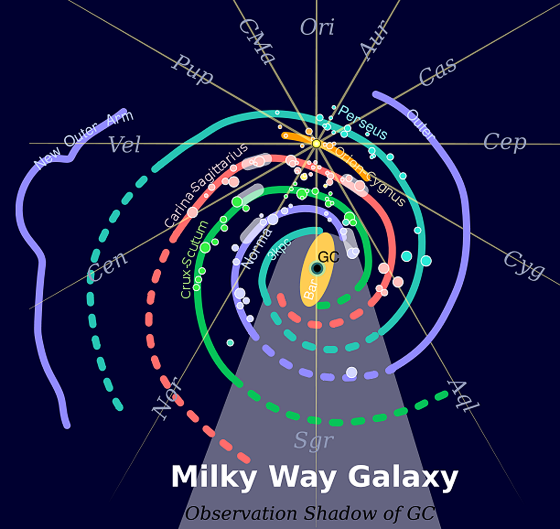
by User:Rursus – A redevelopment of Image:Milky Way Arms-Hypothetical.png: details about method below.User:YUL89YYZ, User:Ctachme, Kevin Krisciunas, Bill Yenne: “The Pictorial Atlas of the Universe”, page 145 (ISBN 1-85422-025-X) and ?ÁOR., CC BY-SA 3.0, https://commons.wikimedia.org/w/index.php?curid=2221433

This diagram from Wikipedia illustrates what we really know as opposed to what’s educated guesswork. The dashed areas are hidden from us, and extrapolated from what we DO know, with varying degrees of accuracy. Notice that the galactic core throws a huge “shadow”, blocking direct observation of a huge wedge of the galaxy.

Our best guess is that for this purpose they contain 2/3 to 3/4 of the stars in the Milky Way.

Which brings us back to that more-than-somewhat-rubbery guess as to how many stars are in the milky way. The fact is that every time there has been a revision to the number of stars over the last century, it’s been upward, so a higher figure seems more probable than a lower one. If we apply the smaller fraction to the larger estimate, and the larger fraction to the “real” estimate, and then average the results, it may be hoped that some of our errors will cancel out and at least give a workable number.

The result: 227,222,222,222. Call it 220,000 million for convenience.

A lot of these stars are going to be too young to have planets, or are too energetic for life – it’s the same thing, so far as we’re concerned. Many of them will be too cold. A lot of early SETI work restricted the range to reasonably sun-like stars, and also excluded binary and triple-star (‘trinary’) systems, because the then-prevailing theory was that planets couldn’t or wouldn’t form in such systems. This excludes about 98% of stars.

That was back in the days before we found ways of actually detecting exoplanets. These days, it’s routinely assumed that the percentage of stars which have planets is close to 100%. But that doesn’t address the temperature concerns.

If we look around our solar system, though, we quickly find that those concerns are somewhat overblown. There are three factors that aren’t being taken into account.

  • Planet-sized moons close to giant planets can generate internal temperature through tectonic action.
  • Our profiles of life are based on what we know of chemistry, which is evolving all the time. I was taught, for example, that there were four states of matter. A fifth, super-cooled, was later added. Now there’s a sixth. So our knowledge of chemistry, which currently defines only two possible chemical “profiles” for life, is still evolving.
  • It’s already well-known that atmospheric pressure changes melting and boiling points, anyway – so the potential ranges of planets on which life might form is far larger than is often thought.

So I’m putting brown and red dwarfs back on the list of potential life-bearing sites. They aren’t supposed to be excluded at this point, anyway, according to the Drake Equation. That, in turn, puts 80-90% of the previously-excluded solar systems back into contention. Let’s call it 85% – and throw in that 2% that everyone agrees on.

That means that N* should be 191,400,000,000.

Fraction With Planets

The original estimate was that 1/5 to 1/2 of the stars in the galaxy would have planets. Actual surveys and the number and variety of stars that have been found to have exoplanets has exploded that estimate. This is now considered something close to 100%, as I mentioned earlier.

What has to be remembered is that in order for us to detect an exoplanet, the plane of its orbit has to put the planet in between us and its star at some point – or it has to be so massive that we can detect the gravitational “wobble” that it produces. That means that unless there’s some cosmic principle that we haven’t yet figured out, the alignment of planetary orbits is going to align with the rotation of the parent star, which is known to be pretty random relative to Earth – one complete dimension is almost completely ruled out.

This shows three possible planes of planetary rotation for an exoplanet. If either of the green options prevails, we can find the planet by the occlusion of the stars light. If the orbit of the planet never puts it between us and their star, no.

That’s perhaps as much as 1° out of 360° – which would mean that were only finding 1/360th of the exoplanets that are out there for us to find. It could be even less. And yet, as of 1 January 2019, there are 3,946 confirmed planets in 2,945 systems, the most distant of which is 2,540 light years away (an unconfirmed exoplanet is claimed for another star more than 5,000 light years removed from us, and we are finding suggestive hints of exoplanets in the Andromeda Galaxy and quasar RX J1131-1231, 3.8 billion (there’s that word again!) light-years from earth.

Of course, the farther away a star is, the harder it is to detect anything..But there are almost certainly as many planets out there as there are stars, if not a substantial multiple of that number.

Our Onion remains 191,400,000,000.

Planets That Can Potentially Support Life (per star that has planets)

The original SETI conference worked with an estimate of 1-5 planets that can potentially support life, on average, per star with planets. There have been a number of attempts to reduce this over the years. Astronomical surveys have suggested that the correct value is 0.4 – using very pessimistic and earth-like definitions of life. There have been suggestions that the correct number is 0.1 times the average number of planets in a solar system – which, while interesting, begs the actual question. This is a number in heated debate at the moment, as cosmologists try to understand what Hot Jupiters do to the process of planetary formation and stability.

Proponents of SETI continue to set a lower value of 3-5 on this number, pointing out that our Solar System has five.

The more planets we find, the more likely it is that there will be more planets to find, and that some of them will be rocky, small enough, and within one of the habitable zones. But even without that, the factors pointed out above mean that those are not the only planets that could potentially support life.

Trappist-1, for example, is an ultra-cool red dwarf 39.6 light-years from Earth. It is known to posses 7 planets, 3 of them in the liquid-water temperate zone. The other 4 are also considered potentially habitable as they all posses liquid water somewhere on their surfaces.

A huge number of astronomers and lay-people either assume that the conditions have to be earth-like to support life – yes this is the only model that we have that we know works, but that’s not enough to say that it’s the only one that can be – and even if it is, the point made earlier about pressures still applies; it isn’t necessary that the environment be all that earth-like for it to happen.

Putting all this together, I’m inclined to set the minimum value at something like 2.5 – One for the environmental conditions that we know work, and 3/4 each for the variations that we suspect work but aren’t sure of.

If this work was to be scientifically-rigorous, though, what should happen is that star populations get subdivided by spectral class, enabling each set of conditions to be independently assessed. It might be, for example, that conditions within the habitable zone of a red dwarf supply enough less energy that life – the next factor – is considerably rarer on such planets. Whilst things remain lumped together, geocentricism perpetually invades thinking on the subject.

Anyway, that lifts our Onion to 478,500,000,000 – a strange onion, this, where an interior layer can be larger than the one that surrounds it!

The Incidence Of Life

This is thought to either be very close to 0 or very close to 1, depending on who you ask. We have no data other than that of earth.

So let’s try and formulate some.

It’s now well-known that if you stuff the atmosphere of primeval earth in a bottle and run an electric current through it, or expose it to sunlight, or do any of half a dozen other things to it, you end up with the building blocks of amino acids after a while. If conditions are right and we persist long enough in waiting for it to happen, some of those are going to find the right configuration at the right time to form actual amino acids.

Again, if we take amino acids and provide food and energy and mobility and enough time, the probability approaches certainty that eventually something that is simpler than a bacterium, but is nevertheless life, will emerge. We’re mixing billions of amino acid molecules together billions of times for billions of years – even a small chance eventually becomes near-certainty, so long as conditions are remotely hospitable to the chemistry.

And we have already defined the conditions under consideration as being hospitable to life.

The uncertainty remaining is one of “What is enough time”? Here once again we become enveloped in anthropic bias. We have only the one example to look at.

Or do we?

Organic molecules have been found on Ceres, the largest of the asteroids, and in fact these may be more prevalent than first thought. [Scientists] from NASA and the University Of Chicago simulated the movements of 5,000 ice grains like those in the asteroid belt prior to the formation of Earth to over a million years in the turbulence of the solar nebula, which tossed them about like laundry in a dryer, lofting some “high enough [so] that they were being irradiated directly by the young Sun.” High-energy ultraviolet radiation broke molecular bonds, creating highly reactive atoms that were prone to recombine and form more stable – and sometimes, more complex – compounds.
(Excerpted from The Building Blocks of Life May Have Come From Outer Space.)

This is obviously a far more challenging environment for life than a primitive planet earth was – but even so, the first part of the process was achieved. If that environment had persisted, or those molecules found their way to a more hospitable environment, they would have had every chance of developing into full-blown life.

That’s a second data point but one that leaves us delicately poised, because they didn’t actually become life. We have one example that says yes, and another that says “maybe”. So let’s apply a relatively conservative factor of 0.75 for this factor.

Our Onion shrinks to 358,875,000,000.

Intelligence

Here we again need to apply a caveat. By “Intelligence”, we’re talking about too-using and/or abstract reasoning. i.e. an intelligence that we can communicate with. Dolphins and Whales are intelligent enough that we haven’t yet learned to speak their language – but they don’t seem to use that intellect fir anything important from our abstract-reasoning tool-using perspective. The octopus displays incredibly sophisticated problem-solving capability, but it’s even further removed from what we consider intelligent.

This is even more controversial than preceding factors. The original SETI discussion set this to 100%, defining intelligence as inevitable. Those supporting this position employ similar logic to that used in the preceding sections. Others argue that the presence of “only one intelligent species” means that it happens very rarely, and this factor should be extremely low.

I’m personally inclined to having a foot in both camps on this issue. Yes, the chances are low and require the correct stimulation and opportunities, but there are so many opportunities for it to happen that the most pessimistic options seem improbable. If you compare the length of time that life has existed on earth with the length of time that higher life forms have existed, you get a ratio of 0.084-0.141 (depending on which estimate you use of when life appeared and how you define higher life); that’s an average of 0.225, a long way removed from 1 (inevitable), but a lot higher than some of the cynics have suggest (1 in a million or billion).

If we use this admittedly geocentric value, our onion drops to “only” 80,746,875,000.

On the other hand, if we use early man as our yardstick of higher life forms and intelligent life, we get a much smaller number – 0.00276.

That drops the onion to 99080706.5.

But I’m going to use still another value, by defining intelligence as the capacity to send and receive radio signals – 123 years ago. That’s a ratio of 0.00000002674, and re-skins the onion down to just 9596. Call it 10,000 for convenience.

Civilization

This has the advantage of setting the next value at something close to one, which is otherwise another controversial value. Once again, I’m hoping that some of our errors cancel out.

So we have 10,000 civilizations out there happily broadcasting radio waves – at some point in time.

Not so fast, cowboy! There are a lot of fudge-factors in the above. The number of stars along could drop this to a couple of thousand. A more conservative estimate would be 1,000. A really conservative estimate would by 200.

Lifetime

Which brings me to the factor that most disturbs and annoys me. It, like everything else has been, SHOULD be a factor, that is to say a fraction that is yes, and a fraction that is no, leaving only the ‘yes’. For me, this is where the Drake Equation breaks down.

Fraction of civilizations that don’t blow themselves up? Okay, that’s a start. Fraction of civilizations that don’t get wiped out by some cosmic calamity or an asteroid strike or whatever? yeah, that’s a factor to think about.

“How long a civilization lasts” seems totally counter-intuitive in this context.

Replacing this with “fraction of a radio-capable civilization’s lifetime that they are actually broadcasting” gets us somewhere interesting.

Everything else has been about the number of civilizations out there that we might be able to detect. This is all about trying to say “the percentage of those civilizations that we can actually detect” – but it’s usually not described that way.

Two ways to detect E.T.

There are two ways that we can detect an alien civilization through their manipulation of the electromagnetic spectrum – the first is listening for a message they have sent us, and the second is detecting their radio ‘noise’.

    Distances Between Civilizations

    Before we can reasonably analyze either of them, though, we need to get some impression for the average distance between these civilizations.

    The milky way is roughly 150,000-200,000 light years in diameter, giving it a radius of 75-100,000 light years. But most of that is outlying material; in terms of the parts we’re interested in, it’s about 100,000 light-years across and about 1,000 light-years thick. But that thickness is the average for the whole thing, and the core noticeably bulges; about three times the thickness of the arms. We also need to exclude that core from our calculation of the plan area of the disk if we hope to get a volume. Looking at the galactic cross-section, the core is about 1/5th of the total diameter across, so about 20,000 light-years.

    When I do that, I get an average thickness of the disk section of 926 light years, and a toroidal area of 2,400 million pi – so the arms contain roughly 7 million million cubic light years.

    That means that each of those 10,000 (if there are that many) would have roughly 700,000,000 cubic light years each, on average. If you imagine two cubic bricks, corner to corner or side-by-side, each with a civilization at it’s center, you get an impression of the arrangement. Exactly side-by-side gives the minimum distance between them, corner-to-corner gives the maximum, and half-and-half gives a rough value for the typical distance. 700 million cubic light-years is a cube about 888 light years on a side.

    The minimum: half of 888 from #1’s brick and half from #2’s adds up to 888 light-years – no surprise there.

    The corner-to-corner is 1256 light years. The in-between is a lot harder to work out in timely fashion, but the average of those two number isn’t far off:1072 light years. I suspect the correct answer will be a little on the high side of that, based on the 3-d geometry I roughly sketched out, so I’d say a little over 1100 light years would be about right.

    1100 light-years away? They’re right next door! Why haven’t we heard anything?

    Not so fast, cowboy! At only 1,000 such civilizations, each would have 7000 million cubic light-years of space. That’s a minimum of 1913 light years, a probable maximum of 2705 light years, and an average of 2309 light-years.

    At only 200, each would have 35 thousand million cubic light-years to play in. That’s a minimum of 3271 light-years, a maximum of 4626 light-years, and an average of 3950, near enough.

    Of course, this being a statistical result, anything up to three or four times or five these numbers is absolutely reasonable – if others are closer, to bring the averages down. Even ten times are plausible, but wins us the galactic loner-for-life tag. That gives us potentially 5500 light years for 10,000 civilizations, 11545 light-years for 1,000 civilizations, and 19,750 light years for 200 civilizations.

    Those numbers are significant. If a civilization 5500 light years from us invented radio at the same time we did, we’ll detect it – 5,377 years from now, at best! In the year 3358 BC, an equal span of years away, the Naqada culture was ruling in Egypt, Cuneiform was new that century, there was an Irish burial mound erected for a child, Enoch disappeared and Methuselah was in charge – according to the Hebrew Bible.

    The Communications Window

    That’s all a bit awkward if the average lifespan of a civilization is, say, 300 years. It means that our 300 years has to match up to their 300 years less the distance between us. If the nearest is only 50 light-years away, we could have 250 years of productive conversation before time ran out for one of us. Maybe 5 messages back and forth. If 100 light-years, that window is down to 200 years, and we’re only likely to get 2 messages exchanged. At 1000 light-years, they had better have had radio in the time of Ethelred The Unready. And at 5500 light-years, they would need to have been capable of showing Methuselah a trick or two.

    Based on the duration of 60 earthly civilizations, the average lifespan of a civilization has been calculated as 420 years. Based on 28 that are more recent than the roman empire, the average falls to 304 years – determined by the same scientist. Food for thought!

    The farther away a civilization is, the longer our civilization needs to last if we are to have contact with them.

That brings us back to our two methods of contact, having gained some feeling for what the distances could be – and hence, the times. The first is to detect a signal deliberately sent out by them, and the second is to detect their byproduct electronic noise.

SETI, quite frankly, pins all its hopes on the first. And on them doing all the heavy lifting, too.

    Sending A Message

    We’ve never sent a radio message to a nearby star. What makes us think that an alien civilization would send us a signal? Especially before there was any way to know if there was intelligent life here?

    But let’s set that aside, and assume that they aren’t like us in this respect.

    Based on an image at https://www.seti.org/

    When you look at radio noise by frequency, from which you want your signal to stand out (assuming you’re sending one), there’s a rapidly-descending wall on the left, caused by electrons in the milky way’s magnetic field, and a series of peaks and valleys on the right caused by the different molecules in Earth’s atmosphere The result is a noise “trough” from 1 GHz to 10 GHz.

    For a very long time, then – almost as long as we’ve had radio astronomy – this “trough” has been targeted as a likely set of frequencies for interstellar communications. Personally, I’m not 100% sold on that, based on my once being told that this was due to absorption of the noise by Hydrogen clouds in space – if that’s the case, then this might be the last frequency you chose – but I’m not 100% sure the information I was given was correct, either.

    But even so, there’s a problem, and a huge one: Doppler Shift.

    Solar systems and the like barrel through space at a fair old rate of knots. If they happen to be coming toward us, every frequency is blue-shifted, moved up the frequency band. If they happen to be moving away, there’s a red shift.

    Our sun, for example, is moving at around 43,000 miles per hour in the direction of Vega, and this speed is not in any way unusual. That means that anything under 86,000 mph closing speed and 86,000 mph receding speed is quite believable – two stars that just happen to be moving more or less straight toward, or straight away from, each other.

    Now, in terms of the speed of light, those speeds aren’t all that spectacular. The difference is 0.013%, either plus-or-minus – but that can be enough to throw it out of the detection band. Because it would mean recalculating the correct frequency for the motion of every star observed, SETI relies on the aliens sending the message to have adjusted the frequency of their transmission to allow for Doppler effects.

    Why are we so special that they would do that? Unless they had already determined that there was intelligent life here – despite our deliberate policy of not telling anyone?

    And then the third shoe drops – if they send a message using FM, SETI won’t receive or understand it. all their efforts are bent toward constant-frequency transmissions – that’s AM or digital. They leave FM to the hobbyist, mainly because it’s difficult and relatively expensive, and SETI has always had to be done on a shoestring.

    Incidental Transmissions

    When the layperson thinks about SETI, even the relatively educated one, they think about picking up the radio “noise” that’s leaking out from the planet. We use so much electromagnetic communications, more every day. And that stuff leaks, despite the best efforts of engineers to contain it.

    They want to keep signals confined to the purposes for which they were transmitted because anything else is wasted power, and wasted bandwidth.

    One of the earliest TV signals to be broadcast was Adolf Hitler opening the 1934? 1936? Olympics in Berlin. That signal is now arriving at any star that happens to be 80 light years away, more or less.

    Throughout the 20th century, our digital noise increased in intensity. It has since started to either stabilize or decline, as more signals are being carried digitally through optic fiber, or more precisely aimed using dish antennas. That’s how we can still be in contact with Voyager 1 even though it is now in interstellar space, the most distant man-made object at 13.2 billion miles away.

    So, if we were to use our best (at the time) radio telescope equipment, and point it at a star (and a planet) that (distance) years ago was emitting just as much radio noise as we were (at the time), from what distance do you think we could detect enough of the signal to recognize it as having an intelligent origin?

    800 light years vs 5500 light years. The 800 is more than a speck, but that’s about all you can say for it.

    Eight hundred light years.

    At best.

    Let’s go back to the scale of the milky way again for a moment. The measurements shown on the diagram to the right are in thousands of light-years. We’re talking a bubble that’s less than ONE thousand light-years.

    Ah, but our equipment has no doubt improved vastly since then. Unfortunately, we’re up against the inverse-square law. To get the 800 out to 1600, we need a 400% improvement in our equipment. Against a background that is increasingly hostile to radio astronomy, which is a whole other story I don’t have time to go into. An eight-fold increase might just about do it.

    But our general broadcast emissions are dropping off as our technology improves. There was a period of peak noticability, and now we’ve started to fade, from a radio signal point of view. By now, that eight-fold increase won’t cut it – we would need a 10- or 12-fold improvement just to stand still. The signals are so much weaker, with so little “spill”.

    Which brings us back to the question of a receptivity “window”. We’ve had radio for 123 years. We’ve had TV for 80-odd years. We’ve had STRONG TV signals for maybe 60 – but we started “the great fade” about 30 years ago. That window, for a civilization right on the edge of reception, was only about thirty years.

The Panic Merchants

I started thinking about writing this article somewhere around August-September last year, when I spent a couple of very interested days reading articles on “where are all the ETs?”

You see, the longer the period of time that passes without our detecting someone, the more extraordinary it starts to look. As a result, there has been a great deal of thought lately that’s gone into the question of why we aren’t finding them, if there’s anyone out there. Some of the analyses and speculations were absolutely fascinating, and frequently cause for considerable alarm – if the SETI enthusiasts’ estimates of 100,000+ alien civilizations within the milky way are to be believed. Others were more benign in nature.

I’d love to point you at the discussions, but I’m no longer sure of the URLs.

But, I think that the factors that I’ve pointed out in this article go a long way toward explaining the radio silence. And to those, I can add one more.

The Principle of Mediocrity states that there’s nothing exceptional about where we are in terms of the physics and chemistry; the natural laws that apply here, also apply out there. That has often been interpreted as meaning that if there are 500 civilizations out there, roughly 250 will be younger than ours and roughly 250 will be older.

I submit that this application is a nonsense. When you toss a coin for the 250th time, there’s still a 50-50 chance that it will come up heads. When you roll a die for the 250th time, it’s still just as likely to come up 1 as it is 6 (wear notwithstanding). Someone has to be first, and assuming that it’s not us is assuming that there is some reason that we can’t be first, and that is a violation of the Principle of Mediocrity.

Statistically, the odds are that we aren’t first – but someone wins the lottery.

But, let’s postulate that we aren’t first, we’re in fact third. One of the others is on the far side of the galaxy from us and we’ll probably never even know they were there. The other one is a mere 30,000 light years or so from us, so far beyond our ability to detect them (and vice-versa) that we may as well not exist – each from the point of view of the other.

The Chance Of Making Contact

Let’s get back to the Drake Equation. What I think should replace the last term in it is The chance of making contact. This is obviously a value that adds up, year on year. You can state that it’s the average chance of success in any given year multiplied by the lifetime of the civilization doing the listening/sending. Our units work out – we have years, and we have per-year.

But what the preceding discussion makes clear is that the chances are NOT very good. They improve vastly if we have nosy neighbors who stop in (metaphorically) to say “hi” and welcome us to the neighborhood and take a good long look at the drapes while they’re here. We aren’t that type.

We show up, and draw all the blinds, and then spend all our time peeking out through the corner of the window to see if anyone’s watching us. We’re the paranoid nutters and ax-murderers of the neighborhood, the ones always described as “very quiet, kept to himself”, the survivalist convinced that the end is nigh. At best, we’re the neighborhood cat lady.

Maybe if we were more welcoming, we would be more welcome.

But, setting that aside, what actually are our chances of making contact, defined as “hearing a signal that may or may not have been meant for us?”

Well, how do SETI searches usually work?

For a period of time, we take a good close look at one particular group of targets. For perhaps a few hours, we’re paying attention to a single possible target – and then we have to move on to the next. When it comes time to plan the next search, the SETI community are spread so thinly that the main objective is not to waste time on redundancy; “Someone checked Beta Hydri last month / last year / a couple of years ago. Nothing. We’re better off looking at a star they DIDN’T examine.”

But the signals are almost certainly so weak that unless they were deliberately signaling us, we have a very good chance of not picking up anything. And it’s no good for them to be signaling us NOW – if they are 200 light-years away, they needed to be signaling us 200 years ago, when there was virtually no chance of them knowing there was anyone here to hear them.

It follows that the chances of a message being sent our way increase with every passing year. But if we don’t happen to be looking in the right direction in the right way at the right time, we will never know the phone was ringing.

That all means that the chance of making contact is still rising – not because of anything we’re doing that’s all that much more than we were already doing, but because the wave front of those strong TV signals is still out there, expanding, and so is the aliens’ wave front of strong TV (“Buy Grimklakk’s Chelating Cream for a smoother finish!”) heading our way. The odds of us being dead-center in the middle of the range of current civilizations are just as great as the odds of us being the first – and either way, we’ve been listening for a while now.

Once a decade is the maximum frequency with which any given star can be assured of being checked, on average – there are some that are conveniently located and are checked more frequently, and some that are not, and which are checked more rarely. And when they are checked, we’re talking a few hours of observation, at best.

So that’s 2 hours every decade. That would probably be enough to pick up an incidental leakage from someone that was close enough – but for anyone outside a 1,000 light-year bubble, we’re reliant on them sending a message at the exact right time. So we have two chances to calculate, one for each detection method, and the total gives us our chance of detection.

    Leakage

    Peak signal period is an estimated 30 years. We’ve been listening for about 50. We’ve had radio for 123. Our detection methods are good for 1,000 light years.

    1000 light years, as a sphere, has a volume of 4/3 pi r cubed – call it 4,200,000,000 cubic light years. The milky way is 7 million million cubic light years. So the ratio is 0.0006 – per decade. SETI started back in 1980, or close enough to that – so we’re coming up on 40 years of it, i.e. 4 decades. Our accumulated chance of detection from leakage is 0.0024, or 0.24%.

    Signal

    We have to assume that there’s a signal sent to be received. 70% or so of the galaxy is open to our radio telescopes, so I’m going to assume that we can potentially pick up 70% of the civilizations that are out there, however many there are. At least, we could, if it weren’t for that pesky speed of light limitation.

    We’ve been listening for about 40 years. So assuming there’s a signal to detect,, we can detect it today if it comes from 40 light years and was sent when we started listening. 40 years is a trivial, a minuscule speck – if I tried putting a 40-light-year bubble on the 800-vs-5500 above, it would have been about 2.2 pixels across!

    But things are not quite so dire. We don’t know L. L might be 1000 years – once you become technologically advanced. So if the people who were first got radio 1000 years ago, their signals could be picked up tomorrow.

    Heck, L might be five thousand five hundred, for all we know. It seems improbable, but not implausible.

    But let’s say that the pessimists are right, and societies only last for a few hundred years. That 300-year block of time is an expanding hollow sphere centered on where the civilization sending it were located, when they sent it. It’s a message in a bottle. There might even be a hundred thousand of them, as the Police song’s lyrics suggest. If they started send radio signals 500 years ago, the outer edge of the sphere is 500 light-years out at this point, and the last goodbye is 200 light-years out.

    The moving window is moving in perpetuity. So the correct fraction is Nx10x2/L divided by the number of hours in a year. At an L of 300, that gives us 0.0000076 per civilization – so, at 10,000 civilizations, we get 0.076 per decade. And, as I said, we’ve been looking for 4 decades – so 0.304, or 30.4%. But, before anyone starts doing high-fives, there’s a catch.

    That’s assuming that there’s a deliberate signal being sent specifically to us. We need to factor the likelihood of that happening as well. There are roughly 512 G-type stars within about 100 light years of earth. Let’s assume a similar number of F and K stars – the three stellar types considered most likely to have earth-like planets and hence earth-like life.

    That gives 1536 stars within 100 light-years. If we were to signal another star without knowing there was intelligent life there, we probably wouldn’t go much further out than that. If we spent 40 years signaling – a number very deliberately chosen – how long would each of those 1536 stars get? 365.25 x 40 = 14610 days. Divide that by 1536, and you get 9.5 days each.

    And, as already pointed out, if we aren’t listening for the ten days that are our turn? Bad luck.

    We’ve spent 40 years listening, but we spread ourselves a little thinner – about 10,000 stars have been examined at least once in that 40 years. 365.25 x 40 / 10,000 = 1.461 days.

    So the final calculation is 30.4% x 9.5 / 14610 x 1.461 / 14610 = 0.00002 – per cent. Or 0.0000002.

    The total

    0.0024 + 0.0000002 = 0.0024002. If we multiply 10,000 civilizations by that fraction, we get 24.002.

    We could have detected as many as 24 civilizations by now!

    But, if we multiply 1,000 civilizations by that fraction, we get 2.4002.

    We could have detected as many as … two?

    And, if we multiply 200 civilizations by that fraction, we get 0.48004 – get back to me in about 50 years…

    …all of which completely ignore the possibility that we are a lot closer to being the first to invent radio out of the 10,000 or 1,000 or 200.

    But that’s just an assumption – we’re equally likely to be at the tail end of the queue to get into the party.

    But there’s still another caveat. As you can see, the chances of accidental detection of leakage are WAY higher than they are from a deliberate message – there are just too many stars in the sky for blind chance to bring two strangers together. But here’s the thing: most radio astronomy surveys are not routinely analyzed for ETI signals, or at least, they weren’t. So we may very well have picked up those 24 signals from 24 neighboring alien races – and not noticed any of them.

    We can state with confidence that 40 years ago, no-one in the 100 closest stars had radio technology. Beyond that, the speed of light kills the chances of a message having been received.

    None of which doesn’t mean that one couldn’t be detected tomorrow. The odds are just as good as today, if not infinitesimally better. But in looking for deliberate signals, the SETI community are looking for the black cat in the cellar at midnight. If they keep it up long enough, and the black cat is really there to be found, they could succeed. But the odds are slim.

    There’s certainly no need to go all Chicken Little – not yet. There’s ample reason for us to have failed to find extraterrestrial intelligences, and no reason to think they aren’t out there waiting to be found. But if the nearest one really is 5500 light-years away, we might have to look for a LONG time.


Comments (7)

Divine Worlds To Conquer: Four Campaigns for the Jan 2019 Blog Carnival


I got a bit carried away with this illustration, I think. 6 worlds, 5 different astronomical backgrounds, 7 lightning bolts. You might not be able to see everything that’s going on at this small scale – but click on the image to behold its’ full 1280 x 1280-pixel energy.

Because I was able push the latest mega-update to the Blogdex out a day earlier than expected, I’ve had time to work on this article for the January Blog Carnival.

I love a good, provocative turn of phrase, a coupling of words that stimulates the creative juices, tantalizes the imagination, and makes you think of things that had never occurred to you before. This month’s Blog Carnival, hosted by In My Campaign, is built around just such a phrase – “Divine Worlds” (well, technically, it’s “Divine Worldbuilding”, but…).

What could this mean? My imagination’s been firing whenever I give it room to fire up ever since I heard it.

Well, the “Worlds” could be literal, or figurative, or even metaphoric. And the “Divine” could indicate a property of the worlds in question, or possession/ownership of them, or the creation of them, or just a relationship between them – one that might be just perception or might have some basis in fact, or might be complete fiction. By my count, that’s 18 combinations.

Well, I’m not going to explore all of those possibilities, for the main reason that my imagination has been obsessing about just a couple of them.

rpg blog carnival logo

Interpretation I:

The Gods created the planes of existence either directly or indirectly so that each being could find a place to dwell that reflected and suited their nature. Now, for some unknown reason, they are secretly making a whole lot more, a discovery that has been made by accident. The PCs are sent to investigate, as have a number of equivalent groups from other planes.

Why might a whole bunch of new worlds be needed?

Interpretation Ia:

Possibility #1 – there’s something wrong with the old ones. Perhaps they are flawed in design and about to break down – the sort of thing that happens when you build in haste. But the Gods discovered the problem too late, and not all the new worlds will be ready in time; people may have to get used to strange new neighbors.

And, if not everyone can be saved because the new worlds aren’t finished, it will naturally occur to those who are not to be chosen to take someone else’s place – by force if necessary.

Let’s further surmise that the world-building process increases the capacity of the new worlds with every passing moment. All hope will not be lost until the existing worlds actually break down completely.

That means that the odds of your being chosen to survive will increase with every one of your neighbors that you eliminate. And, since the Gods will logically choose their followers and adherents first, the more pious someone is, the bigger the threat they pose to your survival.

This is a recipe for genocidal warfare internal to each plane of existence.

Of course, just because an environment isn’t perfect doesn’t mean that you can’t survive there, at least long enough. So this is also a recipe for inter-planar warfare of an equally-genocidal nature, and an almost-complete breakdown of all societies in existence.

Of course, the more gentle and enlightened, the more the citizens will have expectations, and the faster they will break down. Or, to phrase it slightly differently, the more authoritarian the society, the more it will resist collapse through the use of force and intimidation when compared with a more gentle social structure.

That means that the more violent societies will be the last to be able to field whole armies, against an opposition that has largely gone to pieces, socially, with everything to gain by doing so and nothing to lose.

Small wonder that the gods would have tried to keep all this quiet for as long as (in-)humanly possible.

This is obviously the outline for a campaign in three phases. In the first phase, the PCs discover what is going on, encounter other groups making similar investigations, some of which will be friendly and some hostile, some knowing more than the PCs, and some less. This lays the groundwork for the campaign trilogy, and it is also where it is most vulnerable in terms of believability. A number of questions remain unanswered, and concrete answers would be needed.

  1. How were the new worlds discovered, and by whom (from the PCs perspective?
  2. What is the creation process?
  3. Why would the Gods not intervene to prevent the discovery?
  4. What are the early signs of the imminent breakdown?

Question three can at least be answered relatively easily – the creation process might be taking all the Gods’ efforts. Anything less will reduce the number that can be saved. But that answer holds further implications – virtually all clerical magic stops working as soon as the Gods discover the situation and begin world-creating. That would get noticed in a hurry.

Most religious groups would initially look for blame within themselves. Perhaps they had done something to offend the Gods, or failed to do something, or failed to stop something being done. Hardliners and reformers would crawl out of the woodwork, only to be confronted by Progressives who argue that the faithful were not so much abandoned as “left behind”. The religious and theological upheaval would be a small taste of what was to come.

After things had settled down somewhat, internally, the next group to blame would lie outside the congregation. Mages in particular would be targets, since their working of magic without faith undermines the credibility of the faith. Sorcerers can at least be described as possessing “a gift from the gods”.

As was the case when Lolth was apparently killed in the backstory of my Fumanor: The Last Deity campaigns, some high-ranking churchmen would organize the use of mummery to keep the faithful convinced that they had not been abandoned. The Drow, of course, had a downtrodden group of male mages and illusionists to assist in this deception. I’m quite sure that when everyone else started blaming mages, some religious authorities would offer them sanctuary – conditionally.

The last thing that religious leaders would want or tolerate, under these circumstances, would be anyone attempting to blame them. Some sort of Inquisition, a secret police, would be urgently formed. Perhaps certain “Holy relics” can act as a power source in the gods’ stead – such would make dandy symbols of office, and permit the Inquisition to defuse some of the worst skeptics: “You see? The Gods are still there, still answering our prayers. No need to spread Heresy. So you had better shut up, if you know what’s good for you. You won’t get another warning.” Rogues and other sneaks would naturally gravitate into this service as well.

At the same time, the church would start recruiting small, elite, armies to act as bodyguards for the church leaders, and as muscle to prevent any other church pointing the finger at this congregation as the source of all woes.

That means that the churches would already have the core of a decent Adventuring Party ready-made. Cleric-Inquisitor, Rogue, Wizard, and one or two Prime Meat-shields.

But you can go further. Having such groups on hand, a prudent church would seek to use them as investigators to find out what the real problem was and end all this speculation. They would train the best of the best, equip them as well as they possibly could (under the circumstances), fill them in on the truth behind the catastrophic breakdown of the faith (as described in the campaign background), and send them out to investigate. Their mission: fix the problem if you can, but above all else, find answers and return with them.

So that’s our PCs, sorted (in fact, the group bears an uncanny resemblance to the group assembled in Fumanor: Seeds Of Empire)!

The PCs can then investigate the failure of the Gods to “perform on cue” and eventually discover the world-building, and the reasons behind it (the imminent breakdown of the current planes of existence). Of course, other groups are also making the same discoveries. Phase I of the campaign would more or less end with a lecture from one or more of the Gods on the importance of secrecy, and the anarchic collapse that is coming. But, no matter what the PCs decide to do with the information they’ve obtained, the word will get out – someone will report back to their superiors, who will realize that the residents of their plane are to be partially sacrificed to enable some of the residents of some other plane to survive, and the word would leak.

Phase II of the campaign starts with the rise of anarchy and civil war – more or less everywhere. This breakdown was already the trend, as phase I made clear. The PCs find themselves in the thick of it, discovering plots and sabotaging armies and cutting supply lines and backstabbing allies who were about to back-stab them, and deciding whether or not to go along with war crimes (read: commit acts of genocide as ordered by their superiors – some will, some won’t). If the PCs won’t, that means they have to turf out the current leadership and lead a morality-based revolution of their own.

And all the while, in the background, the signs and portents and side-effects of the progressing breakdown of the plane of existence itself would add urgency and perhaps a touch of surrealism to this dystopian vision.

Phase II would end with the arrival of the first planar invasion force.

As stated earlier, this would be from a martial world, a society in which force compels obedience. A lawfully-aligned society, in other words, and probably an evil one, to boot. Right away, that points to the Devils, but that seems too obvious to me (besides, I have bigger fish for them to fry a little later). But whoever this group are, they won’t be the last.

It would be as though you were this isolated group having your own little war with a neighboring tribe when World War II washed over the top of you without warning. Until then, only the most learned of your people even suspected that their might be other tribes out there.

Phase III forces the PCs to look at the bigger picture, and places them in position to make decisive differences in that bigger picture. They won’t achieve that by main force, but by diplomacy and intrigue and subterfuge and alliances and the gathering of intelligence. Which dominoes will they push over, and which ones will they glue down – and will that be enough to keep them standing? Especially when the table on which they have been placed is experiencing it’s own instabilities – reality is continuing to break down, remember!

The climax of Phase III is when the PCs, in the middle of a critical situation, are suddenly evacuated by the Gods to their new home, they are amongst the lucky ones. And facing a whole new set of invasions – why attempt to conquer a burning building when you can go for the real prize, the brand-new home that’s almost finished, over on the far side of town?

Of course, this means going up against the Gods themselves, a prospect that would scare off most of the “weaker” groups. But not the Lords of Hades and Princes of the Abyss (or is that the other way around? never mind). Suddenly, the stakes are raised yet again, and the bigger picture shown to be just part of an even more sweeping landscape.

There would be strong temptation to make this a whole fourth phase of the campaign. I would strongly resist that urge, simply because there is too great a similarity between this and what’s already happened in Phase III. Instead, make this the epic climax of Phase III – in which the PCs start to plan and create the structure of society that will emerge after the breakdown. They should be prepared to throw existing assumptions out the window, making sacrifices and hard choices to get there. Perhaps the Elvish Forests can be largely preserved – but only on one of the outer planes – though a number of permanent bridges can be erected between there and the forests of New Earth. Perhaps the price of achieving all this is that the Dwarfish Tunnels have to go – but some of the Dwarfish populace can be saved, residing aboard vast ships made of enchanted Elven timber that sail the void between the worlds.

Again, there are two options that the GM should choose between – either the emergence of Devils and Demons is an inevitability (however changed their circumstances might be in the new cosmology), or the PCs will have to discover that there is a necessity to their existence – which means that the GM will have to have figured one out in the first place.

Personally, I would plan speculatively on the latter, and keep the former in my back pocket as a fallback to be employed if I couldn’t devise a sufficiently compelling reason. And my thoughts would probably start along the lines of the existing devils and demons being redeemable, however unlikely that might be – something that could not be guaranteed about their inevitable replacements. This takes the GMs conflict and makes it part of the fabric of the game world – the PCs either preserve (some of) the Devils They Know, or take the chance that what arises in their place will be even worse.

And, of course, the Epic Finale is the final collapse of the old reality and the PCs and their fellow Saved desperately holding off the doomed invaders from the old.

This, to me, is an outline for a campaign that would be always intended to go Epic. It starts big, with all theology blighted by Iconoclasm and Heresy and Schisms, with attendant social upheaval, and only gets bigger from there. Part II, in retrospect, is a bit of a “calm before the storm” compared with the grandiosity of the revelations of Part I and the inter-planar scope of Part III – but it’s deeply personal, which should raise the intensity enough that the PCs won’t initially notice.

Interpretation Ib:

All of that was built on one possible answer to the initial question posed, but that’s not the only way things could go.

Possibility #2: It’s a Divinely-generational thing. The current Gods are aware that their time is running out, and they need to start building up replacements. The problem is that for whatever reason, the current crop are barren – perhaps they are consuming too much of their vital essences catering to the needs and whims of clerics (and fighting off the privations of those who would do them harm, like Devils and Demons). So they are building this enormous divine Power Pack, which they will colonize with a handful of the ignorant, who they will Convert. In these (unstable, temporary) Paradises – one new plane and subject populace per Deity – populations of the newly-faithful should boom.

That in turn will give the Gods a temporary boost, sufficient that they can create their heirs. Of necessity, these new faithful will be sacrificed in the process – but because they have been raised to expect that, it’s a sacrifice they will make, willingly. Ultimately, to claim their own divinity, the children will need to overthrow and usurp their parents’ power, just as their parents had to do long ago (this is starting to remind me of the Greek Gods and the Titans).

How would you raise and educate a new generation of Gods? Tell you what, I’ll get back to that in a moment.

There are all sorts of directions I could take this concept in, in terms of a campaign. I could have the PCs be the younger deities without the players knowing it, for example. Or they might be residents of the “Sacrificial Lambs” who are starting to question the blind loyalty to the Gods of their parents, as young people often do. Or they could be from the “Old World” and curious about what the Gods are up to. Personally, I think I could have the most fun with the first answer, but your mileage might vary.

So you’re a PC in this campaign. You wake up one morning in a strange place, with no memory of who you are beyond your name, and a minimal amount of practical expertise of some sort – a first level character with amnesia. Your mission is to make your way in the world, to survive and prosper, and to ultimately regain your memories.

Nor are you the only one – there are three or four others, perhaps more, all in the same place and same situation.

From Day One, it becomes clear that you are being persecuted by the Gods. If you make a minor mistake, you are punished mercilessly. If you fail to learn a lesson quickly enough, you are punished mercilessly. If you fail to stand up for yourself, you are punished mercilessly. If you do stand up for yourself when in the wrong, you are punished mercilessly. And there are endless opportunities to do all these things that come out of the woodwork whenever you even look in a given direction.

And yet, from time to time, there are random acts of kindness, and goodwill, and charity. And, should your life ever truly be threatened, some sort of miraculous intervention will “just happen” to take place. You are a divine plaything, a favorite toy. Or so it seems.

At night, your dreams are of living in paradise, of standing in judgment over others, of being the deciding factor in life-and-death situations, and of never quite measuring up to the expectations of your parents, who you can never quite picture. Strangely, you seem to learn (i.e. gain XP) from these experiences (mini-adventures), no matter how fanciful or bereft of context they might be.

Some of your number fall, or despair, or just give up and settle down to an ordinary life, or repeatedly fail an important lesson, or demonstrate abject stupidity (from which nothing, not even Divine Intervention, can save you). One or two become cold and cruel, or yield to temptation – not petty stuff, serious.

Eventually, there are only the PCs and one or two others from the original group left, and they have achieved skill and power enough that if they work together, they could conceivably bring down a Deity (probably a minor one). That night, their dreams reveal who their parents were, and who they really are, and that they were raised in luxury and wanting for nothing, only to be turfed out on your ears one morning and your memories erased.

Everything that you have experienced since has taught you (1) to be resentful of the treatment you have received at their hands (you were right, this is personal); (2) to believe that you can do a better and fairer job; and, (3) taught you the necessary skills to perform the tasks of a Deity. Or rule a kingdom. Or run a major business.

Under those circumstances, you would be fully expected to show up to lay claim to your birthright – by force, if necessary. Which it will be. Once you’ve started taking over from one God, you can’t stop there, because the old guard will stick together to oppose you. So you overthrow the Gods, and appoint yourselves in their place.

Only then do you learn the whole truth – that all this was done deliberately, to prepare you to take over and compel you to do so when the opportunity arose. And only then do you learn of the uncounted numbers of faithful who were sacrificed ruthlessly to bring you into existence – the final revelation that transforms the old Gods into villains.

“Any shortfall in your numbers will eventually be filled in the natural way of such things, until the demands on your time and attention are all being met. And then, one day, you too shall become barren and find your potency waning, and will have to prepare a new generation.” is the final advice of your parents, discovered after this moment of revelation, inscribed onto a memorial to the faithful who made this ultimate sacrifice. “Having orchestrated this act of barbarity, we are no longer deserving of being the Gods of the faithful of this existence. And so we do this, knowing that it will set in motion a sequence of events in which we will be judged and found wanting, and punished accordingly. And we do this, willingly.”

But the campaign isn’t necessarily over at this point. For the Gods to have reached this point, they must have become aware that they were letting little things slip, and little things sometimes grow into big things. There is, quite frankly, a considerable mess to clean up. Let them go wild with divine might and authority, reordering the material worlds into paradises. Starting with what to do with those children of the Gods who didn’t measure up. The PCs have been raised to sit in the Big Chairs, it’s only fair for them to have the “fun” of doing so for a while.

For how long? Well, I mentioned that one or two NPCs had survived, and suggested that some had turned cruel and heartless; the implication is that at least one of the NPCs falls into this category, and will begin scheming to take the ultimate power all for himself. He starts by killing the other NPC Deity, or coming close to it, before the deed is discovered. Once the PCs sort out this mess, the campaign can end.

But that’s not the only way all this could go. The PCs might discover the truth BEFORE deciding what to do about their parents, and BEFORE the ultimate sacrifice has to be made – giving them the choice of sacrificing someone ELSE, instead. Or flat-out refusing – prompting the Gods to start committing atrocities that the PCs can’t stand for. The whole purpose of this campaign is for the PCs to challenge and overthrow the Gods themselves – with the willing connivance behind the scenes, of those Gods.

Interpretation II:

Some worlds are Divine, others are not. There is a Spiritual Cosmology in addition to the Secular one that most planar travelers see, the details of which are a closely-guarded secret shared by the different Churches and Faiths.

This ordering of the heavens binds planes together and interconnects them in ways only the most theologically-wise can comprehend, even dimly. Much that is strange and mysterious to the secular world – like souls, and travel to the afterlife when you die, and the relationships between Gods and Demons and Devils, can only be explained correctly by taking these spiritual channels into account.

And sometimes, the Gods act in mysterious ways because of the imperatives implicit in this spiritual reality.

What might such an interlinking permit?

Why not a direct communications link to the souls of the faithful – so that when a member of the faithful says that they hear God speaking to their very soul, they are being literal and not figurative.

It could also provide the pathway along which the soul proceeds to judgment after death. Of course, like all courts, this one is a little backed up, so there is a limited window to recapture or intercept the soul, either fueling Necromantic magics, or returning the individual to pseudo-life as an Undead. Indeed, if the departed had sufficiently strong motivation, he might break off the path and make his own way “cross-country” to return as a ghost.

Judgment implies that not everyone gets into the final reward. Rejects may be sent back for another try, or have a punishment conferred for a period of time before they are paroled, from which state they may eventually earn their way into heaven by helping others, or they may be condemned to eternal punishment in the service of a Demon or Devil.

This unlocks a whole new perspective on those – races, for want of a better term. I spoke earlier of the need for a Necessity for their existence – well there is one example; the Devil Lords and Demon Princes are of the Gods, and punishing those sent to serve as their underlings simply harnesses their antisocial proclivities for the general welfare of all, while giving them someone to exercise their worst tendencies against. They LIKE being cruel, and torturing others – this satisfies them while bettering society as a whole. And, should the supply of new victims ever run low, they can always pay a visit (or send underlings to do so) to the “mortal world” to stir things up with a temptation or two. It’s what you call your basic “win-win”.

So far, not a whole lot has changed in terms of the surroundings and trappings of a typical game – but there’s a different context, and a slightly different flavor.

The key point to emerge so far is this: that the gods are sometimes compelled to do things that seem cruel or capricious for reasons that surpass mortal understanding – whether they want to, or not.

That seems a fertile ground that a campaign could grow from – because inevitably, there will come a day when a God will say, “I will not! There must be a better way!”

The instruments charged with divining and executing that better way? The PCs, of course.

In a way, this gets them to the tail end of the previous idea without their having to earn their “reward” – and with none of the power that is required to solve problems without a lot of hard work. It’s a justification for throwing the PCs neck-deep into problems of the GMs devising for which they are hopelessly unprepared and expecting them to be able to muddle through, anyway – a sort of James Bond in D&D – “In their majesties’ divine service”.

But the time will come when they have to pay the piper for all this fun – they are getting a hair slower, or want to raise a family of their own, or simply want to settle down and enjoy life, or soon will, in the eyes of the Deity or Deities to whom they answer, and they know too much.

And there’s only ever been one answer to people who know too much, and it’s not very satisfying for the people in that position. Suddenly, we go from being 007 to being Jason Bourne….

So, there you have it: three campaigns (and a few variations) built around just TWO of the sixteen possible interpretations of the phrase “Divine Worlds”. There are sure to be at least fourteen more…

Bonus: Interpretation III

This article was done, and done early – or so I thought. But this morning, in the shower (where I often have some of my best ideas), a fourth interpretation grabbed my attention. So here it is.

This campaign idea uses the term in the possessive sense – these are the worlds that are subject (at least nominally) to the Gods’ will. There may or may not be others that are not so subject, such as Hades. But lately, the mortal inhabitants of those worlds have been growing more and more secular in their beliefs, treating the Gods and their intercession as though it were their right to command. Quite frankly, it’s not on, and the Gods have decided to go all Biblical on their asses and remind them just who’s in charge around here.

As always happens when the Gods decide to let themselves get ticked off at something, they drew lots to choose one who would be the messenger that explained what was happening, and why, to the mortals. This time around, that “honor” went to Alice, the goddess of field mice and lesser creatures, the meekest and most innocuous of the Gods, who absolutely detests confrontations and argument of any kind.

Alice is small and shy, in charge of many small creatures – birds and butterflies and field mice. Nothing so nasty – her turn of phrase – as the insects or spiders, they have their own icky God looking after them. Nothing so big and impressive as a bull – though cows usually fall within her domain. Nothing so useful as Dogs or Cats, either. But Mice and Rabbits and Squirrels and Butterflies and Lambs and the like, yes.

Any miracle that she wishes to work has to manifest through one of these creatures, but she doesn’t do very much of that sort of thing. Fortunately, she’s resourceful and creative, even if she is so darned nice that you’d never imagine her causing trouble for anyone – she’s more likely to hide in the corner.

To help her, she has been given a number of Apostles to advise her, spread the word, and function as her agents – the PCs and some NPCs. There should be a kobold, a human, an elf, a dwarf, a halfling, a gnome, a lizard man, and an orc or bugbear or something of the sort. First come, first served – and character class is up to the character.

When these are gathered – and they start off scattered only for the Goddess to gather them all together at the start of the campaign – and compare notes, they will find that they are all exactly the same age, relatively speaking.

As soon as they are gathered, the rest of the Gods get down to business, inflicting punishments and plagues and the like, even while Alice is explaining things to her chosen – perhaps the term would more accurately be rendered, “bequeathed” – Disciples. These are the cast-offs of the other Gods, the subjects they are most comfortable doing without, the representatives of their races they didn’t want – except in the case of one or two of the more muscular Gods, who wanted to show off, and one or two of the more serious gods, who, well, took the task seriously. So the Elf and one of the more exotic choices are elite representatives of their races, but any players choosing those races won’t get told that until after they choose.

The Elf gets to roll two extra dice during stat generation and can distribute the resulting points to any of their primary stats. The other “elite” member gets to roll one extra die for each stat but can’t swap the points around.

Unknown to any of the players, there’s a hidden “extra” stat – call it “Divine Muscle” if you like. This is their power to cause miracles when they want to – it’s equal to 150 less the total of their six primary stats. Alice is meek and humble, remember, and empowers other such people disproportionately. Each of these points may be traded in for a clerical spell level at will – but once used, they are lost until the end of the adventure, and even then, 1d6 of the points are lost permanently. So the characters will start off with huge Divine Muscle but lose it as they grow more capable themselves.

But every miracle has to be centered around one of the creatures subject to Alice (including the Apostles – buff spells will work). And each adventure is convincing another cynical and obstinate population to reform their ways.

The first targets will be relatively easy. Then they will get more difficult and complicated. The GM should get creative. Along the way, the PCs will encounter those who would promise one thing and do another, and those who couldn’t tell the truth if it lay down beside them, and the corrupt, and the evil, and yes, those who feel threatened and would do them harm, and those who smell an opportunity and try to take advantage of the situation. The most obdurate and stubborn and complicated races will come last – when the PCs are most experienced, but at the same time, when they are at their weakest in Divine Power. On top of that, each population will have been subjected to one or more plagues or punishments, agonies that only the Apostles can heal with their Miracles – very selectively – and each will have it’s own internal theological issue for the Apostles to solve. That might be Iconoclasm, or Heretical beliefs, or theological corruption, or believing their own race to be superior, or secularity, or pig-headed stubbornness (Elves and/or Dwarves, I’m looking at you for that one).

The Kobolds should be fairly easy – they’re easily intimidated and used to bowing to authority. Orcs won’t be much harder; they aren’t easy to intimidate, but again have a very hierarchical structure that they obey implicitly. Halflings tend to be simple folk, but getting them to actually do something might be a problem. Gnomes are too clever by half, and way too cynical, and probably too difficult to follow the Halflings directly; you might need to insert a couple of easier targets from amongst the more exotic and difficult races. From there, things should only get more exotic for a while – the Giants and the four Elemental Planes, for example – then the Elves/Dwarves, then the Dragons, and finally and most complicated, contradictory, stubborn, willful, deceptive and treacherous of them all, Humans.

This is a campaign that would work well for youngsters, with the problems becoming more difficult as they mature over the course of a few years – which would work as a once-a-month deal. If your players are older, start by emphasizing the light comedy embedded into the concept and let things become grimmer and more serious as the campaign unfolds.

And that’s what I thought of in the shower.

Comments Off on Divine Worlds To Conquer: Four Campaigns for the Jan 2019 Blog Carnival

Blast from the Past: On Feats


blast from the past logo

This article was originally published by Johnn Four as an extra for Roleplaying Tips entitled “Five Things About Feats”. He recently decided to sunset it, but I think there’s still life in the old girl yet. So, when he offered to pass it back to me for revision into a CM article, I didn’t hesitate.

This article is timely in that I’m still trying to get the Blogdex finished by the end of the month – I’m deep in the middle of an 80,000 word -plus- update at the moment, and finding that the demands of ordinary life – shopping, game prep, etc – are beginning to bit into available time.

Recently it became necessary for me to review several collections of Feats for inclusion in my D&D 3rd Edition campaign, and in the process, I was struck by a number of similarities between the Feats being offered from different sources. Reflecting on these common patterns gave rise to some more general thoughts on the nature of Feats in the d20 systems in general. Realizing that others might also find these observations, deductions, and opinions to be of value, I have compiled them into the following analysis.

Part I – A general classification system for Feats

Feats come in a number of basic flavors. One way that can be used is “Official” vs “Unofficial” content, but that’s too simplistic to be all that useful – the game designers don’t have a monopoly on good ideas (or bad ones for that matter). A better system is as follows:

  • Enhancement Feats – these take an ability that a character has, and make him better at it. The original ability may be restricted in terms of who has access to it.
  • Avoidance Feats – these let a character stop an opponent from doing something they would normally be capable of.
  • Extension Feats – these let a character do something they are normally forbidden to do.
  • Customization Feats – these let a character do something extra when they succeed in a given task, but often do nothing to make it easier to carry out the task. If the “something extra” is particularly spectacular, they may even make it harder.
  • Clarification Feats – these take a situation that is a little murky in the rules and define, as part of the feat, both a normal way of handling the situation, in addition to containing one of the above types of Feat.

Any of these types of feat can be game unbalancing, giving too great an advantage for what they cost. Some may be unintentionally unbalancing; others are intended to let the characters who have taken them get away with murder. I have seen one feat on the internet, for example, that lets a character subtract hit points from his own total and add them to the damage done by any attack, regardless of whether or not the attack hit. So there is another type of classification system for Feats: “Good” ones and “Bad” ones (from the GMs perspective, of course)!

But which ones are good and which ones bad? How can a GM tell the difference? What standards should be applied, what criteria?

Part II: Good Feats Vs Bad Feats – some definitions

In seeking to define the differences between a good feat and a bad feat, let’s start by listing all the possible good things that a feat can achieve. The perfect feat:

  1. benefits the character that takes it
  2. is unique
  3. clarifies rules gray areas
  4. extends or enhances campaign background
  5. does not assume campaign background elements that may not be in place
  6. individualizes characters
  7. applies in a variety of situations
  8. is specific in the benefits that it brings
  9. is simple to apply
  10. is consistent in level of benefit in comparison with existing feats, and/or
  11. has some other redeeming value

While it’s fair to say that a feat that does not achieve ANY of these is a Bad feat, there are obviously going to be gray areas in between – feats that have some, but not all, of these characteristics. I have yet to see the perfect feat! That said, a feat does not have to be perfect to be perfectly acceptable. It follows that any proposed feat has to be considered in terms of each of these criteria, and that failure in any specific respect may or may not constitute a down-check for the feat.

Part III: Assessing Feat Criteria: 11 Questions

There are 11 questions (the number is just a coincidence) that can get to the heart of a feat and its value, and they are as relevant to D&D 4e and 5e as they are to the game system for which they are designed. With a slightly more metaphoric eye, the same questions can be applied to any game ability that is considered, whether that’s a new super-power or a new spell.

    Q1. Does the feat benefit the character that took it?

    If a feat holds no value to the character, they won’t take it, that much is self evident. But there is an equally-important distinction to be made here – there is a HUGE difference between benefiting the character who takes the feat and penalizing everyone who does not, and that difference is not as obvious without a little deep thought. Ultimately, a feat of the latter type encourages everyone to take it, making characters less distinctive. Even a feat that everyone of a certain class or type has to take goes too far in this respect. No matter how good a feat might be in other areas, a failure with respect to this criteria is an automatic rejection, in my book. The rejected feat, if it has enough other virtues, might provide the inspiration or even the foundation for an original feat, but in its original form, the feat is as dead as a dodo.

    Q2: Is the Feat unique?

    If a new feat is exactly the same as a pre-existing one, why do you need it? That’s the obvious question. Once again, though, there is a deeper issue to be considered in this section, and it derives from the obvious answer to that question – that you can only take most feats once. Game systems break when pushed too far (like most things in life); that’s the reason that restrictions on the number of times a feat can be taken exist in the first case. Having a feat that gives exactly the same benefits as another feat pushes the system, potentially beyond its breaking point. Once again, this is grounds for an immediate rejection.

    But, there are cases where this is not quite so clear-cut. A feat that gives a benefit under specific circumstances is not the same as one that gives the same benefit under different circumstances, or is it? This is one case where the devil is in the details, particularly if a third feat, or class ability, or whatever, lets the character change the circumstances so that they overlap. If the referee is completely convinced that the two sets of circumstances can never overlap, then despite the same benefit, the two feats are unique and distinct. If the referee is uncertain, he has a harder assessment to make. His choices are to permit one feat but not the other; to permit both and risk an overlap; or to actually amend one or both feats benefit descriptions to specifically prohibit stacking of the benefits.

    These are not easy choices. If the arguments given above are held as valid, the “take the risk” option is obviously unsatisfactory. If only one of the two is to be excluded, which one should get the green light and which should be erased? That answer can be a relatively easy one if the circumstances of one feat completely contain those of the other – the choice is then between a broadly-applicable feat or the more specific version – but this is not often the case. In general, it’s better – and far easier – to adjust both feats to specifically state that the benefits do not stack with each other, and then reassess them both. In addition to the usual questions, there is one very specific question that should be asked in this circumstance:- “is there any clear benefit to taking one feat over another in the general case”? A yes answer again gives a reasonable basis for rejecting one feat over the other. A no answer permits each feat to be considered on its merits.

    Q3: Does the feat clarify the rules?

    Some readers may ridicule the entire concept of a rules clarification existing within a feat. The rest of us know better. A good example is a feat from Fantasy Flight Games “Monster’s Handbook”, which spells out a procedure for Playing Dead. When a feat offers a rules clarification as part of it’s description, the first question to be addressed under this criteria of judgment is “do you agree with the rules clarification, or do you have a better way of handling this subject?”. Work very hard at answering this question objectively; it’s very easy to fall in love with a house rule because you wrote it! If you don’t like the feat’s suggested rules change/clarification, then you have only two choices: Change the feat to suit the way you’re handling that aspect of the rules, or reject it out of hand. If, on the other hand, the suggestion embodied by the feat is an improvement on the current situation, or is something you hadn’t even thought of before, then the feat can be assessed on it’s own merits – but the fact that you already like the way the author’s mind works is certainly an encouraging sign.

    Too encouraging! It can be easy to overlook flaws in the feat if you’ve been prejudiced by the rules clarification. The correct procedure in this case is to completely reassess the feat, under the assumption that the rules clarification is already in force. (Heck, if the clarification is that good, the change should be in force immediately!) It might be that the clarification was written on a good day, suggested by some other GM’s handling of the situation, while the feat itself was written on a bad day. By taking the rules clarification out of the picture, you can be more objective about the rest of it.

    However, where a feat contains a clarification that makes sense, it’s a good indication that there are grounds for SOME sort of rules dealing with the subject. So even if you don’t use the original, you should make the effort to have SOMETHING, even if you have to write it yourself.

    Q4: Does the feat extend or enhance the campaign background?

    Once again, this is not something that many feats embody. But there are a few that have this attribute, and when it exists, it should be considered extremely carefully. One example is a feat that makes translating spells from one spell book to another when the mages are of different races. Right away, this feat extends not only the campaign background but also the rules that interpret that background into game mechanics, – stating that by default, mages can’t translate spells from one race to another, which implies that each race has it’s own unique style of magic. Why, it’s even possible that each school of magic actually originates with a different races’ mages!

    The implication is that there should be some sort of racial modifier to spells of the given type when cast by the race in question – again, something that can easily be expressed through the introduction of a feat available only to members of that race, or a feat that lets others gain the same advantage as the race in question. What if a race’s pre-existing modifiers are merely the most overt and obvious manifestations of these potentials? What if these facts have been lost, but are awaiting revelation in some long-lost tome? This one hypothetical feat has sparked enough concepts to completely reinvent the campaign world!

    In fact, I have seen several “new character classes” and even “new races” that could be better described as existing types with one or two additional feats, something that really shows the power of the Feat as a conceptual tool. A combat-oriented character class with lots of abilities pertaining to the riding of Dragons, which is how this class travels, and which is it’s sole point of uniqueness? Why not just describe the pertinent class abilities as a series of Feats, and list membership in the social organization “Riders Of The Wyrm” as one of the prerequisites?

    Suddenly, Wyrmrider Mages and Wyrmrider Clerics and all sorts of other combinations become possible, extending the background far beyond the original fighter variant). Several of the feats in the various Faerun supplements fall into this category.

    Assessing this kind of feat can be extraordinarily difficult, because they connect to the campaign and the rules in so many ways and in so many places – so much so that maybe its a subject for a whole separate article sometime! But, in general, the principles used to assess rules clarifications can be brought to bear here. The first step is to extricate the feat from the campaign elements, and to assess each on their own merits – if that’s possible. You are under no obligation to accept the whole package!

    Either way, lets start by looking at the campaign elements. Do they contradict things already established within your campaign world? Do they contradict plans you have for the future?

    A “Yes” to either question is an almost-certain repudiation of the background elements at least, or of the whole package if you were unable to extricate the rules elements.

    Rules issues should be considered for all feats, whether or not they fall into this particular characterization. Broadly stated, the rules elements are the proposed amendments to the art of the possible within the rules, and the consideration that comes under this criterion’s heading are how those rules integrate with the campaign and its history.

    Does permitting the feat enable or a contradiction in campaign history, for example by opening the door to a more sensible solution to past problems? For example, a feat that permitted mass healing of disease by clerics would fail this test if a plague were an integral part of the campaign history.

    Does the feat create an easy escape clause from a problem that is currently endemic to your campaign world, or that is central to current or future scenario plans? Feats that can cause these sorts of problems vary from the obvious to the very subtle. A feat that prevents misunderstanding of magical communications is trivial, so narrow in scope that it will certainly fail later tests – but if you intend to have a war start because of a misunderstood communication, the existence of this feat will certainly complicate the GMs situation.

    In a nutshell: is the campaign world better off if this feat is excluded, not because it’s inherently bad in general, but because it’s specifically bad for this campaign? If yes, regardless of the acceptance or otherwise of campaign elements contained within, or inspired by, the feat, it’s gone.

    But it’s always worth noting these things – in writing – for future reference and for future campaigns, and because thinking about them helps inspire new ideas – for campaigns, for scenarios, for character motivations.

    Q5: Does the feat mandate the inclusion of new campaign elements?

    In some ways, this has already been addressed in the previous discussion, but the forced inclusion of campaign background elements is one of my pet peeves. To a very large extent, this is my biggest criticism of the D&D rules in their current form; each racial description contains sociology and personality traits that are almost inextricably entwined with the rules. Ditto each class description, even more so. These are things that should be in a wordbook or campaign setting, NOT the core rules. But, setting that to one side, if a feat makes certain behaviors easier or makes sociological assumptions, for example by assuming (or stating outright) that elves – or Dwarves, or whatever – have certain abilities or attributes, it deserves to get a more rigorous scrutiny. If I don’t want mages to be able to do create scrolls, I do away with the scribe scroll feat – which means that any feat that lists scribe scroll as a prerequisite, or that has anything to do with scribbling spells on or into anything, is immediately suspect.

    The questions raised in this section are more about the underlying assumptions of the feat and the applicability of those assumptions to the campaign world, than they are the more overt ingredients discussed in question 4. The time to consider those issues is when the review from that question is still fresh. The hard part about this area is identifying those underlying assumptions. These essentially come down to two areas – the requirements to be met in order to qualify for the feat, and the circumstances under which the feat will be beneficial (which is not the same thing).

    So let’s look at the requirements. What do you have to do to meet them? Is a feat required that is not normally taken by the character class? Or a skill? Will the feat be useless or unnecessary or redundant by the time the qualifications are met? And, ultimately, what assumptions about the campaign world do the requirements make, and how viable and appropriate are those assumptions?

    And then there are the circumstances under which the feat will be beneficial. Is there an alternative that could be called on that would be equally valid on such occasions? Is the feat only useful for a given race, or a given class – or a given class from a given race? Alternatively, does any character meeting the requirements for tracking the feat automatically gain benefits all the time from the feat? And finally, one of the most significant questions of the section: does the feat change or eliminate one of the defining characteristics of the race or class?

    The answer to any of these questions could be enough to reject a proposed feat out of hand; it could be reason enough to accept the feat as written; but, it mostly likely points out flaws in the design of the feat. These flaws could kill the notion, but if they don’t, they will define what if anything needs to be amended or clarified at this point of the review process in order to make the feat acceptable.

    Q6: Does the feat individualize characters?

    Which comes first, the chicken or the egg? In so many games, characters are more distinctive at low levels, when they have differences in what they are good at and what they aren’t; as the characters grow in experience, they gradually grow towards archetypal examples of their character class, good at everything the class represents and at least capable in others.

    To some extent, adding more feats to the list of choices available solves this problem, or seems to, and that’s one reason why every GM worth his salt is always going to at least look at any new feat that gets put under his nose. In reality, this is only deferring the problem – possibly to beyond the planned retirement point of the characters, but possibly not. It’s always easier, in some ways, to craft adventures for established characters, whose interactions can be predicted, whose capabilities are known, whose responses can be anticipated.

    Some feats encourage specialization, and hence individuality. In particular, feats whose value to a character is based on that character’s ability in one very specific area; and to some extent, given a limited pool of characters in play at any given time, these work to create individuals. After a while, though, you begin to notice that these are simply archetypal sub-types of a given character class with different personalities; the capabilities are the same.

    Combating these tendencies and trends are the concept of Prestige Classes – classes that, like feats, have significant requirements in both a gameplay and a characteristics sense. But the introduction of a new Prestige Class is a Very big deal. every feat must be re-scrutinized in the context of a character of the Prestige Class type, for example, because any prestige class brings with it the risk of game imbalance. every Prestige Class carries inherent extensions to the Campaign world, introducing new character dynamics, organizations, reactions to the same, and so on – all the baggage given such tight scrutiny under criteria 5 and 6.

    As a side note, a lot of players assume that if it’s in the DMG or some other official publication, it is automatically available, and that if they meet the game mechanics requirements, all they have to do is take a level in the Prestige Class. One even once suggested that doing so then made it the GMs responsibility to put in place the implied social requirements, i.e. the gameplay requirements. Disabuse players quickly of any such notions! Any prestige class must be explicitly permitted or refused in advance, and the GM should ensure that players have to actually work towards achieving one, in more than the game mechanics sense. The players should plan their advancement, and make sure that the referee knows their plans, so that if a particular requirement has to be met, he can put the potential for it in place; and if a prestige class is not permitted, the referee can ensure that it is quite impossible for anyone to meet the requirements, so that there can be no accusation of bias in letting one character have something and not another. But, I digress….

    Some feats go further than simply encouraging specialization, they encourage individuality. Feats that can have multiple different effects, amongst which the character has to choose at the time of taking the feat, for example – if it can only be taken once. Feats that explicitly prohibit certain combinations of classes and feats, or that specifically prohibit the taking of alternative feats. Feats that use their requirements to mandate the taking of other feats. Make no mistake about it, restriction may be irritating – but it’s a good thing in the long run. If you have 7 character classes, each of which has 3 or 4 archetypes, each of which has 3 different character development paths in terms of prestige class opportunities and 8 different paths in terms of a linked series of feats over many levels, you have 252 or more distinctively different character types even before races and personalities are taken into account.

    While that much variety is almost certainly a pipe dream, GMs can work actively to create it. Whenever you look at a new class, prestige or otherwise, consider making its class abilities a linked series of feats. You can use prerequisites to exclude certain classes or races; or to mandate that the feats individualize a certain race or class, to control the pace of development within the feat series, to effectively create a new archetype within some or all of the character classes. And, of course, there are some feats that already do this.

    As usual, there’s a downside, some danger to watch out for. In this case, beware of feats that let one character class do something that is the unique province of another character class. Don’t let it, in other words, act to reduce the individuality of characters. (The same thing applies to a Prestige class!)

    Such feats are always worth close examination, and considerable effort on the part of the GM to make them compatible with the rest of the campaign. So far, a lot of these criteria have been focused on the negative, examining reasons for rejection. Feats of this type, in contrast, demand that you look for ways to keep them. That’s not to say that they can’t be dangerous in terms of making the character TOO good at something – or at too many things. Which brings us to the next criteria:

    Q7: Does the benefit apply in a variety of situations?

    The more narrowly focused a feat is, the more dangerous it can be, by pushing part of the system, or the roleplay, beyond breaking point. If a character makes a substantial investment in being good at something, they will try and use it as much as possible. They will try to change circumstances into situations that permit the use of the ability, because it gives them an edge. The personality of the character will slowly change, to justify all this – and the new personality will then be used to justify further enhancing the character’s capabilities in the given area.

    As a rule of thumb, the more narrowly defined a benefit, the greater that benefit becomes. I have yet to see any feat take this trend to a blatantly absurd extreme, but I have seen some come close. Where a skill can be used for several things, but the character only cares about one of them, any feat that enhances that skill’s use specifically and explicitly in that way risks issues of game balance.

    A friend of mine often makes the point that if you ask a referee 10 times for something that gives them +10, they will probably say no, but if you ask for ten different things, each of which gives +1, they will probably get at least 3 of them, and possibly more. Throw in rephrasings and alternate justifications, and over time, the character will get that +10. Or more. That’s the danger of narrowly-defined benefits.

    Whenever I examine a feat that is so narrowly defined that it will be useless most of the time, I always ask myself what I’m missing. Is there some class ability or racial ability, or whatever, that will, or can, become truly overwhelming in this situation? I was once presented with a proposed feat that enabled a cleric character to use his ability to turn Undead to “turn” (i.e. make flee in fear) the living worshipers of deities to which his deity was opposed, provided that he was standing on ground hallowed to his deity, by making “the wrath of God” apparent to the foes. But, the mage of the party was carrying items that enhanced any fear attack that the character made, and had a feat that let him synergize with the cleric to add his INT bonus to any other character’s skill checks and rolls. And another member of the party had a class ability that automatically sanctified the ground for a given radius around him. (NB: I was not the GM). Add all of that together, and you can soon reach the point where on any roll other than a 1, no sentient enemy could come within 60′ of the party if the party weren’t ready and waiting for them. On the surface, the feat presented was not all that unreasonable, but the compound of effects was such that the party would quickly become near-invulnerable. They could loot dungeons and ruins with near-total impunity to gain the treasures within, treasures that would only add to their overwhelming might. Even taking one of the three elements of the cocktail produced an ability that was just too strong to be permitted.

    Particularly dangerous are feats that introduce a new type of bonus, or a bonus of an unspecified type. Be especially wary of bonuses that imply that they are of a given type or for a given reason; as a rule of thumb, assume that these will be interpreted by at least one player in the most favorable way possible. This is what makes the Bard class so dangerous, as several GMs have found to their utter despair – they generate Morale Bonuses, a new category of bonus that therefore stacks with everything else. Is a “blessed weapon” bonus the same as a “sacred” bonus? Assume the worst and act accordingly – Beware the over-specific!

    Q8: Is the feat specific?

    Having waxed reasonably eloquent (I hope) on the dangers of feats that are too specific, we have the other side of the coin: feats that are too general. One website I have visited contained a feat that gave +1 to everything per level, provided that the character remain honorable – with scant definition of what that meant. The requirements mandated that only characters of 10th level or more could take the feat. A strict interpretation of the feat as written meant that on taking it, the character would get +10 to all rolls and checks – saves, skill checks, attack rolls, damage rolls….. the list goes on. Looking more closely at the context of the feat, it became clear that this +1 was to apply only to levels of a specific 5-level prestige class, suggesting that things were not so bad as first thought – but this is still a HUGE benefit to ANY character. Too big, in fact!

    There are two good reasons to reject feats that are too broad (of which the above is an extreme example). The first is that the more broadly-defined a benefit is, the more likely it is to stack with other benefits from other feats – and that is something that you have to keep a very close eye on, as explained previously. The second is that it acts to reduce the uniqueness conferred by more specific feats. Instead of a +1 on all attack rolls, why not half-a-dozen feats each giving +2 to a specific attack maneuver, or to a specific weapon type? The more specific a feat, the more it encourages the creation of other feats. Reject the generic!

    Q9: Does it over-complicate things?

    This is my weak point, I have to admit. Things that look completely functional on the page turn into a dog’s breakfast when used in play. For example, I introduced a skill called Piety that was, to a priest, the combined equivalent of a spell points system and a measure of how faithful the cleric had been to the tenets of his faith. On paper it looked fine, and I was preparing a list of feats that would enhance various aspects of its use in play; but in play, it bogged things down terribly, the players hated it, and it has been a miserable failure. As a result, the Piety skill – and the feats – are about to join the scrap heap.

    As a means of self-control in this respect, I have come up with a rating scale for how much additional complication a rules change incurs. Modifying that scale for feats gives the following REVISED AND UPDATED Table:

    1-6 Base complexity of the game system where 1=simple and 6=complex. Most versions of D&D/Pathfinder are 3 or 4 depending on how much experience you have with the system. I usually use 3.5 for the purpose.
    +0.5 add a fixed number to a reasonable static number, every time.
    +0.5 add a fixed number to a die roll, every time.
    +1 add a die roll to a reasonably fixed number, every time.
    – 1 if a required die roll is one that you always have to make anyway.
    +1 for each circumstance or condition that must be met for the action to take place that will not AUTOMATICALLY be satisfied by everyone who qualifies for the Feat.
    +1 for each circumstance or condition that must NOT apply in order for the Feat to be used.
    +1.5 for each additional die roll required to use the feat.
    +2 each additional thing that the feat or ability lets you do that you normally can’t do.
    +2.5 each thing that the feat or ability stops opponents from doing, that they could normally do or be expected to do.
    +2.5 for every additional variable that has to be updated more frequently that would have to be tracked anyway.
    +2.5 for every additional variable that is added to the game system and has to be updated when a character gains levels (or on other infrequent occasions).
    +3 if every use of the Feat or ability requires additional explanation, discussion, or interaction with the GM.
    +4 for every additional variable that is added to the game system that has to be updated every 1-3 times per game session (or on other regular occasions).
    +6 for every additional variable that is added to the game system that has to be updated every combat round (or on other frequent occasions).

    When you rate a feat for complication, the lower the score, the better in terms of simplicity, but the more prone to being overgeneralized the feat is – scores of 1-5 tend to be fine. Middle scores then to be a little more complicated, but are more likely to have substantive issues within the text, or to be excessively narrow in definition – scores of 5-8 are concerning, and 9-10 are worrying. High scores tend to have real risks in terms of the substance, real issues in terms of the assumed facts, real dangers and rewards in terms of additional campaign elements, and extreme concern over the complications that will be introduced. Any score over 10 sets my alarm bells ringing.

    But the level of complexity is not enough, in and of itself, to reject or approve a feat. These results must be interpreted in the context of what contribution the feat makes. No matter how good feat might be, at anything over twelve points I would look at simplifying the proposal.

    Q10: Is the feat Excessive?

    A number of the issues raised have had elements of game balance concern. This section is the bottom line on how good the feat is, based on the benefits given by preexisting feats. For example, the Players Handbook lists a feat that gives a +4 modifier to one specific skill, and a feat that gives +2 to two different but specific skills. It has feats that give +1 to specific kinds of rolls, like attack or damage rolls, where there is only the one type of roll to be made under the given circumstance, and others that give +2 to rolls where there are multiple different rolls that could apply, like saving rolls. If a feat lets you do one thing that’s normally forbidden, under one specific circumstance, it has reasonably low requirements; if it lets you do multiple things or has multiple circumstances under which it applies, it usually has at least one and more often 2 prerequisites (frequently other feats). If a feat is specifically more useful to a given character class, its power level reflects the rate at which characters of that class gain levels, and hence, gain feats – fighter feats tend to be less spectacular, individually, than mage feats, unless they have requirements that are extremely difficult to meet. Metamagics will typically allocate a low level spell to the sort of power level where you might expect to find a spell of the given power level once the metamagic is taken into account – a doubling of one simple numeric value is +1 spell slot, eliminating a requirement is +2 slots, replacing a variable with a fixed number equal to its maximum is +3 slots, and completely overcoming a major restriction like casting time is +4 slots.

    Using these pre-approved feats as guidelines, it can soon be determined whether or not the feat is excessive. The +1 per level feat mentioned in question 8 clearly violates these guidelines – a sure sign that it needs amendment or outright rejection.

    Initiative and other tightly-focused variables

    Specific mention should be made at this point of Feats that enhance a single aspect of character activity all the time, especially those which offer an advantage in determining initiative. Since Initiative is only rolled once per combat, it can be suggested that feats which add +1 in this area are less powerful than a feat that adds +1 to an attack or damage roll. Don’t believe whoever is making the suggestion!

    The tactical advantage that can result from always or even frequently going first in combat is worth at least +1 on each attack – the correct method of analyzing the benefits of such feats is ‘how large a combat bonus can result from permitting the character to act first?’ Going first may permit the character to reach cover, conferring up to 90% automatic miss chance when attacked by missile weapons. Consider how much additional AC the character would need in order to reduce the chance of a hit to 4/-, and you might perceive a different value for such a feat!

    Then consider the reduced effectiveness of mages and the like due to damage that may be inflicted before they can act even once. Think about the additional options that the character has in combat by virtue of acting before the opposition can do anything to stop them.

    The conclusion is clear: +1 to initiative is substantially more massive than a mere +1 to hit, which can easily be countered by any of innumerable adds to AC! Worse, feats that add to initiative always seem to stack, and never seem to have ANY conditions that have to be met – they are ‘always on’. Another way to look at +1 to initiative is to count the number of levels that a character needs to achieve in order to get +2 stat (and hence +1 to the stat bonus) – usually 8. How many +1’s to the base combat value does a character get in that many levels? Again, usually +8, and an extra attack in some rounds to boot!

    It’s also possible that a feat is under-powered, not giving enough to justify its being taken by a character until they are running short on ideas and should be thinking about retirement!

    Q11: Does it have some other redeeming value?

    I won’t pretend to have covered everything in this discussion, and certainly not to have covered the issues exhaustively. There is always the potential of a feat having some other virtue that I haven’t thought of. For example, it might make the GM’s life easier in some fashion. It might explicitly ban something the GM doesn’t want anyone to be able to do, or make possible something that the GM wants people to be able to explicitly do. One example is a feat I created that lets characters creating Undead give those Undead additional character levels – at the expense of their own. It might encourage something the GM wants to encourage, or discourage something that he wants to discourage. All these are virtues that might not necessarily be covered in the analysis thus far.

Part IV: The final assessment: Approve, Reject, or Modify?

So, having looked at just what value a feat has, and what the penalties for inclusion of that feat are, you are now in a position to make a rational choice about that feat’s inclusion. Some of the sections raised the potential for positive aspects of a feat – new character development options, new campaign directions and ideas, and so on. Others discussed grounds for objecting to a feat.

In making a final determination, I will go over a feat for a second time. If the feat has something positive to contribute under a given heading – be it a rules clarification, a new background element that I like, a character development path, or simply scope for character individualization, or whatever – I give it a + sign, one for each. If a given section dwells on the negative, grounds for rejection or modification, and the feat falls fowl of one, I give it a minus sign, one for each. If a feat has no pluses, its gone. If a feat has two or three negative signs more than it has positives (or worse), it’s probably not worth the effort to salvage – extract any worthwhile bits and use them in some other way. But, if it has some virtue, and only a couple of negative factors, I look at the complication score. If that is high, then again, steal the good bits and forget the rest; if it’s not, then perhaps it’s time to start tinkering.

Let’s be frank – almost any feat sourced from anywhere beyond the PHB will need tweaking. There are exceptions, but they are just that. Each minus sign is a weakness in the feat’s design that you should try and eliminate. If it’s too general, make it more restricted; if too strong, reduce the benefit; if too complicated, try and reduce the work involved. Look at other ways of handling a feat – for example, using combat bonuses in the same way that metamagics raise the spell slot, to confer some advantage in battle, instead of making something possible outright. Do the same thing with skill DCs – raise the DC required but let the characters do something special if they succeed. Throw incongruous aspects of the character together – a feat that is triggered when your attack bonus is higher than a character’s INT bonus. Look at building choices into feats – and consequences of those choices. Try to base a feat on the things that are happening anyway under those circumstances, instead of adding an extra task.

And leave yourself open to ideas. For every 3 feats you approve, even if you have had to modify them to make them acceptable, you will probably think of another one all on your own. While feats are normally player-centric, think about specific feats and how they might apply to NPCs, or to creatures of various kinds. That having been said, never permit an NPC to have anything that you would be unwilling to let a PC have!

Part V: Closing Thoughts: some unusual feat applications

Feats can be taken by just about anything. Most GMs think of imbuing a feat into a magic item sooner or later; but how many think of imbuing a magic item with a feat that empowers the item, not the character wielding it? Feats that are only useful when lots of characters have them, for armies? How about a Druid’s Grove? Or a mountain range? Castle Walls?

Any feat can be treated as a magical effect – and that gives rise to a mechanism for using feats in unusual places and unusual ways. Creating specific feats for these different applications – assuming that everything is sentient on some level – can open up new worlds of thoughts and ideas. Caradras, The Cruel – with “Summon Snowstorm” as a feat? Why not?

Why not, indeed….

Whew! Updated at last! The logo for this article (and any similar ones that come along) took a LOT longer to complete than I expected – and I’m afraid the results of rushing still show a little. Sorry for the late posting, I’ll try and get my act together for next week!

Comments Off on Blast from the Past: On Feats

The Great Campaign Mastery Trivia Quiz Answers!


image courtesy pixabay.com/905513


Celebrating Campaign Mastery's 10th Birthday!

I’ve thought long and hard about how to display this post. The problem is that on the home page, for a while, you’ll be able to see it – and then scroll down far enough, and you’ll find the questions. I thought about trying a javascript “show hidden text on click” option but wasn’t sure enough of what I was doing or how to do it. That left me with two rudimentary approaches, and I’ve decided to employ both – for a while.

First of all, if you are sight-impaired and want to attempt the questions BEFORE the answers are revealed, click on this link right now.

For everyone else: The questions are below, followed by the answers – in black text on a black background. Left-click at the start or end of one of the boxes and you can highlight the text, revealing the answer. Or, you can click on this link:

                                                                   Answers Page

…. and you will be taken to a “hidden” page here at Campaign Mastery with both questions and answers in black on a white background – meaning that you can see all the answers at once. The choice is up to you.

When the two drop off the front page of the blog, about three months from now, I’ll quietly replace the “black” with “white” on the blog-post version and get rid of the hidden page, editing these instructions accordingly.


Q1

What is the word that Eliar reads from the Knife in David and Leigh Eddings’ “The Redemption Of Anthalus”, and what is the novel about (two words hyphenated) in a Fantasy context?

A1

The word is “Lead”, and the novel is about “Time-Travel” in a Fantasy context. “Time war” would also usually be an acceptable answer, but isn’t usually hyphenated.


Q2

The third creature whose name starts with a K in the D&D 3.5 Monster Manual.

A2

A Krenshar, a creature that “seems to conbine the worst features of a wolf and a hiena” – but whose illustration suggests that all the flesh is gone from its face, revealing the muscle and bone beneath, a detail that should probably be mentioned in the description, don’t you think?


Q3

“Eureka”, “Sliders”, and “Space: Above & Beyond” – aside from being TV Sci-Fi series, what do the first episodes of all these shows have in common?

A3

The Episode Title. Eureka‘s first episode is named (unimaginatively) “Pilot”; Slider‘s first episode is a “movie length” episode also named “Pilot”; and the two-part first episode of “Space: Above & Beyond” are named “Pilot (Part 1)” and “Pilot (Part 2)”, respectively. Only in this last case can the title be justified by any content relating to piloting anything.


Q4

In Anne McCaffrey’s “Pern” Sci-fi/Fantasy series, who uses genetic engineering techniques to create the first Dragons?

A4

The character’s name is Kitti Ping.


Q5

Steve Jackson Games, through the pages of The Space Gamer and later Pyramid poked fun in mocking tones at the failures and foibles of RPG rules from everyone including themselves. In which game system did the strip suggest that 3 people were transported to the God Plane per day, every day, from a typical city population of 10,000?

A5

Runequest.


Q6

How many shelves of The Essential Reference Library for Pulp have been cataloged so far?

A6

14, there’s just one to go!


Q7

If you were to watch the first season of “I Dream Of Jeannie” today, what one thing would be obviously missing or different?

A7

The producers didn’t find the iconic theme music or produce the definitive title sequence it accompanies until the second season, which was also the first to be shown in color. The first season is sometimes omitted when the series is repeated, for this reason. The animation was the work of the famous Warner Bros animator, Fritz Freling.


Q8

There’s one anime “series” that became famous in the late 80s/early 90s amongst the Australian RPG-playing community as exemplifying the power-gamer attitude. What is the English title by which the series is known outside Japan?

A8

The Dirty Pair.


Q9

Name the novel by Larry Niven and Jerry Pournelle in which a science fiction author is escorted through Hell by Benito Mussolini.

A9

Inferno. There is a sequel, Escape from Hell which is relatively unknown.


Q10

Which RPG replaces dead PCs with clones of the original character?

A10

Paranoia.


Q11

In 1120, Henry I of England made peace with Louis VI of France when Henry’s only legitimate son drowned in the sinking of which Ship in the English Channel?

A11

The White Ship.


Q12

The third creature whose name starts with a K in the Pathfinder (1st ed) Bestiary.

A12

The Kyton, a creature reminiscent of the early work of Wes Craven, the horror movie producer. Sometimes known as a chain devil to those who don’t know better, these residents of Hell are not true devils. Their origins are unknown, but the write-up includes a couple of interesting speculations.


Comedy and Fantasy are not natural bedfellows but there have been numerous attempts at shotgun weddings, of varying success. Name the following three examples:

Q13

Series of short novels by Robert Asprin and later Jodi Lynn-nye which were originally intended to lampoon the most common fantasy tropes, and which were adapted into comics and a board game, both featuring art by Phil Foglio of “What’s New” fame (for at least part of the run of the comic).

A13

The “Mythadventures” series, which starts with “Another Fine Myth”. (“Mythadventures” is the second title in the seires, but the two titles would probably have been swapped had Robert Asprin thought of the second title in time. He missed the absolute, final, too-late-to-change-anything deadline by about half-an-hour).

Q14

This series of stories shows psychologists figuring out how to move from one reality to another, an the first is set amongst the Norse Gods as Ragnerok approaches.

A14

“The Incompleat Enchanter” by L. Sprague deCamp and Fletcher Pratt.

Q15

A TV series whose premise is “a supernatural being marries a mortal”.

A15

“Bewitched”. While Buffy & Spike do marry in “Buffy The Vampire Slayer”, you can’t say that was the main premise of the series. The other popular but incorrect answer was “I Dream Of Jeannie”. Contrary to popular myth, “I Dream Of Jeannie” was never a rip-off of this still-popular-in-repeats TV comedy series – it was based on part of a movie, The Brass Bottle, though it was an attempt to capitalize on the success of “Bewitched” and the producers made no bones about it when asked.


Q16

In which Sci-Fi novel was the term “Parallel Worlds” first used, and who was the author?

A16

“Men Like Gods” by H.G. Wells, in 1923, twenty-three years after quantum theory (now inseperably linked to the concept) was first proposed and eighteen years after Einstein expanded on the theory. While Einstein was troubled by certain aspects of Quantum Theory, leading to his famous quote, “God does not play dice with the universe!”, he accepted the theory. Ironically, by expanding “universe” to “multiverse”, i.e. accepting the validity of Parallel Worlds, the aspects which troubled Einstein can be resolved.


Q17

The fourth Feat listed in d20 Future.

A17

“Charismatic Plus”, which confers two traits chosen from a list of six upon the character, giving them an interpersonal advantage.


Q18

Jurassic Park, Flash Gordon, Beverly Hills Cop, Batman – which is the oddest one out, and why?

A18

“Beverly Hills Cop” has never been transformed into an officially-sanctioned and licensed RPG. The same can’t be said of the others:

“The Batman Roleplaying Game” was published by Mayfair Games in 1989.

“The Savage World Of Flash Gordon” is an adaption for the Savage Worlds game system and available from Pinnacle Games.

“The Lost World: Jurassic Park Roleplaying Game” was a single volume with simple rules, 3 adventures, and pregenerated characters from the movies. It’s not considered very successful as an RPG on any level.


Q19

In Robert Don Hughes’ “Pelmen the Powershaper” series, who is the merchant who is trying to arrange safe passage for him and his “cargo” past the two-headed dragon when Pelmen turns the heads against one another?

A19

The character’s name is Pezi. Not sure if that’s supposed to rhyme with “Pasty” or “Queezy”.


Q20

One of the space aliens who occasionally appear in The Simpsons shares his name with a prominent Klingon in the original Star Trek series who later reappeared in an episode of Star Trek: Deep Space Nine (again played by the same actor many decades apart). What is the name of the other one, Backwards?

A20

The Klingon was “Kang”, and his partner-in-space-travel is “Kodos” (who was also a [non-Klingon] villain in the original Star Trek!), so the correct answer is “Sodok” – which, ironically, sounds like a Vulcan name!


Q21

In what way does a scorched-earth policy resemble “I Dream Of Genie?”

A21

When the series was cancelled, the producers burned the set to the ground to avoid storage costs, a common practice at Hollywood Studios at the time. Only a few props survived in the hands of cast and crew, including Jeannie’s hand-painted bottle, which was kept in Barbara Eden’s personal bank vault until she donated it to the Smithsonian.


Q22

In retrospect, 1674 was a key year for the British Empire. Why?

A22

On Feb 9, Britain and Holland signed the Treaty Of Westminister, ending the Anglo-Dutch War; Under the terms of the treaty, New York and Delaware were returned to England (so you could also define it as a key date in US history even though there wasn’t a USA yet). The British were then free to expand their trade networks and prosperity while the rest of Western Europe were embroiled in debilitating wars. The net result: The British Empire.


Q23

Name the 1-page original RPG by Mike (of Campaign Mastery), written in unlicensed homage to an animated TV series starring Dick Dastardly, Muttley, and Penelope Pitstop (amongst others) and, more broadly, to the spirit of the great Warner Brothers animated cartoons. (Hint: the final two words are “The RPG”.)

A23

“Wacky Races The RPG”.


Q24

Just after Jeremy Clarkson was sacked from Top Gear (technically, asked to resign), the BBC released a never-seen-on-TV Top Gear Special hosted by Richard Hammond and James May in which they investigated motoring “if the worst should ever have happened.” Segments included driving to work in the midst of a simulated nuclear winter, how to make racing fun when there are only two racing drivers left alive, and if there was only one barrel of petrol left on the planet, which cars would each choose for their last-ever drives, and why? – What was the title of this 73-minute special? (Hint: the first two words are “Top Gear”.)

A24

“Top Gear: Apocalypse”.


Q25

Which is often said to be the first RPG to employ a dice pools mechanic?

A25

“The Ghostbusters RPG”.


Q26

Short Story by Robert A Heinlein in which the owner of a hardware store falls foul of a magic-based protection racket.

A26

“Magic, Inc.” which was also the name of the business side of the protection racket.


Q27

How many episodes of “My Favorite Martian” are there in the first season of the show?

A27

Season one contains 37 episodes, which seems an extremely odd number the more you think about it.


Q28

According to the 2014 article at Campaign Mastery, the Envelope is doing what?

A28

Ticking.


Q29

The fifth skill listed in “Star Trek: The Next Generation RPG” from Last Unicorn Games?

A29

Artistic Expression. – the description of which sounds fine until you realize that it’s INT based and not emotive in nature, when the reverse probably makes more sense. Some users of the game system might also be thrown by the fact that it applies to all forms of artistic expression equally (I was!) until you realize that each time you improve this skill (like others within this game system), you have to define a speciality within it. Then it seems clever.


Q30

The Daleks are arguably the most iconic villains in Dr Who. Why would you be in trouble if you had to spell the word “Daleks” using only the chemical symbols of the elements?

A30

The “K” and “S” are easy – Potassium and Sulphur. There’s no element with the chemical symbol “E” and there’s no “Le” either. Finally, while there are three elements whose symbols start with a “D”, there are none that are “D” on its own, and none of the three is a “Da”. So it can’t be done. The best you could do is equate the first 26 elements with the letters of the alphabet – in which case, the sequence would be Be-H-Mg-B-Na-K, or Beryllium – Hydrogen – Magnesium – Boron – Sodium – Potassium. Ironically, if my memory of chemistry is correct, these are five of the elements that react most energetically (i.e. explosively) with oxygen.


Q31

In Lyndon Hardy’s “Master Of The Five Magics,” what is the name of the alchemic ointment that Alodar and Saxton seek to make from the formula found in the Iron Fist?

A31

A “caloric shield”.


Q32

Name the famous robot who appeared in the first-ever Columbo mystery?

A32

Robbie The Robot, of Forbidden Planet fame, who has probably appeared in more movies and TV shows than most people expect, including The Invisible Boy (1957) and episodes of The Gale Storm Show, The Thin Man, The Addams Family, Lost In Space, The (original) Twilight Zone, The Man From U.N.C.L.E., Mork & Mindy, Project U.F.O., Space Academy, Gremlins (1984), the 1988 direct-to-video movie Phantom Empire, and a 2006 TV Commercial for AT&T. However, not all of these are of the original (which was modified for reuse along the way); that was retired and placed in a Museum in 1971. ‘He’ was inducted into the Robot Hall Of Fame (yes, there really is such a thing!) in 2004.


Q33

What was the first RPG to represent a product exclusively licensed to the game company?

A33

Some people will think it was Call Of Cthulhu, and expect me to tell the story of Chaosium vs TSR (TSR had obtained some licences for use in the AD&D Volume “Deities & Demigods” (and mistakenly assumed that the works of Lovecraft were in the public domain), so they didn’t check up, a costly error. The second printing of the D&D volume was without the Lovecraftian Mythos as a result) – but the correct answer is a tie (by year) between “John Carter, Warlord Of Mars RPG” and “Star Trek: Adventure Gaming in the Final Frontier,” both published in 1978. Some sources suggest that the John Carter game beats out Star Trek, others reverse them or stand mute on the subject. This is all particularly surprising because the Estate of Edgar Rice Burroughs are known to be extremely protective of his legacy, and RPGs were still very much a new thing at the time. I smell more to this story! But, in the absence of any definitive source, I would accept either of these – and give a bonus half mark for both. (And simply answering “a tie” is only worth 1/2 a point!)


Q34

True Or False: There is more oxygen in the top few feet of soil than there is in all the atmosphere above it.

A34

True. Silicon Dioxide contains two atoms of oxygen and is the basic formula of quartz and sand, ubiquitous in soil. Being a solid means that it packs those atoms millions of times more compactly than oxygen in a gaseous form. Add the CO2, NO2, and H2O in the atmosphere (and all the other oxygen-bearing gaseous compounds as well) and it’s still nowhere near enough.


Q35

Some sources state that no-one knows where the term “Mexican Standoff” originated. Others point to its first use in print in work of fiction from 1871, or to a supposed US Warship that was actually alleged to be a pirate vessel in 1865 – but there is no actual record of the term being used at the time in describing what became, indeed, a Mexican Standoff in the modern meaning of the term. Some suggest the Spanish-American war as a likely source, but with no evidence, while others claim that it is offensive because the term “Mexican” was used at the time as a derogatory term to imply inferior workmanship within the US – even though a Mexican Standoff, being three-way and completely evenly-balanced, is clearly a superior form of a Standoff. Finally, and here’s the question, some sources – without explanation or attribution – claim that the term is slang from another country despite it being quite unlike the usual forms of slang used there. What is the name of that country?

A35

Australia. What I think probably happened was that the concept originated during the Spanish-American War, was reinforced by reports of the incident in Melbourne Australia with the suppposedly American warship, and so entered the American zeitgeist, and was then immortalized in print in the novel of 1871 – in other words, that there’s a grain of truth in all the theories. Proving it would probably require finding the term in personal correspondence prior to 1871 but not before 1865. That’s a very narrow window, and to the best of my knowledge, no such search has ever been undertaken, and it’s entirely possible that no such usage has survived, anyway. So we may never know for certain.


Q36

What is the title of the sequel to WarGames?

A36

“WarGames: The Dead Code” Most people are surprised to learn that there even is a sequel.


Q37

In the D&D 3.5 DMG’s example of play, who gets the 6th passage of dialogue?

A37

Tordek, a Dwarf fighter, reminding the GM of his character’s Darkvision.


Q38

In Andre Norton’s “The Beast Master,” the protagonist has a psychic bonds with an American Black Eagle, a pair of Meerkats, and a great cat crossbreed. I’ve often referenced the novel in thinking about Familiars for D&D. What is the protagonist’s name?

A38

Hosteen Storm, a Navaho Indian. This novel is very useful for getting a handle on how Familiars and Animal Companions might translate into roleplay.


Q39

Name the Alice Cooper album famous for the extended monologue by Horror legend Vincent Price.

A39

“Welcome To My Nightmare” which includes the iconic title track and the hits “Department Of Youth” and “Only Women Bleed”.


Q40

According to the the series at Campaign Mastery, a good name is what?

A40

Hard To Find.


Q41

According to an interview he gave to Atlas Of Adventure, how many copies of original D&D did Gary Gygax expect to sell when he released it in 1974?

A41

50,000 at best.


Q42

Why is the chemical symbol for Potassium a “K”, anyway?

A42

The “K” stands for “Kalium”, which is the medieval latin word for Potash, from which Potassium was first extracted. I would also have given half marks for “It’s the latin name for Potassium” – not entirely correct but not completely wrong, either. The name Potash represents various salts that contain potassium in water-soluble form; it derives from “pot ash”, which refers to plant ashes soaked in water in a pot, which was the primary means of manufacturing the product before the industrial era.


Q43

The original printing of Mary Shelley’s “Frankenstein” had a subtitle that is now often left off in reprints, so famous has the main title become. What was this subtitle?

A43

“Or, The Modern Promethius”. Half-a-point if you left out the “or”.


Q44

TV shows are often ‘tweaked’ after the pilot episode airs. What prominent casting change was made after the pilot episode of My Favorite Martian (which was also entitled, “My Favorite Martian”)?

A44

Mrs Brown’s teenaged daughter was written out. In the pilot, Mrs Brown teaches her daughter how to manipulate men while protecting her from the advances of wolves like Tim and is rather less ditzy and scatterbrained than she is depicted in the rest of the series.


Q45

In the section “Cross-Fertilizations: Metagenres in SF” in Star Hero from Hero Games, what is the Sixth “Metagenre” listed?

A45

There isn’t one, this is a trick question. “The Return Of Hamlet” is presented in a similar manner to the Metagenres, but is in fact described as a subgenre of the “Tragedy” Metagenre.


Q46

Name of the novel in which computers create a simulation of Ragnerok for the entertainment of the population of Muspell’s Planet, and its author.

A46

“Project: Millennium” by Curtis H. Hoffmann. I’d recommend a copy, it’s a fun blend of sci-fi and fantasy, but they are very hard-to-find these days.


Q47

Stargate: SG-1 created a parody of itself as the centerpoint of an episode in their 5th season (I thought it was the 100th episode but didn’t seem to be when I went back and counted – though I may have mis-counted). What is the name shared by both the episode and the spoof TV show?

A47

“Wormhole X-treme” – ‘because having an “X” in the title always makes something sell better,’ a comics in-joke from the era.


Q48

When did Polaris become the North Star?

A48

“Stellar precession” is the term used to describe the motion of the point in the sky that coincides with Earth’s axis of rotation. In about 500 AD, which is roughly 1518 years ago, this process brought Polaris into line (more or less) with that axis, making it the North Star or Pole Star. In 3,000 BC, a star named Thuban (Alpha Draconis) was the North Star, and in about 13,000 years, it will be Vega (with a couple of others along the way in the meantime). A complete precession cycle is 25,800 years in length – so in 26,300AD, Polaris will once again become the North Star.


Q49

The most powerful weapon in AD&D was arguably the Vorpal Sword. Can you name the poem from which the term Vorpal derives?

A49

“Jabberwocky” by Lewis Carroll.


Q50

Name of the novel on which RPGs have become a combination of cosplay, live roleplaying, virtual reality, and special effects, which takes place in a custom-built amusement park?

A50

“Dream Park” by Larry Niven and Stephen Barnes.


How many did you get right? Hope everyone had fun with this change-of-pace!

Comments Off on The Great Campaign Mastery Trivia Quiz Answers!

Sizes Of Infinity


New years are about new beginnings, about punctuating the year that was, to separate it (however artificially, however optimistically) from the year that is to come. This article is about new beginnings, and being aware of the options you have, but it might not seem so, at first. Bear with me….

One of the hardest concepts in mathematics for a lot of people to wrap their heads around is the maths of infinity. That’s because infinity is weird. No, I mean really weird.

Let’s start with an easy one:


i.e. any number multiplied by infinity gives infinity.

Infinity is already infinitely large, it can’t get any bigger.

But if you divide both sides of that equation by infinity, you get “any number equals one”, and that makes no sense whatsoever. The only alternative is to decide that infinity divided by infinity gives infinity!

How about this:

i.e. any number added to infinity is still infinity.

This happens because infinity is not just the biggest number that you can think of, it’s – literally – infinitely larger than that. It’s easy to show that logically, that also means that infinity divided by any finite number is still infinite.

A little standard algebra turns the last equation into:

i.e. it doesn’t matter how much you take away from infinity, there’s still an infinite amount left over.

In fact, you can subtract any finite number from infinity without making a dent. Actually, you can do so infinite times and you’ll still be left with infinity.

A little thought turns that into:

not zero as would be the case when subtracting any finite number from itself (are you starting to get a glimpse of how weird a concept “infinity” actually is, yet?)

There’s only one way to sum up that last equation: all infinities may be infinitely large but they are not the same size. And with that, we’re through the looking-glass.

An Empty Reflection?

Some might be tempted to say that nonsense results just mean that “infinity” doesn’t really exist! Certainly, physicists get really uncomfortable whenever infinity symbols start turning up in their calculations, because they have never been able to come to a consensus on the issue.

My first year course in calculus at university had a fair amount of focus on “trends in dependent variables described as a function of an independent variable, as the value of that independent variable approached infinity”, something that I mentally summarized as the “ultimate trend”. This turns out to have all sorts of applications in the real worlds of physics, biology, and geology (amongst many others), as well as being of interest mathematically.

That must mean that “the trend as x approaches infinity” must mean something real, and so infinity itself has to have some sort of real meaning, even if it’s just an abstract ideal like “Absolute Zero”.

Which means that infinity is real, and all those head-scratching calculations are real. “But surely you can’t prove the suggestion that infinities are different sizes?” comes the last gasp of sanity, fighting pluckily over in the corner. Well, let’s see.

plot to same scale of y=one half of 2 to the power of x, y=x, and y=the square root of x, respectively.

Here are the graphs of three different mathematical functions. We all know how these work – you pick a number on the horizontal (x) axis, go straight up or down until we find the curve, then straight left or right to the vertical or (y) axis to read off the result. All three of these trend toward y=infinity as x approaches infinity.

If you plot all three functions on the one graph, to the same scale, you soon find that three points are automatically defined: 1,1 is the only spot where all three cross one another, two of them also converge on 0,0, while the third crosses the y axis at 0,0.5. That gives two points for each of the curves, which in turn enables them to be scaled and positioned perfectly.

In fact, the equivalence defines a boundary region – at any point in between an x of 0 and an x of 1, a real result can be obtained using the function. Outside of that range, it’s not so certain. The third curve simply doesn’t exist for values of x less than zero, and the first keeps getting closer and closer to a y of zero but never quite gets all the way in that region. But it’s the region to the right on the x axis of this defined point that is of most interest, because somewhere on that line is the “point” of infinity, at which point the function result is the trend as x approaches infinity.

So, if I put all three graphs together like that, and put a mark on the x axis greater than one and say “this represents infinity”, you get this:

the same three functions on the one graph

And, since we already know that the results of all three functions are infinity at the point where x=infinity, you can immediately see that all three give “infinities” of different sizes. And, in fact, you can confirm that by making another mark even further to the right, also labeling it infinity, and looking at the resulting infinities. You could almost say that “infinity greater than infinity” is both true and false at the same time – but that’s not quite right; the problem is that you can’t glance at them and say one is larger than the other, you need something else to give them context. So it’s more accurate to suggest that, like Schrodinger’s Cat and other quantum states, the outcome is simply unresolved.

You can even derive, from this set of functions and the infinities that result, all those calculations of infinity that I described earlier – proof that I’m not making this stuff up. Infinity is real, and really strange.

Infinite Combinations In RPGs

Most GMs and game designers never spend time thinking about infinity. And that’s a mistake, because the mathematics of infinities are vital to running an RPG.

Let’s say that you decide to run an RPG Campaign. You have an infinite array of possibilities in plot and character, and the first thing you have to do is cut that infinity down to size.

You start by choosing a genre, or a game system, which defines a genre for you. That takes away the infinite number of options that are unique to all those other genres. So, what you’re left with is infinitely smaller than the infinity that you started with – but it’s still infinite. You can never subtract a number from infinity and be left with a finite number – infinity just doesn’t work that way.

Every choice you make defines your campaign’s constituent building blocks more clearly, excluding still more of the possibilities of character and plot. But always, the number remaining is still infinite.

In practice, it can be argued, none of that matters. A whole bunch of those remaining possibilities will be virtually indistinguishable from each other. Use one of them for an adventure and you exclude not only that plot, but all those variations that are too similar to it.

In other words, you can, in this case, subdivide infinity into some finite number of categories, each of which will be infinitely large, but each of which has common elements that will distinguish one infinity from its neighbor.

If your category definitions are too broad, you violate the axiom that makes them useful – because you can run more than one adventure from the ‘category’ and have them be sufficiently different from each other to be acceptable.

The Lesson Of Infinity for GMs

That matters, because a lot of people don’t come up with an adventure and then classify it within their taxonomy; they pick a broader category that has not been represented for a while within the campaign (or at all), choose a sub-category that sounds interesting, and use the description as a starting point, a template, for the design of the adventure: “I think I’ll do a heist plotline next, that sounds like fun…”

It’s all about the way you think about the different types of adventure that you can run. Too narrow a definition yields adventures that are potentially too similar to each other being permitted – boring! – while too broad a classification structure fails to isolate the discrete combinations that will be of greatest interest. Neither is particularly helpful.

So, the next time you’re creating something new – be it a campaign, or an adventure, or an encounter, or an NPC – pause for a moment to review your mental taxonomy. Is your system of thought too narrow or too broad? Are you, in fact, making it harder for yourself?

Infinities demand respect. Anything less, and the finite eventually breaks down under the burden, like a campaign that’s run out of ideas.

This image combines “sunrise-1756274” by pixabay.com/qimono, “stars-1246590” by pixabay.com/Free-Photos, “fireworks-1885571” by pixabay.com/nosheep, and text rendered using cooltext.com, with compositing and additional editing by Mike.

Comments Off on Sizes Of Infinity

The Christmas Miracle


This image combines “Christmas background 3762099” from pixabay.com/AngelaRoseMS2, “background-2909020” from pixabay.com/monicore, and text rendered using cooltext.com, with compositing and additional editing by Mike.


There’s a long tradition of TV shows doing Christmas episodes. These are Christmas themed in some way, often by having the action occur over the holiday period, and if necessary are out-of-continuity or even non-canonical. This has led to an equivalent pattern occurring in some RPG Campaigns.

Christmas adventures are often much harder to do well than they appear from the outside.

“Peace On Earth and Goodwill To All” – where’s the adventure in that!?
Celebrating Campaign Mastery's 10th Birthday!

No, in an RPG, Christmas usually means that the world around the PCs is going to Hell in a Hand-basket, and it’s up to the PCs to solve the problem just in time for December 25th.

And yet – derailing plots that are taking the world to hell in a hand-basket is probably what the PCs do most weeks of the game year, anyway. It’s not that much of a celebration, is it?

That usually means that what you end up with is a typical adventure that has been marinated in excessive seasonal schmaltz and Christmassy kitsch.

For me, the ultimate expression of the spirit of Christmas, the ultimate exemplar, is what has sometimes been called “The Christmas Miracle” or the Christmas Truce.

The Christmas truce was a series of widespread but unofficial ceasefires along the Western Front of World War I around Christmas 1914. It was early in the war, which had entered a relative lull as all sides reassessed their strategies in response to developing stalemates.

Foreshadowing the Truce

The groundwork for the truce had been laid during the pre-Christmas week, when French, German, and British soldiers crossed trenches to exchange seasonal greetings and talk. This in turn had been foreshadowed by patterns of fraternization that developed as the ground war bogged down into the trenches of the western front. Both sides’ rations were brought up to the front lines after dusk, and soldiers on both sides noted a period of peace while they collected and consumed their food. By 1 December, a British soldier could record a friendly visit from a German sergeant one morning “to see how we were getting on”.

Despite relations between French and German units being generally more tense, the same phenomenon emerged, despite denunciations of the practices from both sides’ commanding officers. In early December, a German surgeon recorded a regular half-hourly truce each evening to recover dead soldiers for burial, during which French and German soldiers exchanged newspapers.

Other truces could be enforced on both sides by weather conditions, especially when trench lines flooded in low-lying areas, though these often lasted after the weather had cleared.

The proximity of trench lines had made it easy for soldiers to shout greetings to each other. Men would frequently exchange news or greetings, helped by a common language; many German soldiers had lived in England, particularly London, and were familiar with the language and the culture. It must be remembered that the warring parties, especially the English and Germans, had been friends and allies and both sides had been dragged into the conflict through a domino-chain of entangling alliances.

Several British soldiers recorded instances of Germans asking about news from the football leagues, while other conversations could be as banal as discussions of the weather or as plaintive as messages for a sweetheart. One unusual phenomenon that grew in intensity was music; in peaceful sectors, it was not uncommon for units to sing in the evenings, sometimes deliberately with an eye towards entertaining or gently taunting their opposite numbers.

There was a general mood amongst the troops of “live and let live”, as a result. Infantry positioned close together would stop or resist overtly aggressive behavior and often engage in small-scale fraternization, engaging in conversation or bartering for cigarettes. In some sectors, there would be occasional ceasefires to allow soldiers to go between the lines and recover wounded or dead comrades, while in others, there would be a tacit agreement not to shoot while men rested, exercised or worked in full view of the enemy.

German and British troops during the Christmas Truce of 1914, uploaded to Flickr on December 25, 2017, by Cassowary Colorizations, used under the Creative Commons Attribution Generic License version 2.0 terms.

Christmas 1914

On Christmas Eve and Christmas Day, men from both sides ventured into no man’s land to mingle and exchange food and souvenirs. There were joint burial ceremonies and prisoner swaps, while several meetings ended in carol-singing. Men played games of football (‘soccer’ to Americans) with one another, giving one of the most memorable images of the truce.

Peaceful behavior was general but not ubiquitous; fighting continued in some sectors, while in others the sides settled on little more than arrangements to recover bodies. Still, roughly 100,000 British and German troops were involved in the unofficial cessations of hostility along the Western Front. The first truce started on Christmas Eve 1914, when German troops decorated the area around their trenches in the region of Ypres, Belgium.

The Germans placed candles on their trenches and on Christmas trees, then continued the celebration by singing Christmas carols. The British responded by singing carols of their own. The two sides continued by shouting Christmas greetings to each other. Soon thereafter, there were excursions across No Man’s Land, where small gifts were exchanged, such as food, tobacco and alcohol, and souvenirs such as buttons and hats. The artillery in the region fell silent.

British and German soldiers fraternizing at Ploegsteert, Belgium, on Christmas Day 1914, by homo mundi [Public domain], via Wikimedia Commons. This work is in the public domain in its country of origin and other countries and areas where the copyright term is the author’s life plus 70 years or less.

The truce also allowed a breathing spell where recently killed soldiers could be brought back behind their lines by burial parties. Joint services were held. In many sectors, the truce lasted through Christmas night, continuing until New Year’s Day in some.

Aftermath

The events of the truce were not reported for a week, in an unofficial press embargo which was eventually broken by The New York Times, published in the then-neutral United States, on 31 December. The British papers quickly followed, printing numerous first-hand accounts from soldiers in the field, taken from letters home to their families, and editorials on “one of the greatest surprises of a surprising war”.

By 8 January pictures had made their way to the press, and both the Mirror and Sketch printed front-page photographs of British and German troops mingling and singing between the lines. The tone of the reporting was strongly positive, with the Times endorsing the “lack of malice” felt by both sides and the Mirror regretting that the “absurdity and the tragedy” would begin again. French and German reporting was more muted and even critical, even while the spirit was lauded in an abstract sense.

Reflection

No spontaneous truce on this scale had ever occurred before, and none has ever happened since.

The other night, I was musing in my bed, half asleep, when I suddenly wondered why that was.

In 1915, a few units arranged ceasefires but the truces were not nearly as widespread as in 1914; this was, in part, due to strongly worded orders from the high commands of both sides prohibiting truces. Soldiers were no longer amenable to truce by 1916. The war had become increasingly bitter after devastating human losses suffered during the battles of the Somme and Verdun, and the use of poison gas.

Okay, the soldiers on both sides had ample reason to be bitter in 1916. And military commands have become more passionately bloody-minded since; the era of gentlemanly behavior toward an enemy was on its last legs at the start of WWII. And the major conflicts of western nations since have been with enemies with vastly different cultures, in Asia and the Middle East; perhaps they don’t recognize the Western Christmas traditions or consider it a Holiday celebrating peace and hope.

Those all seem likely contributions to the singular nature of the event. And it took a tremendous amount of trust in, and respect for, the enemy; it might simply be that on every other potential occasion, the combatants were simply too paranoid.

Yet, having said that, it suddenly seems about as unlikely as the Christmas Miracle itself. All of them, every single time?? Naaah. There must be still more to the story.

Over the century-plus years that followed, society has become more secular and less religious. Does this decline in spiritualism itself make the Christmas Miracle less likely to ever occur again?

Outrages

Certainly, Christmas itself has been morphing over the years into a more secular holiday, despite persistent and consistent attempts to preserve the spirit of the season in the young of every generation. Inch by inch, in small increments, the wowsers and killjoys have been eroding it. There have, in recent years, been attempts to ban nativity scenes on the grounds of political correctness (“Christmas spirit ‘under threat from PC brigade’ “, The Telegraph, UK, 10 December 2007; “Some men of straw are lurking in the manger“, Sydney Morning Herald, 6 Dec, 2006), but the actual success of such attempts in France and Belgium in 2017 (“French Court Bans Christmas Nativity Scene In Public Buildings“, ChristianPost.com, 18 November, 2017, and “Belgian town removes Christmas nativity scene in case it offends Muslims, gays and victims of church abuse“, The Sun, 10 February, 2017) sparked global outrage. Okay, some of those sources are not legendary for the reliability of their reporting, so take those with a grain of salt, if you must; but I’ve been seeing similar news stories for more than two decades.

Everything from Christmas Carols to Christmas Light Displays have been threatened, and in some cases banned. It doesn’t matter that in the wake of the outraged complaints, most of these bans have been revoked and renounced; the point is that they have been occurring regularly – from Connecticut, in the US, to towns in Victoria, Australia.

This climate of Christmas being under attack is so pervasive that it has led to pranksters making hoax claims about bans that have gone viral. Certainly, one home in Victoria has been forced to close its Christmas light display because the numbers that it was drawing led the state government to classify it as a tourist attraction, requiring crowd-control measures and public liability insurance to be paid by the homeowners. They can’t afford to do so, and so the popular display has been canceled.

With every diminution of the more Spiritual side of Christmas, crass commercialism assumes a greater share of the ‘meaning of Christmas’, and the spiritual overtone of “Peace On Earth” that I referenced earlier also diminishes.

Need

War isn’t going to go out of fashion as a human endeavor anytime soon, and that means that the need for a moment of Peace remains as vital as ever. If Christmas is losing its connection to the principle of Peace, becoming more secular and commercialized, perhaps we, as a culture, need to seek out a replacement, one that is also secular in nature so as to insulate it against such decline.

Spaarnestad Photo SFA007001826, Armistice Day, uploaded to Flickr 10 November, 2008 by the Netherlands National Archive from the Spaarnestad Collection (photographer unknown), showing a German soldier lighting the cigarette of a wounded English Soldier. No known copyright restrictions.

One possibility is Armistice Day. In Australian RSL (Returned and Services Leagues) Clubs (who use their profits to support and commemorate serving and ex-service Defense Force members and their dependents – membership is seen by some as a way to show their support for the military services and those who serve in them without endorsing participation in any given conflict), there is always a minutes’ silence called for at the start of the 11th hour of the eleventh day of November.

Armistice Day is always secondary as a commemoration to the Australian Services to Anzac Day, which is observed on April 25 every year, and is a public holiday to boot. I told the backstory of Anzac day in A Legacy Of War back in 2015. Lately, there has been a considerable push to expand the scope of that commemoration with ceremonies, speeches, and other public events, in an attempt to rejuvenate the day. So far, that movement hasn’t yielded much, but each year the movement seems to grow a little stronger.

It has its advantages – it’s recognized pretty much globally (Germany is an exception but there is a similar national day of mourning that occurs on the Sunday closest to 16 November; it would not require much, in terms of procedure, to align it with the other national days), so it’s already international in scope.

And yet, Armistice Day is more about mourning the dead, a somber counterpoint to the celebrations of Anzac Day or the equivalent in other countries. It’s NOT about Peace, save that the peace declared is necessary to permit such reflection. In terms of context and nuance, the two occasions are totally at odds, heading in two completely different and naturally-incompatible directions.

Nor are there any other such secular Holidays that it seems appropriate to encumber with a celebration of peace, that seem compatible with the desired purpose.

Except one.

Christmas Redux

The Christmas Miracle happened. It’s a part of Secular History.

If we are losing contact with the spirit of Christmas, surely a celebration of the Christmas Miracle and the broader theme of global peace would be a fit and deserving substitute that would rejuvenate at least that aspect of the season’s significance?

That’s what redux means – “brought back” or “revived”.

Christmas Tales

So, to that end, I’d like every GM reading this to ask themselves,

  • What shape would a Christmas Miracle analogue take in your game world?
  • What are the forces stopping it from happening?
  • How can they be overcome? By the PCs? With a Deus-ex-machina up the GM’s sleeve if he needs it?

…and there’s your Christmas Adventure. It’s the same basic formula that Terry Pratchett used in “Hogfather”.

Wait one – a deus-ex-machina?

These are normally unforgivable, unusable, undesirable plot devices exploited by the lazy and symptomatic of writing incompetence. But it’s (falsely) said that there’s an exception to every rule, and in this case it happens to be true. You see, what a Christmas story really is, is a celebration of the spirit of the holiday season at a metagame level. And that makes certain metagame stunts that are normally intolerable, fair game – because they are also metaphenomena. Or, to put it another way, you can get away with it because it’s Christmas and Christmas Miracles are part and parcel of the seasonal DNA.

Whether Christmas is part of your faith or not, I invite you all to join me in celebrating Peace, remembering the Christmas Miracle, and mourning the fact that it hasn’t been replicated in any other conflict.

Season’s Greetings from Campaign Mastery!

Comments Off on The Christmas Miracle

The Great Campaign Mastery Trivia Quiz!


Image courtesy pixabay.com/GermanLopezR,
Stars, shadows, & highlights by Mike

One of the side-effects of some of the medication that I’ve been prescribed is that I have unusually vivid dreams. Some of these have solved plot problems in my games, others have suggested articles for Campaign Mastery (almost word-for-word), some have just been fun. Perhaps unusually, some have been serial episodes, continuing a dream sequence begun months or even years earlier.

Until I began taking this medication, I rarely remembered my dreams on waking, and the few that I did recall persist in my memory for decades. For example, when I was about 12, I dreamed that I had worked out how to fly, superman-style. I can still remember vividly the effortless push at the small of my back, the sensation of soaring out over the front yard at my Grandmother’s home, the visual stimulation of chasing the sunset as the last rays of sunlight ascended skyward through the clouds…

As a result of both these phenomena, I tend to pay attention when I dream. Which brings me to one night last week, when I was making my final plans for this tenth anniversary. I dreamed that I was attending a Christmas party at Stephen Tunnicliff‘s, accompanied by a number of mutual friends, and he demanded that I “bring out the Trivia Quiz”. I replied that since I hadn’t expected to be at the party (true, since he died of a heart attack some years ago), I hadn’t prepared one. He, and several of the other attendees, insisted quite pointedly that this was not good enough, so I shrugged, said, “if you insist,” and got on with creating one on the spot.
Celebrating Campaign Mastery's 10th Birthday!

(When the gamer’s group with whom I played, the NSW Wargamers, were meeting at Woodstock, a council building that we rented for playing RPGs and board games, I produced a number of trivia quiz tournaments that ran alongside the games being played – each week, I would put up ten or twenty questions, and after everyone had submitted their answers, post the results and the correct solutions. There were even times when people who had no game to play would turn up just for the Trivia Quiz! So there is a past association between the quiz and RPGs. And Stephen regularly hosted both Christamas and New Year’s parties. Anyway…)

Upon awakening, I immediately scribbled down a couple of questions. And then a few more. And then some more. And… well you get the idea. So, in memory of my friend, here is The Great Campaign Mastery Trivia Quiz! Answers will be posted in about a month.

Some of these are easy, some are very obscure or even fiendishly tricky. Some are fantasy-oriented, some sci-fi, some derive from RPGs, some from media, some from real-life science or history – and some from Campaign Mastery. Maybe.

[Evil Chuckle]

The best I can manage without looking things up is 38 – and I wrote the darned thing!

So have fun, and Season’s Greetings from Campaign Mastery!

Oh, PS: I’ve randomized the question sequence. Getting one question right won’t give you any help with the next…

The Questions:


  1. What is the word that Eliar reads from the Knife in David and Leigh Eddings’ “The Redemption Of Anthalus”, and what is the novel about (two words hyphenated) in a Fantasy context?

     
  2. The third creature whose name starts with a K in the D&D 3.5 Monster Manual.

     
  3. “Eureka”, “Sliders”, and “Space: Above & Beyond” – aside from being TV Sci-Fi series, what do the first episodes of all these shows have in common?

     
  4. In Anne McCaffrey’s “Pern” Sci-fi/Fantasy series, who uses genetic engineering techniques to create the first Dragons?

     
  5. Steve Jackson Games, through the pages of The Space Gamer and later Pyramid poked fun in mocking tones at the failures and foibles of RPG rules from everyone including themselves. In which game system did the strip suggest that 3 people were transported to the God Plane per day, every day, from a typical city population of 10,000?

     
  6. How many shelves of The Essential Reference Library for Pulp have been cataloged so far?

     
  7. If you were to watch the first season of “I Dream Of Jeannie” today, what one thing would be obviously missing or different?

     
  8. There’s one anime “series” that became famous in the late 80s/early 90s amongst the Australian RPG-playing community as exemplifying the power-gamer attitude. What is the English title by which the series is known outside Japan?

     
  9. Name the novel by Larry Niven and Jerry Pournelle in which a science fiction author is escorted through Hell by Benito Mussolini.

     
  10. Which RPG replaces dead PCs with clones of the original character?

     
  11. In 1120, Henry I of England made peace with Louis VI of France when Henry’s only legitimate son drowned in the sinking of which Ship in the English Channel?

     
  12. The third creature whose name starts with a K in the Pathfinder (1st ed) Bestiary.

     
  • Comedy and Fantasy are not natural bedfellows but there have been numerous attempts at shotgun weddings, of varying success. Name the following three examples:


    1. Series of short novels by Robert Asprin and later Jodi Lynn-nye which were originally intended to lampoon the most common fantasy tropes, and which were adapted into comics and a board game, both featuring art by Phil Foglio of “What’s New” fame (for at least part of the run of the comic).

       
    2. Thhis series of stories shows psychologists figuring out how to move from one reality to another, an the first is set amongst the Norse Gods as Ragnerok approaches.

       
    3. A TV series in which a supernatural being marries a mortal.

       
  1. In which Sci-Fi novel was the term “Parallel Worlds” first used, and who was the author?

     
  2. The fourth Feat listed in d20 Future.

     
  3. Jurassic Park, Flash Gordon, Beverly Hills Cop, Batman – which is the oddest one out, and why?

     
  4. In Robert Don Hughes’ “Pelmen the Powershaper” series, who is the merchant who is trying to arrange safe passage for him and his “cargo” past the two-headed dragon when Pelmen turns the heads against one another?

     
  5. One of the space aliens who occasionally appear in The Simpsons shares his name with a prominent Klingon in the original Star Trek series who later reappeared in an episode of Star Trek: Deep Space Nine (again played by the same actor many decades apart). What is the name of the other one, Backwards?

     
  6. In what way does a scorched-earth policy resemble “I Dream Of Genie?”

     
  7. In retrospect, 1674 was a key year for the British Empire. Why?

     
  8. Name the 1-page original RPG by Mike (of Campaign Mastery), written in unlicensed homage to an animated TV series starring Dick Dastardly, Muttley, and Penelope Pitstop (amongst others) and, more broadly, to the spirit of the great Warner Brothers animated cartoons. (Hint: the final two words are “The RPG”.)

     
  9. Just after Jeremy Clarkson was sacked from Top Gear (technically, asked to resign), the BBC released a never-seen-on-TV Top Gear Special hosted by Richard Hammond and James May in which they investigated motoring “if the worst should ever have happened.” Segments included driving to work in the midst of a simulated nuclear winter, how to make racing fun when there are only two racing drivers left alive, and if there was only one barrel of petrol left on the planet, which cars would each choose for their last-ever drives, and why? – What was the title of this 73-minute special? (Hint: the first two words are “Top Gear”.)

     
  10. Which is often said to be the first RPG to employ a dice pools mechanic?

     
  11. Short Story by Robert A Heinlein in which the owner of a hardware store falls foul of a magic-based protection racket.

     
  12. How many episodes of “My Favorite Martian” are there in the first season of the show?

     
  13. According to the 2014 article at Campaign Mastery, the Envelope is doing what?

     
  14. The fifth skill listed in “Star Trek: The Next Generation RPG” from Last Unicorn Games?

     
  15. The Daleks are arguably the most iconic villains in Dr Who. Why would you be in trouble if you had to spell the word “Daleks” using only the chemical symbols of the elements?

     
  16. In Lyndon Hardy’s “Master Of The Five Magics,” what is the name of the alchemic ointment that Alodar and Saxton seek to make from the formula found in the Iron Fist?

     
  17. Name the famous robot who appeared in the first-ever Columbo mystery?

     
  18. What was the first RPG to represent a product exclusively licensed to the game company?

     
  19. True Or False: There is more oxygen in the top few feet of soil than there is in all the atmosphere above it.

     
  20. Some sources state that no-one knows where the term “Mexican Standoff” originated. Others point to its first use in print in work of fiction from 1871, or to a supposed US Warship that was actually alleged to be a pirate vessel in 1865 – but there is no actual record of the term being used at the time in describing what became, indeed, a Mexican Standoff in the modern meaning of the term. Some suggest the Spanish-American war as a likely source, but with no evidence, while others claim that it is offensive because the term “Mexican” was used at the time as a derogatory term to imply inferior workmanship within the US – even though a Mexican Standoff, being three-way and completely evenly-balanced, is clearly a superior form of a Standoff. Finally, and here’s the question, some sources – without explanation or attribution – claim that the term is slang from another country despite it being quite unlike the usual forms of slang used there. What is the name of that country?

     
  21. What is the title of the sequel to WarGames?

     
  22. In the D&D 3.5 DMG’s example of play, who gets the 6th passage of dialogue?

     
  23. In Andre Norton’s “The Beast Master”, the protagonist has a psychic bonds with an American Black Eagle, a pair of Meerkats, and a great cat crossbreed. I’ve often referenced the novel in thinking about Familiars for D&D. What is the protagonist’s name?

     
  24. Name the Alice Cooper album famous for the extended monologue by Horror legend Vincent Price.

     
  25. According to the the series at Campaign Mastery, a good name is what?

     
  26. According to an interview he gave to Atlas Of Adventure, how many copies of original D&D did Gary Gygax expect to sell when he released it in 1974?

     
  27. Why is the chemical symbol for Potassium a “K”, anyway?

     
  28. The original printing of Mary Shelley’s “Frankenstein” had a subtitle that is now often left off in reprints, so famous has the main title become. What was this subtitle?

     
  29. TV shows are often ‘tweaked’ after the pilot episode airs. What prominent casting change was made after the pilot episode of My Favorite Martian (which was also entitled, “My Favorite Martian”)?

     
  30. In the section “Cross-Fertilizations: Metagenres in SF” in Star Hero from Hero Games, what is the Sixth “Metagenre” listed?

     
  31. Name of the novel in which computers create a simulation of Ragnerok for the entertainment of the population of Muspell’s Planet, and its author.

     
  32. Stargate: SG-1 created a parody of itself as the centerpoint of an episode in their 5th season (I thought it was the 100th episode but didn’t seem to be when I went back and counted – though I may have mis-counted). What is the name shared by both the episode and the spoof TV show?

     
  33. When did Polaris become the North Star?

     
  34. The most powerful weapon in AD&D was arguably the Vorpal Sword. Can you name the poem from which the term Vorpal derives?

     
  35. Name of the novel on which RPGs have become a combination of cosplay, live roleplaying, virtual reality, and special effects, which takes place in a custom-built amusement park?


So, there they are! Fifty questions ranging from the easy to the malevolently difficult. You won’t solve all of these with Google…

Comments (2)

Combining Abilities: Teamwork and Synergy between RPG Characters (updated)


Image by pixabay.com/3dman_eu

One problem. Two characters with the same Skill. How do they combine abilities to make the problem easier to solve? Or are two heads no better than one? This is the Dual Competence rules problem.

Another problem. One character has the Skill needed to solve it, another who doesn’t – but who has to actually do the work, acting as the eyes and ears of the first. Is the second character a help or a hindrance? To what extent? This is the Two Places At Once rules problem.

A third problem. Two characters, one with the relevant skill, one with a related skill. Both need to work together to succeed.
This is the Combined Competence rules problem.
Celebrating Campaign Mastery's 10th Birthday!

A fourth problem. There’s a large weight to be lifted, or a heavy door to break down. It’s going to take the efforts of more than one character to achieve the desired result. How do you correlate their attempts into a straightforward success or failure? This is the Universal Shoulder-To-The-Grindstone rules problem.

A fifth problem. It would normally need two or more characters acting in a coordinated fashion to solve it – but the only character in the vicinity is on his or her own. How much more difficult is it to find and apply a solution? This is the Two-Is-Less-Than-Many-Hands problem.

Most game systems ignore these questions entirely, putting them into the too-hard basket, especially when you realize that the one set of procedures/rules (ideally) have to handle all five problems. Is that even possible?

I have to admit that this article has sat around unfinished – practically un-started, to be honest – for the best part of a year because I found the subject matter so daunting. Well, it’s not going to get any easier just sitting there, and if it’s a daunting subject for me, how much more problematic must it be for a GM with less experience? So I’m biting the bullet…

These are all instances of the correlation of two skills or abilities possessed by different characters combining in some way to achieve outcomes that are more difficult, or even outright impossible, for one alone. They are the sort of problems that crop up with great regularity in real-world play – from two characters combining to research something in a library, to multiple characters searching a room, to a craftsman and an apprentice working together to make something (the latter presumably under the direction of the former), to a team trying to move a football from one end of the playing field to the other.

Typically, the only aspect of rules which is in any way similar that is addressed by rules systems are the existence of Flanking rules for Combat, and these often feel tacked on or superficial, mostly concentrating on the question of whether or not the rules apply in a given case. Little or no profound thought is spent on exactly what the impact of achieving flanking actually is – if for no other reason than anything other than outrageous oversimplification quickly bloats out with variables that distinguish one situation from another.

Not exactly a template to be considered analogous to a solution to these other problems, then.

Potential Solutions

Most GMs will quickly come up with five possible solutions. Those with any knowledge of probability and a little time on their hands will usually think of a sixth. I’m going to add a seventh to that list that would only occur to anyone with some familiarity with D&D 5e (actually, I’m dropping it into the list at a point where that seems appropriate).

These are the building blocks of solutions to the problems posed at the start of the article. Which one provides the best solution to a specific problem, and whether or not a common one-size-fits-all solution can be identified, will need to be determined after I’ve taken a hard look at these potential solutions. It’s even possible that none of these solutions will be ideal, or even workable.

The possible solutions are:

  1. Add skills/ranks/stats/stat modifiers together, one player rolls for both characters?
  2. Add a fixed bonus/penalty if second character makes their roll.
  3. Add a scaled variable bonus/penalty if the second character makes their roll.
  4. Add a capped bonus/penalty if the second character makes their roll.
  5. Second character success confers advantage to the first; both must succeed.
  6. Multiply chances of success?
  7. Multiply chances of failure?
    Add skills/ranks/stats/stat modifiers together, one player rolls for both characters?

    This is an obvious technique when it comes to stats, such as multiple characters combining their strengths. Many GMs then extrapolate the same approach to the other questions by combining other numeric variables. And yet, while on the surface, this seems like a sound approach, it is easily demonstrated that it is incomplete and inadequate as it stands.

    Contemplate a tug-of-war. If simply adding the strengths of the different individuals on each side together and comparing the totals were all that was involved, the same team would win every time – or, if evenly matched, neither would ever win. Clearly, this doesn’t happen in real life – so there clearly needs to be some kind of die roll involved, and that propels us into the realm of one of the other answers.

    Nevertheless, the concept that some numeric value associated with a character may be applied to another character, perhaps in scaled or modified or capped form, may be a vital one and is worth noting for future reference.

    A second problem stems from the perfection of the act of totaling values in this way. There’s no loss for redundancy of effort, no wastage from overlapping efforts. Again, it seems unlikely that this matches real-world experience, though it does suggest a possible nature for the required variability – that when numeric values accumulate through mutual effort, the total contribution of an individual represents a theoretical maximum, with reality being a fraction (large or small) of that theoretical total. Another principle that might be important!

    Add a fixed bonus/penalty if second character makes their roll.

    This seems to answer most of the skill-related problems raised, at least at first glance, and for a long time, this was the approach that I took. I even extrapolated backwards, applying this principle to attempts to combine stats.

    Without bogging too deeply down in mechanics, lets look at how it functions: Character 1 has the greatest expertise or greatest contributing stat. He has, say, a 60% chance of success. Character 2 has a considerably small contribution to make – 40%, say. The concept would be that if character 2 succeed in his low-probability attempt, he confers a bonus to character 1’s attempt, and if character 1 also succeeds, then the group effort as a whole succeeds. The bonus could be as little as 5% or 10%, or as much as 35% or 40%. Assuming a d20 roll, those are the equivalent of +1 through to +8, the latter being as much as the character has to give.

    How to decide what the bonus should be? Well, in this case – assuming we’re talking D&D/Pathfinder – I would fall back on a principle that I have noted previously in the scale of bonuses from magic items and feats. As a general rule, these confer +2 to a stat (i.e. +1 to a stat bonus) or 2 lots of +2 to separate skills, or one lot of +4 to a single skill. This works because it implies a focusing of the effects – +1 to all abilities deriving from a particular stat, or +2 to a narrowly-defined subset of related abilities, or +4 to a single specific capability. I’ve even inferred from these relationships that it should be theoretically possible to confer +1 to four specific, related, skills in the same way – something that’s proved useful as a theoretical model from time to time – or even +2 to one and +1 to two others, all more or less equivalent.

    Well, this is clearly one specific application of the principle of combining abilities, so I would argue in favor of +4, or +20%, being the fixed contribution.

    So far, then, so good. But the whole structure is about to come crashing down. Why? The bonus conferred is all-or-nothing. It doesn’t matter if the second character’s chance of success is 10% or 55% (having defined it as less than that of the first character) – if the character is successful, the first character gets +X to his chances. In the abstract, this seems reasonable, but it trivializes the contribution of the second character in a way that might not sit well with players over the long term. What’s more, there’s no capacity in this system for incompetence to get in the way. If a character with a chance of success of only 10% tries to help out, there should be at least some risk of them being more hindrance than help.

    Part of the problem is that there’s a limited window for improvement to the first character’s chances – in the example cited, that’s only 40%. If the first character’s chances were 80%, there would only be 20%. Less, if the system defined a given natural result as an “always fails”, which some do.

    So, for these reasons, the results seem inadequate to reasonable needs. We may need to look further.

    But there is a variation to consider before we abandon this line of thought altogether. The second character’s attempted assistance could simply provide a fixed bonus to the first character with no need for the second character to roll at all. This interprets the assistance rendered purely in terms of its effect on the capabilities of the first character, and is a far simpler solution in real-world play.

    It doesn’t take much thought to discover the flaw in this arrangement, however. Taking our example of 60% again, character 1 is 40% away from certain success (or 35% away from near-certain success if that’s as close as he can get). If each character assisting is worth +1 on d20, then he simply recruits 8 (or 7) of them. If they contribute +2, he needs 4 assistants to succeed every time (or almost every time). And it doesn’t matter how incompetent those assistants are, how ham-fisted or feeble-thumbed. Even a total incompetent only needs 20 assistants to be perfectly capable. I’m sorry, that just won’t cut it.

    But this does extract a valuable principle – each participant in a shared activity needs to make a roll of some sort to determine their contribution to the group’s success. And, ideally, they should contribute a greater risk as well as a greater potential for success.

    Add a scaled variable bonus/penalty if the second character makes their roll.

    One solution to these needs is to measure the amount by which the second character succeeds, then apply that amount – perhaps scaled – as a bonus or penalty to the chances of the first, who is then rolling for the ultimate success or failure of the group activity.

    This certainly answers all the objections raised about the preceding solution, which is why this is the model that I eventually settled on for both my 3.x house rules and the official rules of my home-brew superhero campaign. But it might not be the final word on the subject; it’s simply a workable solution.

    A key question must be what scaling to apply. First, should any scaling be linear, or non-linear in nature? Linear involves simple mathematics, non-linear makes extremes far less likely and seems more realistic as a result.

    If the 2nd character only succeeds or fails by a small amount, something close to a 1-to-1 scale seems appropriate – succeed by 1, add +1; succeed by 2, add +2; and so on. But from the +3 point onwards, that seems to grow too large, too quickly. That argues against the use of a simple scale.

    My instinct would be to double intervals. So, succeed at all, and you get +1. The interval between no success and some contribution is 1. Double that to get to the next threshold and you can see that success by 2 or 3 yields +2. Double again, and success by 4, 5, 6, or 7 yields +3. Double once more, and success by 8, 9, 10, 11, 12, 13, 14, or 15 gives you +4. And success by more (on a d20) might give you +5. Similarly, failure could yield -1 all the way down to -5.

    Suddenly, the competence of an assistant matters, but is not all-important. When you bring in multiple assistants, however, even this starts to look a little extreme. So how about tripling the intervals instead? Succeed by 1 or 2 and you contribute +1. Succeed by 3-5 and you contribute +2. Succeed by 6-14 and it’s +3. Succeed by 15-20, and it’s +4. And you have to allow for the possibility that another of the multiple assistants will fail by a similar amount.

    There are other options. My aforementioned superhero campaign rules double the number of assistants needed for a potential bonus. The number who succeed in their checks is the number who contribute. At one point, I looked at using the total margin of success by all of them as a percentage of the accumulated potential margin to determine the fraction of the potential contribution actually passed on. Practical considerations – a team of 100 researchers under the direction of a chief scientist would have required 100 skill checks – put the kibosh on that notion. Instead, I chose the option of differential thresholds of skill, which is a little more complicated to explain. In a nutshell, it divides the “assistants” into ever-growing “bands” of competence, and doubles the number of each more-incompetent band required to equal a single member of the next less-incompetent band, while placing a cap on the number who could occupy a given band (which also doubles).

    You could have 1 Grade-1 Assistant, 2 Grade-2 Assistants are the equivalent of a second Grade-1 assistant, 4 Grade-3 makes a single additional Grade-2, 8 Grade-4’s make a single additional Grade-3, and so on. Maximums are 1, 4, 16, 64, 256, 1024, and so on. Each band is 25% wide in skills (the system is d%-based). So, if the lead researcher has a 60% skill, Grade-1 assistants are those with skill between 35-59%, Grade-2 are 10-34%, Grade-3 are -15%-9%, and so on (the system sets 0% as the minimum skill needed to employ a skill to a professional standard, and the total skill range is -140% to +140%), so Grade-3 are university students and new graduates, and Grade-4’s are secretaries and janitors and the like.

    Your first grade-1 assistant can add 20%, each successive equivalent to a grade-1 assistant – or, more accurately, given the maximum populations stated, each grade-2 assistant or equivalent can add +10% (up to a maximum of +10Î4=+40%). Each grade-3 assistant or equivalent not already contributing can add +5% (up to a maximum of +5Î16=+80%). In theory, each grade-4 assistant or equivalent not already contributing can add +1% (up to a maximum of +1Î64=+64%), but there is a maximum modifier permitted within the system of plus-or-minus-150%, and assistant grades 1 to 3 (or equivalents) already account for +140% out of the +150% cap.

    Of course, there’s nothing to prevent you having more grade-4’s than can contribute – or even splitting your forces (i.e. making your grade-1 a researcher looking into some separate problem). You can have assistants that are almost as competent as you are, or a lot more assistants that are barely fit to wash your beakers out, or any combination in between.

    Something like this is necessary when institutional research becomes possible and relevant, i.e. in Sci-Fi and Superhero campaigns (but even there, I have it apply only when absolutely necessary; the rest of the time, I’d use a modified form of the first system). In a Pulp campaign, discoveries are made at the speed of plot, and maverick lunatics are just as likely to come up with impossible-to-replicate results as a world-class university professor. In anything more primitive than the pulp era, the number of assistants you can have is so restricted by economics and politico-social structures that simpler models are adequate.

    The takeaway of greatest significance is that any hope of a “universal solution” should be regarded as pie-in-the-sky.

    Getting back to it, then, we seem to have an adequate answer for D&D/Pathfinder and other similar Fantasy Games, and for Pulp games for that matter. There may be better answers, but at least we have a fallback position.

    Add a capped bonus/penalty if the second character makes their roll.

    Rather than a non-linear scale, perhaps the idea of a linear scale can be salvaged by adding in a cap to the advantage or penalty. At least, that’s the question that quickly occurs. But capped to what? +2? +3? Anything more, and you might as well not have the cap. Frankly, this doesn’t really add anything, and enthusiasm for it as a solution is likely to quickly fade.

    Second character success confers advantage to the first; both must succeed.

    This is an interesting idea drawn straight from D&D 5e. If the assisting character succeeds in his roll, he gives the second character a mulligan that he can exercise in the event of failure, and perhaps a small bonus if he succeeds by a relatively substantial amount – say, +1 if the assistant succeeds by 6 or more.

    What’s immediately missing from this formulation is the question of incompetence. But we can modify the notion to provide it: If the assistant fails by a certain amount or more, he confers an anti-advantage upon the main character attempting whatever it is. Balance suggests that it should match the threshold to the added bonus – so this might require a failure by 6.

    What’s an anti-advantage? Well, “advantage” lets you re-roll – once – if you fail. So an anti-advantage forces you to re-roll – once – if you don’t fail. Or, you could phrase them, respectively, as rolling 2 dice and choosing the best result or the worst – they mean the same thing.

    This solution even scales to accommodate multiple assistants, if you’re lucky enough to have them. Two assistants, say: the following combinations are possible: 1) Bonus+Advantage from both; 2) Bonus+Advantage from one, Advantage from the other; 3) Bonus+Advantage from one, Anti-Advantage from the other; 4) Advantage from one, Advantage from the other; 5) Advantage from one, Anti-Advantage from the other; or 6) Anti-advantage from both.

    The two options available are clearly either “advantage stacks” or “advantage doesn’t”; the first scales more genuinely, the second is more consistent with normal 5e practice.

    The option 1 outcomes for the 6 combinations listed would be: 1) Double Bonus+2 re-rolls if needed; 2) Bonus+2 re-rolls if necessary; 3) Bonus, no re-rolls; 4) 2 re-rolls if necessary; 5) you’re on your own!; and 6) 2 re-rolls must succeed before overall success can be achieved. Overall, there is a substantial benefit to having multiple assistants, but it comes mostly from evening out the risk of one of them failing.

    The option 2 outcomes for the 6 combinations listed would be: 1) Double bonus +1 re-roll if needed; 2) Bonus +1 re-roll if needed; 3) Bonus only; 4) re-roll once if needed; 5) you’re on your own; 6) must re-roll once if you don’t fail the 1st time. That’s three of the possible outcomes that give a re-roll, and two of the remainder that confer no penalty.

    Personally, I would choose to simplify the mechanics by choosing option 2.

    The flaws in this proposal are those that are inherent in the Advantage-re-roll mechanic, which I analyzed back in 2012 in On The Edge: Implications of the D&DNext Advantage mechanic. In a nutshell, the lower your chance of success, the less benefit you get out of a re-roll because you are still likely to fail the second time around; the higher your chance of success, the less benefit you get from a re-roll because you are less likely to need one, and the maximum benefit (worth +25%) comes at an 11-or-less chance, but so does the maximum penalty from the other side being advantaged. In other words, the game system both rewards and punishes mediocrity disproportionately. If you are highly skilled, you have less need of advantage and are less concerned with the other side having advantage, and if you are very poorly skilled, neither will have much of an impact.

    This makes it very hard to work out exactly what a character should need to succeed in any attempt to do anything, at least in comparison to a simpler mechanism. Presumably, if you’re playing 5e already, you’re used to doing so, in which case this might be your ideal solution by virtue of the consistency with the rest of the game system.

    For anyone else – interesting idea, but no. The downsides are too great, and the fact that it would bear no resemblance to the game mechanics used elsewhere in the game system are a distinct negative.

    Multiply chances of success?

    When I was very much younger, an even younger player who knew just enough to get himself into trouble suggested that this was the way to go. I didn’t buy it then, and I don’t buy it now, and some simple examples will show why. Let’s look at the effects for three different main characters (50%, 60%, and 80% chance of success) with (a) no assistance; (b) a 10% assistant; and (c) a 50% assistant.

    Assumption: attempting to do a 2-person job single-handed is worth +2 to the target number, i.e. -10% chance of success. (Note, however, that I would normally use a +5 value – this will be shown to significant later).

    Aa: 50%-10%=40% chance of success.
    Ab: 50%x10%=5% chance of success. Red flag #1.
    Ac: 50%x50%=25% chance of success. Red flag #1.
    Red flag #1: The main character is better off with no assistant.

    Ba: 60%-10%=50% chance of success.
    Bb: 60%x10%=6% chance of success. Red flag #2.
    Bc: 60%x50%=30% chance of success. Red flag #2.
    Red Flag#2: Having an assistant minimizes the benefit of greater skill.

    Ca: 80%-10%=70% chance of success. Red flag #3.
    Cb: 80%x10%=8% chance of success. Red flag #1. Again.
    Cc: 80%x50%=40% chance of success. Red flag #1. Again & Again.
    Red flag #3: the higher your skill, the more relatively insignificant the penalty for not having enough hands becomes, so the less you need an assistant – not that you ever DO get any positive benefit out of an assistant.

    It’s simple mathematics, really: if you need to succeed with both rolls, the fewer the rolls you have to make, the more likely you are to succeed. To determine the chance of succeeding on all rolls when that is what’s needed, multiply the individual chances of success together.

    Unfortunately, this kind of throws some cold water over every suggested solution, even the standby one – because they are ALL of the “both rolls need to succeed” variety other than the already-rejected simple-modifier-for-assistance model. I’ll come back to that in a moment.

    Multiply chances of failure?

    No, the correct mathematical approach to any set of rolls in which only one of them needs to succeed is to multiply the chances of failure together to determine the net chance of failure.

    Let’s run those same series of calculations from the previous section over again, and you’ll see what I mean.

    Aa: 50%-10%=40% chance of success.
    Ab: 50%x90%=45% chance of failure = 55% chance of success.
    Ac: 50%x50%=25% chance of failure = 75% chance of success.
    There is a definite benefit to having an assistant and it is proportionate to the skill of the assistant.

    Ba: 60%-10%=50% chance of success.
    Bb: 40%x90%=36% chance of failure = 64% chance of success.
    Bc: 40%x50%=20% chance of failure = 80% chance of success.
    With increasing skill, the benefits of having an assistant diminish…

    Ca: 80%-10%=70% chance of success. Red flag #3.
    Cb: 20%x90%=18% chance of failure = 82% chance of success.
    Cc: 20%x50%=10% chance of failure = 90% chance of success.
    ….but never vanish entirely.

    There’s a lot more work, because first you have to convert chances of success into chances of failure, then do the multiplication to get the net chance of failure, then convert that into the net chance of success. But it gives the right answers.

    So it’s impractical as a solution, but provides an appropriate answer in principle.

    The question now is, is either the above or the discredited “multiply chances of success” relevant to that default answer, or to the “industrial scale” answer that I placed in the sidebar?

    At first glance, the answer may appear to be ‘yes’ with respect to the “chances of success”. However, closer examination shows that the question is mis-phrased. It’s only ‘yes’ if the question is to maximize the likelihood of success AND capitalize on it. The fact that the assistant can fail and the overall task still be successful means that the two rolls are decoupled, and so neither of the models of coupling rolls – multiplying chances of success, or of failure – are relevant.

The Partial problem perspective

Part of the reason why I (and probably you) feel like we’re groping our way towards a solution is because we haven’t actually defined exactly what “assistance” means. Does it mean making it easier for the main character to solve the whole thing? Does it mean solving (or attempting to solve) a smaller part of the whole, one that is commensurate with his relative skill?

There was a time when the latter set of possibilities would not even have occurred to me; GMing TORG expanded my horizons enormously. In particular, as I have stated before, TORG divides tasks into simple and complex. Simple tasks can be performed by a single character executing a single die roll, or even by simply stating their intent if the GM is feeling generously-disposed. Complex tasks are things like evading pursuit in a car-chase, or defusing a bomb. The key distinction is usually the tension that can result from only achieving a partial success with a single successful roll – if the tension doesn’t ramp up, it’s not worth making it a complex task.

Complex tasks are divided into four stages. These can all be the same difficulty, or the difficulty can vary – a lot depends on the GM’s ability to divide the overall task into four processes or procedures in his own mind, then assess them individually. Nor do all these tasks have to be completed by the same character – genuine team efforts assume new dimensions when assessed in this light.

So, under most circumstances, I would lean towards the “Partial Problem” perspective, with the Assistant or Assistants solving only one of them – and, should they fail to do so, with the main protagonist of the situation having the opportunity to salvage the situation.

A related thought presents itself, however: Can the protagonist improve his chances of success by dealing with the remaining three processes or procedures individually? How can you decide what the right difficulty levels should be?

Well, depending on the circumstances, the protagonist may or may not be able to recover from a failure by the assistant. if he can, then the die rolls are still decoupled; if not, we’re back at a situation in which both phases need to be successful, a coupled roll in which each of the sub-rolls must succeed.

In the latter circumstance, the probability of success overall is equal to the product of the chances of success of each of the stages. If you want the PCs to have a 50% chance of success, or think that that’s appropriate to what they are trying to achieve, then the formula is a% x b% = 50Î100. If b% is, say, 20 – defined as the % chance of the assistant helping to solve the problem – then a% = 250%. But a% is, under the TORG model, comprised of 3 more rolls – call them a1%, a2%, and a3% – and those also have to be factored in. Let’s say that a1% is 75%, and a2% is 60%, then a3 x100 = 250Î100/75/60, or 20/36 – roughly 56%.

But a better approach is to work with target numbers. If the entire task has a target number (a DC) of, say, 40, then you can say that “a1 x a2 x a3 x b = 40Î20Î20Î20”. And, as soon as you see it laid out in that way, you can see that anything over DC 20 in a2, a3, and b reduces the twice-as-high DC of a1. So setting two of them to DC 25 gives DC 40Î16/25 = DC 25.6 – you could call it DC 25, or DC 26 if less charitable. So, to get an overall DC 40, the assistant has to make one DC 20 check and the protagonist three DC 25 checks.

Multiplication of four numbers is difficult to do in your head, though, and if you throw in some division as well… it would be far more preferable to find some approximation that used addition and subtraction, even if it were less accurate.

Fortunately, there is something that will do the job: Overall DC = the sum of all (individual check DCs minus 10). So, if there are to be four checks, and the target is DC 40, the calculation is a1+a2+a3+b-40=40. So any combination that adds up to DC 80 would be satisfactory – something like 25, 25, 20 and 10, for example.

This is superior because these are absolute targets, and the chance of success then incorporates individual skill levels. You can even leave it up to the protagonist how much responsibility he is going to allocate to the assistant, or can define the targets yourself.

The upshot is that we now have multiple viable solutions to the problem, and we can pick and choose between depending on the circumstance and needs.

Reassessing the Five Questions

So, let’s take another look at those five questions and see where we end up.

The Dual Competence problem

Two characters with the same Skill. How do they combine abilities to make the problem easier to solve? Or are two heads no better than one?

Okay, the two may have the same skill, but they won’t necessarily have it to the same degree. Mathematically, if the second character’s skill or stat roll is less than half that of the more proficient character, the latter is better proceeding alone unless he needs help – in which case, this is really a Universal Shoulder-To-The-Grindstone problem.

All of our potential solutions apply.

  • Second character success gives a scaled bonus to the overall task:

    The critical decisions that the GM needs to make is what the relative Difficulty targets are going to be, because his roll is assessed in terms of degree of success or failure, which then provides a modifier to the protagonist’s roll.

    • Setting the assistant’s roll low means he is more likely to confer a bonus to the protagonist. However, it probably means that the protagonist’s roll is going to be against a harder target. Setting the roll high means that it’s extremely unlikely that his contribution will be helpful; that might be appropriate for an extremely technical task, but most of the time, it will be counterproductive in terms of game-play. In either case, this is still dividing the overall target DC into two rolls of unequal size.
    • If the assistant’s target is 12, and the overall target is 15, the assistant is accounting for just 2 of that overall total (12-10=2).
    • That leaves 13 for the protagonist to contribute, which sets his DC to 23. However, if the assistant does well, he could potentially give the protagonist a +5 bonus, effectively dropping the DC target to 18. If the protagonist already has stat bonuses of +4 and another 4 in relevant skill ranks, that would give him a better than 50-50 chance – he needs 10 or better on his die roll.
    • Compare that to the no-assistant alternative: DC 15, less 8, is 7. So the protagonist would succeed on a 7 or better – IF the GM didn’t penalize the DC because the character is attempting to do solo what should be the work of two people. A penalty of +2 to the DC leaves him slightly better off solo than using an assistant; a penalty of +3 leaves things evenly balanced; a penalty of more than +3 makes the assistant a better bet.
  • Second character success confers Advantage to the protagonist (with a bonus if success is great enough); second character failure by a like amount confers Disadvantage to the protagonist.

    Once again, the critical decision to be made is in the form of the relative Difficulty targets. These establish whether or not the protagonist has Advantage, which can markedly impact on his chances of success (depending on his ability and the Difficulty that he has to achieve).

    • Setting the assistant’s target is more involved using this system. If you set it relatively low, you are more likely to confer advantage on the protagonist, and the commensurate increase in his target number makes that more beneficial. If you set it relatively high, you are more likely to confer disadvantage on the protagonist, but the commensurate reduction in his target number may make that less significant. On this occasion, it’s the “low assistant target” that is more appropriate to a highly-technical situation, and – unless some such consideration was in play – I would do my best to achieve a balanced outcome, i.e. one in which the assistant had a 50/50 chance of success.
    • If the assistant has +2 in stat bonuses, and +1 in skill ranks, a target of 14 would require a roll of 11 or better – which is 50/50 by definition. Once again, we need to split the overall DC of 15; 15=(a-10)+(14-10)=a-6 So a=21, and that’s the DC for the protagonist.
    • Half the time, the assistant will confer advantage on the protagonist. He has +4 from stats and +4 from skills, so his first roll has a target of 21-8=13 (or better). If he fails, (60% chance), he needs to hope that his re-roll salvages the situation; 60% of the time, it won’t. 60% of 60% is 36%, so his overall chance of success is 64%. If the assistant did well enough to also confer a +1 or +2 bonus, those numbers become 55% of 55% (=30%, 70% success) or 50% of 50% (75% overall success chance), respectively.
    • Less than 25% of the time, the assistant will confer a disadvantage. His target remains a DC of 21. There’s a 60% chance that he will fail immediately; if he doesn’t, there’s a 60% chance of a 40% chance that he will fail on the second roll, or 24% So there’s a total of 84% of ways that he can fail, leaving only a 16% chance of success. The success or failure of the assistant is close to make-or-break.
    • Without the assistant, the protagonist faces a +5 DC for attempting the task solo on the overall target of DC 15. So he needs 12 or better on the die roll, and has no second chances. The character is slightly better off not having an assistant. However, if the assistant gains just one or two more skill ranks, the increased likelihood of having advantage – or, more likely, the reduction in the DC target of the protagonist – more than compensates.
The Two Places At Once problem

One character with the Skill to solve a problem, another without – but who has to actually do the work, acting as the eyes and ears of the first character. Is the second character a help or a hindrance, and to what extent?

This throws a number of complications into the mix. The “protagonist” is now the lower-skilled member of the pair, possibly even having no skill at all (relying on native stat rolls). I have the vague memory that this automatically confers Disadvantage in 5e. On top of that, the character with the skill has visualize the situation from the protagonist’s description without being able to see what’s going on for himself, which has to be worth at least +2 and possibly more to the difficulty, and then has to issue clear, concise, and timely instructions to the protagonist (another +2 or more), who needs to comprehend them (+2 or more to the protagonist’s roll). The rest is the protagonist devising the correct solution and the antagonist correctly implementing it, which is to say the normal rolls.

Frankly, if the party gets out of this with the protagonist only getting +2 difficulty and the adviser only getting +4, they should count their lucky stars. Once again, the technicality of the task is a major consideration – if the task is extremely technical, +5 and +10 might be more appropriate, if it’s not, the +2 and +4 beckon. In between yields in-between numbers.

So let’s assume +3 and +7, respectively. Which means that we can disregard those complications until the last minute, and simply treat the task as a normal one.

  • Second character success gives a scaled bonus to the overall task:

    This works exactly the same as it did above, assuming the same overall and relative DC base targets – but the roles of protagonist and “assistant” are reversed.

    • So we have a protagonist with +2 and +1; and an “assistant” with +4 and +4, who is taking the bulk of the base difficulty. If the overall DC is to be 15 (ignoring all those complications), that gives base DCs of 12 and 23 respectively, just as last time.
    • Once those numbers are known, we can apply the additional complications (DCs of 12+3=15 and 23+6=29, respectively), and then start to contemplate the outcomes.
    • A DC of 29 means that the assistant needs to roll 21 or better to succeed. So a foul-up somewhere along the line is inevitable. The vast likelihood is that the assistant will confer a -2 to -4 penalty to the protagonist, on top of everything else.
    • A DC of 15 would normally require a roll of 12 or better. If the penalty from the assistant is -2, that goes up to 14; if -4, it goes to 16. So the scale of the problem is such that it is possible to succeed – but difficult.

    But, if I was running a PC in this situation, I would anticipate the difficulties and do whatever I could to ameliorate the situation. If I could take extra time and double-check everything, I would make a point of it. If I could simplify the complexity of the overall task, perhaps being less ambitious, I would. In fact, I would probably overcompensate. This holds the potential of eliminating or even reversing those penalties, increasing the likelihood of success.

    And, as a GM, if I were to put characters into this sort of situation, I would ensure that I had provided the opportunity for characters to react in this way. I would rather the characters attempt something moderately difficult and succeed than attempt something more ambitious and die trying when it wasn’t necessary.

    It’s also worth pointing out that this all postulates a situation in which the expertise of the “adviser” is critical to success. If it’s as simple as draining the sump and filling the gas tank with sand, the degree of expertise required goes way down, and the overall difficulty should plummet accordingly.

  • Using Advantage/Disadvantage

    Once again, and with the concluding caveats still in mind, this is also exactly the same as last time up to the point where we start resolving outcomes.

    • Base DCs are 21 and 14. With modifiers, they become 27 and 17. Looks like the GM didn’t buy the amelioration arguments, assuming that you’d be doing that sort of thing as much as possible anyway.
    • DC 27 means that the more-skilled “remote assistant” needs a 19 or 20 to succeed. So there is a slim chance of conferring Advantage. However, there’s a much greater chance of putting the protagonist at a Disadvantage.
    • DC 14 means the protagonist needs 11 or more to succeed. If he has Advantage, his net chance of success is 75%; if he is not at Disadvantage, it’s 50%; and it’s 25% if he is. The “value” of the assistance is critical.
The Combined Competence problem

Two characters, one with the relevant skill, one with a related skill, have a problem to solve. Both need to work together to solve the problem.

Once again, we have a similar basic situation, but with a different penalty to ascribe. What’s the penalty for only having a “related” skill?

With the basic system, it’s just another modifier to be applied to the “assistant’s” roll.

This might be handled differently according to the option chosen – depending on whether or not unskilled use automatically confers disadvantage and whether that precludes the possibility of also having Advantage.

Normally, Disadvantage would simply cancel out Advantage. But I would contemplate making an exception in this limited case, because if you don’t, employing an assistant cannot possibly confer a benefit to the character. Preserving the utility of having assistance demands thinking outside the box, and crawling out the bottom is the easiest way to go.

So, assuming that we do that, we now have to work out how to handle double Disadvantage (one outcome) or both Advantage and Disadvantage (another outcome).

The first is simple – add another d20 and you still have to take the worst, which is the same (in probability terms) of meaning that you need a third roll to be successful before you succeed.

The second is a little more complicated. There are two approaches: advantage first, or disadvantage first. I suspect that these will have a marked impact on the overall outcome. (I went ahead and calculated it, and found a huge difference – advantage first gives about 4.3% chance of success, Advantage second gives about a 24% chance of success.

So the question that you have to ask yourself is which one is more in keeping with the spirit of what’s going on? Given that the chance of success is about 20% with neither advantage nor disadvantage, and that it’s good to be generous as a GM when it doesn’t cost you anything much, I would go with the Advantage Second model. But that’s up to you.

The Universal Shoulder-To-The-Grindstone problem

There’s a large weight to be lifted, or a heavy door to break down. It’s going to take the efforts of more than one character to achieve the desired result. How do you correlate their attempts into a straightforward success or failure?

This introduces yet another class of issue. Most of the time when Strengths need to be combined, it’s to achieve some third-tier effect – like lifting something, or everyone joining forces to use a battering ram. And those effects are usually non-linear and only related to the other numeric variables by implication.

The Hero system fairs better than most in this respect – every +5 to a stat doubles all the derivatives of that stat, so if STR 10 can lift 100kg, STR 15 can lift 200kg, and STR 20, 400kg. That makes an increase predictable – if, eventually, too large to be plausible. But that’s easily fixed: you simply specify that having the assistance of a second character who successfully makes a STR check adds bonuses to the collective strength index as though it were a bonus to a skill roll or their total personal lift value, whichever is greater.

And, if it works that simply with one game system, why not with others? Well, it’s not quite that simple.

For a change, I’ll pull out the Pathfinder rule-book for this example. Let’s say that we have a character with a stat bonus of +2 helping a character with a stat bonus of +4 – which keeps our examples consistent. Those are the equivalent of STR 14-15 and STR 18-19 – call them 14 and 19, respectively. Let’s further assume that the lower STR character is starting with a light load and the higher STR character with a medium load. That means that the assistant is carrying 58 lbs or less (45 sounds reasonable), while the stronger character is carrying between 117 and 233 lbs (200lbs will do). More importantly, the maximum load that the STR 19 character can bear is 350lbs, so he has 150lbs of capacity left, while the maximum for the weaker character is 175lbs, leaving a capacity of 130lbs.

If the pair are confronted with a 200lb boulder that they have to relocate out of their way, it’s too heavy for either one alone. They might attempt to split it in two, but it stubbornly refuses to cooperate. The only solution is for them to work together. 200lbs is well within the combined carrying capacity of the pair, so you would expect this to represent little difficulty.

Work out the maximum result that the character can get, Divide the maximum heavy encumbrance of the character by the result. You only have to do this once for a character; the results won’t change unless the character changes his STR. What it gives you is a number of lbs per STR DC of +1, starting at zero. So, work out the DC (rounding up) for what the character is currently carrying – this won’t change unless the character’s load or STR changes, either. That gives you the DC for them to make a Stat check. As usual, the results then convey a bonus or penalty. Now do the same DC calculation (if you haven’t already) for the other character. Determine their STR DC. They get to make a check, with the bonus from the assisting character(s). Multiply the weight per DC by however much the stronger character succeeded by. Adding that to the amount they are already carrying gives you exactly how much the pair or group can lift.

So, STR 14, 45 lbs out of a maximum of 175. The character has +2 modifier, so the maximum he can get on a STR roll is 22. Divide 175 by 22 – roughly, it doesn’t have to be exact – 175/22 is roughly 88/11, so 8 lbs per +1. Which gives his current load of 45 lbs a DC of 6 (with a few pounds reserve before the next increase). The character makes a STR roll and probably succeeds – quite probably by a reasonable margin, though with any particular roll, who knows? Let’s say that he gives +3 to the stronger character on this particular roll.

Our stronger character: STR 19, 200lbs out of a maximum of 350. The character has +4 modifier, so the maximum he can get on a STR check is 24. Divide 350 by 24 (roughly) and you get 350/24 = 175/12 = 88/6 = 44/3 = 16 1/3 lbs per +1. Call it 16 lbs. This gives the current load of the character a DC of 200/16 = 100/8 = 50/4 = 25/2 = 13. He makes his STR check and succeeds by 6, plus the +3 from the weaker character, for a total of 9 – which, between them on this attempt lets them handle 9×16 = 135 lbs. Not enough to lift the boulder, but certainly enough to move it a little, perhaps rolling it to one side. Note that the problem isn’t really the assisting character; it’s the size of the load the stronger character is working with. If he sheds his armor and pack, dropping the carrying capacity that he’s using, he also reduces the DC he has to achieve, which in turn increases the amount by which he succeeds.

Or perhaps you think that the final calculation should be based on double the margin of success, and/or the contribution by the assisting character should be doubled. These are your House Rules, you can rearrange them as you see fit. You could even decide to forego the whole notion of a STR roll and simply add the unused carrying capacities of the two characters together in such cases – but there’s still that darned tug of war….

The Two-Is-Less-Than-Many-Hands problem

A problem would normally need two or more characters acting in a coordinated fashion to solve it – but the only character in the vicinity is on his or her own. How much more difficult is it to find and apply a solution?

Well, this is a question that we’ve answered a couple of times already in the course of the discussion, albeit by applying one of two arbitrary values – +2 difficulty, or my personal recommendation, +5 difficulty. Per “pair of hands” that should be used, but aren’t.

The Standard Tests

There are five standard tests that I use whenever I think deeply about this sort of thing (and turn those thoughts into House Rules). Between them, they make sure that I’ve got the practicalities nailed down pretty well. This post is already extraordinarily long, so I’m just going to hit the high points of each.

    The Sneak Test

    Five PCs, all trying to sneak across the room at the same time. If one fails, they all fail. Having them roll individually is the obvious approach – but it presumes that none of them can help any of the others. What if character #1 dislodges something that would fall to the ground with a loud clatter (a failure) – but character #2 is in a position that lets him or her attempt to grab it and set it down quietly? Interpret that into game mechanics using your chosen game system and apply to a couple of randomly-chosen typical characters. Make a note of any additional House Rules you come up with – for example, characters who succeed might pay their resulting “bonuses” into a pool that can be used to offset failure by another character, so that a sufficiently catastrophic noise can’t be prevented, but anything less might. The choices are yours.

    The Lift Test

    I’ve already shown you this one – a boulder too big for two characters to handle, given the load they’re carrying. You might like to look at an even larger boulder with three or four characters instead, because this is the sort of thing that’s likely to be a group activity..

    The Man Those Oars Test

    Another group activity, but this has a double-sting to it. You don’t need great strength to man an oar; it’s more important to get the timing right, matching your counterpart on the other side of the vessel. You also don’t want to get out of sync with those in front and behind. So it’s rather more complicated and comprehensive than it first appears.

    The Football-Pass Test

    This is another whole-of-party test. Each member in succession is to receive an object (the football) and carry it a specified distance forward past 2-6 characters trying to intercept them, then “hand it off” to the next PC – who will have to have read the plans and motion of the character with the football well enough to be in position to receive it. The more poorly they have done so, the more difficult the roll needed to take possession. The goal is to get the football the whole length of the ground.

    The Crossword Puzzle

    Two characters are attempting to solve a crossword puzzle. They’ve gotten all the easy words, between them – and are now trying to figure out the more complicated ones. Use a real crossword for added realism. Bonus: work out a way in which the roll determines how long you can research the subject on Google.

The very ordinariness of these potential applications go to showing how universal this problem is. You don’t have to adopt my solutions; you just need to find a satisfactory answer. Finding your own techniques and mastering them is therefore something that should be a priority for every GM. Because the one thing that you can state for certain is that before too long, these rules will be needed – and probably in relation to a problem that you’ve never even thought of. That’s just the way these things work.

Even with the considerations described at the start, I almost didn’t write this article today. You see, last night I thought of a new category for the Blogdex, one that to the best of my recollection would have absolutely no articles to populate it, even though it is a very common occurrence. I was tempted to write that article, instead…

Updates

Björn Arnold, in the comments, has quite astutely pointed out a couple of omissions. Some hasty research later, here they are.

Aid Another

Rather than the 3.5 rules, I looked at the Pathfinder version on the basis that it was more likely to be current and in use.

“You can help someone [succeed] by making the same kind of skill check … If you roll a 10 or higher, the character you’re helping gets a +2 on their check.” There are a number of restrictions, the most significant of which is that the character aiding another has to be capable of solving the problem or challenge on their own (presumably with a successful skill check at an improbable DC, or why don’t they just solve the problem in the first place).

This is typical of the limited attention devoted to cooperative actions in RPGs, an inadequate gesture in the right direction.

It’s full of holes. The the DC is high enough, a character can work miracles on a successful roll – “I run across the sunbeam until I’m on top of the thief then jump on top of him” stuff. So either the restriction is totally irrelevant, or the GM is required to enforce a double-standard and hope that no-one notices that high-DC successes only only count as successes when he “wants” them to.

It’s too restrictive. “The same kind of skill check”? Please, as though there were only one way to skin a cat. If that were rephrased to “Only abilities that the GM deems appropriate can be used in an attempt to aid another. A skill check of the same kind is always considered appropriate,” then the situation would be much improved. Consider: Character #1 is attempting to burst through a gathered crowd of Undead to place a holy symbol on the altar. Character #2 attempts to Aid Another by using his Turn Undead to make the gathered crowd hesitate and rear back, even though he is not capable of Turning them all.” That sounds utterly reasonable to me, and reasonably clever, to boot.

It’s inflexible. One size of difficulty fits all, and the benefit is always +2 if you succeed, no matter how much or how little ability you have to contribute.

It could be seen to punish competence – “If you roll a 10 or higher” is vague. If that’s a straight die roll and not a fixed DC target, then the rules make the DC for Aiding Another effectively equal to 10 + your skill level and stat bonus. I don’t think so.

In the alternative, it’s too easy. A DC of 10 means that even with a single skill level and no stat bonus, a character needs only to roll a 9 or better to succeed, which they will do more than half the time. A character with +8 in skill and stat bonuses only needs to roll 2 or better, and will come as close as you can get to automatic success. Frankly, that’s why the benefit has to be so trivial.

All right, to be fair, at low levels – up to level 4, say – +2 can be a significant boost. But to your 16th-level whatever?

This is a symptom of a lot of games that comes from insufficient variety in playtesting. Most playtesters will play a game the way it’s supposed to be played, i.e. characters start at 1st level and have to work their way up. That means that by the time the playtest concludes, either the characters have advanced way too fast, or higher levels have hardly been tested at all. Most game companies don’t even realize this is a problem, so they don’t do anything about it.

Another question arises: Stacking limits. “Aid Another” bonuses either stack, or they don’t. If they don’t, only one character can ever aid another, denying the conceptual existence of the 3-man job. If they do, it’s far too easy to just keep throwing warm bodies at an impossible check until enough of them succeed to give you +20 or +40 or whatever. Both answers are irretrievably flawed.

Conclusion: Aid Another is not a good prototype for rules on Collaborative Efforts.

“Skill Challenges” from D&D 4e

Caveat: I’m not a 4e expert, I’ve never played the system, so the following is strictly from a theoretical appraisal of the mechanics as described on the WOTC website.

The GM defines a problem or situation as an encounter requiring a certain number of successful skill checks before the encounter is resolved in the PCs favor. If they accumulate a certain number of failures before achieving that target, it ends in a PC failure. The GM also nominates which skills are most applicable to the situation (the Primary List) and a number of lesser skills that may be able to contribute to a solution (the Secondary List).

Skills on the Secondary List must achieve a “Hard DC” while those on the Primary List must achieve an “Easy DC”. Anything the players want to try that’s not on the Primary List are automatically considered to be on the Secondary List unless it is utterly brilliant (which some interpret as being ‘capable of solving the situation with a single die roll’, i.e. aborting the entire Skill Challenge). The GM is entitled to consider any roleplayed action or ability use other than a skill as an automatic success or an automatic failure towards the respective totals.

On the face of it, an interesting concept, with a lot of things to like about it. It took a little while to digest it, but then the flaws began to make themselves apparent.

It’s inflexible. Some solutions may be far more viable than others and should count for more than one success. The rules as stated break a problem down into N equal steps, of which N-F must succeed (where N is the number of successes needed to “win” and F is the number of failures needed to “lose”). It then insists that each of these stages must be resolved separately – you can be 5/6ths of the way to success but that doesn’t make the final step any easier.

It’s anarchic. There’s no need for a rational and coherent plan; a character can do anything he wants, even something that would arguably make matters worse, and it still counts as a success if he makes his skill check. At the same time, no matter how “right” a character’s intended action is, if they don’t have the skill to perform it on their own, it doesn’t count as a success.

It’s easily abused and encourages cliche behavior instead of roleplaying. Once again: as a character, you have a choice: go with what the GM wants you to use to resolve the situation (easy DC), even if that’s not your character’s style, and no matter how bad you are at it, or you can go with your strengths, no matter how irrelevant or harmful they might be to the situation (hard DC), because you are more confident of making a hard DC in an area of competence. At low levels, this might work; at mid-to-high levels – as soon as you have 10 skill ranks in something – the whole system starts to break down.

It’s inflexible in other ways, as well. It locks the GM into one of two black-and-white outcomes, success or failure. You might as well be using a Choose Your Own Adventure book. Real life isn’t like that, and neither is a well-run RPG – there are all sorts of halfway houses in between. Perhaps you get offered everything you’ve been trying to bargain for – but at a much higher price than you really want to pay, for example.

It’s an overbearing solution. The system imposes the adventure author’s preferred solutions onto the players and penalizes them for thinking outside those channels.

On the positive side, however, the players are free to contribute anything they think might help the situation (assuming they are playing it straight and not trying to exploit the mechanical failures described) and they will be assessed even-handedly – even if the system is prejudiced against them. That’s more than most game systems manage – just take a look back at “Aid Another”.

But, last – and the worst failing of all – this system turns what should be a roleplaying situation into a die rolling situation. Despite the interesting elements – which take a more holistic view of the party as a whole than most game systems, which are focused exclusively on the individual – this is an abysmal solution to the problem with some minor saving graces.

Comments (4)

Blogdex 1000


Progress reports are located at the bottom of the article.

1029596_93055954_s-opt

When the Blogdex was first published, it was brilliant. It made it easy to find the exact article I wanted to refer to, enabling rich cross-linking that would lead the reader to other relevant content and began creating a broader overview from the individual articles. I’m sure that it performed a similar service for those readers who found it on the site.

When the Blogdex was first published, it was a nightmare. It was so large a document (38,475 words if you don’t count all the HTML formatting; 62,352 if you do – 107 pages of content) that it broke all sorts of systems and subsystems – everything from the RSS Feed on down.

As time went by, it became less useful and less frequently consulted as the content that wasn’t indexed grew as a percentage of the total.

Celebrating Campaign Mastery's 10th Birthday!

At around the time of the 750th post, it became almost obsolete; the articles I was cross-linking to weren’t on the index, they were too recent. I thought seriously about updating it – which was (long-time readers may recall) the original plan – but was daunted by the structural complexity and the sheer amount of work involved, and circumstances that would not accommodate either of those considerations.

I wasn’t about to let that get in the way this time around. I’ve been planning for this for about a year, now. I had other ideas as well – but they were let go when the planning and organizational requirements threatened to make the Blogdex untenable. For example, a roll-call of podcasts and webcasts, with their advice to GMs, similar to the one I did for bloggers in A Campaign Mastery 750th-post Celebration. Well, that will have to wait for the 1250th post, due around the end of October, 2023. After all, I’m not just celebrating the 10th Anniversary milestone, significant as that is – I’m also celebrating the 1000th post here at Campaign Mastery that has meaningful content! Again, the most appropriate way to do it that I can think of is by updating the Blogdex, and in the process, celebrating those past 1000 posts!

The Usual Review – extended

It’s traditional, when these milestones come around, to provide some site insights. So, in it’s ten years, Campaign Mastery has seen 1,371,092 page views by 546,475 visitors who have been to the site 809,475 times. There have been 1009 posts (including this one), producing 5517 approved comments, 295,218 spam (and counting). The average visit lasts almost 1.75 minutes and the average visitor has been to the site almost 1.5 times.

When you factor in the number of visitors who drop in, realize “this is not the site I’m looking for” and exit almost immediately, those numbers are huge. 74.42% of visitors fall into that category, accounting for 406,687 visitors, visits, and page views. That means that the remaining 139,788 actual readers have provided 964,405 page views over 402,788 visits, the numbers shoot way up – 2.9 visits to the average reader, and 2.4 articles (pageviews) read per visit.

And those are articles of substance – the average is currently estimated to be around 4,200 words (down from 4,450), so 1008 articles is 4,233,600 words.

If you figure that the average visit time of those who depart right away is 10 seconds, which seems reasonable, the average visit length for the rest works out to 6 min 21.4 seconds. Or, to put it another way, 78,970,762 seconds have been spent by visitors actually reading the content. That’s 914 days, 19 min, and 22 seconds, if they did it consecutively with no gaps, 24/7. A smidgen over 2.5 years. If it only happened 8 hours a day, that’s 7.5 years. If it was 8 hours a day, five days a week, that’s 10.5 years – about 6 months longer than the site has even existed!

Another “measure of success” is that our security systems stop about 6,500 attempts to hack the site every month, totaling more than 350,000 over the life of the site. I don’t know if that’s higher or lower than others, and I’m not sure that I want to know!

Comparisons

It’s worth comparing the numbers above with those from the 750th post. Since then, there have been: approx 350,000 page views and approx 220,000 visits.

A more recent snapshot was included in Beginnings And Legacies, the New Years post at the start of 2018. Since it was published, we’ve had 43,982 visitors, visiting 58,059 times, and viewing 80,464 pages. That’s over roughly 11 months of the current year.

These are all numbers to be proud of, and I am. There are literally hundreds of visitors who have come to Campaign Mastery more than 500 times. There are tens of thousands who have been more than 100 times, and about 100,000 who only pop in occasionally but who have been back more than once.

But, looking over the last few years of the history of the site, one thing is clear:

The Ennies Cast A Long Shadow

You can get a better idea of how Campaign Mastery is, and has been, traveling if you look at the graphic below.

visitor stats for the last 29 months 4 days

The first thing you notice is the big clump of high numbers on the left-hand side. The red line is the average traffic to the site (number of visits) before the Ennie nomination, at which time the growth rate was about 4% per annum; the Green line is what they immediately went up to (on average) when Campaign Mastery won Silver. For almost two years, this 50%+ boost to readers continued, and then – as abruptly as it came – it stopped.

A little further to the right, you can see the effect of merely being nominated. I still get a few visitors every day from the list of nominees.

The second thing that there is to notice is that with the exception of those months on the left called out for Ennie-related boosts, the average each month has been fairly consistent. Sure, some months have been low – October 2017, and October-November 2018 – but there have also been a number at the average or better, and the Ennie-nomination months were way better. And even during the Ennies-win boost, November and the months to either side of it were noticeably lower in visitors. It’s just something that seems to happen every year.

The red line was just below 10,000 a month; the blue line is just below 12,000. And, when you track the weekly values, and do the math, growth is still about 4-5% per annum. Campaign Mastery, from the standpoint of readers, is doing just fine.

The Immediate Future

So Campaign Mastery is ten years old – how do I plan to celebrate? And how am I going to get around the problems with the Blogdex?

I have feature articles planned for December 10th, 17th, 24th, and 31st. There may be other surprise pop-up articles as well – I neither confirm nor deny.

But the Big Birthday Project is going to be the Blogdex.

  • You may have noticed that “The Best” has been replaced by “Blogdex” in the menu at the top of the page. “The Best” is now considered a special subcategory within the Blogdex. (Actually, I bet most of you haven’t. The menu is like the furniture, never noticed unless it collapses.)
  • Starting 2 days from now, and continuing daily, I will be adding a page to the Blogdex every day. Each page contains a master category (and there has been a little reorganizing since the original Blogdex).
  • At the same time, I will be posting these pages contents here at Campaign Mastery as posts.
  • That means that the last one will go up on December 23, if all goes according to plan. But I’ve got the rest of December as margin for error. And most of January, if I need it – though I would rather spend that time preparing my campaigns for 2019 play.
  • These posts and pages will initially be seeded with the content from the first Blogdex. They will be updated daily with new material until the Blogdex is up to date. I calculate that I’ll have to do 2.4 months worth per day to finish at the end of the month. I’ll try to do 3 to build up a cushion and let me take a few days off over the holidays.
  • Because I’ve slowed the publishing rate of late, there will be an acceleration towards the end – right when the overheads of having to update many pages will really be starting to bite. This is not a coincidence.

You read that right – for most of the month of December, there will be daily updates to Campaign Mastery, or near-daily.

Resetting The Official Post Number

I’ve written before about the problems in counting posts, here at Campaign Mastery, most recently in the introduction to “If Wishing Made It So“, which was – technically – the 1000th post. The problem is that there are a number of posts that I don’t think count toward the site’s mission, which I analyzed in great detail in the original Blogdex, and which I will recapitulate a little later in this post.

An announcement of “No post today” should not count (that’s happened just 2 or 3 times in 10 years). If the site limits (as they were at the time) force an article to be broken up into several posts – it happened – and those were published virtually simultaneously, it should count as one and not three (or whatever). Extraordinary announcements – be they about service difficulties or Ennie nominations – shouldn’t count. And so on.

All told, there are 10 or 12 posts that shouldn’t count by a reasonable definition of function. And perhaps another 4 to 6 that shouldn’t count by stricter definitions, and another half-dozen or so that maybe shouldn’t count under the strictest and most pedantic of definitions.

So, if this is officially post 1009 – which it is, according to the system software – then the corrected number is 999. Or 997. Or 993. Or 991. Or maybe just 979. And the real 1,000th post could happen next week, or at the end of the month, or in January, or February, or March, if I publish at the rate of 1 a week.

With the four feature articles planned, the “technical” count will go up to 1013. With 16 additional Blogdex posts, it will hit 1029 by the end of the year. So, here’s the plan: The final post of 2018 will be officially designated the 1000th. Any shortfall that a strict count would produce will be more than compensated for by the multiple Blogdex posts. And whether they count as one or as sixteen – who cares?

A restatement of purpose

As part of the original Blogdex, I analyzed the mission statement of Campaign Mastery – it’s at the top of every page, right under the blog title. I thought it appropriate to recapitulate and update that section of the original for this post.

    Expert advice on creating and running exceptional campaigns

    That mission statement contains four key pieces.

    Expert Advice

    I’ve been active in this hobby for approaching forty years, and I’ve seen and done a lot in that time. This magazine/blog (‘magablog?’) exists to pass on what I’ve learned, and any new thoughts, discoveries, and insights that present themselves as I continue to game and grow. There are so many posts tagged “DM Advice” that it no longer shows up in the tag cloud – 595 of them.

    Creating

    There’s an emphasis on creation and creativity. One of the most frequently-used categories here is ‘The End of The Rainbow’, which is the term I coined to symbolize inspiration and sources of inspiration. Any post so tagged is one that contains plot ideas that you might be able to adapt to your own adventures and campaigns, if not incorporate outright. As of this writing, 335 posts have been tagged that way.

    Running

    It’s not enough to make something great, you have to be able to use it, and use it well. Otherwise, what’s the point? So the second major strand of discussion is using whatever you’ve got, and how to do it as effectively as possible, or providing tools for readers to use. There are more than 160 posts devoted to writing, more than 200 dedicated to tools & techniques, and more than 150 to running encounters (note that some of these overlap!) – enough that practicality is a third key strand of content.

    Exceptional

    Well, at least, I hope so. I strive for a depth of article that few blogs can match. Others might be more profound, or more insightful, or more easily-read; my goal is to write articles that are both comprehensive and evergreen. While I will often tag posts with a particular game system, such as D&D, that usually means that the content can be specifically applied to campaigns using those game mechanics – not that it is or should be considered restricted to those game systems. Very few articles at Campaign Mastery could not be tagged “Universal”.

    The other aspect of uniqueness that helps make Campaign Mastery stand out is my style, which is as close as I can get to my conversational style. That’s one of the tricks that I use to achieve my ability to write quickly, and it’s something that I learned from the non-fiction of Isaac Asimov. It means that I employ more words than are strictly necessary, but those words flow out far more quickly than they would if I strived for a more succinct mode of expression. It’s my ongoing hope that it also makes the articles easier to read as well.

The Mission

So that’s what I aim for with Campaign Mastery. But that all comes at a price. The more content there is in an article, and the depth I strive for generates a lot of content, the more inadequate the introductory paragraph/section becomes as a synopsis of the whole.

On top of that, I’m not afraid to digress if it seems interesting enough, relevant enough, useful enough, or important enough. Several times, people have told me that they later discovered that they had given up reading an article too soon, because there didn’t seem to be anything of value to them within it – and in the process, missed a tip that would have greatly benefited their games. Others, who skim articles, often report shooting straight past the meat of the article. I do my best to call these asides out in a very visible way, but sometimes it’s simply not enough.

The real price to be paid is time. It takes me a lot of time to write an article for Campaign Mastery – sometimes more than I really have. It takes a lot of time for people to read those articles. I recognize that doing so is an investment of a very precious commodity, a GM’s time, and so I try hard to reward that investment.

These considerations have all played into my thinking about Campaign Mastery beyond the tenth anniversary.

The future of Campaign Mastery

I abandon a lot of ideas and half-finished articles because it becomes clear that they simply won’t fit Campaign Mastery’s publishing timetable. Over the last year, I’ve been experimenting with different ways to lift those constraints. Some have worked, others have been partial successes, one or two have achieved only abject failure.

The Campaign Mastery Guarantee

With the possible exception of outside forces beyond my control, I will commit to publishing a new and complete article once a week, just as I have been.

Beyond That Promise

The rest of the time I have available for Campaign Mastery will be spent working on one or more articles that have fallen into the “too much time” trap. When these are complete, one of two things will happen – they will either be inserted into the regular publishing sequence, pushing back the article next scheduled to appear (or maybe the one after that), or they will be held aside for publishing in a low- to mid-priced e-book (depending on the content and page-count). Once I’ve largely caught up (and heaven knows when that will be), I’ll start taking published articles here at Campaign Mastery and updating them for e-book publication, too. And, for the record, I consider US$2 or less to be low-priced and US$5-10 to be mid-priced). At last count, I had almost 70 of these half-complete projects underway.

And, from time to time, I might post something extra “mid-week”. But this will be an exception, not a rule.

In particular in e-book terms, I’m looking at the 24 remaining parts of the Diversity Of Seasons series. These take about a day per season per location, with 1 season for 7-8 locations contained in each post. If I could work on CM seven days a week, that would be barely manageable – but I can’t, so these take 2-3 weeks each to complete. The current plan is to post twelve-to-fourteen more of these here at Campaign Mastery – finishing Winter, and covering Spring, Summer, and Autumn for those locations whose Winters have already been featured – and to put the remaining 10-12 into a mid-priced e-book. When I get that far, the plan will be to alternate – one “post” for the e-book, one long-term post for Campaign Mastery.

But, before I get to that, there’s another epic post to complete. It’s so big that I might have to publish it as a free e-book or even an e-book bundle. Or I might split it into four or five or six parts (even though it really needs to be read more-or-less as one continuous document or you tend to get lost). It’s that big. To be honest, I haven’t figured out how to best manage it yet. But I’ve been working on it for more than a year, and want to see it done, so that’s my priority.

Changes To The Blogdex

I’m planning to incorporate a couple of changes into the Blogdex as I go.

  • One or two of the categories have been slightly redefined – “Rules” has become “Rules & Mechanics” and now includes RPG Theory, for example.
  • There will be a couple of new categories – “Places” and [Ongoing] “Campaigns”.
  • Some of the campaigns will have new sub-categories – I’m going to add “Time Travel” to the Genre Overviews, for example. Some existing categories will be renamed – “Problems” will become “Problem Solving”, for example.

Other changes will occur as a result of the content – if something just doesn’t seem to fit the existing subcategories, that indicates the need for another subcategory. Growth will be organic, just as it was in the original.

How to use the Blogdex

At the top of each page of the Blogdex is a menu panel. You can get to any page of the Blogdex from any other page. Each button on the menu leads to one of the subcategories of the Blogdex. To use the Blogdex, simply decide which category is most likely to contain the article you want to find, and click on the button that goes with that category. The master page also lists the subcategories for the whole index structure to help you. Right now, the only links that are active are to and from The Best. That’s where those daily updates come in.

Once you get to a category page, you will find a definition/description of the category, a list of the subcategories, and the page content. Some subcategories are further divided so that related posts are grouped together. Decide the subcategory or subcategories that you want to check, and scroll down to it. I am investigating the possibility of using anchor tags, but these all have to be done manually, and I’ve never worked with them before.

When you get to the right subcategory, scroll through looking at titles and descriptions until you find what you are looking for. Posts are NOT necessarily listed in date sequence. Again, the purpose is to collate related posts into clusters. Each entry includes one or more paragraphs of description. Some series may have a single entry that links to each part of the series, or to the first part, or to the series index page.

Where items are relevant to several categories or subcategories, they will either be drawn out into a dedicated sub-category, or redundant entries made. Better to list a post two or three times than not be able to find it when you want it.

So, that’s the plan. I’ve spent the last two days intensively working on the graphics, layout and HTML that will bring it to fruition, and suspect that I have one more day of work on that front, and then it’s all about content….


Update 5/12/2018

Layout finalized, HTML markup devised, main page uploaded, “The Best” page uploaded, this article completed and uploaded for publication just after midnight.

Update 6/12/2018

Layout revised, HTML markup revised accordingly, “Genre Overviews” page created & uploaded. Nov 2013 posts indexed, new sections added to Blogdex. Projected completion 1 day behind schedule.

Update 7/12/2018

Layout revised & simplified, HTML markup revised completely, “Genre Overviews” page updated to new design, “Campaign Creation” page created & uploaded. Dec 2013 posts indexed, new sections added to Blogdex. Projected completion 1 day behind schedule.

Update 8/12/2018

Despite losing most of the day running Dr Who, “Campaign Plotting” page created & uploaded, most Jan 2014 posts indexed, new sections added to Blogdex. Revised HTML structure quick and easy to work with, efficient. Planned Anchor Text test. Projected completion 2 days behind schedule.

Update 9/12/2018

Anchor text attempt not working, abandoned efforts rather than waste time. “Rules & Mechanics” page created & uploaded. Section for Campaign Tone added. Indexing completed for Jan 2014, Feb 2014, and part of March 2014. Projected completion 1.5 days behind schedule.

Update 11/12/2018

“Metagame” page completed and uploaded. Malformed links corrected on all pages (both published and unpublished. “Publishing” page renamed “Publishing & Reviews”, button unchanged. Indexing completed for March 2014 & half of April 2014. Cumulative total 26,684 words, not counting the Blogdex home page (354 words) or The Best (1679 words already published). Projected completion 2 days behind schedule.

Update 12/12/2018

“Players” page completed and uploaded. Added a new section, “Adventure & Plot Ideas” to the Adventures page. April 2014 indexed. Projected completion 2 days behind schedule.

Update 13/12/2018

“Names” page completed and uploaded. Discovered a number of entries that had been misfiled into the “Names” page and relocated them to the correct sections. Added a new section, “Copyright” to the Publishing page. May & June 2014 indexed. Projected completion 2 days behind schedule.

Update 14/12/2018

Added new sections for “Characters In General”, “Actual PC Examples”, and “Actual Villain Examples” to the Characters page. “Characters” page then completed and uploaded. July, August, & most of September 2014 indexed. Projected completion 1.5 days behind schedule.

Update 15/12/2018

Re-titled an existing unlabeled section to “General Articles & How-To’s” on the Game Mastering page. Completed and uploaded the “Places” page. September & October 2014 indexed. Reassessed projected completion based on indexing only 2 months per day until all pages uploaded to January 8.

Update 16/12/2018

Added a new section, “The Role Of Players” to the players page. Completed and uploaded the “Campaigns” page. Indexed the remainder of 2014. All scheduled work (Pages: 12/18 now published. Indexing 2014-2018: 20% done) completed for the day. Cumulative total 56,030 words, not counting the Blogdex home page (now 371 words) or The Best (1679 words already published). Estimated completion: revised estimate unchanged.

Update 18/12/2018

Although no progress may be visible, quite a lot has been done behind the scenes, and will show up as a monster update tomorrow or Thursday. I’ve found that it’s easier to index related posts together, so I’ve been working on “The Secrets Of Stylish Narrative” (5 parts) and The “New Beginnings” series (10 LONG parts, 5 done), and restructuring the “Adventures” page ready for uploading. The work done is enough to consider the Blogdex on-schedule.

Update Very Early 21/12/2018

There’s a lot to get through…

  • Moved “Adventure Structure and Writing” to the top of Adventures section list. Moved “Puzzles & Mysteries” to follow “Encounters” on the Adventures section list.
  • Created subsections for the two series mentioned in the previous update.
  • Completed indexing the “New Beginnings” series.
  • Restructured the Blogdex. All series with more than 2 parts not already in a subsection will be moved into a subsection of the single most appropriate page, and use a “filled” hex icon not an “open” one. Other sections of the Blogdex will contain either links to individual posts within the series or a “See Also” notation pointing to the page containing the subsection.
  • Reformatted content in the Genre Overviews section to the new standard. Further pages to follow every day or two. This change will add another 8 days to the publishing schedule. It will also slow indexing to one month per day for a while, adding an additional 6 days to the estimated completion date, which is now Jan 24.
  • Added new sections for Campaign Concepts, Campaign Philosophy, and Campaign Theme to the Campaign Creation page. Renamed “Structure & Writing” section “Structure & Formatting” on the Adventures page. Added new section “Stress & Exhaustion” to the Game Mastering page. Added new section “Research” to the Fiction & Writing page. Renamed “Prep Scheduling” section to “Prep Management” on the Game Mastering page.
  • “Adventures” page completed and uploaded (old layout).
  • Jan 2015 Indexed. Feb 2015, Apr 2015, May 2015 all 1/2 indexed. Mar 2015 partly indexed.
Update 21/12/2018
  • Created subsections for the “Lessons From The West Wing” first article series, the City Government Power Bases” series, and the “Casual Opportunities For Priests” series, updating Page 2, Campaign Creation, to the new format.
  • Added new section “Writing Oration and Dialogue” added to the Fiction & Writing page.
  • “Game Mastering” page completed and uploaded (old layout).
  • Most of Feb 2015 Indexed. Started Indexing “Some Arcane Assembly Required” series. Note that these items have NOT been uploaded to the Blogdex, and will form part of a larger update over the weekend (lost time gift-wrapping or it would have been done).
Update 22/12/2018
  • Created subsections for the “Some Arcane Assembly” series and the “Character Hooks” series.
  • Updated Page 3, Campaign Plotting, to the revised format.
  • Unnamed “General Writing” section formally entitled “Writing – Adventures, Fiction, & Non-Fiction”.
  • “Fiction & Writing” page completed and uploaded (old layout).
  • Feb 2015 & March 2015 Indexed. Uploading held pending major weekend update.
Update 23/12/2018
  • Created subsections for the “This Means WAR!” series, the “Rules Mastery for Dummies & Busy GMs” series, and the “All Wounds Are Not Alike” series.
  • Renamed “Alternative D&D Healing & Damage Rules” to “Other Alternate Healing & Combat Rules”.
  • Updated Page 4, Rules & Mechanics, to the revised format.
  • Added a new section, “Creating Locations” to the Places page.
  • “Publishing & Reviews” page completed and uploaded (old layout).
  • April 2015 & May 2015 Indexed save for the “Further Thoughts On Pacing” series, which extends into June 2015. All indexed content Uploaded, confirming that the overhead from updating that content is now more than 2 hours and rising, and that this time can productively be better spent doing more indexing. Therefore content updates will be done in large batches from now on.
  • I promised a big weekend update – how does an additional 39,228 words since the last tally suit you?
  • Tomorrow is Xmas Eve, and the next 2 days are officially “days off” – except that I have a post for tomorrow ready to upload!
Update 26/12/2018
  • Didn’t get anything extra done over Xmas but did get a much-needed battery-recharge from the time off.
  • “Examining Psionics” moved to a dedicated subsection of the Game Physics section, Metagame page.
  • Updated Page 5, Metagaming, to the revised format.
  • “Assassin’s Amulet” page completed and uploaded (old layout). Just one page to go!
  • “Further Thoughts On Pacing” subsection added and removed (see below).
  • “Swell and Lull” series excerpted into a subsection dedicated to “Campaign Pacing” in the Plot Sequencing section of the Campaign Plotting page. “Further Thoughts On Pacing” added to this subsection. Upload scheduled for a major update in the next few days.
  • May 2015 indexing completed & June 2015 Indexed. Upload scheduled for a major update in the next few days.
Update 27/12/2018
  • Updated Page 6, Players, to the revised format.
  • “Miscellania” page completed and uploaded (old layout). The Blogdex is structurally complete!
  • “Props” section of the Metagame page renamed “Props & Handouts”.
  • New section “Player Agency” added to the Players page.
  • July 2015 indexed (save for one entry in the “Basics For Beginners” series, which extends through to March 2017, and technically isn’t finished yet – there are supposed to be three more parts still to be written and published! Upload scheduled for a major update in the next few days.
Update 28/12/2018
  • Updated Page 7, Names, to the revised format.
  • Indexed half of the series “Basics For Beginners”, the equivalent of a month’s posts. I’d have gotten more done, but got sidetracked. Upload scheduled for a major update over the weekend.
Update 30/12/2018
  • Found a way to get anchor links working – for the first link only. Still contemplating how best to use it.
  • Updated Page 8, Names, and Page 9, Places, to the revised format.
  • “Focusing On Alignment” series excerpted into a dedicated subsection.
  • “The Characterization Puzzle” series excerpted into a dedicated subsection.
  • “We All Have Our Roles To Play” series excerpted into a dedicated subsection.
  • Completed indexing “Basics For Beginners”.
  • Edited the ALT tags on all menu graphics to make the blogdex more user-friendly for the vision-impaired.
  • Added “Player Types” section to the Players page.
  • Over 32,500 words uploaded to the Blogdex.
Update 18/1/2018

I’ve been promising a monster update to the Blogdex, and here it is! Real Life and Game Prep have begun to bite into available time, but even so there’s been a huge amount of progress.

  • Updated Page 10, Campaigns, and Page 11, Adventures, to the revised format. Partially updated Page 12, Game Mastering, likewise.
  • August, September, October, November, and December of 2015 Indexed. Jan 2016 half-indexed. Dec 2015 was a key date, because that included the 750th post, the half-way mark in the project.
  • Added “Other Reviews” to the Publishing and Previews page, amongst others.
  • “Creating Ecology-based Random Encounters” series excerpted into a dedicated subsection, amongst others.
  • Populated the Campaign Synopses section with subsections for just about every campaign I’ve ever run.
  • Brought those sections up to date (starting from zero!). Note that this involved reviewing all 750+ posts indexed to this point, including their comments sections, for Each Campaign (all twenty of them)! — It wasn’t enough for an article to mention or be about the campaign, it had to include a description of some in-game action.
  • Brought the “Actual PC examples” section up to date (starting from almost zero), organizing the PCs according to campaign. Note that this also involved reviewing all 750+ posts indexed to this point, including their comments sections! For EACH PC – all 55 of them!
  • Brought the “Actual Villain examples” section up to date (starting from almost zero). Note that this also involved reviewing all 750+ posts indexed to this point, including their comments sections! So far, there are 17 of them.
  • In total, that’s 7,360 posts that have been reviewed in addition to the indexing listed above!
  • Commenced adding clarification/explanatory notes to the start of many sections. This will be ongoing, but not every section will get one.
  • Noticed myself adding some additional tips and tricks and advice to the Blogdex that has never appeared in any article on the site. That’s right, the Blogdex now comes with “Added Extra Value!”
  • Over 72,770 words uploaded to the Blogdex. The total (not counting the home page or “The Best”) is now 203,531 words. The largest individual page (by a LONG shot) stands at more than 43,000 words!
  • Commenced planning how to integrate continued work on the Blogdex with other activities. Bottom line is that work on it will continue until it’s done. Only the pace will vary.
  • Restructured the main index page to use one column instead of two, mainly to better fit all those campaigns and PC lists!

Comments (2)

Principles of Randomness


10,000 random points mapped 100 at a time (100 frames taking 2 seconds to play). Genuinely random results appear to contain clusters of results and results forming straight lines, both of which we instinctively consider non-random events.
Image by CaitlinJo via Wikipedia Commons, Licensed under CC3.0 for use with attribution.

701 492 537 313 432 835.

191 489 361 702 127 659.

723 296 032 553 407 934.

Those all look like fairly random strings of digits to me. How about:

333 333 333 333 333 333?

Or
022 022 022 022 022 022?

Or
123 450 123 450 123 450?

Or
000 000 000 000 000 001?

Because the human mind detects a pattern, it rejects implicitly the possibility of achieving that pattern by random means. But all these random strings of digits are equally probable; I’ve simply cherry-picked outcomes that play to human perceptions or misperceptions, to prove a point.

In AD&D’s DMG, there was a random dungeon generator for solo play. Great for giving a new GM the chance to wander around the rules and get to know them; lousy for any other purpose. This was truly random and uncontrolled; you were just as likely to get a 40′ x 40′ room with 1 Skeleton in it as you were to get a 10′ x 10′ room with a family of Black Dragons.

The concept of randomness is fundamental to RPGs, as I have explained in past posts. The primary method by which GMs inject randomness into their games in a reasonably controlled manner is by using die rolls.

But it’s not the only way. There are mathematical functions that can be used to generate strings of random numbers on computers, and those have been adapted into various die rolling apps and contrivances over the years – starting, from memory, with Dragon Bones, long ago.

How Random is Artificial Randomness?

How random are these random numbers?

They aren’t, not really. But then, neither are any of the numbers I showed at the start of this article. They were all generated by playing around with my desktop calculator app and then throwing away any leading digits and the decimal point.

A mathematical function provides a consistent result – give it exactly the same inputs, and it will give you the same result, time after time, completely predictably. The key words here are “exactly the same inputs”. Computer random number generators all rely on a “seed value” but various values can be applied to it so that the results appear random.

If you use some sort of semi-random value as the seed, the output quickly approaches a good simulation of randomness – for example, the last 4 digits of the time since the year 1980, in seconds.

For these pseudo-random results to be of use to us in any practical sense, they usually have to be interpreted, and that’s where things once again can get sticky. There are a couple of lessons that I had to learn the hard way.

For example, let’s say we’re trying to simulate a simple d6. The random number generator spits out a value between 0 and 1 – a long string of decimal places.

The easy and obvious answer is to multiply our random number by 6, and then lop off any decimal points. But, if you do that, the first thing you’ll see is a whole heap of 0’s and no 6’s.

Okay, so you have to multiply by 5, lop off the decimal points, and add 1 to the result? Because a d6 produces results of 1 to 6, not 0 to 6, right?

Let’s say that our initial random numbers are – by pure coincidence – 0.0, 0.1, 0.2, 0.3, 0.4, 0.5, 0.6, 0.7, 0.8, 0.9, repeat. This spreads the outcomes evenly in probability across the range 0-1, doesn’t it?

Put those into our d6 simulation, and we get 1, 1, 2, 2, 3, 4, 4, 5, 5, 6, repeat. That doesn’t look like a very even distribution at all, does it? 3 and 6 are simply not coming up often enough. And understanding why starts to get very complicated.

A fair assumption would be that it’s because of a rounding error. So, you decide that what you have to do is round the results off and not just throw away the decimal points. And this looks good at first, but that impression doesn’t survive.

It’s because we’re collapsing ranges of outcomes into a point, and our rounding-off function makes those ranges unequal. And, on top of that, because we’re mapping one scale onto another, we can still get rounding errors.

refer text

You see, people are used to thinking of numbers as this precise thing, and sometimes they aren’t. Numbers can be downright fuzzy when you get right into it. What people really mean (but don’t realize it) when they say “one” is “any number greater than the minimum threshold for an approximate value of 1 and less than the minimum threshold for an approximate value of 2”. Changing the rounding only changes the thresholds.

No, the real problem here is that we’re taking an infinite range of decimals and squeezing them into too small a set of finite values separated by thresholds – and that computers have no capacity for dealing with fuzziness.

Implications Of Fuzziness in Random Numbers

This is hugely important in computer games in which money rides on the outcome. Any sort of bias is totally unacceptable. It’s slightly less important in computer games that have in-game buy-ins, and slightly less important again with computer games that cost you nothing but time. And, at that same level of importance, we also find all the RPG applications, where these principles also apply.

Any table which does not map individual results to singular outcomes can be described as containing thresholds at which the next outcome applies and intervals between thresholds. In fact, ANY non-infinite non-recursive sequence does so, whether it be die rolls in series or randomly-generated digits in sequence, or some device intended to simulate one or the other..

I know a number of GMs who (back in the day) refused to permit Dragon Bones to be used at their tables because they didn’t trust the randomness of the outcome to be evenly distributed across all the possible results. And while this appears a somewhat paranoid perspective, to be fair (and as I hope I’ve shown), the subject can be a LOT more complicated than it first appears.

Minimizing errors

The more decimal places we carry our random number to, the smaller the resulting rounding error. This is good, because it means that we can reasonably simulate such real-world things as dice and slot machines and weather patterns and roulette wheels and what-have-you. With enough sophistication in the interpretation engine of a game, we can even simulate human behavior within a limited context – AI opponents in racing games, for example, can make decisions and even mistakes, just like a human player.

It all comes down to the interpretation of the results. And that brings us squarely back to RPGs.

The Relevance to Applications of Randomness

There are two real applications of random numbers in an RPG. The first is to select between possible outcomes of an action, i.e. to incorporate the fuzziness in outcome caused by innumerable un-enumerated variable factors. Some will bias the likely outcome one way, some the other, but the final result is a definite outcome. This is the application of die rolls to resolve attack attempts and skill rolls and the like.

And the other is as a decision-maker. If the alternatives are sensible, then this can – in theory – work. But, quite often, the alternatives are not equally-sensible, or equal in probability, and the end result is an AD&D Random Dungeon, where sometimes results are believable and sometimes they strain credibility beyond breaking point.

Yet, there can be no doubt that if we don’t throw a little randomness into the picture, the results are inherently biased. Does the villain think of the solution to the conundrum being presented by the PCs? If the GM can’t think of one, the villain obviously can’t – but what if there is a solution that’s obvious to the DM?

Well, what’s sauce for the goose, as the saying goes. Make a roll to see if the villain thinks of the way out. Or, if he’s smart enough to automatically succeed on such a roll eventually, make a roll to see how long it takes.

This is constraining the outcomes into sensible ones and then randomly selecting between them. But trying to simulate everything this way slows the game to a crawl and, worse, relies on the GM being cognizant of all the possibilities, all the time. That’s an unrealistic expectation.

One way to counter it is to roll the dice and then work out an interpretation – even, possibly, just what you were rolling dice for. In other words, roll the dice and then free-associate with the result relative to the highest and lowest possible rolls.

I’m not a big fan of this. What if you have no ideas? What if your ideas suck? What if your ideas are stuck in a rut? What if you risk becoming (gasp) predictable?

Your imagination only has to fail once and you can find yourself in big trouble. Better by far to have some notion of where the villain wants things to go, and roll for how far he is able to advance his plans – then free-associate with that.

What this all boils down to is knowing when to apply some randomness, and when not to. You could call it directed randomness, or confined randomness, or even planned randomness – but my preferred term is constrained randomness.

Why? Because that relates everything back to the skill checks that we’ve already decided are completely acceptable. And, just as you don’t require a PC roll to do up a button or tie his shoelaces, it implies control over the circumstances and restraint in the outcomes being selected between to amongst those that move the game forwards.

So, Randomness is not always a good thing?

Let’s take another example. Something is about to happen to one of the PCs, you don’t know which.

One option is to simply roll for which one it is going to be.

But a far better approach would be to consider which of the players has had the least to do so far, and which will have the least to do for the rest of the days’ play as far as you can tell, and choose the player who scores lowest in both respects. This is metagaming – but it’s metagaming to spread the spotlight a little more evenly.

A third alternative would be to choose the PC target who would interact in the most entertaining way with whatever is going to happen, enhancing the vicarious entertainment for everyone at the gaming table. Again, metagaming for a positive purpose.

In my book, choices 2 and 3 have it all over choice 1. The only thing the first option has going for it is that it looks “fair” to the players. So “roll” and collapse the outcome to your predetermined choice. This is sometimes known as a Magician’s Force.

When you play blackjack or roulette or whatever in a casino (virtual or real), you have a simple objective – end the game with more money than you started with. It won’t always happen; the odds always favor the house. But they all want you to have fun getting to whatever the outcome is so that you’ll come back and try again. And it goes without saying that the games have to be absolutely fair, or customers will walk. Even the perception of non-randomness could be a major problem for this kind of business – so they have good reason to make sure that they really understand randomness.

The analogy with roleplaying games couldn’t be clearer.

Of course, beginners tend to favor games with simple rules. That’s so that they can make mistakes that are obvious enough to learn from them, which in no way describes even a simple RPG. And, to be fair, most games these days are designed to optimize the payouts if you know what you’re doing – even slot machines such as those offered by NetBet slots.

On a multi-line slot machine, how much do the odds improve with each additional line? Which configuration of bets results in the best odds of winning more than you have spent? Or at least of minimizing losses on this pull of the handle or push of the button so that you can have another chance with what’s left?

There is also the phenomenon described as beginner’s luck. Or, to put it another way, non-random randomness.

Wikipedia’s brief article on the subject lists a number of explanations for the perceived phenomenon, some of which I must admit had never occurred to me. But RPGs add one more: the GM going easy on a new player (whether or not you should do so is a subject for another time). The key point to be made here is that randomness is inherently fuzzy unless you make it your business to delineate its significance.

The Principles Of Randomness

All this can be boiled down to a few simple Principles.

  1. Only apply randomness when you know what the outcomes are that you are selecting between.
  2. Only apply randomness when all possible outcomes drive the game forward.
  3. Know when randomness is best applied to a PCs actions and when it is better to assume an outcome.
  4. Avoid using randomness to make decisions; make decisions, then employ randomness to determine speed, or success of implementation, or overlooked factors.
  5. Always know what the random numbers mean.

Randomness doesn’t have to be your enemy. In fact, it can be your friend. Letting a PC make a skill check and being ready and willing to accept whatever the outcome is because you can still navigate the game forwards regardless of that outcome, has a wonderful way of letting the players feel in control of their characters, for example, even though you may know better.

One of the most subtle lessons that Beginners have to learn is how and when to apply randomness – and how and when not to. There will be subtle nuances to the practices any given GM adopts, and this forms part of the foundation of the ephemeral but very real thing, that GM’s personal style.

But, just as with an RPG, knowing the direction in which you are heading enables you to steer your way more quickly and unerringly to that destination. Knowing that you have to learn to remove the fuzziness from your randomness makes it easier to pay attention to that, and grow in your mastery more quickly.

It’s sometimes said that probability is a statement of ignorance as to the outcome. The same is true of any black box in which initial conditions go in one end and an outcome emerges from the other. Probability is actually a set of tools for trying to guess at the inner workings of such a black box. Randomness is a black box; using it intelligently, putting it to work for you, means connecting it up to outcomes. You don’t need to understand randomness to be a good GM – but, as with most things, the more you know, the more you can tweak the results to achieve your goals. And when your goals are for everyone to have fun at the game table, that’s a good thing.

Celebrating Campaign Mastery's 10th Birthday!

This is a suprise extra bonus post to commence the tenth anniversary of Campaign Mastery in style! There will be other surprises as the month unfolds.

I hadn’t intended to post another article on Randomness so soon, but a confluence of several different factors made it an appropriate choice. The message content is significantly different. So I don’t think anyone will have a problem with it.

And it seems somehow appropriate, given the history of the site, that I post something before the 10th anniversary officially starts. After all, for the first month, we were posting articles but not telling anyone outside of a select circle of reviewers that we existed – so that when we did go live, we appeared to hit the ground running.

Well, I can’t use that trick, this time around! But a sneaky extra post – that I can do!

Comments Off on Principles of Randomness