The Christmas Miracle

This image combines “Christmas background 3762099” from pixabay.com/AngelaRoseMS2, “background-2909020” from pixabay.com/monicore, and text rendered using cooltext.com, with compositing and additional editing by Mike.

There’s a long tradition of TV shows doing Christmas episodes. These are Christmas themed in some way, often by having the action occur over the holiday period, and if necessary are out-of-continuity or even non-canonical. This has led to an equivalent pattern occurring in some RPG Campaigns.
Christmas adventures are often much harder to do well than they appear from the outside.
“Peace On Earth and Goodwill To All” – where’s the adventure in that!?

No, in an RPG, Christmas usually means that the world around the PCs is going to Hell in a Hand-basket, and it’s up to the PCs to solve the problem just in time for December 25th.
And yet – derailing plots that are taking the world to hell in a hand-basket is probably what the PCs do most weeks of the game year, anyway. It’s not that much of a celebration, is it?
That usually means that what you end up with is a typical adventure that has been marinated in excessive seasonal schmaltz and Christmassy kitsch.
For me, the ultimate expression of the spirit of Christmas, the ultimate exemplar, is what has sometimes been called “The Christmas Miracle” or the Christmas Truce.
The Christmas truce was a series of widespread but unofficial ceasefires along the Western Front of World War I around Christmas 1914. It was early in the war, which had entered a relative lull as all sides reassessed their strategies in response to developing stalemates.
Foreshadowing the Truce
The groundwork for the truce had been laid during the pre-Christmas week, when French, German, and British soldiers crossed trenches to exchange seasonal greetings and talk. This in turn had been foreshadowed by patterns of fraternization that developed as the ground war bogged down into the trenches of the western front. Both sides’ rations were brought up to the front lines after dusk, and soldiers on both sides noted a period of peace while they collected and consumed their food. By 1 December, a British soldier could record a friendly visit from a German sergeant one morning “to see how we were getting on”.
Despite relations between French and German units being generally more tense, the same phenomenon emerged, despite denunciations of the practices from both sides’ commanding officers. In early December, a German surgeon recorded a regular half-hourly truce each evening to recover dead soldiers for burial, during which French and German soldiers exchanged newspapers.
Other truces could be enforced on both sides by weather conditions, especially when trench lines flooded in low-lying areas, though these often lasted after the weather had cleared.
The proximity of trench lines had made it easy for soldiers to shout greetings to each other. Men would frequently exchange news or greetings, helped by a common language; many German soldiers had lived in England, particularly London, and were familiar with the language and the culture. It must be remembered that the warring parties, especially the English and Germans, had been friends and allies and both sides had been dragged into the conflict through a domino-chain of entangling alliances.
Several British soldiers recorded instances of Germans asking about news from the football leagues, while other conversations could be as banal as discussions of the weather or as plaintive as messages for a sweetheart. One unusual phenomenon that grew in intensity was music; in peaceful sectors, it was not uncommon for units to sing in the evenings, sometimes deliberately with an eye towards entertaining or gently taunting their opposite numbers.
There was a general mood amongst the troops of “live and let live”, as a result. Infantry positioned close together would stop or resist overtly aggressive behavior and often engage in small-scale fraternization, engaging in conversation or bartering for cigarettes. In some sectors, there would be occasional ceasefires to allow soldiers to go between the lines and recover wounded or dead comrades, while in others, there would be a tacit agreement not to shoot while men rested, exercised or worked in full view of the enemy.
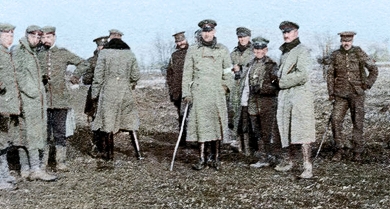
German and British troops during the Christmas Truce of 1914, uploaded to Flickr on December 25, 2017, by Cassowary Colorizations, used under the Creative Commons Attribution Generic License version 2.0 terms.
Christmas 1914
On Christmas Eve and Christmas Day, men from both sides ventured into no man’s land to mingle and exchange food and souvenirs. There were joint burial ceremonies and prisoner swaps, while several meetings ended in carol-singing. Men played games of football (‘soccer’ to Americans) with one another, giving one of the most memorable images of the truce.
Peaceful behavior was general but not ubiquitous; fighting continued in some sectors, while in others the sides settled on little more than arrangements to recover bodies. Still, roughly 100,000 British and German troops were involved in the unofficial cessations of hostility along the Western Front. The first truce started on Christmas Eve 1914, when German troops decorated the area around their trenches in the region of Ypres, Belgium.
The Germans placed candles on their trenches and on Christmas trees, then continued the celebration by singing Christmas carols. The British responded by singing carols of their own. The two sides continued by shouting Christmas greetings to each other. Soon thereafter, there were excursions across No Man’s Land, where small gifts were exchanged, such as food, tobacco and alcohol, and souvenirs such as buttons and hats. The artillery in the region fell silent.
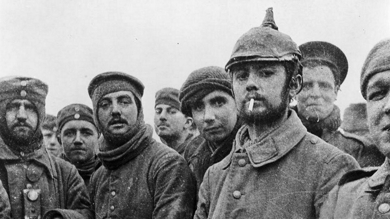
British and German soldiers fraternizing at Ploegsteert, Belgium, on Christmas Day 1914, by homo mundi [Public domain], via Wikimedia Commons. This work is in the public domain in its country of origin and other countries and areas where the copyright term is the author’s life plus 70 years or less.
The truce also allowed a breathing spell where recently killed soldiers could be brought back behind their lines by burial parties. Joint services were held. In many sectors, the truce lasted through Christmas night, continuing until New Year’s Day in some.
Aftermath
The events of the truce were not reported for a week, in an unofficial press embargo which was eventually broken by The New York Times, published in the then-neutral United States, on 31 December. The British papers quickly followed, printing numerous first-hand accounts from soldiers in the field, taken from letters home to their families, and editorials on “one of the greatest surprises of a surprising war”.
By 8 January pictures had made their way to the press, and both the Mirror and Sketch printed front-page photographs of British and German troops mingling and singing between the lines. The tone of the reporting was strongly positive, with the Times endorsing the “lack of malice” felt by both sides and the Mirror regretting that the “absurdity and the tragedy” would begin again. French and German reporting was more muted and even critical, even while the spirit was lauded in an abstract sense.
Reflection
No spontaneous truce on this scale had ever occurred before, and none has ever happened since.
The other night, I was musing in my bed, half asleep, when I suddenly wondered why that was.
In 1915, a few units arranged ceasefires but the truces were not nearly as widespread as in 1914; this was, in part, due to strongly worded orders from the high commands of both sides prohibiting truces. Soldiers were no longer amenable to truce by 1916. The war had become increasingly bitter after devastating human losses suffered during the battles of the Somme and Verdun, and the use of poison gas.
Okay, the soldiers on both sides had ample reason to be bitter in 1916. And military commands have become more passionately bloody-minded since; the era of gentlemanly behavior toward an enemy was on its last legs at the start of WWII. And the major conflicts of western nations since have been with enemies with vastly different cultures, in Asia and the Middle East; perhaps they don’t recognize the Western Christmas traditions or consider it a Holiday celebrating peace and hope.
Those all seem likely contributions to the singular nature of the event. And it took a tremendous amount of trust in, and respect for, the enemy; it might simply be that on every other potential occasion, the combatants were simply too paranoid.
Yet, having said that, it suddenly seems about as unlikely as the Christmas Miracle itself. All of them, every single time?? Naaah. There must be still more to the story.
Over the century-plus years that followed, society has become more secular and less religious. Does this decline in spiritualism itself make the Christmas Miracle less likely to ever occur again?
Outrages
Certainly, Christmas itself has been morphing over the years into a more secular holiday, despite persistent and consistent attempts to preserve the spirit of the season in the young of every generation. Inch by inch, in small increments, the wowsers and killjoys have been eroding it. There have, in recent years, been attempts to ban nativity scenes on the grounds of political correctness (“Christmas spirit ‘under threat from PC brigade’ “, The Telegraph, UK, 10 December 2007; “Some men of straw are lurking in the manger“, Sydney Morning Herald, 6 Dec, 2006), but the actual success of such attempts in France and Belgium in 2017 (“French Court Bans Christmas Nativity Scene In Public Buildings“, ChristianPost.com, 18 November, 2017, and “Belgian town removes Christmas nativity scene in case it offends Muslims, gays and victims of church abuse“, The Sun, 10 February, 2017) sparked global outrage. Okay, some of those sources are not legendary for the reliability of their reporting, so take those with a grain of salt, if you must; but I’ve been seeing similar news stories for more than two decades.
Everything from Christmas Carols to Christmas Light Displays have been threatened, and in some cases banned. It doesn’t matter that in the wake of the outraged complaints, most of these bans have been revoked and renounced; the point is that they have been occurring regularly – from Connecticut, in the US, to towns in Victoria, Australia.
This climate of Christmas being under attack is so pervasive that it has led to pranksters making hoax claims about bans that have gone viral. Certainly, one home in Victoria has been forced to close its Christmas light display because the numbers that it was drawing led the state government to classify it as a tourist attraction, requiring crowd-control measures and public liability insurance to be paid by the homeowners. They can’t afford to do so, and so the popular display has been canceled.
With every diminution of the more Spiritual side of Christmas, crass commercialism assumes a greater share of the ‘meaning of Christmas’, and the spiritual overtone of “Peace On Earth” that I referenced earlier also diminishes.
Need
War isn’t going to go out of fashion as a human endeavor anytime soon, and that means that the need for a moment of Peace remains as vital as ever. If Christmas is losing its connection to the principle of Peace, becoming more secular and commercialized, perhaps we, as a culture, need to seek out a replacement, one that is also secular in nature so as to insulate it against such decline.
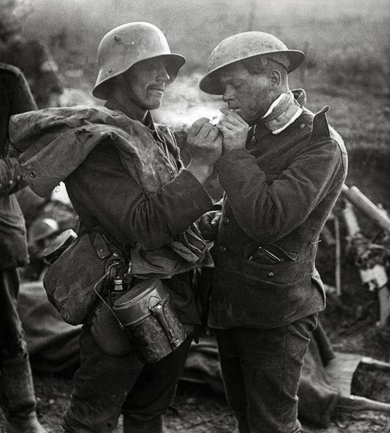
Spaarnestad Photo SFA007001826, Armistice Day, uploaded to Flickr 10 November, 2008 by the Netherlands National Archive from the Spaarnestad Collection (photographer unknown), showing a German soldier lighting the cigarette of a wounded English Soldier. No known copyright restrictions.
One possibility is Armistice Day. In Australian RSL (Returned and Services Leagues) Clubs (who use their profits to support and commemorate serving and ex-service Defense Force members and their dependents – membership is seen by some as a way to show their support for the military services and those who serve in them without endorsing participation in any given conflict), there is always a minutes’ silence called for at the start of the 11th hour of the eleventh day of November.
Armistice Day is always secondary as a commemoration to the Australian Services to Anzac Day, which is observed on April 25 every year, and is a public holiday to boot. I told the backstory of Anzac day in A Legacy Of War back in 2015. Lately, there has been a considerable push to expand the scope of that commemoration with ceremonies, speeches, and other public events, in an attempt to rejuvenate the day. So far, that movement hasn’t yielded much, but each year the movement seems to grow a little stronger.
It has its advantages – it’s recognized pretty much globally (Germany is an exception but there is a similar national day of mourning that occurs on the Sunday closest to 16 November; it would not require much, in terms of procedure, to align it with the other national days), so it’s already international in scope.
And yet, Armistice Day is more about mourning the dead, a somber counterpoint to the celebrations of Anzac Day or the equivalent in other countries. It’s NOT about Peace, save that the peace declared is necessary to permit such reflection. In terms of context and nuance, the two occasions are totally at odds, heading in two completely different and naturally-incompatible directions.
Nor are there any other such secular Holidays that it seems appropriate to encumber with a celebration of peace, that seem compatible with the desired purpose.
Except one.
Christmas Redux
The Christmas Miracle happened. It’s a part of Secular History.
If we are losing contact with the spirit of Christmas, surely a celebration of the Christmas Miracle and the broader theme of global peace would be a fit and deserving substitute that would rejuvenate at least that aspect of the season’s significance?
That’s what redux means – “brought back” or “revived”.
Christmas Tales
So, to that end, I’d like every GM reading this to ask themselves,
- What shape would a Christmas Miracle analogue take in your game world?
- What are the forces stopping it from happening?
- How can they be overcome? By the PCs? With a Deus-ex-machina up the GM’s sleeve if he needs it?
…and there’s your Christmas Adventure. It’s the same basic formula that Terry Pratchett used in “Hogfather”.
Wait one – a deus-ex-machina?
These are normally unforgivable, unusable, undesirable plot devices exploited by the lazy and symptomatic of writing incompetence. But it’s (falsely) said that there’s an exception to every rule, and in this case it happens to be true. You see, what a Christmas story really is, is a celebration of the spirit of the holiday season at a metagame level. And that makes certain metagame stunts that are normally intolerable, fair game – because they are also metaphenomena. Or, to put it another way, you can get away with it because it’s Christmas and Christmas Miracles are part and parcel of the seasonal DNA.
Whether Christmas is part of your faith or not, I invite you all to join me in celebrating Peace, remembering the Christmas Miracle, and mourning the fact that it hasn’t been replicated in any other conflict.
Season’s Greetings from Campaign Mastery!


Discover more from Campaign Mastery
Subscribe to get the latest posts sent to your email.
Comments Off on The Christmas Miracle