Campaign Mastery helps tabletop RPG GMs knock their players' socks off through tips, how-to articles, and GMing tricks that build memorable campaigns from start to finish.

The Right Quip at The Right Time: Humour in RPGs


851578_47643641_medAn Elf, a Dwarf, and a Goblin go into a bar… Oh, you’ve heard that one? Good, then you can tell it to me sometime!

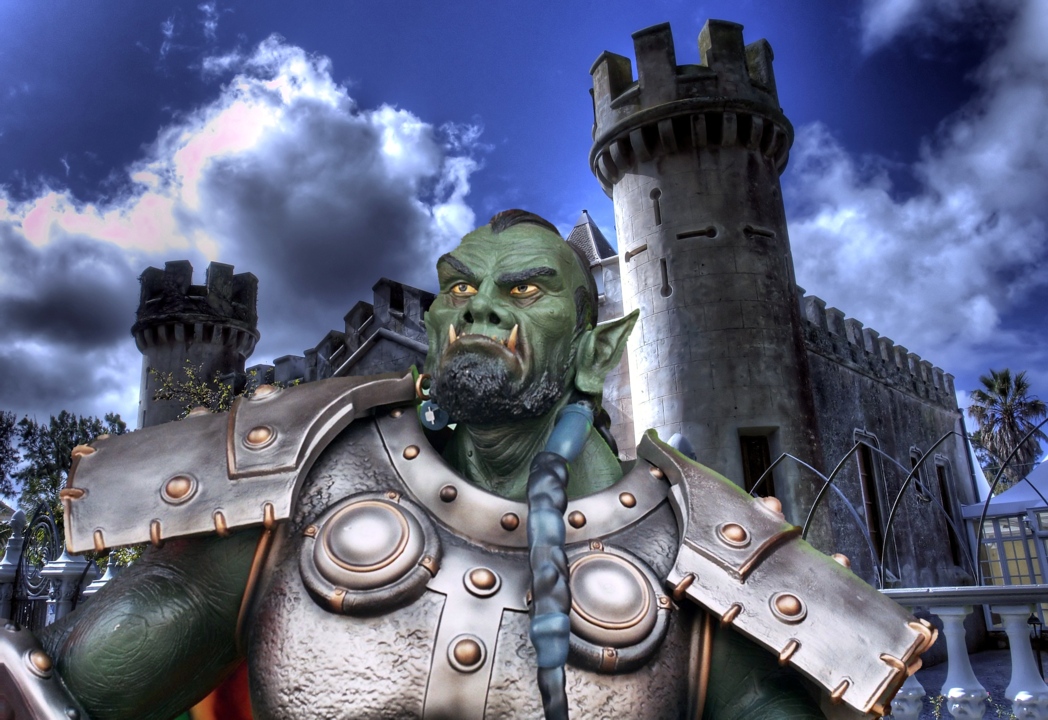
Humour is really hard to do WELL in an RPG, some types of humour moreso than others. Silly jokes, like Orcs in tutus, are easy, but are more likely to bring a moan and grimace of pain than a genuine belly laugh.

There’s an art to genuine humour: it’s a little like a seduction, with the humourmeister leading his audiance one step at a time towards the punchline that will reduce them to hysterics. One misstep along the way and the whole thing can explode in your face, and the punchline falls flatter than a soufle.

Like an RPG, humour has its own internal consistancy, zigzagging its way through plot and dialogue as it homes in on the denouement. It can sometimes help to think of it as a game within a game.

So, for this month’s Blog Carnival, I thought I would look at some of the different types of comedy and how they can work – or not – in an RPG. (Definitions and categories taken from Buzzle.com).

Anecdotes

Anecdotes have a limited value in RPGs by virtue of their nature as an ‘amusing story’. Either they are told to the characters, or the characters are participating in an anecdote. The first is not very interactive, and the second means that the GM is relying on the characters to react in a specific way to the circumstances – which usually places the humour at such a far remove from the characters that it might as well not be there.

The best use of an anecdote is to use them to convey NPC personalities to the characters in a way that’s a little more entertaining and memorable than a dry recitation of qualities (or their absence).

Banter

If the banter is between an NPC and a PC, this relies on the player being in the right frame of mind for it to occur spontaniously. The best ways of using banter are PC-to-PC and NPC-to-NPC. The first requires collaboration and collusion between the players, but it can work brilliantly and is solid roleplay.

The second only works if there’s a second GM to take the second part; the advantage is that it can be polished and rehearsed in advance to both sound more natural, and to convey both overt information and personality information to the players. Be careful not to overdo it, though – RPG is an audiance-participation activity! Consider, for example, the extract below from the most recent Adventurer’s Club session:

Mike: “Yes, absolutely, Lionel. Horses would be faster, but at some point would have to be abandoned – hopefully, they would still be there when they came back down, but who knows?”

Blair: “I agree, Malcolm. So, anyway, you have to leave your boat –”

Mike: “It’s a ship, Lionel, It goes out to sea. I’m told Sea Captains are fussy about that.”

Black Humour AKA Gallows Humour

Black humour juxtaposes distressing subjects like death with humour to make them more tolerable. As such, it has a definite place in RPGs. Good players will use it to reflect their character’s response to grim situations, and good GMs will have NPCs use it to lighten grim moments. Don’t expect too many lasting laughs from anyone, though.

Blue Humour

Blue humour is based on body parts, bodily functions, and sexual acts, and there is a razor-thin line between funny and vulgar – a line that’s drawn in a different place for each person. Blue humour in an RPG similarly walks a tightrope, between entertainment and offensive. While it might suit some groups of players and some GMs, the majority of campaigns should steer well clear of such dangerous waters. A good guide is whether or not the players use blue humour when not in character.

Blunders

I’m not a fan of Mr Bean and the style of comedy he represents, but my players are, and it is an exceptionally easy style to incorporate into an RPG from time to time. The most recent use of this style in one of my campaigns took the form of a British character, “Lionheart”, in my Zenith-3 superhero campaign. “Lionheart” had significant powers, but was hopelessly incompetant at using them for anything more than a spectacular show. The character was well aware of his limitations, but believed that any admission of them would damage the public confidence and do more harm than good; instead, he let the PCs do all the ‘heavy lifting’ in the encounter while he manouvered the enemy forces into exposed positions, and took all the credit. Between alternate rolling of the eyes, gales of uncontrollable laughter, combat, and roleplaying, a good time was had by all. Except the villains, of course!

Burlesque & Caricature

This is a handy tool for GMs to have in the armoury, and one that most GMs utilise whether they realise it or not. Essentially, it consists of exaggerating a style of language or behaviour way beyond cliche, to the point of lampooning it; think “Inspector Clusou” from the Pink Panther movies, or just about anyone from “Allo! Allo!”.

This fingerpainting of personalities suggests superficiality to the players, often leading them to underestimate the NPCs – a trick that, even when they get wise to it, can trap experienced players. To meake it work, though, the GM needs to throw himself into the role, heart and soul; play it to the hilt. Cross your eyes, wave your hands, do whatever you have to, but ensure that you go beyond what you would normally do even when playing a flamboyant personality.

And, in the meantime, it’s entertaining to both players and GM.

Farce

A farce starts slow and gradually gets sillier and sillier. This can work in a one-off campaign, but tends to be disruptive to long-term campaigns. However, there can be occasions when the GM can bring about the opportunity to engage in a farce even in a more lasting campaign, such as a character who is temporarily tainted or cursed with abysmal luck, when anything that can go wrong, will. When this is not due to any fault of the character affected, it can be tempting to sublimate the potential harm that could be inflicted on the character into a ‘preposterous disaster’; when this happens, you will usually have the support of the other characters, who will percieve that you are ‘pulling your punches’ to make events humerous and not disastrous.

Irony

Irony is a more intellectual type of humour in which an achievement or outcome is inverted in consequence, ie the process of succeeding in the immediate task subverting or undermining the overall objective. Irony is an essential element of any RPG when the time is right.

Melodrama

Melodrama is all about exaggeration and artificially-heightened drama. When pushed to extremes, it can be humerous and entertaining to watch, but I’m not convinced that it’s as much fun to experience from the player’s perspective, so while it is possible for high melodrama to play a role in selected scenarios, lesser doses – below the comedy threshold – are better suited to RPGs.

Parody

A work designed to mock, poke fun at, or comment on, some other original work. Individual scenarios and entire campaigns can be set up as parodies or homages. These generally function by taking one or more distinguishing elements of the source material and placing it into a new context. When the context is inappropriate to that source material, or incongruous in some respect, or depicts some of the more absurd aspects of the source material through that juxtapositioning, the result is a parody; for example taking the gang subculture of a modern urban environment and setting it in a nursery or preschool.

Practical Comedy

Practical Jokes and Pranks are stunts or tricks designed to make someone feel foolish or victimised for the amusement of a third party or to humiliate the target. Careful application of practical jokes with one or more PCs as targets can elevate the player’s level of motivation to engage in a scenario in which they were only mildly interested while taking advantage of the inherant distance between player and character to minimise the extent to which the player takes it personally. Beyond this application, practical comedy has a limited applicability to RPGs.

Repertee

Witty comebacks, clever replies and droll retorts can all be entertaining and reflective of a particular personality – Spider-man has used this technique since the character first appeared back in the 1960s. But as the basis of scenarios or campaigns, there is no real value in this style of comedy.

Satire

This branch of comedy makes use of witty language and situations to convey insults or scorn; human vices, follies, abuses, and shortcomings are reprimanded using ridicule, burlesque, derision, or irony. Typically, the subject of satire is too narrow to be the basis of an entire campaign, but individual scenes or scenarios can be satirical.

Sitcom

Comedy in which the humour derives from reactions to ordinary situations. Sitcoms don’t generally work well as foundations for whole campaigns; either the characters, the game setting, or both, generally have to be extraordinary in some respect. However, a sitcom scenario in the context of an existing campaign can be an amusing change-of-pace, or ordinary lives in an extraordinary setting can make the basis of a sitcom campaign if it has a humerous bent.

Stand-up Comedy

Since this comedy is all about someone standing up in front of an audiance and telling anecdotes and jokes, it is not especially conducive to interactive game-play. It can be used for an interesting alternative to a monologue every now and then, but that’s about it.

Slapstick

Comedy with chases, collisions, practical jokes, where people just do silly things (or do ordinary things with silly results). Slapstick runs the gamut from Charlie Chaplin to the Three Stooges to Bugs Bunny. It can be hard to sustain and keep different and fresh, so it’s probably not suitable for a campaign, but it can be a recurring element or even the foundation of a single scenario.

Conclusions

Comedy is hard. So many types of it are unsuited to form the foundations of a campaign. But individual scenarios, recurring comedic themes, and specific encounters can all be used for comedic purposes, and if you’re careful to draw on the full gamut of comedy, an entire campaign can be built as a comedy.

Comments (13)

Lore Enforcement: The Legal System in an RPG


620961_81352753_hang_knot_sm

Let’s talk for a minute about the law. Most legal systems are based on two things: the protection of certain general principles that are considered fundamental truths by the society in question, and a long history of precedents matching punishments with violations.

Criminal law, for the most part, is fairly straightforward. Not much has changed in the nature of criminal acts for centuries, if not millennia. Make appropriate allowance for social class restrictions and technology and you have most of it covered. Fraud still remains fraud, for example, even if it is conducted over the internet. What little remains can be summed up as the presentation and verification of evidence. Who can testify, who and what is considered most reliable, what cultural and social attributes are automatically considered unquestionable?

More frequently useful, and often overlooked in games, are the commercial and civil courts. The civil courts are all about someone doing something with someone else’s property, whether it is being harmed by that property, purchasing that property under false pretences, violating someone’s posession of that property, or whatever. They measure the harm done to someone and impose financial compensation. Take a look at a standard insurance policy, for example; every microscopic line of fine print is the result of someone cheating, or attempting to cheat, the law. Similarly, every line of public liability law stems from someone claiming that someone else permitted or caused them to come to harm through negligance or intent; every componant of a car derives from a string of automobile accidents.

Ownership and authority are civil matters: who is permitted to do what with someone else’s property, for example. In the middle ages, it was quite permitted for a freeman to travel anywhere he wanted in search of employment, and quite routine. Permission had to be obtained from the local representative of the owner of the lands into which the freeman had been born; he in turn set a fee which the freeman had to pay to the owner of the lands each year in exchange for his liberty to wander. Serfs and Freemen had an obligation to perform certain services on behalf of the land owner in return for the right to farm his own personal allotment the rest of the year, though the amounts differed from social class to social class, and year to year, and Lord to Lord. Prosperous individuals could pay someone else to work their share of this burdon – the baker or blacksmith was able to satisfy his farming obligation by paying someone to work on his behalf, or was exempted. In addition, in return for the right to work his professional trade, a licence fee had to be paid, usually in the form of so much product of his labours – so many loaves of bread or horse shoes (or whatever) per month. The mills and bellows and other professional tools were usually the property of another (usually the Lord, who bought them as an investment), and also had to be rented, and so on; it was quite rare for a craftsman to own his own equipment.

In fact, just about anything was negotiable with hard currency except in times of war and strife, and sometimes even then. Many people in modern times consider this to be a modern corruption of the legal system, not realising how far back the historical precedents can be traced; in olden times, these arrangements were open and above board and public knowledge; now they considered immoral, and so are conducted furtively and secretly, but the reality hasn’t changed – the wealthy can get away with far more than the poverty-stricken. As late as the turn of the century, in some places, it was quite legal to buy your way out of dury juty, and it was considered revolutionary when the wealthy were not permitted to buy their way out of the draft in the US during World War I (an amendment to the draft law that would have permitted it was narrowly defeated).

An even more important consideration is civil rights, violation of which is ALSO a matter for the civil courts. It can be argued that these are the descendants of the local codes of conduct that every village and township had in fuedal times, which determined the fines to be paid (to the Lord) for violations of public morals and peace. In fact, jury trials also stem from these precedents by long tradition; in the middle ages it was often even more important to be popular than to be wealthy, as guilt or innocence in all civil complaints and many minor criminal matters (those not directly affecting the Lord) were decided by the most respected of the accused’s neighbours. That’s worth remembering, the next time a celebrity gets off with a wrist-slap – that it’s nothing new! The concept of such a jury being biased against an individual was known, but was deemed unimportant except in capital cases or crimes against the Crown. In all other cases, the risk of being found guilty because of a bad reputation amongst your neighbours was considered an incentive to behave yourself and not make enemies!

It’s when these principles are applied to an unfamiliar setting within an RPG that things get interesting. How might a mage harm another, and how would civil laws change to accommodate these harms? Is the Lord entitled to a fee for every spell he permits the mage to cast, or perhaps an annual fee? How much stronger are the legal protections of the Church when the Gods’ will is expressed patently through a cleric’s miracles? Druids are often considered the protectors of the earth; how are their rights accommodated, and can they trump those of a minor Lord? There are innumerable questions that can be posed, and they can have a direct impact on what the PCs in a campaign are permitted to do and what they aren’t, on who has authority over them, and so on.

This is one of my favorite topics in Superhero campaigns. Not only because I am a fan of courtroom drama, but because superheros are in the profession of law-enforcement. Can a masked character even testify in court? Is he forced to divulge his real name? If not, how can his identity be ascertained? Is he required to read a suspect his rights before attempting to apprehend the villain? Is he responsible for collatoral damage – and can he be sued? Telepathy, Precognition – in fact, almost any form of enhanced sense – may create trouble because the evidence against the bad guys is thrown out of court, AS IS any evidence that would not have been found without that lead (“fruit of the poisonous tree”).

In one memorable plotline in my campaign, one of the superhero team was accused of murder. Prosecuting him was a Special Prosecutor appointed by the court, Perry Mason. Defending him was Denny Crane of Crane, Poole, and Schmidt [Boston Legal]… I got a sore throat from all the dialogue I had to read that day, but on several occasions the players were in histerics from laughter, as each side did their utmost to outmanouver the opposition, usually with sprinklings of wit and sarcasm and flashes of genius. Ultimately the question came down to jurisdictional considerations, since the PC was from another dimension, and he got off on a technicality! (One of the most entertaining scenes: The PC was a shapechanger whose normal appearance was that of a Gargoyle. Crane asked his expert witness what the law was concerning Gargoyles? The Answer: Federal and State laws don’t mention Gargoyles at all, and Boston only mentions them in the Building Codes, violation of which is a property offence. If anyone is injured by a Gargoyle, they are entitled to sue, but you wouldn’t lock up the statue…)

So spend a few minutes considering the laws of the realm in which your campaign takes place. What are the obligations of a citizen? Of a visitor? What rights and what responsibilities do the PCs have? What are they forbidden to do – and what can they buy their way out of? How will these change as they become wealthier, and more famous? And how can the GM use this information to complicate the PCs lives and entertain his players?

Comments (11)

Ask The GMs: Pacing Your Campaign


How do you pace a campaign? How do you know if you’re giving too much or too little in experience and treasure? And how do you get the PCs to explore more than the local area?

Ask the gamemasters

Hello Johnn and Mike,

I have been gaming on and off for about 10 years but am a rather new GM (about to start my second campaign). My goal is to create an epic “explore the world” type campaign, but I have run into a roadblock when it comes to pacing it.

I would like to avoid going into the epic levels, but at the same time I actually want the players to see most of my world at one point or another. The tricky part is that my current gaming group likes to fully explore everything to the smallest detail (in our current game, we are all level 6 and have never ventured beyond a 25 mile radius).

So, basically, my question is how would I pace my campaign in such a way to allow players to explore to their heart’s content, not gimp them on XP, and still somehow have them explore the world by level 20?

Thanks in advance for your help!

Ask the GMs - Mike

Mike’s answer:

The short answer – and unfortunate reality – is that it can’t be done. You can’t buy a shopping mall for the price of a concession stand and you can’t give people a dollar a day for a year and not expect them to have $365 at the end of that year, and both of those are analogous to what you’re trying to achieve. It is small wonder, then, that you’re experiencing a great deal of frustration.

Having said that, it’s not the end of the world. [Johnn: groan, nice pun Mike.]  There are solutions to your problems, but it means making some fundamental changes to the assumptions of your campaign. I might add that these are problems most new GMs have to come to terms with; I certainly did, and have seen others struggle with them as well.

You don’t specify which game system you are using, which makes it a little harder to give specific advice, but the ‘level 20’ cutoff is indicative of D&D 3.x, so I’ll assume this is the game you’re playing. The advice offered will need tweaking to suit other game systems.

Encounter Density & Effectiveness

The 3.x DMG states that it should take thirteen evenly matched encounters for characters to earn a level, that is to say 13 encounters with enemies whose numbers and levels are the same as those of the PCs party; other game systems might have a different method of handling encounter balance, but the general principle remains. More difficult encounters earn more experience, easier encounters earn less. That means, over a 20-level campaign’s life, there should be encounters totalling 260 evenly-balanced encounters. If there are more ‘light’ encounters then the total number of encounters will be higher, if there are more encounters designed to be difficult for the party, then there will be less than 260 in the total campaign from 1st to 20th level.

However, many GMs don’t use encounters effectively; it’s a constant struggle finding tactics that enable encounters to live up to to their full potential. I include myself in this category, by the way, so you aren’t alone. Because players find it so easy to achieve victories, it’s tempting to throw bigger and meaner monsters at them instead of getting better at using what you’ve got. This solves the immediate problem of giving the characters a challenge, but it’s a false economy, because they earn more XP from the bigger encounter, reaching epic levels (or the end of the road) far too soon, and long before the campaign is finished. What’s more, because the PCs’ abilities increase with their XP totals, this is a self-destructive spiral to campaign obliteration.

It’s made even worse because bigger encounters have bigger treasures, which further amplify the party’s effectiveness, which require an escelation in the size of the creatures needed to challenge the party. The result has come to be known as a “Monty Haul” campaign. Here’s a test: add up the total value of magic items each PC has and compare them with the recommended totals for an NPC of equivalent level. If the PCs total is much higher, then they have more treasure than they should.

I don’t know how many encounters your PCs have had while exploring the 25-mile radius area, but I would be greatly surprised if the total was anything close to the 78 (6 levels with 13 encounters each) evenly-matched encounters that the ‘book’ says it should be, for the simple reason that there should not BE that many evenly-matched encounters in so small an area. I would guess the number to be closer to 20-30, with the balance being made up of much smaller encounters. That would indicate that you’ve been throwing CR at the problem; far from shortchanging the PCs on experience, I suspect that you’re giving unearned XP away.

So how can you make your encounters more effective? That’s a subject for a blog post in it’s own right, if not a whole series of them. But here are a few tricks that I’ve found useful in this respect:

  • Identify the most powerful ability of the creature, then determine a tactical situation that permits it to be used to greatest effect.
  • Identify the biggest weakness of the creature, then identify a means of preventing the party from exploiting it. That might be a relevant magic item, or it might be environmental.
  • Humanoids: find a tactical situation that would make them a fair match for the party if the encounter was down a couple of CR. Generally, that means identifying advantages that give each of them between +2 and +4 to hit.
  • Make sure that magic items in the possession of intelligent creatures are exploited.
Recovering from ‘Monty Haul’ mistakes

Again, this really deserves a series of blog posts of it’s own! But here’s a few thoughts for consideration.

  • For every 2 levels the party’s treasure exceeds what they should have, consider their level to be one higher than it actually is. This reduces the xp they earn from an encounter to a number more reflective of what they actually learn in combat training under the circumstances; it’s not them beating the encounters so much as it is the magic weaponry.
  • If the party have been getting too much XP because the encounters have been a higher CR than they should be, even up the balance. Throw lots of low-level encounters at the party instead of one big one. For example, there might be nothing left in the 25-mile radius that’s higher than CR2. They will still be getting the XP that they earn, but their progress will slow. And eventually they will get bored enough to move on.
  • Tax them: Capital Gains on treasures might force them to sell off some of their grosser items to pay the bill.
  • Start doling out low-level treasures. +1 swords are not very interesting when the PC already has a +3 sword. And, of course, no-one has the hard currency to actually BUY the +1 swords from them.
Don’t set interesting encounters/locations too close together

Another mistake that is common to new GMs is thinking that the players have to be entertained no matter what they do. If the party knows  there will be a new dungeon next week, no matter how close-to-home they stay, they have no incentive to go out and see the world. If you want the PCs to explore an area of 5000 square miles in the course of a campaign, and there are 250 encounters in levels 1-20, then that’s an encounter every 20 square miles. Of course, low level encounters will be ubiquitous; so the first twenty, say, will be found within a couple of miles of their starting point. That further boosts the rarity of higher-level encounters.

The PCs have to ‘seek out’ the adventure after a while; it doesn’t walk up and knock on the door. Not if you want a ‘see the world’ campaign. If they’ve explored everything interesting in an area, bore them while rumours circulate around them of interesting goings-on further afield. They will soon get the hint.

Make sure you’re playing the same campaign

But there’s a danger to be recognised in that advice: you might be running, or think you’re running, an “explore-the-world” campaign, but your players don’t seem that interested in exploring the world, just one small corner of it. You need to find out what they want, and make sure that you’re both playing the same campaign! If the players don’t want to “explore the world”, suddenly you need to switch gears and perhaps start developing a local campaign of political intrigue. Do this before deciding whether or not to kick them out of the nest!

Avoid XP for it’s own sake

Some GMs feel they have to handout XP every session. Bah, Humbug! say I; PCs should be rewarded for what they do, but those rewards don’t have to be in the form of experience. Political influence, social recognition, being considered an expert in a field – these are all rewards that can and should be issued instead of XP when it’s warranted – not in addition to XP!

Heck, I consider magic items and hard currency to be valid alternative forms of reward, the value of which should be deducted from any XP award received from an encounter.

Here’s another ‘food for thought’ comment: just how much is a +1 magic item worth? If it’s +1 to hit, that’s the equivalent of a character gaining a level! How about handing out an item that gives +1 to a particular skill, instead? Well, feats give +4 to a single skill, or +2 to a related pair of skills, or +1 to a related set of 4 skills. And you get a feat every 4 levels (ignoring bonus feats for some classes). Once again, a +1 is equivalent to a free character level! How about hard currency? Enough money to buy a magic item is the same thing as having that magic item up your sleeve.

Okay, that’s all a little extreme; you get +1’s to a whole heap of things when you gain a level, so the actual value in XP terms of such rewards is less than a level per +1, probably something like 1/10th of a level, but it gets you thinking, doesn’t it?

Epic Campaigns demand Epic Levels…or serial campaigns!

What happens when characters reach 21st level, anyway? Do they turn into pumpkins, or something? It’s incredibly rare for characters to get a campaign of epic scale and scope completed by then. That leaves four choices:

  • Abandon the campaign incomplete
  • Epic Levels, here we come!
  • No more levels
  • Retirement

Each of these has its own advantages or downsides. Abandoning the campaign leaves lots of unexplored ideas to be appropriated for the next one. Epic levels permits the campaign continue to a storyline conclusion at its own pace. ‘No more levels’ does the same thing, but means that the PCs can no longer advance, and cannot improve except by finding bigger or better magic items; they will rarely face significant opposition and will quickly get bored and start agitating for one of the other solutions (but they’ll generally put up with it if there is an end in sight). And the last lets them start over again with new characters in a new location; their old characters become NPCs under the DM’s control.

Closed vs Open-Ended campaigns

“Explore the world” is an open-ended campaign concept. There’s always more world out there to explore, and the PCs will never get to see it all before reaching any arbitrary conclusion point. That’s why it should never be the dominant theme of a campaign, in my opinion; instead, campaigns should be decided in story terms, and if that story lasts so long that the PCs achieve epic levels, so be it.

The only way for open-ended campaigns to work is by adopting a “killer GM” mentality, at least in part. You need to kill off PCs at a steady rate and have them start with new low-level characters. This means continuity of party, not of characters; individual members may come and go, but the adventuring party itself continues. As a rule of thumb, four players with a level cap of 20 should mean that one character gets killed every 5 levels and starts at 1st level again.

That makes it harder to decide on the right balance of encounters. A high level character can kill anything that’s a fair fight for someone 5 levels lower than them without breaking a sweat, under most circumstances, and will get virtually no experience for it. Anything that’s a fair fight for the higher level character will be able to obliterate the low-level characters without blinking. It makes the whole campaign harder to GM, and that’s why I dislike open-ended campaign concepts.

Developing a Plot-Driven campaign

I design my campaigns to tell a story, with beginning, middle, and end. Then I map it out according to the number of encounters I expect to take place in each phase of the story. Within that story structure, I create scenarios that are complete stories within their own right, but that also advance the main plot and let the PCs determine the outcome of the events with which they get involved. The plotline itself develops and evolves with character actions; I don’t create plot trains, just a list of what the next situation is that the PCs are going to encounter and have to deal with. The plotline also evolves to include specific character goals and ideas.

By way of demonstration, here’s a campaign outline, created on the spot:

  • Levels 1-3: Intro campaign, demonstrate house rules, establish PCs, NPCs, and setting. A small village at the point of intersection between the Elvish Empire, Dwarven Confederation, and Human Kingdom. PCs are all locals or have settled here for some reason. Adventures are all local to the setting, introduce elves and dwarves.
  • Levels 4-5: Dwarvish traders stop appearing in the village. PCs are sent to find out why, and discover that a plague is sweeping through the population. Evidence suggests a plot by Elves. They deny responsibility. While the PCs are investigating, the Elves come under attack by Bugbears and Orcs wielding Dwarvish-made weapons.
  • Levels 6-7: Elves and Dwarves go to war, PCs caught in the crossfire. PCs locate ancient Elvish maps to the Drow Tunnels.
  • Levels 8-9: PCs enter the Drow tunnels in search of answers. Slowly, they discover that Lolth has undergone a radical shift of character, reflected in religious and social practices. Ultimately, it is revealed that Lolth has been “possessed” by the ghost of a Demon Prince who is seeking to create a new body for himself; he needs elven magic and dwarven expertise to create a Demonic Warforged to inhabit. Then he can turn his attention to the human kingdom currently under the sway of his ‘killer’ and arch-rival, another Demon Prince. He succeeds in tricking the two warring parties into creating “super-weapons” which he combines into the Demonic Warforged, takes up residence within (abandoning Lolth to try and plead her innocence) and abandons the Drow.
  • Levels 10-11: PCs are able to negotiate a tentative truce between Elves and Dwarves by showing each side how they were tricked. Reports reach them of a ‘plague of demons’ infesting the human kingdom and of mass conversions to demon-worship. Party is sent to force the Orcish Tribes into backing down by killing the Orcish General and making it look like a power-play by the Bugbears.
  • Levels 12-15: Having ended the Orcish/Bugbear invasion and restored peace amongst the Elves and Dwarves, the PCs must now turn their attention to the ‘demonic plague’ of the Human Kingdom. They discover that each Demon Prince has summoned hordes of his followers, burnt down the churches, etc. PCs must discover why the Gods have not intervened. Eventually, they learn that the Gates Of Heaven have been sealed by a Necromancer Demi-lich.
  • Levels 16-18: PCs search out the Demi-Lich in the Trollwastes and overcome him, opening the gates of heaven. The Gods make the PCs their standard bearers. The PCs discover that the Demi-Lich’s plan was to weaken both Demon Princes sufficiently so he could overthrow both of them and become the most powerful Prince in Hades, that he was the one who set the conflict between them in motion in the first place, that his plan was for them both to bind themselves to the human kingdom so that when his prepared invasion force wiped out the humans, the Princes would lose enough power to become vulnerable. The PCs are faced with moral dilemma: Protect humanity and save the Demon Princes, or permit the destruction of the Demon Princes at the price of millions of innocent deaths. They don’t have much time to ponder, the attack force is already on its way.
  • Levels 19-20: Resigned to trying to restore the status quo (the best of a pair of bad choices), the PCs take on the Red Dragon Army and their Goblin Cleric riders in a do-or-die battle while fighting off the demons they are trying to ‘save’. Just as they look like they’re winning, Drow Armies invade as Lolth seeks revenge. The war quickly spills over into the Elven forests which are set ablaze. At campaign’s end, humanity is scattered and at least half corrupted irredeemably by Demons, the Elvish Empire lies in ruins, the Dwarven Mines have been sealed. The Drow have been driven off, and the PCs are left to try and rebuild the broken pieces of the former societies; but the Demon Princes have been expelled, and the Demi-lich is dead, and the Drow are also a broken society. For many years to come, the re-emerging societies will be vulnerable – and the Orcs and Bugbears are still lurking…

This is a campaign outline that puts the PCs in the middle of epic events, in a position to shape the outcome in a number of ways. It forces the PCs to get out and explore the world, but that is always secondary. Note that they are always reacting to what other people are doing, but that there’s no strict timetable – if the PCs want to spend a couple of extra sessions exploring the Elven Forest or the Dwarven Mines, then they can. Nor is it all that confined in terms of levels – the PCs could easily pick up an extra level during the initial Elvish/Dwarvish War and make up for it by getting one fewer level elsewhere, or even advancing into epic levels if necessary. Finally, because it’s plot driven, the campaign has a built-in endpoint that still leaves plenty of the world to explore and practically begs for a sequel campaign in which to explore it.

That last statement is the final secret to unlocking what you are trying to achieve. Why lock yourself into trying to fit everything into one 20-level span? Why not 2, or 3, or 4 campaigns? You can even do things like having a sequel campaign starting in a part of the world far removed from the events of the preceding one – the players might not even realise that it’s the same game world until they travel to an area still suffering from the aftereffects of the previous campaign!

So, my concluding advice would be to develop a rough master plan, one that will draw the PCs into the wider world around them, and don’t worry so much about having this particular group of characters do it all. Get the players used to exploring on a broader front and let time take care of the rest.

Ask the Game Masters - Johnn

Johnn’s answer:

Good stuff, as always, Mike. You covered things off nicely, and I have only a couple of things to add that might help our new GM.

Talk with your group – get specific

Mike already pitched the excellent idea of speaking with your group about their preferences. I would also suggest you get specific. Often, leaving things in general terms doesn’t reveal the heart of the matter. So, come prepared with a few questions that will get a conversation started and get you specific answers.

For example, I’d like to learn more about why your group explores areas in such minute detail. Is this due to type of gameplay, GMing style, player preference? If you can clearly understand their motivation in this regard, you can apply Mike’s advice above to greater effect.

Be aware that many players don’t like to chew up precious game time with such discussion. Consider organizing the conversation to occur away from the game table if you think this is the case. Maybe do a group dinner, or get a group forum thread going somewhere.

One preference you might reveal is exploration versus XP. My friend’s wife Liz loves to explore and discover new places, for example, and she’ll choose this activity over XP-earning activities. If your group is strong in the exploration desire, then you might be able to scale back XP rewards to keep levels in check. However, this does not solve the problem of time. If it takes 10 real life years of gaming weekly to explore the world at this pace, you’re still stuck with an unworkable situation.

Does everything turn up interesting?

Are you, by chance, rewarding micro-exploration by serving up something interesting wherever the party goes? If so, what incentive do you provide for wandering further from safety, contacts, and familiar environs? I’ve been guilty of this in the past in an effort to keep things interesting regardless of character choices. However, in the long run, your best bet, as Mike explained, is to mete out your encounters carefully along a timeline and inside your desired map scale.

It will take an adjustment period, but in the long run it’s better to develop GM skills and group processes to communicate that there’s nothing interesting going on in this corner of the world. For example, create informative descriptions using character skills. “You each take a brief look around and find nothing remarkable. Gord and Rellan, with your keen perceptions, you are pretty confident this area has nothing notable in it.”

Sometimes, if the party is stuck on a false assumption an area must contain a clue or interesting feature, I’ll switch to out-of-character mode and tell them outright. This breaks immersion a bit, but with limited game time each session, and increasing player frustration at pursuing what will ultimately be a waste of time, I’m always willing to give my friends a clear message to move on.

Avoid unnecessary XP sources

There are a few situations, depending on your GMing style, where unplanned XP awards crop up. With a bit of forethought, you can mitigate these to keep things moving along a timeline quickly and not rack up unexpected XPs.

The first common culprit is travel. Do you feel the need to fill travel time with random encounters or drop-in encounters? Resist this urge where appropriate. You might, for example, summarize an uneventful trip in a minute or two of description, and then have the PCs arrive at their destination – no encounters necessary. I hand wave PC travel often, and sometimes the group is quite relieved, believe it or not. They might be pursuing an objective, for example, and a bunch of roadside or overland encounters just delays things for them when they are anxious and excited to keep on the path of their goal. [Mike: And don’t forget that the same effect can be used to build suspense and expectations when these aren’t high enough – IF it’s clear that someone is deliberately trying to stop the group achieving their objective.]

Another trap is large dungeons. Consider shorter crawls. The 5 Room Dungeon format might be perfect for you.

A third pitfall is all or nothing encounters where full XP are earned just by surviving, which the meddling PCs always seem to do. :) Instead, plan specific outcomes as encounter goals for PCs and reward and penalize accordingly. For example, combats are almost always fought to the death. Instead, require the PCs to take the leader prisoner, or to reduce the overall threat of a tribe. Not doing this means 50% XP for all kills.

Cheers,

Johnn

Ask The GMs is a service being offered by Campaign Mastery. More info >

Comments (11)

Ask The GMs: Weather, Not Climate


How do you give your campaign realistic weather without overloading the GM with Admin tasks?

Ask the gamemasters

Hi, both of you,

First I would like to praise you for a wonderfully done job!

My question is about weather in role-playing games.

Let me expain: I’ve been running a campaing for a while now where the PCs evolve in a world of my creation. Recently, my players made me realise my world lacked a real climate. It has seasons and I think I’m using ’em well, but actually I have a problem with the weather. Sun, rain, wind and other. They made me realise about 95% of the days are sunny with no wind. The other 5% is more often for particular encounters or specific roleplaying purposes, so now when it’s rainy or windy or otherwise, they know something is gonna happen sooner or later. Do you have any tips or ideas on how I could make my world’s weather realistic and handle it easily?

Thanks for your answers!

Ask the GMs - Mike

Mike’s answer:

The problem:

Weather is never an easy subject. On its face, it looks simple, but let’s consider the real world that any game system would have to model. Weather is driven by Chaos Mathematics, which means that tiny changes can cascade into monumental consequences. A butterfly flaps its wings somewhere at the wrong place and time and you get different weather 2000 miles away and five days later. So the reality is difficult to reduce to a simple simulation, which is what you need for an RPG.

Of course, we’re not necessarily all that interested in accurately modelling real-world physics. It’s a game, and simulation verisimilitude can and should be sacrificed in the interests of playability as necessary. But even then, there are other problems that make weather a difficult subject to handle well.

Weather is a non-static system, where one day’s weather influences, but does not dictate, what happens tomorrow. That means keeping track of day-to-day events and ensuring that the trend, over many game seasons, reflects the climate that has been deemed by the GM to be appropriate to the geography in question, while still providing the degree of randomness that’s necessary to making it feel real.

So, with that in mind, here is a quick review of the different solutions I have used over the years, with their pros and cons:

1982: My First Weather System

One of the earliest House rules I introduced into the first campaigns I GM’d was a weather system. Each geographic region would be assigned a climatic model that specified seasonal baselines for temperature mean (both day and night), temperature variability, rainfall likelyhood, rainfall intensity, rainfall duration, and so on. A couple of die rolls then gave a random value within the indicated range of statistically likely results, with a slight chance of an extreme weather result. What made the system a little different to others that I had seen in The Dragon and in other campaigns and rules systems was that each die roll provided a modifier to the results of other die rolls relating to that particular day’s weather, and another to the rolls for tomorrow’s weather, and another to the weather for the day after, and one to the season overall. Some of the these modifiers acted to exaggerate the more extreme results in severity and likelyhood, some to bring it back towards the climatic baseline, and some introduced long-term biases. There was even a threshold limit that would indicate a climatic shift for the geographic region.

This system, with two competing feedback loops pushing weather toward extremes and toward conformity, respectively, worked a treat as a weather simulation system, but it was a lot of bookkeeping and a lot of work to maintain. And it wasn’t properly documented. So when there was a critical failure of the real-world weather around me, and the rules were reduced to soggy woodpulp, it was abandoned.

What happened? Well, it’s not really relevant, but I’m sure you won’t let me out of the building without an explanation so, in brief: I was unemployed at the time, and could not afford public transport both to and from gaming. One way, yes, but not the round trip. So I used to walk the 16km home each Saturday night, with a heavy backpack of rulebooks and notes, rain or shine, hot or cold. It took me between 4 and 6½ hours depending on conditions and load. So, one summer’s night, I got caught out in the open by a seasonal but unexpected storm which ripped my umbrella to shreds and thoroughly soaked anything in my non-waterproof backpack that wasn’t protected. The weather tables bore the brunt of it, but protected everything else, so I couldn’t (and can’t) complain too much.

This was in early 1982. In modern times, with spreadsheets and javascript-enabled web pages and the like, it would be relatively easy to take most of the work out of using the system, so I now regret losing the game mechanics that I had worked out more than I did at the time. But anyway, that’s what happened.

1983-2002: The Real World

For the next many-some years I largely ignored the question, or took whatever was happening outside the window, seasonally adjusted. A cold, wet, day in summer became a cold, wet day (or heavy snow day, if appropriate) in winter, as necessary. A simple solution, but one that my players quickly cottoned onto and started to take advantage of.

So I started inverting the pattern – a cold, wet day became a mild, dry day in winter. That took a little while longer for them to figure out, because sometimes I was lazy and didn’t swap things around. But within a few months, they could get it right 90% of the time.

So then I started using tomorrow’s forecast as today’s weather. That worked for 2 years. Then I started inverting tomorrow’s forecast – another year, but by now it had become a game-within-a-game to them, a challenge to get them warmed up for game time.

When they started getting too good at that, my TORG campaign was just getting underway. I decided to start using the weather as it was on the day I first drafted the scenario as a basis – whether it was a day, a week, a month, or six months in the past.

These techniques all had the additional advantage that I didn’t have to tie the daily weather to a specific season, just document conditions relative to whatever I was expecting.

That worked for more than 5 years, until that campaign came to an end, and I found that when starting a new campaign, the system didn’t confer enough variation from day to day, because so many scenarios when a campaign are starting out are gestated simultaneously, or close to it. So it was back to the drawing board, and a search for a new solution.

2003: Weathergen 2.1

In 2003, when I started running my original Fumanor Campaign, I came across an online program called Weathergen. You specified the climate and the season and it generated a full month’s weather for you as a web page. It was not as sophisticated as the customised solution that I had developed years earlier, but it was a lot less work, and I used it exclusively for that campaign. I would still be using to this day if it were still available, but it’s not. When I went to generate weather for the opening session of the One Faith Fumanor campaign, I got a 404 – website not found.

2007: The Quest Begins

So I started searching all over the place for alternatives. There are weather generation software packages out there – a Google search for “+RPG +Weather +Generator” finds 32,800 results – and I’ve downloaded a heap of them to trial. None of the ones that I’ve tried have quite satisfied me, but that hasn’t bothered me, because I’ve found a new solution based on modern technology.

2008-9: The Internet Beckons

With the advent and modern ubiquity of the internet, many countries have official websites devoted to their bureaus and departments of meteorology. These not only provide current forecasts, they also frequently have historical information. Supplementing these are the many newspapers who have online archives, which sometimes include weather forecasts. So these days, I draw up a shortlist of “terrestrial equivalent” locations and use the appropriate forecasts for the season. It can require a little planning ahead – if, for example, I know that the PCs are about to be in an Athens-like climate in summer, and it’s currently winter there, then I really need the forecasts from six months ago; there are only two ways to get those, either through an archive of some sort, or by collecting the information that I need six months in advance.

Derailing The Plot Train

That need obviously tends to encourage plot trains, if the GM doesn’t take precautions. To guard against that, I try to look not at where I expect the PCs to be, but at a subset of places they might be and prepare accordingly. After all, if I gather information that I turn out not to need, I can always put it in a drawer until I DO need it. I also like to declare a secondary source in the other hemisphere if I can find one that can be used if I need something unexpected at short notice. If I have to, I can take a semi-appropriate forecast and tweak it to my needs – I might take temperatures from New York and rainfall from Sydney to simulate an area that is bone-chillingly cold in winter but receives only widely-dispersed heavy snowfalls.

Ultimately, all you need is a starting point for inspiration and the rest can be faked.

Ask the Game Masters - Johnn

Johnn’s answer:

You ask a great question, because weather in RPGs is a chronic under-achiever as a game element (pun not intended). I agree with Mike’s advice. Here are a few additional thoughts:

Build Your Weather a Year in Advance

If the location of the story is going to be fairly predictable, then determine your weather a year in advance, or for as long as you think PCs will be in the region. (I once calculated weather for a whole decade because I was GMing a home base campaign.) This not only gives you an answer for every day of the campaign for a long period of time, but it helps you do this bit of campaign planning in one short sitting.

If the location isn’t predictable, you’ll need to create weather on a shorter term basis, or possibly mid-session.

Weather Should Affect Gameplay

Make the weather affect the game. How does it impact the PCs? How does it impact their foes, locations, encounters, and plot points? If you’re going to put thought and effort into generating weather, then put it to use during encounters and situations.

  • Weather for pure flavour is great and is a minimum requirement. Use weather as another way to provide detail and description. Yesterday the smithy was where the PCs dropped off gear for repairs. Today it’s a wet and cold place because a chill wind is blowing rain under the awning and into the work area, and wide streams of water flowing off buildings and through the middle of streets makes everyone clutch capes and hoods tightly as they dash between places, leaving no room for identification, much less chatter.
  • It also is a good tool for generating hazards and boons. Consider the risks of being cold and wet, the benefit of having the wind at your back, and the boon of clear skies for direction. As a bonus, weather can be dropped anywhere outside and provides temporary dangers to make common routes interesting again.
  • Game mechanics for weather effects are good too, for some games, such as D&D. They can reward character building choices (such as outdoor skills). They can also present the group with interesting options. Is heavy rain coming? If so, should they chance the valley to shave a day off travel time, or take the ridge to avoid flooding, landslides, and other dangers?

So, while you’ve requested realistic weather, please do consider in-game consequences your system of choice presents to characters, encounters, adventures, and campaigns.

Use Earth Patterns

Here are some additional resources to add to Mike’s advice on using real-world weather. (By the way Mike, great tip of basing game weather on the weather currently outside.)

Use Supernatural Weather to Liven Things Up

If your setting permits, be sure to add weird, extreme, supernatural, or magical weather to your calendar. Such weather adds a lot of storytelling potential to campaigns, keeps the players on their toes, and gives you interesting new encounter backdrops.

Supernatural Weather, Part 1

Supernatural Weather, Part 2

Random weather Table

Note that Roleplaying Tips reader Rick Heron devised a random weather table for his campaign that you can download and try out.

The Weather Track

To borrow from D&D 4E mechanics for a minute, how about building a weather track? The thing with many weather generators is they do not take into account season or duration. You could easily build weather tracks per season, or even per month, to provide daily patterns that seem realistic to your players.

And duration is a feature often overlooked by generators. One day it’s sunny, the next there’s a storm, the third day is cold, and the fourth is stormy again. The weather feels random because it bounces around so much at the whim.

I’ve lived in Vancouver, BC where the weather arrives and lingers forever, like a relative who can’t take a hint. Last year I noticed Vancouver set a record for over a month of getting rain every day! Whereas my current home, in Edmonton, sees the weather change quickly, and some days hourly.

Using the D&D 4E track system (ala disease and poisons) lets you mimic a weather system approaching and either settling in or clearing out. Instead of a disease, it’s a weather event. Each day, or hour, make a roll to see if the event strengthens, stays the same, or weakens.

Complement the weather track with a random table of possible events, weighted by chance of occuring in any particular month. Don’t forget to add supernatural events. For each day, roll on the table, and if a weather event occurs, switch to the monthly or seasonal weather track.

In addition, for each month in your game calendar, set a default day. This day represents normal temperature, precipitation, wind, sunrise time, and sunset time for that time of year. When a weather event isn’t triggered, or when one clears up and another hasn’t triggered, the weather reverts to the default day for the current month.

Final Thought

If I had to choose one method over anything else, it would be to generate a year’s weather in advance. I would use a generator or do it by hand, but with a forecast in place, you can smooth out any unbelievable anomalies, change mid-game if desired, and re-use for future years (another tip for another day) and future campaigns.

Cheers,

Johnn

Ask The GMs is a service being offered by Campaign Mastery. More info >

Comments (14)

“This Means War!”: Making huge armies practical (Part 5 of 6)


This entry is part 5 of 6 in the series This Means WAR!

This is part five of this six-part series. Parts 1 and 2 discussed the fundamental concepts needed to simulate a unit of 100 soldiers. Parts 3 and 4 described a step-by-step procedure for conducting battles between two armies. But if the PCs are mere bystanders, there is not a lot of point to it all. Which is where Part 5 comes in….

Part 5: Personal Wars: Integrating War and Combat

Armies vs a PC:

The most common situation to arise during War is that a PC is in the middle of an army unit which is attacked by another army unit. If that’s the case, we have to divide the attacking army into two parts – the part that’s in battle with the other enemy unit, and the part that’s in combat with the PC.

[Read the rest of this entry…]

Comments (1)

“This Means War!”: Making huge armies practical (Part 6 of 6)


This entry is part 6 of 6 in the series This Means WAR!

This is the final installment of this 6-part series. Parts 1 and 2 discussed the fundamental concepts needed to simulate a unit of 100 soldiers. Parts 3 and 4 described a step-by-step procedure for conducting battles between two armies, and Part 5 described how to integrate the PCs into the war action. This final part looks at unusual and exotic abilities, such as are found in the most unusual and dramatic creatures wihtin the D&D game, and how to integrate those abilities into a unit’s capabilities.

click thumbnail for the full-sized image

click thumbnail for the full-sized image

Part 6: Unusual Unit Abilities and Miscellenious Notes

Feats

If all troops in a unit have the same feat, the GM should look for a way to translate that into a tactical advantage for the unit. Some feats – those that improve a chance to hit, or increase the critical range – already have inherant means of expression within the system. Others, such as Mobility, may need further thought.

Where some members of a unit have a particular feat and others do not, they lose the benefits of that feat while operating as part of a unit. They have to, in order for the system to preserve any semblance of playability; that’s the unfortunate reality. It follows that the closer the similarities between members of a unit, the more effective that unit will be in battle. It can sometimes be worth splitting a full unit into two half-units, seperating the troops along the lines of whether or not they have a given feat that provides a clear tactical advantage. [Read the rest of this entry…]

Comments (4)

“This Means War!”: Making huge armies practical (Part 3 of 6)


This entry is part 3 of 6 in the series This Means WAR!

Part 1 and Part 2 of this six part series discussed the fundamental concepts needed to simulate a unit of 100 soldiers. Part 3 begins applying the theory…

Part 3: Playing At War: The War Round

Having turned each unit of 100 men into, effectively, a single creature, and simplifed the combat mechanics down to the number of points of damage inflicted, no attack rolls required, what is the actual process at the gaming table?

Like ordinary melee combat, which can be conducted within and simultaniously with, war, events are broken up into phases. PCs and unique NPCs should roll initiative as usual, and the usual rules for changing initiative numbers hold for them. Armies are treated a little differently.

Initiative Phase & Action Phase

An army’s actions in a round are divided into two parts: the initiative phase and the action phase. The initiative phase for a given type of amy unit is rolled each round, as

  • d20 + Initiative Modifiers + Unit Quality.
  • Only initiative modifiers that ALL members of the army unit posess apply to a unit’s initiative.

The action phase has the same action number every phase, and is equal to

  • 11- Unit Quality + Modifiers. It is this target that each army is attempting to beat with its initiative roll.

Armies always act AFTER any PCs and Unique NPCs that have actions on the same action number as an Army’s phase. [Read the rest of this entry…]

Comments (1)

“This Means War!”: Making huge armies practical (Part 4 of 6)


This entry is part 4 of 6 in the series This Means WAR!

This is part four of this six part series.

Part 1 and Part 2 discussed the fundamental concepts needed to simulate a unit of 100 soldiers. Part 3 began discussing the practicalities of war in play, introducing the Initiative and Action Phases, the Action Order and handling Initiative for army units, and unit Morale. Part 4 will continue discussing the procedures for conducting a battle.

Part 4: The War Round (Continued)

The War Round Action Phase (Continued)

There are 7 stages to a the Action Phase of a war round. Part 3 identified these stages and detailed the first of them, the Morale Check. The article now continues with the other 6 stages: Movement, The Leadership/Tactics Check, The Luck Check, Tactical Advantages analysis, Attack allocation, and Attack Resolution.

Movement

In an Initiative phase, an army unit can move half it’s movement allowance or it can attack. In their action phase, they can move a maximum of 5’… which would be invisible at the scales reccomended. So, in effect, an army can move in it’s action phase and make a single attack, or it can stay still and make full attack.

This is not entirely realistic, nor is it in keeping with the normal D&D rules. It’s the result of the level of abstraction necessary to simulate other aspects of unit behaviour in battles while maintaining playability. [Read the rest of this entry…]

Comments (2)

Ask The GMs: Networks Of NPCs


What do you do when the PCs start recruiting people as information sources? A game master writes:

Ask the gamemasters

Hi Mike and Johnn,

I’m running a 3.5 D&D campaign, where the player characters are largely based in a major city. Because of the structure and history of the campaign world, my major cities are quite large, which makes for plenty of nice opportunities for my players.

Recently, the group uncovered a secret shrine to a dark god, where sacrificial victims were being kept prisoner. They freed the victims, saving them from a gruesome fate, and now they have four more contacts who they can go talk to for information… Which is wonderful! Except that I am at a loss as to what to do with these NPCs that they now have “on tap.” The party has over a dozen such contacts, most of whom are simple commoners. I don’t really feel the need to create each NPC the way I would a combat NPC; but how do I keep them all organized? How do I bring them to the table? Is it better to use a sort of rough character sheet for each NPC, with room for doodling? Or try to use index cards for each one, or some third option?

Gratefully awaiting your wisdom (*grins*)

Ask the GMs - Mike

Mike’s answer: There’s A Spider In The Web…

This question boils down to five inter-related issues in my mind.
• Who are these people?
• How will they interact with the PCs & the Campaign?
• What game prep is required for using the NPCs this way?
• What is the best way of keeping this campaign element organised?
• How should I use them in my campaign?

Who are these people?

There are two entirely separate groups, soon to be joined by a third if my assessment is correct, and the answers are subtly different for each.

Group 1: The Original Contacts

These are probably just what they seem – ordinary people who will take anything interesting they overhear (rumours, gossip, and intelligence in general) to the party. Most parties that settle in a fixed location for any length of time develop such contacts. Since these are just ordinary people, they will cover the entire spectrum of personality profiles. When it comes to informants, there are thirteen fairly standard profiles:

  • The Altruist: always tries to do what they perceive to be the ‘right thing’, often decided by applying an extremely narrow and prejudiced moral code. Likely to be a stalwart member of a religious group, their information tends to be petty but reliable except when it involves a member of a social class, profession, religious affiliation, or race that crosses their prejudices.
  • The Busybody: involves themselves in everybody else’s business, and tends to jump to conclusions, then proceed as though these conclusions were irrefutable. They make themselves fairly obvious, and often get themselves (and those around them) in over their heads. Information will be reliable, but misinterpreted, and it will soon become known that the busybody is a ‘stooge’ for the PCs. As they make enemies, those enemies may use the busybody to lure them into traps, feed them false information, etc. Initially useful, they will slowly become a millstone around the PCs’ necks; but they are so darned sincere it’s hard to cut them loose. Of course, if the PCs ever spurn or rebuke the Busybody, they will cross the line and become enemies instead of allies, and the Busybody is also often the vengeful type.
  • The Deceptive: A shady customer, usually up to something of a criminal nature, often relatively petty and meaningless. The Deceptive will say or do anything if it looks like it might benefit them. Their information starts off being useful and accurate, especially if they are involved with an organised criminal structure of some sort. If it involves criminal behaviour or something that the authorities are trying to hush up, this is the archetype most likely to stumble across it. They are untrustworthy, and if caught, will sell the PCs out in a heartbeat. Ultimately, they should come across some information they try to use for their own benefit, get caught, and become informants against the PCs. It might be quite some time before the information, and the change of loyalties, comes to the PCs’ attention.
  • The Idealist: this archetype is very similar to the Altruist; they believe in a Cause (always capitalised in their minds), and can justify almost anything in the pursuit of that cause. Gratitude will only carry this informant so far; to continue acting as eyes and ears for the PCs the Idealist will have to perceive the PCs as benefiting The Cause. The fun part comes when you consider the number of potential Causes that exist, which range from the benign to the bizarre; anything from ‘No child should go hungry’ to ‘Mandatory education for all’ to outright terrorism. I’ve had lots of fun with Druids who adopt a radical Greenpeace-style agenda and attempt to bring down “civilization” because its byproducts are polluting the planet. ‘Orcish Rights’ is another personal favorite. And then there was the woman who wanted to make umbrellas illegal because they came between people and the cleansing rain of the Gods…. The Idealist will rarely have access to any worthwhile information outside of events relating to The Cause, and are prone to hyperbole and overreaction to such news. Any information unrelated to The Cause is usually accurate, but may be understated or undervalued.
  • The Greedy: every collection of informants always includes one whose in it for hard currency. Their information is for sale to the highest bidder, their loyalty is to themselves. The most the PCs will have earned is preferred customer status. His information is rarely complete, but is usually spot-on – making him one of the most reliable sources of information. Of course, the PCs may not realise this! He may have to educate them…
  • The Meek: not necessarily cowardly, this archetype includes the humble. The meek will happily take any information they stumble across to the PCs if the PCs seem more reliable, more honest, or more able to act on it than the authorities, but will rarely go looking for information. They will often avoid offending anyone, and find it easy to rise to positions where they are exposed to information of value, but to get anything important, the PCs will have to push them.
  • The Naive: the uncharitable might suggest that between the Altruist, the Idealist, and the Meek, this category is rather redundant, but this archetype is reserved for those who elevate innocence to an art form. The Naive will believe anything he is told, by just about anyone, or can be easily convinced through argument. That makes their information unreliable, but by looking for the truth that lurks behind the information that these eager puppy-dogs bring to the PCs, other information can be placed in context. They are best used as an indicator that there is something for the PCs to be informed about.
  • The Opportunist: similar to the Greedy and the Social Climber in many ways, but differs from them in that those archetypes make deliberate plans to achieve specific goals. The Opportunist is more happy-go-lucky, always seeking to maximise their personal benefit from whatever comes their way, in whatever way seems most beneficial at the time. This archetype never passes on information unless there is some obvious benefit for them in the process, and their information will put the PCs into a confrontation with those who have caused trouble for the Opportunist or who stand in his way. For GMs, the easiest way to handle this character is to put the cart before the horse, and decide how they want the NPC to attempt to benefit next, and what stands in the character’s way. That in turn gives a lead as to the target and subject of the information that will be provided to the PCs.
  • The Professional: some people can’t help confessing, others can’t help acquiring information and blabbing it. This person always knows more than he’s supposed to, about just about everything, which puts both him (and anyone he might have spoken to) in personal danger. Sometimes, he doesn’t have the answer to a question; he will hear invented ‘rumours’ and ‘whispers’ and ‘hints’. This archetype makes his living selling information; he might give away one free (minor) sample, but after that he will charge all that the market will bear. Unlike the Greedy, the Professional always has some idea of the value of his information, and usually has a fairly strict pricing policy. He may even have his own code of professional conduct.
  • The Revolutionary/Anarchist: feeds information to the PCs simply because the PCs aren’t the authorities and the archetype are troublemakers. Their information will target the ruling classes and their activities, or possible future activities. Often paranoid, the revolutionary’s information will usually be reliable and misinterpreted. To determine what information this character type might feed to the characters, try to come up with a conspiracy theory linking unrelated events external to the PCs, then decide who would have knowledge of such a conspiracy if it were really true. The results will be a rumour that “person X” knows something about “event Y”, which the anarchist will gleefully provide to the PCs, even though the NPC has made the whole thing up out of whole cloth. While this archetype’s information will be correct occasionally, most of the time it is a way of throwing red herrings in front of the party. You can even make a personal rule that if the PCs believe it or act on it, then it’s a false rumour, but if they dismiss it, they should have listened!
  • The Social Climber: this archetype comes in two flavours: those who seek to use the PCs to clear their path upwards in society by causing trouble for rivals, and those who see the PCs as people who Will Be Important and who want to hitch their wagons to their coat-tails. The first is generally already a member of the upper classes, the latter is simply not as high up in society as they think they should be or they want to be. Their information is high-level gossip; what this diplomat likes for lunch, what the count’s hobbies are, etc. They are best used as plot devices to move stories forward when the PCs get bogged down, facilitating introductions to the people the PCs actually need to talk to. They are often useless unless the PCs already have a target in mind – “who do you know at the Centaur Embassy?”.
  • The Traitor: no matter what any given organisation does, there will always be people who disagree with either what they are doing or how they are doing it. If these people care enough about the situation, they will become traitors to it – joining the target organisation if they weren’t already on the inside when this opinion was formed. This archetype always has one of the others as a subtype. Their information is always reliable and top-quality but doesn’t come very often.
  • The Victim: sadly, there are those who the world victimises. No matter what they attempt, it turns sour on them. And then there are those who cannot see the glass as anything other than half-full and evaporating! The victim’s information is always about their personal experiences and what has gone wrong this week; if something’s about to succeed, the Victim will have sold his interest the week before for a pittance (or had it stolen from him). This archetype is a doom-and-gloom merchant. Their information is always reliable and usually comes too late. Make a habit of using them to fill in any blanks in the plotline that need explanation after the fact, and ensure that the NPC has always suffered in some way as a result of events (no matter how much they may have profited in other ways).
Group 2: The Rescued Prisoners

Whether or not they – or you – realised it at the time, your PCs choices have irrevocably changed the tone of your campaign. You are now running an “Action/Spy” campaign – James Bond in a medieval fantasy setting. The PCs have started setting up an intelligence agency.

These come in all flavours. Many commercial operations have them to keep tabs on what their rivals are up to. Some monitor their suppliers, backers, and sponsors/investors to be prepared for any scandals they might become embroiled in. The Baker Street Irregulars were a key part of Sherlock Holmes’ operation, as was his brother Mycroft. The French resistance are famous the world over (but for a real eye-opener, take a look at what the Danish did during WW2). While the great spy agencies liked nothing better than to ‘turn’ someone important on the other side, they weren’t averse to using ordinary citizens. They could often engineer promotions for these people until they WERE in a position of usefulness to them in their games of intelligence and counter-intelligence.

That means you don’t have to change the campaign you have planned; the events will still be the same, but the context – the ways the PCs will get into scenarios, and sometimes how they will get out the other side of them – have changed. Knowledge is power, and it is unlikely the PCs will ignore the tools that have fallen into their hands. To some extent, this change should have taken place anyway; as the PCs rise to prominence through success, many people from the archetype lists would have sought them out with information in any event.

Most of the rescued prisoners will also come from the archetypes already listed. It’s possible that they all will. But there are two more archetypes that this interpretation of what’s going on, and its significance, add to the mix that simply cannot be ignored.

  • The Traitor (type II): To quote what I stated earlier, “No matter what any given organisation does, there will always be people who disagree with either what they are doing or how they are doing it. If these people care enough about the situation, they will become traitors to it – joining the target organisation if they weren’t already on the inside.” That includes, by definition, the organisation of informants the PCs are setting up. Sooner or later, someone in the network will turn against them and become a traitor to the PCs. The reasons will vary according to the archetype subtype to which the traitor belongs. But from that moment on, there will be someone out there who knows more about what the PCs are up to than they should. And if they should consider the PCs to be enemies, or rivals… (I’ve tried to include enough information in each archetype description that you can determine who will turn traitor, and under what circumstances.)
  • The Double Agent: I have to admit that the first thought that I had when I read the original question was “How could I use this against the PCs? What a Golden Opportunity….” and that thought has coloured everything I’ve written in response. To be more specific, I thought that one of the original informants might have turned traitor, and warned someone else that the PCs were going up against the worshippers of the dark god, and that this group had then placed someone in a position to be captured by the cultists and rescued by the PCs, purely to infiltrate their growing network.My second thought was that perhaps the cultists themselves might have ‘planted’ a fellow worshipper in amongst the prisoners as a stool pigeon; this person is now amongst those rescued by the PCs and in the perfect position to use them to protect and nurture a new group of cultists. One thing is certain: once the PCs get a taste for the benefits an intelligence agency can bring them, sooner or later someone WILL set them up to rescue people purely to infiltrate. It’s inevitable, they will inadvertently acquire a double-agent in their network sooner or later.
Group 3: New Contacts

It might be that the PCs have turned the prisoners loose, and recruited the others you mention, with no clear idea in mind, and no better idea of what to do with them than you have, but sooner or later they will have a question that needs answering and someone will think of those NPCs and decide to ask them. At a stroke, the NPCs will go from adventure by-products to assets, to be exploited; and as soon as that happens, the PCs are in the intelligence game, and will start looking out for opportunities to recruit new members. This might have already happened by the time this reply gets posted. Every new recruit is that much more likely than the last to be representative of the last two archetypes.

NPC Networks – Game Prep & Admin Requirements

How do you keep track of such a network of NPCs? How much prep work should you do in generating these NPCs? Here’s how I do it:

Contact Dossiers

These are what I use to organise and track NPCs in my campaigns. The “Contact Dossiers” is just an exercise book or binder with the pages numbered. I use these to track a dossier on each character, listing name, profession/occupation, place of employment, a physical description, any roleplaying notes, and the archetype (and subtype, if necessary) they represent. Underneath these, numbered, I list each contact they have with the party, what they told the party (if anything) and what the information really signified, if anything.

I try to be as succinct as possible. “Rescued from Dark Cult by PCs” would pretty much cover the entry for the events you described. When I run out of space on a page, I just move to the next numbered page and keep going. At the bottom of the previous page, I’ll write ‘—> X’ where ‘X’ is the number of the new page; at the top of the new page, I’ll put the NPCs name and archetype, and ‘Y <—‘ where Y is the previous page number relating to that character. My actual preference is for a loose-leaf binder; I’ll explain why a little later.

Contact Index

It can still involve a fair amount of page flipping to find the pages you want. To make the relevant pages easier to locate, I also create a ‘Contact Index’, using one of those really cheap personal phone books that I’m sure you can pick up from a $2 shop or its equivalent. These have the big advantage of being in alphabetical order. I’ll add an entry for the NPC by name (both first and last, if necessary) and instead of a phone number, I’ll write the page number of the contact Log that I’m currently using, slowly compiling an index showing all the pages relating to that NPC.

Event Log

The ‘Event Log’ is just another exercise book, or another section of the binder containing the Contact Dossiers. Each page details one scenario or session of play, depending on how I’m organising this campaign. I write the play date, a BRIEF synopsis of events (3-4 lines at best), and a list of the names of any NPC contacts that resulted from it or played a significant part in it (including the major villain!).

With these three volumes, I can find anything I need to know about the characters and their every interaction with the party, plus any mannerisms or techniques I employ in roleplaying or characterising them. (Players note: this technique works perfectly well from the other side of the table as well, and usually enables you to ‘remember’ petty little details your GM would rather you forget!)

NPC Character Sheets

The question asks about how much information should be recorded for each contact, suggesting that doing a complete character generation for each would seem to be overkill. I agree completely with this. Nevertheless, if the first page of an NPC’s entry into the Dossier Log is a character sheet, there are a number of neat things that you can do with it. For a start, you can leave everything blank until you NEED to add a detail. You don’t NEED to write in a strength score, but if that number ever becomes important, you can decide what it is WHEN YOU NEED IT. This accomplishes three things:

  • it makes it easy to keep each NPC consistent;
  • it permits the NPC’s details serve the needs of the plot; and,
  • it permits character archetypes as NPC character classes.
Archetypes as NPC character classes

(One of my better ideas:) Every time an NPC does something in keeping with their archetype, I rate the difficulty as an EL and determine how much XP the NPC gets for it. Every time they step outside their archetype, they also get XP, with a bonus. Eventually, they gain enough to earn a character level. The level number serves as an immediate indicator of how good the NPC is at ‘playing’ their archetype. If I ever have the need to fully generate the characters stats, this enables additional skill point allocations, etc, representing the things they have learned as part of being the character they are. A 1st level Busybody gets involved in the lives of their neighbours, a 10th level Busybody has stuck their noses into public policy, and has probably told the local priest what his sermons should be about. A 1st level criminal is a petty thief, a 15th level criminal has a gang, runs at least one racket, is well-known to the local thieves guild as a rival, a successful member, an administrator, or a provider of services. He might be a fence specialising in the sale of high-end jewellery, or of stolen artworks, or whatever, with a network of black market contacts.

You don’t need to define the details of these NPC classes; the name and level alone are generally enough of an indicator as to what they are capable of. (I just love the idea of a tenth-level busybody!)

Using An NPC Network

NPC networks can serve multiple purposes in a campaign:

  • Getting the PCs into scenarios by providing rumours
  • Forewarning PCs of enemy actions directed against them
  • Getting the PCs the answers they need to progress in a scenario when they get stuck by direct hints or facilitating contact with experts
  • Creating secondary problems for the PCs if they are getting through a scenario too easily
  • Misleading the PCs with plausible but false or unreliable information
  • Highlighting unnoticed significances within campaign events
  • Explaining mysterious events retroactively
  • Generating Scenarios in their own right (Traitors and Double-Agents)

It shouldn’t come for free

While some of these might cause problems for the PCs, for the most part an intelligence service is beneficial to the PCs, and as such it should not come for free. The opportunity to add to the service is just as much a reward as a better magic weapon would be, and this should be taken into account when you calculate treasure and other rewards.

Game Prep

Before play, look over the scenario. How are you going to get the PCs involved in the action? If no obvious way suggests itself, perhaps an NPC contact can bring the PCs’ attention to something that’s going on. If the events are not something the PCs would be interested in getting involved with, perhaps the NPC has misinterpreted the significance of what’s occurring.

If I want the NPC information to be mostly accurate, if limited, I’ll use a reliable source; if the information has to get the PCs involved in a situation they probably wouldn’t want to touch with a 10-foot pole, I’ll use an unreliable source to throw bait in front of the PCs. They might take it, they might not.

I’ll also look at what information the PCs might need to solve any mysteries, and whether or not their characters are likely to have the skills needed to get those answers on their own. Sometimes I’ll feed information to them in advance, sometimes I’ll have it arrive in a timely fashion, and sometimes they will have to dig for it.

Once the PCs have a double-agent or traitor within their network, I will also look at how much and how soon the party’s enemies can learn of their activities and try to find some way for the enemy to take advantage of it – either by involving themselves directly, or by rescuing key members of the opposition facing the NPCs to add to his own organisation, or by simply doing something else while the PCs attention is elsewhere.

In-Play

If the scenario starts to bog down, I use a member of the NPC network to drop a clue or fresh lead to the PCs. After a while, they start going to their informants’ network whenever they get stuck, without realising that this places the GM in total control of what they find out, and when.

And that’s the ultimate significance of what the players have done…. (Mike exits to crash of thunder and maniacal laughter)…

Ask the Game Masters - Johnn

Johnn’s answer:

What a wonderfully thorough answer, Mike! The 13 NPC informant types are excellent, as is the three group breakdown you’ve provided.

The only thing that might be useful for me to add are some related links:

Ask The GMs is a service being offered by Campaign Mastery. Click on the link at the top of the page to find out more.

Comments (19)

Carnus Session #13 – Bearded in Orcus’s Lair


orcusLast night was Session #13 – Bearded in Orcus’s Lair of my D&D 4E Carnus campaign. I used to write session logs after each game night, but fell out of practice due to time pressure. However, the benefits of logging are too great, so it’s time to get back into the habit. Roleplaying Tips readers have responded positively to my brief session summaries in the past, so as an experiment, I’m going to try logging about sessions on this web, er, log.

Spoiler alert: if you are a player in my campaign, please stop reading. Secrets are about to be revealed. Orcus will know if you’ve cheated. He’s a tricky one. He also knows your IP.

Bearded in the Temple of Orcus

In Session #12 the characters were dismayed to learn Orcus had a public and open temple in Carnus. A friend had been kidnapped and the first clue was a holy symbol of Orcus painted in blood at the scene of the disappearance (hey, who said Orcus was subtle?). The second clue was a feint trail in the rain that lead the ranger to the Temple District, though the tracks became washed out before they could take the ranger to a specific temple door. After brief inquiry, the group learned Orcus has a temple for followers nestled between two other holy buildings. Outraged, the PCs gathered up their gear and headed to the undead lord’s unholy site.

Further surprises lay in wait, however, as the temple turned out to be a quaint house that smelled slightly like apple pie. While half the party circled around the back, the others entered through the front door to be greeted by friendly and comely young ladies. One played a harp in the greeting room, one was cooking in the kitchen, and the greeter was warmly welcoming them and asking if they’d like some refreshments.

Bewildered, the PCs demanded to know the location of Douven Stahl, their kidnapped friend. The heroes around the back debated whether to storm into the kitchen or wait for a signal. The priestess of Orcus knew of Douven and said he was in the basement. The PCs were welcome to go down into the cellar to investigate. Barging through the house now from both directions, the PCs meet at the cellar door and cautiously descend.

Fast forward to Session #13. The PCs descend the stairs but realize they’ve been tricked. They’ve passed through some sort of invisible portal, because the stairs no longer lead back up to the house, but just to a stone wall. The steps end at the entrance of a horrific chamber with dozens of sarcophagi lining the walls and a dark altar at the far end. Burning braziers in the centre of the cavern cast an orange glow throughout. Standing at the altar appears to be Orcus himself! The characters believe him to be Orcus, though the creature is actually just an aspect of undead lord.

Orcus’s Aspect conducts a quick trial, finds the PCs guilty, and declares they’ve wasted their time because Douven is already dead (just to rub it in). Then he apparently vanishes, leaving the PCs to explore their new prison. (He actually just turns invisible, waiting with impatient glee at what is about to happen.)

As the PCs enter the chamber, the lids on the sarcophagi slam open and creatures from beyond the grave pour out like pus from a flesh golem’s ingrown toenail. A massive brawl breaks out and the PCs are nearly overwhelmed. The PCs also soon learn the braziers explode when approached, and certain floor tiles are pressure traps that release poison gas. The heroes fight courageously on.

Just as the battle tips to the party’s favour, the Aspect of Orcus reappears and lays down the smack on the party’s priest. After the cleric goes down beneath an onslaught of skull mace blows, the demon casts his gaze around the battle, gives a great belly laugh, and the disappears into one of the sarcophagi. The sharp-eyed ranger and two other PCs catch a glimpse of a struggling Douven Stahl also in the sarcophagus, renewing the group’s hope. The beast lied about their friend’s death!

Treasure Type J

Despite horrendous odds, the party wins the battle and takes a rest. Then they search for treasure. As expected, the search comes up Treasure type J. Several sessions ago, one player coined this term to indicated “treasure type Johnn” – no coins, magic items, valuables, or anything to add to the credits column on the party’s balance sheet. Hey, I figure coming out alive with a few lessons learned is reward enough. Go figure. :)

Guard ambush

The PCs investigate the sarcophagus where Orcus and Douven disappeared into, and discover a hidden door. Passing through they emerge into a dark, rainy day. A road takes them to the top of a hill where they spot a swamp and hamlet below. The hamlet is surrounded by a primitive wall and the PCs troop toward it. Guards at the hamlet’s gate challenge the party and the PCs manage to convince them to open the gate. Night is falling and the group needs dry shelter – even the stables would do. As the characters pass through, the gate slams shut behind them and the guards attack. No shabby peasants these guards, the battle is a tough one.

Victorious again, the heroes speculate why such skilled warriors guard this shabby hamlet, and why they attacked without provocation. At this point, the session is called and we wrap things up. Next session the PCs will begin module Master Dungeons M2: Curse of the Kingspire by Goodman Games, of which the guard encounter was the start.

Session reflection

GM notes

My monsters suffered at a few points because of my lack of rules knowledge. I have too many things to read for work and projects though, so I’m continuing with my plan to learn-by-GMing.

There was still a lot of confusion tracking damage to numerous, identical minis. I think next session I go back to marking figs with coloured chips to help distinguish them.

I could do a better job with critter ability use. I remembered a couple of missed opportunities after the session with unused monster powers. I might resume creating encounter tactics checklists.

It was a combat-heavy session, but there was good roleplaying with the guards in encounter Guard Ambush.

I might have to break down and grant a couple of treasure parcels soon lest the unwashed masses rebel.

To dos triggered from this session

  • Treasure from the guards
  • Update the party wiki with XPs and NPC portraits
  • Craft monster tactics checklists for upcoming encounters

Comments (12)

“This Means War!”: Making huge armies practical (Part 1 of 6)


This entry is part 1 of 6 in the series This Means WAR!

The subject of this month’s blog carnival is War. As part of that canival, I present an article on how to referee a war in an rpg. Not one that happens in some distant country, or a neighbouring city, but up close and personal – so close that the PCs can touch it. And not some small skirmish on the fringes – thousands of troops in conflict, maybe tens or hundreds of thousands.

Part 1 and Part 2 deal with the fundamental concepts and prep work needed to make War a practical option within an RPG.
Part 3 and Part 4 describe how to use those fundamental concepts in play.
Part 5 describes how to integrate PC-scale one-on-one combat with a war.
Part 6 concludes the series with miscellenious notes on how to implement unusual abilities and exotic armaments within the system.
So, without further ado…

Campaign Mastery Presents:
“This Means War!” – a system to make huge armies practical to DM

Part 1: Fundamental Concepts & Required Prep

It’s something that every GM inevitably comes across at some point, and it usually ends up causing nightmares: How can it be made practical to GM a huge army, or even more to the point, to have two or more of them engage in battle? The first time I ran up against it, I had very little experience, and opted to create ubermonsters out of each “army” – this was using AD&D, which dates it a LONG time ago. That worked, after a fashion, but it left quite a lot to be desired; the PCs weren’t able to interact with the army as they were on entirely different scales.

The second time around, I had about ten years experience as a GM under my belt, and chose to employ a narrative approach. The PCs interacted with those enemies in their immediate vicinity as individuals, and I simply making up whatever was going on outside of that as it suited me, with reversals, failures, successes, and high drama. The PCs were able to get down and dirty one-on-many, so it corrected the problems of the first method, but it made the battle almost impossible to run, even after I had decided to take the simple step of rolling a d% for each opponant faced on the PC-scale to decide how many hit points they had already lost in the battle, and choosing their tactics and objectives accordingly. There were just too many rolls to make, and too much to keep track of; it bogged down to a pace that made dawdling seem breakneck, with a single skirmish taking 25 hours to resolve.

So, when the problem began to loom on the horizon for a third time, in the preamble to the climactic finish of the first Fumanor campaign in 2004, I decided to have a good solid think about just what was involved and how to simulate the battle in a way that was practical. The results of that effort have never been published – in fact, they’ve never been fully collected in writing before – so this is definitly original material. All I have in the way of notes taken is the working-out that I did at the time, with no explanatory notes (Naughty Mike! Bad Mike!).

But rather than simply providing the results of that first go-round, which were designed for D&D 3.0, I thought it would be more useful, and more informative, to actually go through the process used to construct the ‘war’ rules, so that GMs can choose to apply it to any game system they happen to be using. I can also take the opportunity to formalise and update the rules to full 3.x spec. In any event, the absence of prepared notes on the subject means that I would have to reconstruct the significance of each calculation from scratch anyway! [Read the rest of this entry…]

Comments (4)

“This Means War!”: Making huge armies practical (Part 2 of 6)


This entry is part 2 of 6 in the series This Means WAR!

Part 1 began discussing the fundamental concepts needed to simulate a unit of 100 soldiers, dealing with the number of hits that they could inflict in a round of battle, and the amount of damage that they could inflict.

Part 2 picks up right where we left off…

Part 2: Fundamental Concepts (continued)

Ranged Attacks

Some units have ranged attack capabilities. These don’t normally mean throwing daggers, but do include bows and spears and the like. Because these units have a different chance to hit depending on the number of range increments to the enemy, the amount of damage they inflict has to be calculated for each different range increment. Furthermore, cover may reduce the damage inflicted to 1/2 or 1/4 normal, which should also be calculated in advance. These units trade the ability to inflict damage at a distance for complexity of prep.

Weapons with a reloading requirement such as crossbows permit any enemy unit within range to make a free attack while the crossbows are being reloaded. The commanders of such units have a choice: they can either have all their crossbowmen in a unit fire in unison, inflicting maximum damage, but suffering maximum damage in reply, or they can stagger their attacks, doing half damage at a time but suffering half the normal damage in response. (An army making a normal attack against such a unit still does full damage, this rule applies only to the extra ‘free’ attack). [Read the rest of this entry…]

Comments (6)