Campaign Mastery helps tabletop RPG GMs knock their players' socks off through tips, how-to articles, and GMing tricks that build memorable campaigns from start to finish.

The Value Of Material Things IV


This entry is part 6 of 7 in the series The Value Of Material Things

How far can mosaics go? Check out this picture of the Church Of The Redeemer, aka The Church Of Blood (this small-scale image just barely does it justice). Image by Peter H from Pixabay.

Welcome

…to the latest installment of the “Value Of Material Things” series. Today’s article will focus on Tesserae (Mosaic Tiles), Silk, and Moonstones.

It’s sure to have been deduced, I think, that much of the content of this series is being driven by game prep, and that means that I can simply collate my notes for that prep and generalize a bit and get a post with (hopefully) less work involved.

I’m prepping and pre-uploading as many articles as I can because when I move, I don’t know how long it will be before utilities will be connected. And then I face the long task of updating various websites as to the new address – I tried just doing so when I wanted to order something last time around, and that dealt with 90% or so of them (99% eventually) – but there were still some that got missed until 5 or 6 years later, or fell through the cracks completely (one quite important one).

Plus the headaches of worrying about packages in transit, unpacking, and settling in, discovering a new neighborhood… I expect to be a bit distracted for a while. So I’m getting out ahead of the problem as much as I can, so that I can focus on these other tasks.

Enough preamble, let’s look at goodies!

Tesserae and other Mosaics

Before I get into the value of such things, I thought I should make sure everyone was on the same page as to what they were – because they are all around us and hardly ever get noticed..

A brief introduction to mosaics

Any tiled surface is, technically, a mosaic. My bathroom has one set on the walls and another on the floor – and that will be the case in a great many other places, too.

Modern decorative uses can take such things to a whole other level:

To most people, though, they reserve the term for more elaborate works. Like garden pavers?

These, too, are technically a mosaic.

But no, once again, common usage steers away from these more mundane examples and toward something more elaborate.

This image was provided to Wikimedia Commons (image page) by the photographer, Asturio Cantabrio, under the Creative Commons Attribution-Share Alike 4.0 International license. The description is in Japanese, which Google Translate renders as “Japanese: Tajimi City Mosaic Tile Museum in Tajimi City, Gifu Prefecture. square mosaic tiles.” I count six colors of tile in use to create this pattern.

Hmm, that’s closer in spirit, but still perhaps a bit modern for what most people mean by the term. “These are tiles, we want to talk about mosaics!

There is a sort of quasi-historic application, too, even when we narrow our definitions a bit. I don’t think that anyone would dispute that this is a mosaic – in fact, two of them, other the feature and the other a decorative panel at the top of the wall:

Wikimedia Commons (Image page) provided a lot of the images used in this post, and this is another of them. It was given to them by “Kidfly182”, the photographer, under the terms of the Creative Commons Attribution-Share Alike 4.0 International license. The image is of a mosaic title for the 51st St Station within the New York Subway system. In fact, there’s a whole lot of them, but this one shows the structure more clearly than the others without the need to crop the image.

People have been tiling surfaces since the time of the Roman Empire if not longer. I’ve never heard of any, but it would not surprise me in the least to learn of examples from Ancient Egypt or Assyria.

Mosaics are essentially made up of small pieces of stone that have been selected for color and those differences used to create an image or pattern. These small stones are technically referred to as Tesserae, which I think means “small pieces” in Latin (though I might be wrong).

Here’s a group of them from the middle ages, the Byzantine Empire, made of glass, stone, and gold leaf:

This image was donated to Wikimedia Commons (Image Page by The Metropolitan Museum of Art, New York City, and made available under the terms of the Creative Commons CC0 1.0 Universal Public Domain Dedication which placed it permanently in the Public Domain. The Tesserae themselves were a gift to the Museum of Mrs Harry B. Bartling in 1946. The largest is 9/16 × 3/8 × 3/16 inches or 1.4 × 1 × 0.5 cm. The smallest is 1/4 × 3/16 × 1/8 inches (0.6 × 0.5 × 0.3 cm).

The largest ancient example I’ve ever heard of from ancient times is about the size of a thumb – 2.5 × 0.5 × 0-point-something. As a general rule, a mixture of half-an-inch cubes and 1 inch square tiles also half-an-inch thick won’t steer you too far wrong. In comparison to modern tiles (thanks to modern systems of quality control and manufacturing) they were small and clunky and rustic.

Still sticking with the modern for a moment, though, it would be remiss not to mention some of the incredibly detailed mosaics in the middle east and Islamic temples all over the world. They really are things of great beauty and devotion to detail:

And then, of course, there’s the Taj Mahal…

This is a composite of two different sizes of the same source Image by 5350755 from Pixabay

….and the Sydney Opera House.

This composites three images by different photographers. The overall-view image is by Squirrel_photos, the picture of the lower part of the sails, showing the pattern of tilework, is by HeungSoon, and the side-view of the main sail (cropped by me) was taken by Dominik Truschner. All three were sourced from Pixabay.

I’m not even going to mention the space shuttle (well, just this once).

This image from Wikimedia Commons (Image Page) is in the public domain in the US because it was solely created by NASA, whose copyright policy states that “NASA material is not protected by copyright unless noted”.

Okay, now that that’s out of my system, we can get back on track.

What these examples show is that mosaics are everywhere. But when you speak of them, this is the sort of thing that comes to mind for most people (me included, to be honest):

And, probably the most famous producers of mosaics in more ancient times, and who still come to mind whenever the subject is raised, were the Roman Empire. It was the thing to do (amongst others) to show off your status by getting one in your villa.

Some of these depicted the Gods, some depicted arousing subjects, some featured action scenes like hunting, some depicted strange animal both real (elephants) and fanciful (pegasi), and some were merely decorative. The designs were intended to assist the viewer into a particular frame of mind or mood – to relax, or be spiritual, or just to enjoy your relaxation.

Typically, a scene would be framed by more abstract decorative patterns, as shown in this example:

This image comes from Wikimedia Commons (Image page). It is one of several elaborate mosaic floors preserved virtually intact at Coninmbriga, site of one of the largest Roman settlements in Portugal. The photographer, Pedro Nuno Casetano, from Maia (Porto), Portugal, made the image available to Flickr under the terms of the Creative Commons Attribution 2.0 Generic license. I have cropped it slightly and appended a portion of an enlarged version.

Now, when these walls and floor decorations were left alone, what happened to them? Floors got covered over by debris and earth; walls eventually fell down, often shattering the mosaic. Eventually, the land was either built upon anew, or became farmland – at least in England.

The majority experienced the latter fate, because the done thing amongst the rich was to have a country estate. The rate at which soil builds up varies greatly with the terrain and location – it could be 1/10th of an inch a year or 6 inches a year, or more. Most years, it will be slower than this; but some locations will periodically get inundated by flood waters or volcanic ash, which can add significant fractions of a meter or more. One eruption buried a site under 20′ of ash in a day.

Eventually, a farmer comes along with his plough, and over the centuries, disrupts the soil in which the tiled floors now lie, often cutting great swathes through them. The more deeply buried, the better they tended to be preserved; the points of greatest vulnerability tended to be at the top of hills.

But there’s an ironic catch-22 to consider. The more shallow the ruins, the more easily discovered they are. Many archaeological sites have been discovered because a farmer’s plough turned up a number of Roman Coins, or brightly-colored pieces of tile.

The majority of lost tesserae that have been rediscovered are, therefore, suffering from significant plough damage. Or from bombs or whatever.

This image is also from Wikimedia Commons (image page), which was provided the image by the photographer, “Dosseman”, under the Creative Commons Attribution-Share Alike 4.0 International
license. I have rotated it 90° so that I can show it in more detail. It is of a mosaic dated to the 2nd-3rd century AD, the floor of one room in the House of Oceanus. It was among the first pieces excavated from Zeugma. The mosaic consisted of three panels. To the left was a small bust of Dionysus (here used to give a name to the whole set). Black and white triangles created a focus on the central figure. The middle panel shows a scene of Dionysos and Ariadne meeting in marriage. Ariadne was left on the island of Naxos by the hero Theseus. The panel also shows Pan, god of the shepherds, and Silen. To the right animals and plants are depicted. A pattern of wave and plait surrounds the three panels. It currently resides in the Zeugma Mosaic Museum in Gaziantep, Turkey, the largest such museum in the world.

The way in which such damaged mosaics are handled depends largely on how badly damaged they are and when they were found. There is enough of this one that it has been kept intact after being excavated, but if the side panels were more damaged and the central one more intact, it might well have been cut down in the 19th century to just the central panel.

Mosaic Restoration

Quite often, mosaics are less intact when first discovered than they appear when they are later displayed. Often, they have been broken into fragments by the passage of time and wear and tear.

Putting one back together is one of the greatest jigsaw puzzles one could ever tackle – one in which an unknown number of connected pieces are missing..

There’s a fascinating introduction to the process at TheKidsShouldSeeThis.com:

    Moving and restoring a Greek mosaic.

The page will be slow to load because it’s looking for a video that it claims “does not exist”, but once it does load, scroll past the blank video window to the text. But it’s more concerned with conserving an existing mosaic.

A more comprehensive write-up of a smaller-scale project (with in-progress photos to illustrate it!) can be found at blog.mosaicartsupply.com:

    Marble Mosaic Restoration Project

There are many other fascinating stories and videos to explore on the subject, brought up by a simple Google search for “How are mosaics restored”, but these two will tell you enough for gaming purposes.

Considerations Of Value

The basic methodology used for the valuing of tapestries in Part III of this series will also work fairly well for Mosaics, with a little tinkering,

First of all, material cost per square foot is minuscule compared to that of a tapestry – until you start importing tesserae to get that one particular color just right.

But, second, the sizes can be considerably larger. Mosaics can be 10 million tesserae or more, in total. Even if they only cost 1/10th of a cent each, that’s still a big price-tag at the end of the day.

A third major factor that wasn’t needed with a tapestry is completeness. A mosaic can have a great swathe ripped from it at top and bottom and still be priceless – see for example, The Gypsy Girl, preserved by the Gaziantep Museum of Archaeology, and one of the most recognizable mosaics in the world:

As you might expect, Wikimedia Commons (Image Page) supplied this image. It is an edited version (a derivative work) of another image which was released to the public domain by the photographer, Nevil Dillmen, under the Creative Commons Attribution-Share Alike 3.0 Unported license.

Gaps practically beg the viewer to imagine what might have been within the void, and that can actually enhance the value.

To accommodate this factor, several simple steps are needed:

  1. We start with the % of the composition that is actually complete.
  2. If there’s a single gap through the middle of the work, divide this by 1.3.
  3. If there are two or more, divide by 2.5.
  4. If any voids are on an edge, multiply by 1.3 if they do not damage much more than the border.
  5. Consult the following table, and apply the indicated multiplier to the result:
    • 10% or less: × 0.5.
    • 11%-20%: × 0.75.
    • 21%-40%: × 1
    • 41%-70%: × 1.25
    • 71%-85%: × 1.5
    • 86%-95%: × 1.75
    • 96% or more: × 2
  6. Divide by 100.

This translates the % complete into a value multiplication factor.

19th century archaeology

There’s an article on Grunge that I think everyone with any interest in antiquities and history should read: “What being an archaeologist in the 1800s was really like”. I’ll give the link at the moment, but here are the headlines and a side-note or two from myself for those who can’t read the whole thing.

  • Archaeologists traveled the world
  • For many, it was a childhood dream
  • Some Archaeologists were amateurs

    …actually I would say they all were amateurs, but some were better-prepared or more methodological than others.

  • Archaeologists had their own scholarly societies

    …because some felt that no-one who wasn’t in the field was qualified to judge those who were. A not completely unwarranted perspective, to be honest, but an elitism crept in and dogma began to be entrenched, completely against the scientific method.

  • Some brought food from home – but shouldn’t have
  • It was difficult for women to get respect as Archaeologists

    or in any other learned profession, for that matter.

  • Some Archaeologists were a husband and wife team
  • It was expensive

    It was actually quite common in Europe for Archaeologists to have to sell off the finds from their last expedition to fund their next one. Because that attracted patronage and funding from institutions of learning such as universities and museums, the return could be 200% or 300% of the value of the item. But this encouraged the faking of results and finds when times grew hard. Amongst other faults.

  • There was often conflict
  • They weren’t always careful

    …just the opposite, much of the time, thanks to the expense and the demand for results. But even worse than this, they were often sloppy record-keepers, completely ignoring finds that would be considered historically valuable or even trashing them in the hunt for “treasures” and “relics”.

  • They had to develop new methods, which often included a lot of guesswork

    …which is at least a partial excuse for the criticism leveled in the previous section, but which only makes the failure all the more inexcusable at the same time. When you don’t know what you are doing, and you know that you don’t know, surely the process has to be to document everything and sort out what mattered later? But here, again, I think that the crushing expenses of self-financing expeditions overrode a lot of what good sense there was.

    and, finally,

  • Sometimes, they were looters.

Here’s that promised link:

    What being an archaeologist in the 1800s was really like

Cutting The Damage Out

All this goes to the explanation for the practice of ‘cutting away’ the worse damage to a Mosaic, even though in modern attitudes, this would be anathema..

In terms of value, what does it mean? Well, the overall size goes down – way down – but the % complete goes up.

Critical to deciding where to draw the line was the premise that some content was more valuable than the rest. If you had to lose the border, it was not seen as being as important as the central panels. Often, these were subdivided into three in a row, four in a square, six in a rectangle, or even nine.

If these were connected thematically, it was less important to keep them together as a set than if they combined to tell a narrative, like the labors of Hercules.

And then, you had to take into account what was considered acceptable and what was not by the culture of the time, in terms of damage.

All of which makes it hard to devise any sort of systemic method of appraising the damage.

Frankly, I think that any such system would be so convoluted that it would not be functional; I am fully aware that the tapestry system is riding very close to the limits of utility, and this – I think – would be a step too far.

Instead, using everything discussed through this entire subject, the GM should come up with a gross valuer multiplier based on the damage that he imagines or describes as taking place, and all the contextual considerations I’ve discussed. Do the math for the rest of the process, and use it as the basis for a gut instinct.

Silk

Image by timothy green from Pixabay. Scaled and rotated by Mike.

You may be thinking, wait a minute – wasn’t this covered under Tapestries? Well, the answer is both yes and no…

Raw Silk (undyed), in 1939, was surging in price, month-on-month. Today, the price might be $2.66 per pound, but it could be $3.25 i just a month or so.

The high point, historically, was in January 1920, when it hit $17.46 / lb. No-one thought that the boom in the late 30s would get anywhere near that; a peak of $5, $6, or $7 was forecast depending on who you asked.

In the 1860s, Silk was even more expensive – $5.80 a lb.

That’s the impact of technology, right there. But it also underlines an inherent volatility in the price of raw silk, the fundamental upon which all valuations have to be based. And the dying process complicates things considerably.

Since WW2, the price has stabilized considerably, at around the $4-5 / lb mark.

A Bolt of died silk

All this came up because I needed to value a bolt of died silk. No patterns, no fancy embroidery, nothing like that.

To value such a bolt, ignoring such niceties as the popularity of certain colors in certain cultures we need to know a couple of things.

  • The price of raw silk at the time of purchase, suitably adjusted, will give the purchase price. The price at the time of sale / usage, with those same adjustments applied, will state whether or not the deal was a profitable one.
  • We need to know how much silk there is in a pound of the stuff.
  • That will be determined, in part, by the quality of the silk. So we need to take that into account.
  • We need to adjust for the complexity of the dying process.
  • We need to know the dimensions of a bolt of silk, so that we can turn those density values into a total weight for the bolt. And we need to know how quality impacts those numbers.
  • We need some sort of adjustment for the quality of the dying process – is it patchy or uniform?
  • And that will let us derive the wholesale price of the silk. On top of that, there will be transport costs and profit margins and demand to factor in.

If the silk is embroidered at all,or it depicts a scene or story, take the end result as being the base value of a silk tapestry. This is all about the times when that doesn’t come into play.

The price of raw silk

We’ve already covered this. Historically, prior to WW2, there was a usual price of around $4-$6 and a lot of volatility – most of it coming from transport costs and politics. I’ll come back to this in due course, then.

Size and the dying process

Multiply the unit price by the 1/4 of the square of the width of the bolt in feet (or inches/12)..

Complexity of dying process

If there are multiple colors (usually the case with Chinese silk, less so elsewhere) then multiply this by the number of colors +1.

In effect: 2 colors triples the price, 3 quadruples it, and so on.

If the silk holds more than an abstract pattern, if it has depictions of scenery or whatever, multiply all of the above by 1.25.

At some points, historically, monochrome silk was preferred over patterned silk by western markets. If that applies, calculate the 2-color value as above and divide it by 2 – just to complicate the picture.

The Momme

Silk prices are scaled on the Momme, abbreviated mm despite the inevitable confusion with Millimeters. I’ve reworked the base formula into something that’s a bit easier to use:

    Momme = 375 × Wt (lb) / Area (ft^2).

22 momme is typical. I couldn’t find anything reliable on the range of values, so I’m going to just make some numbers up:

Minimum Momme = 18; Maximum Momme = 26. Very rare exceptions may push the maximum to 30.

The higher the Momme, the higher the price, and the higher the thread density, i.e. the weight per square foot.

While the Momme sounded promising, I couldn’t get a practical approach out of it; instead, I recommend NOT setting the Momme. Instead, at the end of the process, you can calculate the Momme and use that to index the quality of the silk for use in labeling whatever it is that the PCs have (or might have) gotten their hands on.

The density of silk

This proved a more fruitful line of inquiry.

Silk has a density of 120-150 g / m^2.

    1 lb = 453.592 g.

    At 120-150g / m^2, 453.592 = 3.023947 – 3.77993 m^2.

    There are 1550 sqr inches in a square meter.

    So those values for 1lb of silk equal 4687.11785 – 5858.8915 sqr inches.

Silk Quality – impact on density

The higher the quality, the higher the GSM value.

A common ‘base number’ is 135 GSM.

    We can do that by add 11.11% to the lower # of sqr inches:

    111.11/100 × 4687.11785 = 5207.8566 sqr inches.

Bolt width

Bolts of silk are usually 45 or 60 inches wide, though they can be 35 or 36 inches, 39 inches, 41 inches, 52 inches, 54 inches, 58 inches, 66 inches, 72 inches or 80 inches in unusual cases.

Silk Quality – impact on width

Quality is again a factor – the higher the quality, the wider the bolt (usually). So values of less than 50 inches will tend to be closer to the 120 GSM value, while bolts of >50 inches will be closer to 150.

Length of enough of this silk in a pound

To do this, we need to decide on the width of this bolt of silk. Then it’s simply area divided by width to get length.

    If I’m using the middle-of-the-road 135 GSM value as an example, a middle-of-the-road width is appropriate as a first guess. So let’s call this particular example bolt 52″ wide.

    Area / width = length.

    5207.8566 / 52 = 100.15 inches length, or 8.346 feet.

Total bolt length

A bolt is a standard 40 yards (120 feet, 1440 inches) long. As they wind it, small pieces of card or paper are placed at each length; these can be counted without unrolling the entire bolt.

I assume that non-standard lengths are also possible. but that’s a simple adjustment.

Total bolt mass

Divide the total length by the length of 1 lb to get the total mass of silk. Make sure not to mix your units up.

    1lb = 100 inches long (@ 52″ wide)

    so the whole bolt is 120/8.346 = 14.378 lb. That’s 14 lb 5.5 oz.

Base price

Let’s pick a basic price of $5 / lb for raw silk.

    That means that the wholesale price of our died bolt is USD $71.89.

Quality of dying process

You can choose to skip this step and figure that this is already taken into account in earlier steps. Nothing wrong with that.

But, if you want to get your hands a little dirtier:

The more colors, the harder it is to do everything perfectly. That, in turn, has two effects: it makes small errors more tolerable, in terms of value; and it makes the value impact of a high quality job greater.

I could do that by multiplying an error scale by a number-of-colors factor, but… nah, sounds too much like work.

Instead, let’s do this:

    Low Quality process (lots of imperfections):

      1-color = × 0.1
      2-colors = × 0.3
      3-colors = × 0.6
      4-colors+ = × 0.8

    Medium Quality process (the occasional imperfection but you have to look for them):

      1-color = × 0.9
      2-colors = × 1
      3-colors = × 1.05
      4-colors+ = × 1.25

    High Quality process (very few noticeable flaws, even using a loupe)

      1-color = × 1.1
      2-colors = × 1.25
      3-colors = × 1.75
      4-colors+ = × 2.5

There is a general sense that if the bolt itself is of high-quality silk, it would be died by someone with better skills and equipment. There is also a sense that manufacturers would not shoot themselves in the foot with complex color patterns that were beyond the range of their equipment. Those mean that a ‘typical’ outcome can be chosen as the base circumstance, and then varied as needed.

    With a mid-range value for both width and GSM, and therefore for raw silk quality, and making this a monochrome bolt, we get a likely range of results of 0.9 – 1.1, i.e. plus-or-minus 10%.

    Just because we can, let’s pick a +5% value – somewhere in between Medium and High Quality dying.

Bolt value

    $71.89 + 5% = $75.48.

Transport costs, or the history of Silk

The earliest known PROVEN example of Silk dates to China 3630 BC. Legend takes it back further, to about 6000 BC.

Said legend has it that Chinese empress Xi Ling Shi discovered silk when a cocoon fell into her tea cup, and the heat from the tea softened the cocoon’s fibers, making them easy to unravel.

During the Han dynasty (206 BC – 220 AD) silk production was greatly expanded, and it became a status symbol often used as a diplomatic gift.

State Secret

The secrets of silk production were a state secret for Centuries and it was illegal to export silkworms or silk eggs. Eventually, the secret leaked, first to India, then Persia and into the Mediterranean region.

One legend states that the secret escaped China when a Chinese princess smuggled cocoons overseas with her foreign prince. Another says the secret was leaked by a monk who hid a cocoon in his staff.

By the middle ages, it was popular throughout Europe, used for clothing, tapestries, and other decorative items.

Challenges & Set-backs

The first significant threat to Chinese silk dominance, despite it having the reputation of being the best quality, came when the industrial revolution made finely-woven cotton a far more affordable product. A second blow to the industry took the form of a silkworm epidemic contributed to the collapse of the silk market.

That market was starting to recover when restrictions on Chinese trade emplaced during the Opium Wars threatened that market resurgence in the period 1839-1842. In essence, the Chinese authorities tried to fight back by banning the sale of silk to Britain or anyone who traded with them.

Mercantile Response

Since Chinese silk is generally regarded as having the highest quality, this measure was successful for a few months, but as stockpiles mounted and black market prices began to mount, a few brave Chinese merchants became desperate enough to go around the government, which was punishable by death of you got caught.

They sold their silk to “Cousins” who were living in Singapore, which had no such ban on resale to interested parties. When the bans were lifted, Singapore had become the accepted gateway to the Chinese markets.

Modern Times

All of this explains much of the price volatility. Throw in a couple of world wars to disrupt trade and increase shipping risks, and the balance makes sense. These days, the US is the world’s #1 importer of Silk, direct from China for the most part (though some still passes through the Singapore docks). The Silk trade is a mere 0.2% of the world textiles trade, but that is enough for the annual movement to generate billions of dollars, due to the comparatively high value of silk – approximately twenty times that of cotton.

Not even COVID and associated supply-chain disruptions seem to have made much of a difference – nor the trade war between Trump and China. The silk market has finally matured, it seems, and the silk road has been paved over with gold (leaf).

The bottom line

So, with all that history now water under the bridge: the biggest price disruptors over the value of silk has been demand and restriction. The post-WW1 boom caused demand to skyrocket, and that produced that short, sharp peak of $17.50 or so per pound. Before that, silk had gone out of style, pushed aside by cotton; hence a market value around the $3-$4 range. The period of anarchy in the silk trade, and the Singapore Black Market, pushed supply down and supply risks up; both made silk more expensive, around the $5-$8 range.

(If you factor in Inflation, that’s quite a lot). These days, silk is once again a fashionable choice and the price reflects that – it’s back in the $6-$7 range.

Transport costs, and increased transport risks, add as much as 20% to the price if they are high, but silk is no longer a commodity worth risking anyone’s life over. If times are particularly peaceful, you might cut the price by 20%.

Simply decide what the scale of risk is and apply a factor reflective of that to the price.

    Since there’s no mention of anything that would affect the value of our example, I’ll leave it where it was, at $75.50.

Profit Margins

Greedy little merchants, how big a markup would they want this time?

100%?

50%?

The fact is that there is very little profit margin when it comes to silk. Typically, 4-15%, with the .difference being the ability to sell the product at a premium because of its quality. This contrasts sharply with the other textiles, who have risen to dominate the market; the average retail markup on such is in the 53-54% range – on top of the price with shipping costs included.

China is considered the best source, followed by India, and then one of the Stans in eastern Europe (I forget which). The Netherlands was right up there at one point, but have faded back to the pack. Middle-eastern silk is still growing in popularity and value.

    Our example is middle-quality silk with middle-to-good quality dying, so it won’t support premium prices but it won’t be at the bottom of the retail rung, either. Expect a markup of about 10% on the top.

    $75.50 + 10% = $83.05.

Demand Factors

There are three considerations when it comes to demand, and they multiply together.

  1. The demand for silk vs other textiles;
  2. The demand for the base color of this silk;
  3. The demand for the pattern of dyes on this silk.

The default for all of these is 1.

    Silk vs other textiles
    • Demand outstrips supply: × 1.9
    • Demand is noticeably higher than supply: × 1.42
    • Adequate supplies to meet demand: × 1
    • Some oversupply: × 0.75
    • Massive oversupply: × 0.53
    • Silk is viewed as a premium product restricted to the wealthy: × 1.9
    • Silk is viewed as a premium product, affordable for Sunday best: × 1.42
    • Silk is viewed as a top-of-the-line product, but affordable for ‘good clothes’: x1
    • Silk is viewed as indulgent: × 0.9
    • Silk is viewed as pretentious or over-priced: × 0.7
    • Silk is viewed as pretentious to the point of being vulgar: × 0.53

    Only one value from each category is possible, but all 30 combinations can occur. Select the correct values and multiply them together.

      I know nothing about the market conditions for the example bolt, having plucked its values from thin air. So let’s say there’s some over-supply (× 0.75) and it is viewed as affordable by ordinary citizens but not routinely (× 1), for a net multiplier of × 0.75.

    Base Color

    Some colors are more popular than others, but this is very much a cultural thing. White is popular in the west for wedding dresses – the sort of garment where expense is a secondary concern and indulgence is tolerated. In China, white is the color of mourning, and you can’t sell it without massive discounting. Some colors are favored in both cultures – Greens and Reds, for example. Blue varies from one to the other depending on the shade of the color – the brighter and richer color is more popular in Asian markets, while a slightly more subdued color is better favored in the west.

    But all of these assessments change over time, too. White wedding dresses appear to have been gaining in popularity in china, while there’s a whole Goth movement in the west that glorified black – but seems to have waned lately.

    And none of that might mean beans in your campaign world. Green might be the color of Elves, Reds and Browns the color of Dwarves, and Purple the favored tone amongst Halflings – for all I know!

    And, on top of that, fashion trends come and go all the time – depending on the cultural context, only the wealthy might be able to indulge in them, but if that’s the case, they will do so all the more fastidiously because it’s a way to display that wealth.

    So you have to make the call.

    • Base color is in great demand / extreme popularity: × 1.9
    • Base color is a staple of the culture: × 1.42
    • Base color is a common choice: × 1
    • Base color is viewed as cliched: × 0.75
    • Base color is traditionally unpopular: × 0.53
    • Base color is extremely unpopular at the current time: × 0.28

    Unlike the comparisons with regular textiles, it’s possible for more than one of these to be true at the same time when considering an entire market. Multiply all the ones that are applicable together, and then multiply by the results of the silk vs other textiles result.

    If the factor only applies to half the market, use half the indicated value and add half of the appropriate value for the other half.

      Did I specify a base color? I was thinking forest green, which is a slightly darker tone of the color. It’s good for highlighting buttons and gold embroidery, but I might have picked something else earlier.

      Never mind, forest green it is. That’s associated with luck in Asia and both luck and wealth in the west, but it’s more of a staple there than here. But, at any given time, it might be unpopular or cliched, or in extreme demand. Let’s say that it’s somewhat cliched at the moment.

      Pinning some actual values to those:

      Staple of the culture = 1/2 × 1.42
      + common choice = 1/2 × 1 = × 1.21.
      Cliched = × 0.75

      Combination: × 1.21 × 0.75 = × 0.9075.

      Multiply by the overall factor: 0.75 × 0.9075 = × 0.680625.

    Pattern popularity

    This is rarely a factor, to be honest. But when it does matter, it tends to matter a great deal – Double or half.

      Just to have something in every category, I’m going to say that the bolt has a pattern in its monochrome dye job – in some areas, the die is intentionally more pale than others – and the understatement is incredibly hip in the campaign world at the moment.

      × 2 × 0.680625 = × 1.36125.

    Final value

    The final step is, obviously, to combine these values with our retail price to get a final value. This is a simple multiplication.

      $83.05 × 1.36125 = $113.05.

    I’ve never thought to point it out before, but anytime I get a Net $ value (not a $ per unit value), I automatically round it. Below about $250, to the cent; between $251 and $1000, to the dollar; between $1000 and $2000 to $5, $2000 to $5,000 to $10, and keeping to the three significant digits thereafter.

    Momme Revisited

    We’re now in a position to calculate the Momme rating for any bolt of silk that we’ve defined.

    this is useful because we can then apply the result / 22 as a factor for the price of outfits, which takes the quality of the silk, dyes, etc into account.

    The formula was

      Momme = 375 × Wt (lb) / Area (ft^2).

    Applying the values from our example bolt – BTW, always use the biggest ones, so the weight of the whole bolt, the length of the whole bolt, etc (it reduces rounding errors) – we get:

      375 × 14.378 lb / (120 ft × 52/12 inches->ft) =
      375 × 14.378 / (10 × 52) =
      375 × 14.378 / 520 =
      375 × 0.02765 = 10.36875

      — which makes no sense, it should be somewhere close to the middle-of-the road value of 22. And that confusion is why I gave up on using the Momme as the basis of my valuations.

    So, here’s the definition of the Momme scale, according to Google:

    The weight in pounds of a piece of silk 45 inches × 100 yards. Except that the definition quote that I was working from defined 22 momme, not 1 momme, and it did so in a much more vague manner.

    I hate mixed units. better by far to convert everything into inches or feet. But going smaller introduces the scope for rounding errors. That’s probably where the confusion has entered the picture.

    A little further searching finds 1 momme = 4.34 grams per square meter. That’s a far more satisfactory definition.

      135 g / m^2 = Momme 135 / 4.34 = Momme 31.1.

    That seems high to me, but it’s such a straightforward calculation, I’m inclined to accept it.

      So any outfit made from this silk should be priced at 31.1 / 22 = base price × 1.41.

      Let’s apply that: Wizard’s Robes: Base Price 15 GP (again plucking a number from thin air because all my references are packed).

      15 × 1.41 = 21.15 GP = (assuming 10:1 currency ratios) 21 GP 1 silver 5 copper.

Moonstones

Image by Stefan Schweihofer from Pixabay, cropped by Mike

I didn’t notice that Moonstones weren’t on the list of semiprecious stones back in part whatever. When I needed to value a couple of them, I therefore needed to do some additional research.

Basic Information

I learned that once they are cut and polished, moonstones are easily chipped and scratched, which can take 90% off the value, so they have to be stored and worn with some care.

Quality

Cats-eye silvery or white Moonstones are worth (2023) $75 per carat if undamaged. Rarity and quality can lift their value as high as (2023) $1200 per carat. 4-pointed stars × 2.5; rarer effects × 4, gray, or brown × 2; red, peach or green, × 3; clear, rainbow, and blue are worth × 4. Damaged white moonstones are the least valuable at about (2023) $4 per carat.

Size

The latter varieties rarely occur in sizes larger than 15-20 carats, while those of lesser value per carat can be found in sizes measured in hundreds of carats. The largest found to date was discovered at Mount Kilimanjaro in 1918 and supposedly weighs in at 300-450 carats (depending on the source being cited).

Density

Specific Gravity 2.56-2.59 = density / density water

    2.56 = X / 1000 / m^3

    so, X = 1000 × 2.56 /m^3
    = 2560 kg/m^3
    = 2,560,000 g/m3
    = 2.56 g/cm^3.

    Carats = / 0.2 g
    so 12.8 ct / cm3.

The effect of size on value

The usual rule (square the carat size) only applies to the rare gems. The white, gray and brown are a linear progression. Those in between – red, peach, green – use the average of the two.

Source

Note that the best source of high-quality blue moonstones were the mines in Myanmar and these played out in the 1950s. What is found there now is of substandard quality. India and Pakistan now view for the title but neither can hold a candle to the old stones from Myanmar; these are beginning to recirculate, old stones being reused rather than new ones being bought.

That’s a wrap

In the next one of these: Ivory and Jade! After that, I’m not sure what there is left to cover in any part VI, but you can be sure that if anything presents itself, I’ll be right on it.

Actually – now that I think about it – high-tech and magic goodies still aren’t covered…

Comments (2)

The Import of the Color of Neckties


A limited palette means never having to say you’re sorry. Image by Clker-Free-Vector-Images from Pixabay, background splash by Mike

Writing and uploading this in advance in hopes of forestalling any disruption.

It’s been a while since I did something on characterization; the last such was Four Roads To Characterization, back in late 2022.

Hopefully this is a worthy extension of the subject.

While packing recently, I discovered first-hand something that I already knew, deep down inside: I had more neckties than I was ever going to need again.

On The Wearing Of Neckties

My ‘career’ has had four main strands (and a couple of loose threads) before CM came along.

  • Accounts Clerk / Bookkeeper / Forensic Bookkeeper – first for a bank, then for a number of businesses. When you deal with people’s money, even by proxy, you have to wear a tie.
  • Programmer / Systems Analyst – Where I was working, you were expected to wear a tie (and preferably, a suit) if there was ever the slightest prospect of your even being seen by a client. A different tie on every working day in a fortnight was expected (and the occasional weekend or social event) – and noticed.
  • Data Entry – I did this for two censuses in a row, before they moved the whole show to Melbourne. Casual but tidy was completely acceptable, but even junior management (supervisors) were expected to wear a tie. Except after hours and on the regular social events.
  • Graphic Artist / Digital Artist / Photo Editing / Website Design – Ties were not essential but could often help when attempting to sell your services to someone, or if you had to work at their place of business. It’s that customer rule again, this time by proxy.

White-collar work, from start to finish (there was some blue-collar stuff in those ‘Loose Threads’).

In two of those four neckties were an essential part of ‘the uniform’; in the other two, there were times when they were expected, times when they were useful, but for the most part, they could be left in the closet.

Status – Now

Now? Not So much. I write at a computer in my home. I can dress as casually as I like, as shabbily as I like. Who knows or cares?

I’ll wear a tie at a wedding or other official occasion. I will probably wear one at a funeral, depending on whose it is and the nature of my relationship with them. I’ll wear a tie if I have to go to court.

The first two are singular occasions, not sustained activities. The last one is now the controlling, defining factor in how many ties I might need: 5 or 6, plus a couple of spares. Because people do notice, even if only subconsciously, when you wear a different one every day.

The fashion lesson doesn’t end there

I mentioned the dress code at the place of my greatest occupational responsibility, but didn’t give you the whole picture. Not only did you have to wear a different tie every day, but it had darned well better color-coordinate with the shirt and jacket and, well, the rest of the wardrobe.

The basic lesson: start with a limited palette – black, white, blue, gray – and learn through trial and error where you can branch out from that, what works and what doesn’t – and always check yourself in the mirror.

(There was a time when red denim jeans were my favorites. You can see the size of the gulf that had to navigated!)

Nowadays – again working from that ‘limited palette” concept – I barely even think about it, I naturally color-coordinate.

Basic advice for those who might find it useful:
  • Black and White go with everything – almost.
  • Wearing two tones of the same basic color is fine.
  • If your pants are blue, your only safe shirt choices are blue or white.
  • Red ties and blue suits fight each other. Your shirt had better keep the peace – by force.
  • Autumn colors (including tans) make natural combinations with anything but blue, black, or white.
  • Green can be an especially difficult color to coordinate. Approach with caution, except on St Patrick’s day. and finally:
  • A matched outfit can get away with one splash of bright color. With blue or navy pants, they claim that slot – your tie has to coordinate with that one piece of color. Conservative choices always work better than bold ones in this respect.

Independent Verification

My stepfather used to be a chartered accountant, then became the manager of a nursing home, then of three nursing homes, and oversaw their amalgamation into one BIG nursing home. We were talking about this the other day and he made the same observation that I have done – Weddings, maybe funerals, otherwise hardly ever.

Adding the jury duty / court appearances circumstance is all me, though!

But he then extended the thought – now that he’s semi-retired (and becoming more entrenched in retirement as his health starts showing signs of age), outside of those rare circumstances, he doesn’t think he will ever wear a tie again. He needs two to give him color-coordination options and a third for backup, and that’s it.

And that got me to thinking about what we wear, and how that reflects our life status, and how a change in what we wear can announce that life status – or at least hint at it.

Max, the ubiquitous NPC

Actually, amongst my players, the ubiquitous generic placeholder is usually named “Bob”, but I think “Max” has more scope for flavor.

Bob is generally aged somewhere in his mid-twenties to early 40s. He is of completely unexceptional appearance. He may have a fancy title, but no-one ever uses it. And he’s prone to getting renamed later in his life – if he ever turns up again in-play.

Whenever the PCs encounter an NPC that has not been written up in advance by the GM, he gets given the name “Bob”, however temporarily (one of my resolutions for 2024 is to try to replace Bob with Max).

Sometimes, in genuine passerby-in-the-street moments, I can’t even tell you what Bob Max does for a living. He could be a plumber or a crypto-zoologist, a rocket scientist or salesman, a tramp or a billionaire.

But I can usually give some idea of what he’s wearing, and that yields clues as to his profession. (It doesn’t always work, and sometimes I’ll deliberately mix things up – like the Dentist who always wears Khaki because he likes to, you know, support the troops in his own small way).

The right piece of clothing can amplify character traits, create roleplaying pathways where none existed:

“You are approached by a man in a suit. He’s wearing a save-the-spotted-lion button in his lapel.” That’s it – two facts, one of them generic, and right away you feel the pieces clicking into place about who he is, what he wants, and what he’s doing there. Anything else you add, like a particular speech pattern, is just coloring around the edges.

The Return of Max

When a character shows up regularly, what they were gets genericized and labeled, guided by their personality and any other personal facts that come to light.

It’s natural for people to try and label him (or her). Sometimes this can cause confusion (i.e. story opportunities) when two people get assigned the same label and one then gets mistaken for the other…

Anyway, as soon as this happens, their generalized choice of clothing, their fashion sense if you will, becomes their uniform. If ever someone doesn’t wear their uniform, something has happened to drive that change.

It could be mundane (but very human) – “my kids thought it would be fun to swap the tie I had packed for this one” – to personally devastating (“our house burned down over the weekend, this is the only tie that survived”) to a life-altering change of circumstance (“They’re pensioning me off tomorrow, kid. I’m just getting an early start on my new life, is all. Whatta they gonna do, fire me?”)

Pattern leads to exception and exceptions are gateways. What people can see if they look through that gateway is up to the owner of the character.

The PC

That’s right, all this works for PCs, as well.

You can ask each player, “How does what your character wears reflect who and what they are?” – but unless you get it in writing, you had better be good (and fast) at taking notes.

“What symbols do you project to the casual observer, how are they usually interpreted or misinterpreted, what do you do when that happens, and what do those symbols really mean or represent?

“When do you wear something different, what is distinctively different about that clothing, and why?”

There are lots of great questions like these, and all of them illuminate some aspect of the character.

But then the answers have to be collated, tabulated, analyzed, understood, and translated into the answer to the unasked question, “What will NPCs think when they meet you?” – and it’s all unnecessary prep.

A Better Solution

How about if, instead, right before any NPCs are to meet a PC in-game for the first time this session, you ask a simple question – “what are you wearing today?”.

This seemingly-empty question has some very interesting potential consequences.

  1. You get the player to focus on his or her character and not the plot of the moment, better positioning them to roleplay;
  2. You get to decide what the NPC will make of the answer, putting you into the mindset of this individual, better positioning you to be able to roleplay;
  3. It creates an opportunity for a character moment, a soft interaction (i.e. no hard prep required) that smooths the entrance of this NPC into the plot;
  4. You get the other players thinking about how their characters would react in the NPCs place, better positioning them to be able to roleplay;
  5. Those other players will also start thinking about the answer to the same question, should it be posed of them, further deepening the bond between player and PC for at least the duration of the session;
  6. and finally, if this is something the player has never put any thought into previously, you introduce a new character-defining tool into the campaign, for one and all to use.

Wow, but that’s a lot of mileage to get from one simple question!

But it doesn’t even end there…
Choices as a signal

If, in the course of introducing an NPC for the first time in an adventure, you describe what they usually wear (assuming that the PC has met the NPC often enough to have noticed a pattern) and then mention any aberration from this composite, you create a signal of changing circumstances.

By asking yourself the question, in advance, you give yourself permission to evolve the NPC in some way and demand that you take advantage of it.

Suddenly, they aren’t a static creation – they are an evolving organism in a changing set of personal circumstances, and much closer to being a three-dimensional ‘person’.

The alternative

But, what if the NPC hasn’t been appearing regularly? What if this is, in fact, their first appearance in the game?

That means that instead of measuring what the NPC is wearing against the standard of a pattern that has become familiar, the PC will be measuring the NPC against whatever expectations they have of the position and the sort of person who would fill it. Your choice is then to conform to those expectations, or to create a maverick, or – the best answer of the lot – a realistic person who has one or two points of distinctiveness about them.

In other words, to begin to define them from the word ‘go’, as a 3-D person with a set of personal circumstances, that will lead them to evolve and grow over time.

But the benefits don’t even end there!

Perhaps the most potent effect to come out of all this is simply to remind the GM that the NPCs should have lives outside of their in-game appearances and that occasionally those lives will spill over into the game. It reminds you to transcend the mundane from time to time, not because it furthers the game, or the plot, but because it makes the NPC “furniture” feel more solid.

GENERIC: PC encounters an older woman in a hibiscus-pattern silk dress with a hearing aid and thick tortoise-shell glasses, working as a librarian.

POINT OF DISTINCTION: PC notices that she is moving slowly and tenderly, and has a great deal of trouble lifting her arms to return books to the shelves.

INTERACTION leads inevitably to the question “Are you feeling all right” or something along those lines.

PAYOFF: “In my spare time I teach a skydiving course out at the airport. One of the trainee’s chutes wasn’t packed properly or something and didn’t open when they jumped. And neither did his backup chute. I had to cut my lines, free-fall down to him, grab hold of him with my ship, use it to bind us together, and deploy my backup chute in the nick of time. I think I cracked a rib or two in the process.

Compare the NPC you now perceive to the one that you were imagining back at GENERIC PC or even POINT OF DISTINCTION. This ain’t no ordinary granny no more – she’s Indiana Jones in a Skirt and NOT someone to be taken lightly… And she is NOT going to be forgotten in a hurry; her place in the campaign has been well-and-truly cemented!

Remember – Patterns lead to exceptions, and exceptions are gateways. And if the tie doesn’t match the shirt, someone will always notice it. The more interesting question is always, “why?”

A fairly short article this week, designed to give me more time to work on moving, and on transcribing the Orrorsh material…

Comments Off on The Import of the Color of Neckties

The Mists Of Fear Orrorsh Revisited 1


This entry is part 2 of 4 in the series Extracts from Mike's TORG Materials

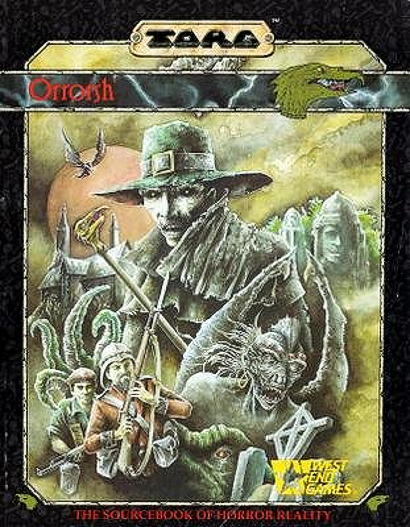
The original Orrorsh game supplement is harder to track down than some, but Amazon has a number of copies still. A different interpretation of the Gaunt Man features on this cover. Those interested should follow (I will get a small commission).

Preamble:

A long time ago, I rewrote some fairly fundamental parts of Orrorsh, the Horror Realm, for reasons explained in the text below. While packing, I discovered where it had been filed away (hidden?).

This is not a complete standalone work; you will still need the official supplement.

Why, then, should I read it?

First, because it demonstrates how to solve a particular design problem that can occur in creating any game world: that the first draft doesn’t deliver what’s promised on the cover.

Second, some of that is achieved by rules changes, so it also demonstrates how to change the official rules of a game system to customize it to a particular set of requirements.

Third, Horror and Scary have a place in any genre, and this can be used as a foundation for bringing those elements to anything from Traveller to D&D/Pathfinder.

Fourth, because game balance isn’t just a gamey phrase, and it’s a target that is easily missed. I think this supplement achieves that, though my TORG players might disagree.

And, finally, because it can be used as a game setting for campaigns / game systems outside TORG (with a bit of work), and one that’s quite different to the normal offerings.

Knowledge Assumed

I do note that this supplement requires more than the usual level of knowledge about TORG and it’s internal background/evolving story. For example, there’s an assumed level of cognizance about The Gaunt Man. I’ll smooth over those rough spots with insertions.

Definitions / Background

Like this.

The original runs to 27 pages. With those inserts included, I can see this stretching to 28-29-30 pages of 10-point text. My goal is to capture the whole in 3 parts, but it might end up being 4 or 5 before the whole thing is done. Or it might be done in two, since most of it is transcription.

Player Comments

The one taste the players had of the Horror Realm involved a guest player acting the role of the Monster/Horror. That player asked a number of questions using post-it notes to clarify different points – some of them specific to the Horror that they were running, and some more generic in nature. I’ve decided to include these, for whatever they are worth, in a different style of inclusion:

Player’s Question

Like this.

— [Reply]

Second Thoughts & Style Notes

Finally, 25 years after the fact, I have a few side-observations to make of my own. Once again, this will be added by way of a text panel that looks just a bit different to the others:

Author’s Note

Like this.

I should also add that I’ve tried a few layout tricks that I’ve never used before. Some of these have worked; some of them have failed catastrophically. NOW FIXED!! The theory was sound, but with HTML and CSS, there can be a vast gulf between theory and actual practice, as I have learned on numerous occasions.

In consequence, it looks like the chapter titles are being repeated – first in graphic form, and then again in the usual section-heading font. I’m leaving these failed experiments in place so that I can come back to them if I ever find the solution. FIXED, FIXED, FIXED!!

For the record, I was trying keep the headings but make the font white and the text 1-pt high or less. (And while I’m on the subject, can anytone explain why align=”aligncenter” only works properly when there’s a caption – even if it’s a virtually invisible full-stop, and how to fix it., I’d be extremely grateful. <<-- STILL A PROBLEM, OH WELL. I'll repeat an edited version of this Preamble at the head of each post. [caption id="attachment_49242" align="aligncenter" width="544"] .[/caption]

1 Why?

1. Why?

Orrorsh just isn’t scary enough. It reads too much like an amalgam of 1950s B-grade monster movies – and while some of these could be mildly scary, anything really scary never have been made in those days as it would not have been commercially viable.

The modern movement toward making movies truly scary for adults and not ‘safe for teens’ started with Stephen King, and Wes Craven, and Nightmare On Elm Street, though the roots of the trend can be traced back to Lovecraft. Compared to them, and those that followed, those B-grade movies can’t cut it.

The reason for the choice of sub-genre is clearly two-fold. (1) The authors liked them (as do I); and (2) you can show them to younger teens without scaring them away, i.e. alienating the early-teen market. My gaming group, in contrast to the average, is (was) adult, experienced, and not likely to find official Orrorsh all that scary. They would act as PCs do – if it moves, shoot it.

2 The Goal

2. The Goal

I want the feelings generated by Alien, Nightmare On Elm Street II, The Thing, Hellraiser, and the like. I want the players to be nervous, which will translate to fear in their characters when they roleplay, if it is refereed properly. Combat should have Alien’s ‘Jump Out Of Your Skin quality about it.

3. How?

3. How?

Through Techniques and Content. the techniques are designed to generate a particular state of mind in the players; Fear is the buildup of tension in an atmosphere of discomfort, suddenly discharged without relieving the atmosphere. The key terms are Atmosphere, Tension, and Discharge without relief.

Atmosphere in roleplaying derives from Environment, Description, Style & Language, and Tone.

Tension Buildup results from Mood and Action.

Discharge comes from Pace and Delivery.

All these terms are defined in detail below.

3.1 Environment

The term applies to the background of the adventure. Playing in an appropriate setting makes it easier to establish – dimmed lights, flickering candles, deep shadows, etc – but none of that is necessary. The environment in-game should be one that produces wariness.

3.2 Description

Description should be loaded with atmosphere-building terms and phrases which reinforce the setting. Make lists of these in advance, if possible. Look for a downbeat, fear-inducing alternative to everything you say.

Instead of “He is 6′ tall and has brown heir and bluer eyes,” try for “His head passes twelve inches beneath the 7-foot high gallows post, his hair is the color of a freshly-opened grave; his complexion is pale, and his eyes so wide and bulging with feat that you have to force yourselves to notice that they are blue”.

Prepare descriptions for generic people and places, not just key locations; when you’re trying to establish an atmosphere, everyone, everywhere, and everything, are all key items.

However, it’s important not to go overboard – emphasis one element, and gloss over the rest. Otherwise, you will drown the more significant contributions out. The example offered above goes too far – edit out the color-comparison of the hair and re-read it, and you will see the difference for yourself. The gallows suggests bulging eyes, which are reinforced by the description. The man who looks hanged is both memorable and conducive to atmosphere.

Author’s Note

Refer to The Secrets Of Stylish Narrative for more tips and tricks in this department.

3.3 Style & Language

Everyone has a preferred style

Author’s Note

…which has usually developed without conscious decisions on their part.

Mine tends towards putting the party in problem-solving situations, with atmosphere overshadowed by vast conceptual leaps. I come up with an idea of a plan and let the party try to figure out what’ going on and how to stop it. That style simply won’t work in Orrorsh without heavy modification – it’s too cerebral.

The style has to be prepared, and practiced, and polished, in advance. Bring something to read (briefly) that will put you in the appropriate frame of mind, hopefully with pictures. Alter the layout from the usu8al, if possible, to prevent your falling into old habits. Atmosphere helps you maintain your style, too.

3.4 Tone

The tone of a session is strongly related to the Style and the nature of descriptions used. Graphic, Blunt, Abstract – all different tones. More than anything else, tone refers to the way you react to events in the unfolding story, especially the mixture of game terminology vs descriptive passages and the content of those passages.

The Tone I set tends to be fairly immediate and abstract, with results described fairly immediately after dice get rolled. Those results will be a 70:30 split between in-game narrative and out-of-game mechanics, which also then generally lead to a narrated outcome. That works well in superhero and modern environments, acceptably in Fantasy environments, and won’t work at all in Orrorsh.

A better tone to set would result from requiring a roll, NOT announcing immediately if it succeeds or fails, instead narrating some action leading up to the crux point that leads to the narrative that includes the results of the roll purely by describing the outcome and the new situation.

Author’s Notes

That won’t work in combat, not without stretching the length of a battle unacceptably. So it should lean the other way, and be short and sharp and full of surprise elements. Some actions – reality alteration, the use of powers – should always interrupt combat with a brief burst of narrative, however.

3.5 Mood:

Getting a mood is difficult, every player and character will have their own at the start of a game session, and – while influenced by the mood of others – will follow their own trajectory thereafter. Mood is the maintenance of Atmosphere.

You can use the Atmosphere generated by the Tone techniques described to help steer everyone into an appropriate mood, but then you have to cultivate and maintain it, which slowly builds up tension.

Game mechanics can be murder on Atmosphere. Nothing shatters a mood and brings the party back to life faster than the tinkling of dice across the table – except possibly side conversations. Most referees evolve a tone that is resistant to these – I like to dwell on the significance or difficulty of the circumstances while it is being made, and to prevent side conversations that aren’t relevant by giving players not directly engaged something to think about while conducting a brief private sub-session for those who are engaged. But as soon as the dice start rolling, the mood shifts to lets-get-down-to-business – whether I like it or not.

Needing to consult the rules, or a spell description, or whatever, is also a dash of cold water.

There are solutions to these problems but they aren’t universal and aren’t 100% effective.

    3.5.1 Pre-rolling

    Get characters (the referee does this for regular NPCs who will be appearing and characters with absent players) to generate a few dozen die rolls at the start of a game session (you can add to leftovers from last time if you like).

      Sub-critical situations

      Unless the situation is a critical one, the GM/player can choose which of their rolls they will use, but must then cross it off the list. If the referee keeps the list and does the crossing out, he can keep going without ever breaking narrative. The player doesn’t have to know what the ‘die roll’ is for before he chooses.

      12-24 rolls will get you through most game sessions, 30 gives some leeway.

      Expect players to respond very tactically to the option of choosing a die roll – they won’t want to waste a good one on trivial side-issues, and may want to get ride of any bad ones when they don’t think it’s going to matter.

      Critical situations

      In more serious situations, the referee has a choice – either switch to live rolling (and spend a lot of time rattling dice in the hands quietly while delivering narrative, see below) or use the next pre-roll result on the list, regardless of whether it is good or bad. In general, I subdivide ‘critical situations’ into ‘critical’ and ‘supercritical’ – the latter being when overall success or failure, or life or death, hangs in the balance. I save the live rolling for the latter.

      Again, if the referee keeps the list of rolls, he can switch to a more mood-supportive narrative mode and keep the game mechanics in the background. But it’s always a player’s choice what their character does.

      Author’s notes

      I have seen some players who deliberately try to invoke situations at the start of a session where die rolls are called for simply to use up bad rolls, or to expend really good rolls on things they think will benefit their character.

      Feel free to play games, inserting unexpectedly critical moments or having the benefits of a good roll be substantial but very temporary, needing a later roll to ‘cement’ them for the longer term if this happens.

      Min-maxers seem to be especially prone to this. It may also be necessary to get the players concerned to make an extra 6-12 pre-rolls.

      Another thought.

      I know of at least one GM who uses this system but with a twist – he gets players to generate two complete sets of die rolls (once) and choose blindly between them. Whichever one is not chosen gets archived for use by an NPC or saved to become the alternate set for the next game session, depending on his needs of the day.

      He also likes to ‘maintain game balance’ by using the one NPC pre-roll pool for all his NPCs and absent players. So some will benefit from good rolls and some will suffer from bad ones, but overall he thinks he is seen to be averaging a straight 10.5 on d20 or 3d6.

      Offered for whatever they are worth as technique refinements.

    3.5.2 Stalling while tension builds

    In critical moments, delay giving results or making decisive actions as long as possible. Don’t be so obvious as to talk about the weather while rattling dice -keep it relevant – but if the players can TELL that you’re building up to something, the tension will rise. (Having an NPC talk about the weather as a deliberate, intentional, overt, stalling tactic, is entirely fair game, however!)

    3.5.3 Recall takes game time – for everyone

    If a player can’t remember something, let them look it up, but maintain the action while they are doing so. Their character can be fumbling in his pack, racking his brains trying to recall an elusive memory, backing away from danger, momentarily frozen in fear, or whatever.

    Author’s Notes

    Some players find this objectionable because it ignores the difference between them and their characters.

    It’s a fair point.

    GMs may like to burn a pre-roll made against the character’s INT – success buys a small amount of leeway to look something up – maybe 5 seconds per point of success, or maybe some less formal tolerance.

    Again, with some players, you may need to add extra pre-rolls to cover this (anticipated) need.

    3.5.4 Pass The Buck or Spontaneous Creativity

    When YOU can’t remember something, or need to look something up, you have three choices.

    1. Stall the game while you do what you have to. Maybe call a 5-minute recess to cover your delay. Neither goes over well if you are even semi-strict about player/PC recall. Sauce for the goose, as they say, should be sauce for the gander.
    2. You can pass the buck, asking another player to look whatever it is up for you while play continues. Prevent abuse (on your part) by having whatever that character does, while they are busy, yield an automatic success.
    3. Or you can make something up on the spot, and even if it’s not correct, the outcome stands – good, bad, or indifferent. No take-backs.
    3.5.5 Crutches

    Sound effects and music can work wonders. That’s why the movies use them. It’s not as easy for the GM to do so – it’s something else that you need to manage when you’re already overloaded, and most GMs can’t compose and perform an orchestral score during the improvisational drama called a role-playing game – but do what you can.

    Hint: Inappropriate music is generally ignored until it becomes appropriate. Inappropriate effects tend to provide comic relief but can break mood.

    2nd Hint: Appropriate music/effects, if too loud for casual conversation to be heard by the whole table, can be even more distracting than wildly inappropriate music/effects.

    3.5.6 Work those NPCs

    Finally, don’t overlook the power of the NPC to maintain and strengthen a mood. The best technique is to have the NPCs mood continuously just a little worse than you want the mood amongst the PCs to be – if the party are wary (start of a session), have one or more NPCs become nervous and fidgety.

    If the party are nervous, let the NPC become edgy. And so on.

    Keep this up properly, and the PCs will be panicky by the time the NPC reaches terrified – the buildup plus the atmosphere will see to that.

    Author’s Notes

    In addition to the techniques described above, there are more insights and techniques relevant to this subject offered in the 2-part Swell And Lull series, and it’s 4-part sequel series, Further Thoughts On Pacing, here at Campaign Mastery.

3.6 Action

PCs are creatures of action. They DO things even in conversation – it’s fairly rare for players to speak in ‘the voice of their character’, the first and third person are also common. “I say to him…” – “My character says…” – “Frank tells him…” and so on.

There are times when this is useful and appropriate – combat for example.

There are times when it’s a pain.

A lot of the power of the mood evaporates when a critical game-mechanics barrier intervenes. Pre-rolls are meant to prevent this. You want the players to identify with their (fearful) characters one-on-one as strongly as possible.

I characterize the two types of situation as Verb and Character periods.

    3.6.1 Character Periods

    During a Character period, you can induce and strengthen the identification with the character by stealing some tricks from novelists. They never say “Frank says” and try hard to avoid using “Frank replies”, and so the technique of implying these things was developed centuries ago – at the same time as Prose, in fact.

    Instead of one of these banal and insipid placeholders, describe an action by the speaker and then recite his statement:

      John shakes his head slowly. “That is not true – you’re lying, and we both know it.”
      “No I’m not, no I’m not!”

    Reaction/Action implies the source of the statement that follows, the content of which is a piece of dialogue, which in turn implies that the second voice is that of the party being addressed within that dialogue.

    Author’s Notes

    You can only maintain that sort of daisy-chain for so long without refreshing the identification in some fashion.

    Mix it up a little – you can have the party about to be spoken to react to what he’s just heard:

      As John continues, George turns away, unable to bear what he’s hearing and not wanting to give John the satisfaction of seeing his reaction.

    Context makes it clear who ‘owns’ the next passage of dialogue.

    You can even have a third party do the acting/reacting, if you are then explicit as to the speaker.

      Judge Mackintosh frowns and makes a note to himself. Jeremy continues, “blah blah blah”.

    Note that not all literary tricks translate into genres as well as others. Pick a writer you like and a work that’s genre appropriate and study it for tricks, noting especially any tricks they have used that left a momentary confusion as to who was speaking the next line as something not to do without extra care.

    You can even get away with “Henry said” and make it powerful, if used in the right way. Compare this:

      “And what did the defendant say or do next?”
      “That’s when I heard him say he wuz gonna kill him.”

    with this:

      “And what did the defendant say or do next?”
      [loudly] “Patrick said he wuz gonna kill him, and that’s just what he done did, too!”

    The stage direction to the GM reading this is probably unnecessary, but it means there’s one thing less that he has to think about on the spot. But keep them REALLY short and simple.

    3.6.2 Verb Periods

    The actual discharge of of tension takes place in a Verb Period, so-called because someone is doing something.

    In Verb Periods, the action should be dramatic and startling.

      The door bursts open and a severed head bounces into the room and rolls into the corner. A gust of wind extinguishes the candle and it’s suddenly pitch-black!

    try to avoid asking mood-distracting obvious questions like “What do you do?” – the players will TELL you what their characters are doing without such placeholders. If necessary, gesture toward the player who you expect to respond when you’ve finished your prepared text / dialogue.

3.7 Pace and Delivery

Which brings me to the final elements of how I use pace to create tension and excitement.

    3.7.1 Delivery

    Try to use a steady, deliberate, pace and serious vocal tones until the moment of a tension discharge, when something dramatic happens – like combat, or a plot twist.

    Note that this does not being monotonous or wooden, or droning.

    As you approach the moment of tension discharge, you can even lower your voice a bit and slow your delivery even more to give the impression of a hush descending.

    Equate the pacing of your delivery to the heart rate of the characters. The human nervous system reacts to a steadily increasing then slowing then increasing pace with the expectation of a release of tension. The adrenaline flows, the heart reacts and begins to speed up and may beat harder, and so on – all the physiological effect of Fight-Or-Flight.

    The adrenaline makes people jumpier, more excitable more excited, more prone to seize on the mood that you have created and amplify it.

    3.7.2 Game Session Analysis

    Below is an analysis of a typical game session using these principles. I did the scaling by eye, so it’s not quite right, but it’s close enough.

This charts tension and nervousness against time, the latter on the horizontal axis. Natural Tension in blue, Induced Tension in Purple, resulting Nervousness / Excitement in green. The game session has been divided into 7 stages – start, first buildup, slowdown, 2nd buildup, negative slowdown, 3rd buildup, and Combat (which should, more accurately, have been labeled ‘Resolution’, but there wasn’t enough space for that. The numbers in green refer to specific notes to be called out in the main text, below.

    Natural Tension always tends to rise as a game session moves toward the end of play for the day, especially if you have a reputation for cliffhangers or big finishes.

    Induced Tension is the tension you create with your tone, pacing, etc.

    Nervousness / Excitement is sometimes referred to by the more general term, Emotional Intensity or just Intensity.

    Authors Notes

    Again, let me point readers to the Swell And Lull series, and thet sequel series, Further Thoughts On Pacing.

    What this text makes clear that I don’t think ever got mentioned in any of those articles is that it is the mood and content of your delivery in the context of genre that determines what the emotional response being intensified is.

    In this game supplement, the goal is to create the suspense of a horror movie when everything goes quiet and you know that something is about to happen – and still usually jump when it does.

    In other campaigns or settings, you might be looking for excitement or drama or a sense of wonder or any number of other emotional qualities. You can even change the goal from one adventure to another to suit the content.

    Key Observations

    First, two general observations about the chart layout that were important enough to note them on the chart itself.

    • The three curves have been offset one vertical division each. Each of the curves starts at their respective zero positions.
    • There is a cause-and-effect relationship being shown. Green is always indicating the response to what happened at the previous purple point. The significance of this is explained in the main observations list to follow.

    So, to the main observations:

    1. at this point, induced tension is rising faster than the intensity response because the rate of induced tension increase is itself increasing as though you were heading for a dramatic moment.
    2. at the second point, instead of that expected dramatic moment, the G< slows his pace and softens his delivery. This is a characteristic of a slowdown phase. Because of the lag, though, intensity continues to rise for a bit. It doesn't fall as far as the dialing down that the GM does because the induced tension is again starting to be increased before it gets that far
    3. Without resolution, induced tension resists dropping too far. A good rule of thumb is that half of whatever increase followed the previous slowdown phase is conserved. Since the previous one was “pre-game”, half of the total increase to date is conserved.
    4. At the second slowdown, half of the gains since the first are conserved, and added to those previously conserved. This shows that repeated slowdowns have a diminishing impact; they aren’t a magic bullet that you can fire at the game session, but instead need to be planned for maximum impact. Two in a game session is usually a practical limit. If there was a third one at the “7” position, it would have negligible impact.
    5. Notice that the second slowdown, while real, didn’t carry a pause in the attempts to build tension, unlike the first one. This is deliberate.
    6. this point shows the impact – the players anticipate a more comprehensive chance to catch their emotional ‘breaths’ but the incessant increases in tension don’t give them the chance. The net effect of the short, sharp 2nd buildup and almost negligible easing off is to ‘prime’ the players to over-react to the third buildup.
    7. At point 7, the GM really starts to turn up the heat. Once again, because of the lag, intensity doesn’t rise as fast as tension, but will tend to overshoot when the buildup ends.
    8. The trajectory of the green line is therefore in complete opposition to the resolution brought by Combat (in this case) or Resolution in general. This increase that “should” take place, but doesn’t, gets internalized by the players, who subconsciously ‘park’ the excess intensity – and the baggage that comes with it – your tone, mood, atmosphere, etc. You induce a tendency for the players to react emotionally in the manner that you want, in other words.

    With the techniques of refereeing Orrorsh now established, we have a delivery system – all we need now is some Content to deliver with it.

3.8 Content Nuance

The “Camp” nature of the horrors and the background they they develop tends to engender laughter and not fear, and genuine laughter dissipates tension.

This makes it clear why the reference sub-genre has to change.

The key elements of content in a TORG Realm or Cosm are the World Laws that define the reality and how it works; the Axiom Levels which constrain and define the culture and society that provides a framework for those World Laws to operate in; the effects of both on the Realm’s population and institutions; the Geography and Political, Social, and Economic realities of the Realm; and the character of the High Lord and how this is reflected in the Realm. Each of these, as they pertain to Orrorsh, is discussed in the following sections.

Definitions / Background

High Lord –
Each reality has a ruler who has the power to shape that reality, but who must also reflect the reality that they have created. High Lords can be overthrown or taken down either by Storm Knights (usually PCs), or by Rivals from within (one of whom then gets to be High Lord), or by the High Lord from another Cosm. Each High Lord has a Darkness Device (to be defined later) which extracts “possibility energy” from the subject populace and uses it or makes it available for use by the High Lord. This is the source of much of their power.

Storm Knight – Sometimes, when you get caught in the middle of someone else changing reality, you gain the ability to do so yourself. The details don’t matter much. The PCs in a TORG campaign are almost always Storm Knights.

Cosm –
The “reality” from which the High Lord and any number of his servants derives. The other ongoing series of articles under the umbrella of the broader series is all about the Cosm of Aysle.

Realm –
Humans, for some reason not explained officially to my knowledge, have vastly more possibility energy to be harvested than the inhabitants of any other reality – so much so that the High Lords feared what they might do with it, but also so much that each feared the consequences of invading, even though (at the time) there was no High Lord of Earth. So the Gaunt Man got a bunch of High Lords together and coordinated a combined invasion by them all; each got a part of the world in which to establish a simulacrum of their Cosm, imposing a new set of natural laws over the population and making that population subject to the World Laws of the new reality. Such an invaded territory is known as a Realm.

World Laws –
The World Laws define the ‘operating principles’ of the reality, both within the Cosm and within a Realm subject to that Cosm.

4. World Laws

4. World Laws

The Orrorsh Sourcebook talks about the powers of Fear and Corruption (completely different tot he Ayslish World-Law of Corruption), but it never actually enunciates any World Laws.

Infiniverse Volume II lists three, but only actually labeled one of them a Law; the others were Powers, and not particularly frightening ones, at that: “Wicked acts lead to Corruption”

What encourages the Victorian-era residents to commit these Wicked Acts?

The power of Fear prevents Storm Knights from playing to the critical moment or invoking reality storms to change reality? The players in my TORG campaign (as of the time of writing the original supplement) have done the first once and the second not at all, so that would really set them quaking – not!

The Law of Eternal Corruption brings monsters back in due course – somewhere else. That’s the most frightening World Law they could come up with?

Perseverance is the best of the ideas, it encourages Storm Knights to push on when their Fear gets the better of them, even though the PCs would do so anyway and protest vehemently id prevented from doing so by the referee.

And, of course, if the residents are subject to Perseverance, what do they need Storm Knights for, anyway?

This extremely-critical analysis should demonstrate that the redesign of Orrorsh has to go considerably deeper than just creating some scarier Horrors. It has to happen from the ground up – by recreating the World Laws that I was just criticizing.

(By the way, it’s no accident that some aspects of the redesign bear a striking resemblance to concepts from Call Of Cthulhu).

Orrorsh now has 5 World Laws:

  • The Law of Evil;
  • The Law of Duality;
  • The Law of Fear;
  • The Law of Perseverance; and
  • The Law of Truth.

4.1 The Law Of Evil:

Acts of Evil are rewarded with Power.

Hekaton, the Darkness Device of Orrorsh, invests part of its accumulated possibility in those who commit Acts Of Evil, granting them powers. The use of this energy generates Fear in the populace, which feeds more power to Hekaton. Persisting in the face of fear reduces this fear through the release of the possibility energy of the unpowered, feeding more power back to the Darkness Device.

One Horror can bring fear to hundreds or even thousands, so the gains of this approach are vastly greater than the investment.

Player’s Question

So Perseverance feeds Hekaton?

— If it’s by a non-Horror, and not by a Storm Knight, yes. Horrors are pretty much immune to the fear they induce in others, and Storm Knights can reshape the reality into one whose laws are more beneficial for them, so they render the law of Perseverance null and void. But ordinary people and some higher animals, absolutely. Creates a delicate balancing act, doesn’t it? Enough Fear to scare people, not so much that they won’t resist it, and that resistance is what Hekaton really wants. The whole first law is just a means to that end.

Definitions / Background

Darkness Device – Mentioned already, it is the possession of one of these that elevates someone to the rank of High Lord by giving them access to huge amounts of raw power.

Possibility Energy – Anyone can change the world, in theory, but few people ever actually do so. This potential, which otherwise would simply be wasted, powers the High Lords by way of their Darkness Devices. This possibility potential can interact with a wave front of changing reality to create a Storm Knight who not only has far more possibility energy at their disposal than most, they can actively use the possibility energy to create a (temporary) bubble of changed reality, similar to what the Darkness Device does (but on a much smaller scale).

4.2 The Law of Duality;

Everything has two sides, the Public and the True.

True Death vs death, True Vision vs sight, True Form vs perceived body, inner being vs Public Face – notice the pattern? Everyone and everything in Orrorsh has two sides to their nature, two different personalities. The hidden persona – body and spirit – can only be perceived in moments of great stress or when utilizing the powers granted the True Form, or when perceived with the powers of Truth.

Player’s Question

Isn’t one just the opposite of the other?

— One personality / persona can be the opposite of the other, and they often have some traits which follow this pattern just to ensure contrast, but they don’t have to be. More interesting characters sometimes result when the two have something in common – for example, both may be very intelligent, but they use this intellect for very different things.

It’s more important that the character and his internal, often suppressed, desires make as much sense, given the character’s identity and past, as the public face of the person they think they are.

Author’s notes

The text in section 4.2 also clarifies an important omission from the text in 5.1 – that Hekaton can gift some powers to the public persona, some powers to the hidden persona, and some powers that either can use. No matter how these break down in allocation, the total will always be the sum of what Hekaton can grant the individual.

It’s entirely common for most of the powers to be allocated to the hidden persona, but not a requirement. Think Werewolf, who only has his powers in his wolven form, and contrast it with a Vampire, whose hidden true self is a corpse, but whose public face has great power.

I was still figuring some of the details out as I was writing. 4.2 implies the above, without stating it outright; 4.1, which talks about the granting of powers, doesn’t mention it at all.

4.3 The Power Of Fear:

True Fear lies at the heart of all acts, Fear at the heart of all Evil.

The True Fear of a character is something defined by the character’s owner at the time of creation / transition to Orrorsh. It is the ultimate motivation, a phobia so deep that its suppression and/or denial defines the character’s motives and deepest desires. It is not always entirely rational.

A True Fear can always be expressed in three-to-four words, the first two of which are “Fear Of”.

As True Fear grows, it causes obsessive behavior and insanity. Only Power can overcome True Fear, i.e. only the commission of Evil Acts can return the lunatic to sanity – and simultaniously weaken the will to resist committing more such acts for more power. Ultimately, Megalomania and Evil are the only ‘cure’ for madness.

Fear is the paralyzing inability to act in an extraordinary fashion due to the dangers, real or imagined, that one is confronting. One of the most fundamental and common of the Powers granted by Hekaton is the ability to generate Fear in others, which of course, is one of the most basic uses of power in general. It also increases self-reliance, easing the wielder’ s own fears.

Player’s Questions

So the only way to ease one’s own fears is to make other people more scared than you are.

— Not necessarily “More scared than you are”, just “More scared of you than they were.” Keep ratcheting up that Fear and eventually you will reach any given milestone. Power enables you to be a bully or a nightmare; with powers that can be used for dark things; being a bully permits you to pretend not to be afraid yourself, earns you more power, which creates more fear.

Are True Fears good or bad for a Horror? Like a Cthulhu Insanity power?

— True Fear is a motivation. Decide what your character is scared of and I can tell you what kinds of Horrors you might become to evade that fear. Fear of death leads to immortality at any price – vampirism. It can also lead to Dr Frankenstein in his laboratory seeking to master death, though that’s more usually a fear of the death of another, i.e. Fear of Loss. There are several pathways leading to Lycanthropy. Fear of Humiliation or of Women can lead to Mr Hyde syndrome. And so on – those are just the traditional ones.

4.4: The Law Of Perseverance

Perseverance is self-fulfilling.

Everyone has the ability to resist the desire to acquire Power through Evil Acts. Similarly, everyone has the ability to persevere in the face of Fear. Doing so is required for any act other than a Wicked Act performed to gain power, and using it for this purpose increases the ability to do so again in the future.

This is the reason Victorians are unable to escape Orrorsh – they would only do so out of fear, and if they can act despite their fears, they have no need to do so. The only alternatives are to fight or submit.

Fleeing would be an act of submission, which eliminates the need to flee.

Definitions / Background

Victorians – The social norms and technological capabilities of the residents of Orrorsh are generally those of Victorian England. Steam Trains, early manufacturing, and so on. An age of Peasants and Gentlemen and Ladies. The era in which professionals rose in general esteem to be counted – in some cases – in the latter parts of society, whereas previously they were all in the lower reaches of society save for the good will of the landed gentry..

That’s a slight oversimplification. Most street lamps are gas lamps, for example, but there will be a few experimenting in electric lighting, which is more of an Edwardian development. But that’s the label that the sourcebook applied, so Victorians it is.

4.5 The Law Of Truth

The Truth has powers that can only be learned through Fear; and only the Truth can destroy Evil.

Knowledge is power? Not in Orrorsh!

Truth is what has the power here – an instinctive connection to the Occult that permits the user to see True Forms, determine the manner of True Death, etc. The problem is that it requires the sacrifice of some of that affinity in order to to do so.

Actually using Truth, in the form of the True Death of a Horror, is greatly disruptive, as each Horror i a fundamental component of the current pattern of Occult Forces. To continue doing so, it is necessary to risk Sanity and Soul in re-developing the affinity with the Occult.

    4.5.1 Horror Is Forever?

    The second part of the Law Of Truth replaces ‘The Law Of Eternal Corruption’ in the sourcebooks, and says almost exactly the same thing – unless you use the manner of the True Death to end a Horror, KNOWING that it is the True Death, a Horror will not die forever.

    Why the caveat on Knowing? Two reasons.

    First, it prevents Storm Knights from keeping a checklist and trying each one in succession: Okay, we’ve tried burning it, stake through it’s heart, sunlight, moonlight, silver bullets, running water — what’s left?” The ‘knowledge’ requirement means that even if they pick the right manner of death, it won’t be a permanent end. In fact, they can cross the True Death off their list because the Horror ‘survived’ it!

    The other reason is conceptual in nature – what makes this the True Death? Well, you aren’t just killing a Horror, you’re killing it with with The Power Of Truth – a nice philosophic point which is the leftover from the original World Laws of the original Cosm of Orrorsh, long since sucked dry of Possibility Energies to feed The Gaunt Man.

    4.5.2 True Deaths

    Only Horrors have True Deaths and a True Death always stems in some fashion back to the True Fear(s) of the uncorrupted being who became the Horror. Just as a Horror no longer fears, so he no longer has a True Fear – only an unquenchable thirst for Evil and Power.

    Player’s Questions

    So Horrors are w/out fear? Except when low in power?

    — No. They always have their True Death to fear, and the price of getting int the way of some other Horror that’s bigger and meaner than you are. But they commit evil acts to give themselves defenses, so they are no longer driven by any fear except the most secret and innermost one, from which they can never escape..

    Author’s notes

    I don’t honestly remember if it was hinted at or stated directly in the sourcebooks or if this was something that I came up with on my own.

    These world laws turn the entire population into components of a process for the generation and harvesting of Perseverance. Anyone who resists the cycle of terror that it inflicts on the population is themselves part of the process, because nothing generates feat faster than giving the people hope only to demonstrate that it was always false, and that the villain was merely toying with the brave resistance – not for his own pleasure, that’s just a side-benefit, but because of the effect that it will have on those who invested hope in the failed resistance.

    Running out of such energy diminishes a population. You can’t operate such a social machine forever, there’s only enough ‘fuel’ to keep it running for so long.

    It’s no good having powers if you can’t use them every now and then for something cruel and despicable. And you can’t generate real fear by playing hackysack – no, you’re going to have to get right in there and do something mean and scary and – for someone – lethal. Preferably with witnesses but some sort of calling card or signature will do.

    That also uses up population. Sooner or later, the factory is going to have to shut down and move shop to somewhere with more sheep to be shorn.

    So, the Cosm currently called Orrorsh isn’t the first, and probably won’t be the last, to bear that name.

    Implications

    There are a number of implications to consider. There’s a wide scale between trivial little men and women who are granted the occasional crumb of power and granting someone the powers and independence of true Horror status; the Gaunt Man and Hekaton aren’t going to give those levels of authority out to just anyone. Prospects would be vetted, trained, cultivated, and – a lot of the time – rejected. They want people whose agendas will add to or help fulfill the Gaunt Man’s agenda. They want Horrors who will use their powers to that end, and who will be smart about it.

    Every time a Horror is ended before it has done all it can do in furtherance of that agenda, both Gaunt Man and Darkness Device are diminished. End enough horrors, and the whole system might fall apart. It’s not tolerable for victories over their creations to become habitual.

    Finally, a system as fiendishly clever as this set of World Laws won’t have sprung into existence from whole cloth; there will have been variation after variation tried until this system evolved. Is it perfect? Probably not – the next Orrorsh Cosm will probably have some small amendment to its nature.

4.6 Comparing The Old

So what’s the difference, really, between this set of World Laws and those official? Persistence seems to work in much the same way as it did, True Death is much the same, as is Fear, and Evil is not that far removed from the old law of Corruption – what’s really changed?

The answer lies in two additions – the Law Of Truth, which REQUIRES Fear to end a Horror, and the Law of Duality and it’s daughter concept, the True Fear, which mandates a Fear so powerful that the character is likely to turn to Evil before he confronts it.

As in Call Of Cthulhu, characters are now required to court insanity and terror to succeed – under the old rules, they simply had to Persevere.

    4.6.1 Walking A Fine Line on a Slippery Slope paved with Good Intentions

    As the game mechanics will show, even the Power Of Truth is not enough to deliver the True Death to a Horror; genuine Power is needed, of the kind you only get from Wicked Acts.

    The characters have to balance fighting the enemy against the risk of becoming the enemy, supplanting the old Horror with an even worse one – themselves.

    Having Possibilities to assist in rolls now becomes extremely valuable, and the value of Storm Knights vs Ords, no matter how Persistent the latter, becomes meaningful.

    4.6.2 An Elegant Solution

    This arrangement is also more elegant in three major ways.

      4.6.2.1 Population Control

      Active intervention by the High Lord is no longer needed to keep the proportions of Horrors to population correct.

      If a second Horror pops up in a region already controlled, the increase in Fear makes it easier to determine Truth. The one that’s smarter and more capable will be able to avoid the Horror Hunters longer than the other one.

      The more Horrors that are unleashed, the greater the population pressure acting to get rid of the weaker ones. Unless the new Horror is really competent, experience probably gives the older, more established one, the edge, leading to the extinction of the upstart, but assuming that advantage will always be decisive is a good way to end up very Dead.

      4.6.2.2 Evolution

      It forces evolution and conflict amongst the Horrors – the more capable of spreading genuine fear they are, the harder it will be for a rival to perform acts of sufficient villainy to obtain the power to displace them.

      The old pattern was too cut-and-dried, too stagnant, and too close to ordinary politics; now a Horror maintains and enhances his power and edge not through political machinations and intrigue, or bureaucratic skill and toadying, but through the successful exercise of his primary power – Fear.

      To the scariest monster goes the most power.

      This is an excerpt from the rendition of the Gaunt Man that graced the cover of “The Gaunt Man returns”. While Amazon has a few 2nd-hand copies at ridiculous prices, there are some new copies left at Days Of Knights.com that are far more affordable. I have slightly enhanced the contrast, brightness, and saturation so that it looks more like the cover of my copy.

      4.6.2.3 The Gaunt Man

      By extension, it lifts the Gaunt Man one step closer to the pinnacle of power, to becoming the ultimate in terror. To get to the top, he had to be scarier than the rest, and to stay there, he has to stay that way.

      Since the players will know or deduce this fairly easily, it becomes a partially self-fulfilling prophecy – they are going to be less effective when it comes to dealing with him, and that will make him more effective against them.

      He’s supposed to be scary enough to scare six other High Lords, for Pete’s sake! How scary can you get?

      4.6.2.4 But – he’s dead, isn’t he?

      It should be noted that in my campaign, the Gaunt Man [was, at this time,] DEAD, torn apart by the Reality Storm which was created by the destruction of the extension of Hekaton in which he was storing all the possibilities that he had looted in his attempt to become TORG. No Eternity Shard, No Eye Of The Coyote, No Dice, Compadre.. Now, if only I could {have] convince[d] the players of that…!

      Author’s notes

      I have to admit that I fell in love with the Look of the Gaunt Man and with the portrait of him as the unifying factor that brought another 6 High Lords to the party and intimidated them enough to keep them in line, at least for a while.

      I was so looking forward to running him as an NPC…! But, when the stats and background arrived, what I was offered was a pitiful fragment of the ultimate Evil Villain that I had imagined.

      A Vision of Darkness

      I had imagined him smart, continually three steps ahead of everyone, but vulnerable to his own Hubris and Ego. I wanted the PCs to have a decent chance of beating him – one scheme at a time – but for them to have to work for it, each and every time.

      Compared to this vision, the character presented by the adventure modules etc was as thick as a mausoleum wall and twice as dense. It was inconceivable that a character so flawed could have achieved half the things attributed to the Gaunt Man.

      Orrorsh Will Fix It

      Well, no, it didn’t. But in that failure lies at least part of the source of my disappointment in the original sourcebook.

      The GM’s Whiteout

      So, I had the character make his bid to become TORG, as shown in one of the early adventures for the game system (I forget which and they are now all packed away), only to discover that he had underestimated the difficulty. Internal politics amongst the other Dark Lords, all of whom feared what he would become if he succeeded, led to discrete hints and aid being provided by a couple of them to the opposition, which put them in the right place with the right tools to write him out of the plot – at least until I could fix things.

      In the adventure, the authors had given the Gaunt Man a couple of strategies for backing out before it was too late. I took those away (the other High Lords again) and I deliberately wrote the character out until it could all be made good.

      And I shipped the entire thing into the background of events taking place before a PC in my campaign ever set foot on Earth, a fait accompli, done and dusted.

      The Return of The Gaunt Man

      It was always my intention to bring him back at the penultimate climax of the campaign. My vision of the Gaunt Man was such that he would have laid plans, and backup plans, and back-up plans for the back-up plans; a succession of outs in case he had bitten off more than he could chew.

      I always remembered that supposedly he was the only one expert enough in possibility energy and its uses that he could conceive of the plan to become TORG. That fitted well with my vision of the character and didn’t fit the depiction of him in the official material at all.

      The Campaign never got that far. So I never did get to run a “New and Improved” Gaunt Man, in the end. Oh well, maybe one day…

Whew! I had forgotten just how much I was able to squeeze onto a full A4 page with a reasonably small font – that’s not 9 pages, that’s just 4½! But the supplement is about to shift into Game Mechanics, so this is an opportune point to end this article.

Things won’t be so neat next time – 4½ pages will be about 2/3 of the way through “How To Destroy A Horror”, and I won’t want to break that up. If I could get another page-and-a-half done, that would see me completely through the “Orrorsh Events” sequence, which would be far preferable – but I’m not sure time will permit that – unless I can squeeze out an extra day or two while dealing with other articles.

So, while I’d love to be certain about what will be in the next part of this series, or this sub-series, we’ll all just have to wait and see!

Comments Off on The Mists Of Fear Orrorsh Revisited 1

An Old Aysle To Run Down 1


This entry is part 1 of 4 in the series Extracts from Mike's TORG Materials

Amazon has just two (second-hand) copies of the Sourcebook left. But that’s still more than I found on eBay.

Preliminaries / Introduction: Why you should read this article

One of the good aspects of packing everything is that you discover where you had hidden away things that have been archived for long enough that those hiding places had been forgotten.

So it is that I h\ave found a whole bunch of material from my old TORG campaign, which I intend to use through 2024 as the foundation of various articles.

I’m doing this for a number of reasons, which collectively spell out why it’s worth your time to read them (some more than others, I must admit).

1. I can (almost) cut an article off in mid-sentence if I have to – so these will be flexible in an uncertain publishing period.

2. The Aysle material constitutes an excellent demonstration of campaign creation and world-building.

3. Aysle is utterly unlike any D&D world that I know of, and my variant on that is even more so. File off a few serial numbers, change a few names, and you have a unique adventuring environment to either visit or reside in for the duration of a campaign.

  1. The Orrorsh material is a lot scarier than the published, official, version – to such an extent that none of the PCs wanted to go there. They had one small taste of it (a freighter adrift at sea) and that was more than enough for them, thank you very much.
  2. A lot of people found the spell construction system to be confusing. So did I, at first – but once I understood it, I thought it was brilliant. Of course, I tweaked it a little, and – hopefully – explained it a lot more clearly than West End Games did at the time. Again, as house rules go, this is an interesting and robust one for GMs to contemplate.
  3. Finally, I’ve got a LOT of material that I can reconstitute or recycle, and if I don’t do this with it, it will never see the light of day. The campaign itself, though officially on hiatus, is unlikely to ever restart – not enough time, not enough interest, and I’ve lost touch with most of the old players. But it may be of benefit/interest to other GMs out there – whether they run TORG or not.

I know that I’ve mentioned the TORG campaign, and specifically Aysle, on a number of past occasions.

Part 3 of the Plunging Into Game Physics series, Tales from the Ether used it as an example, for example. And I described the Campaign as it turned out in play in Part 2 of my biographical double-post, Dice And Life: Bio of a gamemaster, which I posted to commemorate the 5th anniversary of Campaign Mastery.

This isn’t going to be like those occasions; instead of working from memory, I have my actual campaign construction notes for reference, including some forgotten goodies that the players never figured out / discovered.

But I thought I should point out why it is that some of this material might sound familiar to long-time readers.

The Campaign Concept

I’m not going to go into this in too much depth – there’s more than enough content in this category alone to be a post in it’s own right at some future point.

But there are some fundamentally important points to emerge from the process and those are worth highlighting, especially since they impact the main subject of today’s discussion – they explain why this was the starting point.

A Complex Reality

There’s a LOT of material for new TORG players to assimilate. Heck, there’s a lot for GMs to assimilate!
.
This requires massive information dumps or homework assignments that would turn most players and GMs off. I know at least two players/GMs who bought the system and then packed it away as too much like hard work – I know, because I ended up buying stuff from them, second-hand. No, make that four – Graham, Adrian, Stephen,.and Ian. Two of them became players in the campaign when I ran it.

There are six or seven realities, the overarching Infiniverse, the basic rules, the reality-changing rules, the history, and so on. Each reality has its own unique character options and capabilities and rules structures, but characters from the other realities or Cosms can go there and interact with the locals..

From just about day one, I wanted to break all this up into manageable pieces.

The foundations of a plan

So I started working on a way to achieve this.

I picked Aysle as my starting point because the fantasy Cosm would be closest to something familiar to the players.

Phase 1

I deliberately intended to start the campaign prior to the Possibility Wars (which involve those reality-changing rules that I mentioned) so that players could get familiar with the basic game system. ONE reality, ONE set of rules.

They would have an epic adventure (multiple game sessions), from which they would return to discover that the bad guys were now in charge, that a bridge had been opened to a new Reality called Earth, and that a war of conquest was underway.

Since the only hope of freeing their homelands from the forces of Evil was the leader of the resistance (who had been lord high muckamuck when they left), and She was on Earth. So they would have to follow.

Phase 2

That introduces the more complex reality and the basics of the Reality Changing rules, but it keeps them in the Earth-contaminated adjunct to the Fantasy Realm while they get used to them.

A couple of short adventures and (I’m a little fuzzy on this point) they would be sent out to recruit allies in every Realm. The Bad Guys were basically an Oligarchy who had each other’s backs much of the time (even while they plotted and back-stabbed each other). Unless they all faced a crisis at the same time, they possessed overwhelming force.

Which would lead to:

Phases 3+

The PCs would make their way from one Reality to another using available means of transport. Each time they entered a new reality, one player was required to generate a character from that Reality and then choose to stick with what they had or ‘trade them in’ for the newcomer, retaining all earned XP. If a player wanted to volunteer, that was fine, if a new player wanted to join the campaign, that was also acceptable.

That was justified on the basis that each of the ‘new’ characters would have been having adventures of their own before being tapped to join the party. They each had to have their own motivations for doing so, ones that made sense under the “rules” of the Reality that they came from.

One Reality at a time, they would gain a basic understanding of how that Reality worked and the party would slowly metamorphose from a straight fantasy party into something more cosmopolitan.

The last Cosm to be visited was to be Orrorsh, the Horror realm, but the campaign ended before they got that far.

Phase X

I forget how many Realities there were to visit, but Orrorsh was to be the last of them, as I mentioned, and it was to provide the lead-in to the epic conclusion of the campaign, in which The Gaunt Man makes a power-play to seize control of ALL the Cosms and a darker, more sinister plan that had been underway throughout the Possibility Wars was revealed.

The PCs couldn’t save everyone, everywhere – they would have to pick and choose and have a strategy to overcome this threat. It would not happen cheaply, there would be a steep cost involved, but they could win – there were six or seven paths to victory, one for each of the Cosms, but they were mutually contradictory.

Each one required making alliances and having some of those allies not make it out the other side. (The Living Land was usually a casualty, for example).

Realities would change, whole populations would die or be saved, and it would take about half as long as the entirety of Phases 2-to-whatever.

That was the basic plan – a foundation and then add bricks one at a time until the house began to take shape.

Aysle: Fantasy Cosm

From word one, there were elements of Aysle that were hard to get your head around.

The basic world was a pie plate – actually, two very dented pie-plates, base- to-base, with a hole in the middle, through which the sun transited each day – rising at Dawn and setting at Dusk.

Right away, I had questions:

  • How big a Hole?
  • How big a sun?
  • Which way was down?
  • What stopped all the water from falling down the hole?
  • How did you get from one side to the other?
  • Mountains? Tectonic Activity?
  • Conditions near the center?
  • Conditions near the edge?
  • Seasons? How
  • Weather?
  • Sailing ships – Trade Routes? Favorable Winds?

And all that was before I got to the more complicated questions of who lived where, and politics, and borders, and ecologies, and trade goods, and money, and so on (I’ll cover at least some of those in #2 in this series).

Having generated this long list of questions, I set about answering them, one by one.

The Hole In The Middle Of The World

There’s no scale on the maps of the Cosm provided in the sourcebook.

The sun is 93,000,000 miles from earth. If the hole is that big then the maps make no sense – the ‘planetary’ surface would extend out more than 14 AU, clear out to the orbit of Saturn and well beyond.

Okay, so no 93 million miles. That means that the sun has to be a lot smaller and weaker than our sun.

Using The Map

In the text, it describes the world as being about 9000 km radius. The map measures out as 17cm across, near enough. So, not quite 1 cm to the 1000 km, but not far off it – 9/8.5 = 18/17.

The hole has a diameter on the map of 1.2cm. Assuming it’s to scale, that’s a diameter of 18 / 17 × 1.2 = 21.617 thousand kilometers, or about 1250 km. Again, near enough.

The Size Of The Sun?

So, how big is the sun? Radius 9000, and the temperate regions are about 1/2 out, so distance 4500km. The sun goes up into the sky a certain height and then comes down again. (Why? Get to that later).

Advice:
Never be afraid to at least stick your nose down a rabbit hole, you never know when what you find will come in handy!

Angles. At the very edge of the hole, the sun would be virtually overhead. The further away from that center point, the greater the angle at the sun’s highest point.

Insert a stick in the ground, measure the angle at noon, and you would always know your longitude-equivalent.

So let’s look at some Trig.

Aysle Solar Trigonometry

I’ll work the problem using three different values for h and see what I get.

    H = 4500 km:

    tan (theta) = 1
    Theta = 45°
    tan (theta + omicron) = 2
    Theta + Omicron = ~64°
    Omicron = ~14°
    d1 = 6364 km
    d2 = 10062 km
    100 x (d1/d2)^2 = 40%

    h = 9000km

    tan (theta) = 2
    Theta = ~64°
    tan (theta + omicron) = 4
    Theta + Omicron = ~76°
    Omicron = ~12°
    d1 = 10062 km
    d2 = 12728 km
    100 x (d1/d2)^2 = 62.5%

    h = 18 000km

    tan (theta) = 4
    Theta = ~76°
    tan (theta + omicron) = 8
    Theta + Omicron = ~82.8°
    Omicron = ~8°
    d1 = 18554 km
    d2 = 20125 km
    100 x (d1/d2)^2 = 96%

Those last numbers apply the inverse-square law to determine how much less light and heat the edge receives compared to the temperate zone.

So if I can determine how much less heat/light the earth gets at the arctic circle relative to the midpoint of the temperate zone, I can work backwards to get the actual height above the surface.

.

Terrestrial Solar Trig

First of all, the sun is so far away that we can forget the inverse-square law. The triangle at the bottom of the page makes that very clear – a one in 11772 squared difference is essentially no difference at all.

What matters on a globe is the angle of the sun to the normal of that point on the globe. The normal is always perpendicular to the tangent, so that’s the starting point. I’ll ignore axial tilt for a moment.

At the equator, the tangent is at 90° to the sun, and so the normal points straight at the sun – a perfect right angle and they get the maximum amount of sun that it’s possible to get.

At the poles, the tangent is on a plane that includes the sun (effectively), an angle of 0°. The normal is therefore at right angles to the sun.

So, ten degrees north of the equator , the tangent will have rotated 10°, and therefore so will the normal – from 90° to 80°.

The arctic circle is at latitude 66°34′ N – call it 66.5° for convenience – and the tropics start at latitude 23.5°N and extend to 23.5°S, so midway between them is latitude 45°.

When you look at the diagram below, that’s suddenly not as surprising.

It’s actually simpler than it looks.

But there is a lot going on here, so take your time and look it over carefully.

I’ve shown three tangents and their associated normals – which happen to align perfectly with the angle relative to the equator, which just happens to define latitudes. The three chosen are the equator, the Tropic Of Cancer, and the Arctic Circle.

The power of parallel lines makes it clear that the angles I’m interested in are the angles defined as the latitude. In fact, if I extend the tangents until they meet the equatorial normal, I get a right-angled triangle.

(This was originally part of the above diagram, but I wanted to keep the illustration and the text together)

What we’re interested in is the length of the opposite side to the angle. I could have used tan or sin functions but tangent is more traditional.

Actually, what I really care about is the ratio of those lengths, because that (squared) gives the relative amount of sunlight and heat falling on a given area. I don’t actually care about X or Y, I care about the ratio of the two.

So, tropics: vs temperate: 23.5° & 45° respectively; tan(23.5)° = 0.4348; tan(45°)=1. The temperate zones get 43.48% as much heat and light as the tropics.

Arctic vs temperate: 63.5° & 45° respectively; tan(45) is still 1, tan(63.5°) = 2.0057, so the temperate regions get 2.0057 times as much heat and light as a spot on the Arctic circle.

(Actually I think those numbers should be squared – we’re talking area on the surface of a globe, it bends away in both directions, horizontally as well as vertically. So that’s 18.9% and 4.022 times, respectively.

The Earth’s Orbital Ellipse

There are an astonishing number of people who think that the reason we have seasons is because the Earth’s orbit is an ellipse, meaning at one end of it’s annual trip around the sun, it is closer to it.

The ratio between the long axis of an ellipse and the short axis gives the eccentricity of that ellipse (subtract the ratio from 1). The closer to 0, the closer to a circle the ellipse is.

The eccentricity of Earth’s orbit: 0.017. An ellipse twice as long as it is wide has an eccentricity of 0.5, which is to say it’s 29.4 times more extreme.

I’m not saying it would have no effect; just that it would be trivial.

The axial tilt

To anyone who knows anything of the Astronomical specifications of Earth, the number that has probably leapt out at you (if you didn’t know this already) is 23.5°.

This just happens to be the Axial Tilt of the earth’s rotation, and that has a big impact.

.

Let’s call the amount of sunlight received at the Spring and Autumn equinoxes, when both hemispheres receive the same, 1.

Then tan(23.5°) = 0.4348 – so, in winter, hemisphere 1 gets 43.48% as much heat and light; and in summer, they get 1/0.4348 = 2.3 times as much as our ‘standard’ unit. Or are those numbers squared, since we’re talking about areas and globes? I think so – giving 18.905% and 5.29 times, respectively.

Either way, that’s such a huge differential that it far more than swamps the pittance from orbital eccentricity.

Back To Aysle

But, at this point, I decided that I’d looked deeply enough down this rabbit hole; the h=9000 numbers weren’t perfect but they were close enough to the target that I didn’t want to spend any more time on the question.

It didn’t particularly matter what the actual numbers were, anyway; it was enough that there was a solution, one based on using the inverse-square law and a much smaller baseline instead of the angles of a globe. Time to move on.

Let’s Talk About Up and Down

Gravity, says the sourcebook, is always perpendicular to the plane of the world’s surface.

Okay, so we can assume that the sun is small enough that it has no significant gravitational effect.

Mass makes gravity. Aysle is about 1000km thick according to the sourcebook. That’s not enough to make a significant amount of gravity.

Let’s be generous: 9000km radius = an area of 254,469,005 square km. 1000 km thick = a volume of 254,469,005,000 cubic km. Volume of a sphere = 4 / 3 pi r^3, so this is the same volume as a sphere 3931.1121 km radius.

A cubic foot of rock weighs, on average,165.2 pounds. There are 3.531e+10 cubic feet in a cubic km, so our sphere would weigh 1,484,371,653,594,060,000,000,000 lb, which works out to 6.733e+20 tonnes.

Earth weighs 5.972e+21 tonnes, so this is 11.2743% of the earth’s mass.

Surface Gravity should therefore be 0.112743G.

To get anywhere close to 1G, something other than mass has to be making around 89% of the gravity.

Assuming it’s evenly distributed, that would be close enough to a vertical orientation – at worst, there might be a deviation of 7.24%, and that would be right at the outer rim. In the temperate zones, it would be half of that.

For that matter, it doesn’t actually need to be evenly distributed – it could be concentrated under the temperate areas, or where there are mountains.

What is it? Another question to get back to.

Why does the sun rise and fall?

Another gravity-related question, at first glance.

The sine wave image on which this illustration is based was provided by hiclipart.com

Except there isn’t enough gravity to make this happen quickly, i.e. on a daily basis. Unless, of course, whatever it is that’s supplementing gravity also acts on the sun, which – logically – it should.

But some seat-of-the-pants back-of-an-envelope calculations said that there were more problems. Either it all happened too quickly, by far, or the periods of “All Dark” would be excessively long..

On earth, the perception is that the sun tends to hang on for two-to-three hours at or near the zenith of it’s daily ascent into the heavens, having ascended at a more-or-less constant rate each hour and then falling in a similar fashion. In summer, both rates are slower but persist for longer – more sunlight hours are the result.

This is what I was aiming for:

.

It might not seem like much, but I was still concerned with the sun being so much smaller, and whether or not it would deliver enough energy to support a rich ecosphere. In a nutshell, I wanted lots of plant life which could feed lots of animal life which could make life interesting for the PCs.

Add that to the parameters of the “what makes Gravity” unresolved question, then. I need there to be progressively less Gravity as the day reaches its midpoint.

What stops all the water from falling down the hole?

Mountains, obviously – some sort of rim.

Not according to the sourcebook.

So, gravity can’t be uniformly perpendicular at all – strange things happen as you approach the hole, and gravity begins pulling you back toward the tropical regions. And the closer you get to the hole, the stronger this effect. In effect, even though the terrain is flat, the hole is always “uphill”.

This makes a lot more sense if the “Gravity-X” is from a layer in the middle rather than distributed throughout.

It’s a little bit cleaner and clearer, but this is still remarkably similar to my original concept sketch. Note that the colors of the “gravity stuff” get brighter as they approach the center; I didn’t know why I did it that way, but my subconscious must have been feeding me clues!

Under this arrangement, the oceans form a continuous band around the edges of the “hole”, perhaps a bit shallower because the gravity (both natural and from “substance X” is at it’s greatest at the exact mid-point of the disk.

This image shows three things. (1) A cross-section of the central parts of Aysle – the hole, the gravity stuff, and what it does to the oceans; (2) the effect the gravity stuff would have on the sun during passage, stretching it and then letting it go back into shape, re-energizing it; and (3) the impact on ocean temperatures, which more-or-less matches what’s in the Sourcebook.

What Makes Gravity if it isn’t mass? And, if it’s variable, with what does it vary?

So this stuff makes Gravity, i.e. adds extra mass, under some conditions yet to be identified, but that get triggered by the approach and passage of the sun. And it’s deep underground.

The sourcebook says that Dwarves and other races live underground, and that Dwarves are an inventive lot in this reality. Miners and Engineers and the like.

It would be inevitable that they would discover this material and its unique properties, and find some way to take advantage of it. And if that conferred some military advantage, they would impress upon their entire population the need to keep it a secret.

They would also name it. I settled on “Down”, a name that is entirely appropriate to something discovered in ancient times when words were simpler, and a name that would create a false impression if mention of it were ever to escape, since that is also the name for goose feathers and the like.

How does it work?

I felt I needed some explanation, even if it was entirely incorrect, that represented the best guess of the Dwarves as to how this stuff made additional mass.

The theory was that the mass is always there, but pointed in a direction that people don’t experience or perceive. Whatever causes the transition reorients the ‘spin’ of down-particles in the electron soup so that the sense of mass transitions into our world and not this other-world. Only when the Aether is properly polarized through the Down does the true mass (or part thereof) get felt.

This takes some of the basic ideas of quantum mechanics and mixes them up with early atomic models that were more-or-less appropriate for the technology of the era (blunderbusses and early black powder weapons) to assemble a Frankenstein’s Monster of semi-plausible theory.

(These days, I’m reminded of a couple of lines from one of Edding’s Books. One of the (supporting) characters has just offered up a rather specious theological argument, leading another to respond “You’re on very shaky ground” – or words to that effect – to which the reply is, “I know, that’s why you have to run so fast to get across it.”)

Even Distribution – Isn’t So Even

The surface of Aysle, like the surface of most worlds, isn’t smooth. It’s quite lumpy, in fact. Ordinarily, that variability is a tiny fraction of the horizontal distances involved, so the topology looks pretty flat when everything’s in scale, But Aysle is only 9000km in radius, and some of that is Hole.

What’s more, the notion that everything is Larger-Than-Life in a Heroic setting says that whatever Earth has, Aysle has more of, be it huge mountains or deep, deep ocean trenches. Those might just be enough to be visible even to scale.

Mount Everest rises to 8,848.86 m (29,031.7 ft) – that’s 8.85km. But that’s nothing. Olympus Mons on Mars is over 21.9 km (13.6 mi or 72,000 ft) high. And Mars is much smaller than Earth – 3,389.5 km vs 12713.82 km (7900 miles). Olympus Mons scaled to a globe the size of Earth would be 3.75 × 21.9 = 82.125 km. Now THAT’S a mountain to respect!

The Deepest part of the ocean is the Mariana Trench, which falls to a depth of 10,994m – call it 11km. Again, though, Mars has us beat hollow (once we scale it) – Melas Chasma is the deepest trench on the red planet, at 9km deep. Scaled to Earth Size, that’s 3.75 x 9 = 33.75 km.

Put the two together, and you get an altitude differential of 115.875 km (72.001 miles).

If the average thickness of Aysle is about 1000 km, as specified, that’s 11.6%. More than enough to show up at scale!

I thought about showing what 11.6% looked like, but decided instead to show something more important – Bulge, Pinch, and Shear. Heights are definitely not to scale!

The Variability

There are only three things that would change with the approach of the sun. 1. More Heat; 2. More Light; 3. Tidal Stress. Which of these was going to be the factor that activated the increased gravity?

I was already using tidal stress to ‘rev up’ the sun, and I’d prefer not using that for two different things. Rule it out, at least temporarily.

I had problems seeing a 9,000 mile network of mineral veins of some kind carrying light, and it comes and goes so quickly – literally at the speed of light – that it seemed too abrupt a trigger. But I did lift the ‘veins of Crystal’ idea for lighting Dwarven communities – over much shorter distances.

That leaves heat, at least notionally. What clinched the deal was that I immediately saw how Dwarves would capitalize on Down to make themselves even more impressive – and recruitable (for a smallish fee, of course – not all Dwarves are Mercenary, some are merely Greedy. There are even a few altruistic black sheep!)

  • Mountains? Tectonic Activity?
  • Absolutely yes to both. “Down” needs to be a very efficient conductor of heat if it’s to serve it’s purpose of supplementing gravity all over the disk – perhaps slow to heat up in the first place but retaining it’s heat for some time. It would have to be better at channeling that heat along its veins than most metals – perhaps even a high-temperature superconductor (my players never figured that out, they could have made a fortune selling Down to the Cyberpapacy or Nippon Tech!)

    The heat of the sun makes the oceans boil, close to the hole; that’s canon, from the sourcebook. That heats the land beneath the surface, which might also be molten as a result, which makes a LOT of gravity in the closest Down – which then dissipates that heat throughout the rest of the disk, like a giant heat-sink.

    Many, many years ago, I visited an Aunt who had just had underfloor heating installed. This is the same idea, really.

    Seasons? How

    Right now, there’s nothing in place to generate seasons. Heck, there are only solar tides – and the effect of Down would tend to dampen those. Unless the sun also had a core of Down, perhaps.

    I seriously considered whether or not to make Aysle a one-season-all-year-long environment, but decided against it for a couple of very good reasons.

    Reasons To Have Seasons

    First, seasonal variation is necessary to too many varieties of plant life. I wanted high biodiversity, and this seemed a retrograde step in the opposite direction of that.

    Second, while the scale of the impact is debated in some circles, I was firmly convinced that the Day/Night – Lunar/Month – Seasons/Year cycles were absolutely essential to man’s intellectual development. Observing patterns and making rational deductions about the causes, and how to take advantage of the regularity of them, was one of the keys to development of civilization, in my view. With no moons, those cycles were already under stress in Aysle; take away the seasons and the plausibility became extremely doubtful.

    Third, I was also still deeply concerned about the stability of the whole system. Any serous perturbation of the up-and-down solar orbit and eventually, the sun would hit the inside of the Hole. Something acting to create the seasons could be a stabilizing influence.

    Fourth, a setting for Epic Fantasy Adventure demands an epic environment, and part of that is Winter on an Epic Scale. There’s too much fantasy iconography that demands a world covered in a mantle of white.

    Fifth, the sourcebook talks about wobble. Okay, some sort of Wobble, if it’s regular enough, could cause seasons. But what causes the wobble, and why does it not destabilize the ‘orbital’ system?

    And, finally, some sort of Wobble-and-season-inducing phenomenon could provide a supplemental addition to the list of places to Adventure.

    Back to the previous question – How?

    I eventually nutted out a solution in three parts, then added a fourth.

    Uneven Distribution Of Down

    Th first part lay in discarding an assumption that didn’t bear merit on closer examination – that Down was evenly distributed.

    The more I thought about it, the more I realized that on a tectonically-active world, it couldn’t be – some of it would have to melt (and promptly coalesce into a spherical blob of some kind. It would then be carried, along with the other volcanic matter, to the scene of an eventual eruption, where it would act to decrease lava flow, literally pulling it back into the mountain until sufficient pressure arose to overcome this additional resistance.

    More Krakatoas, fewer Kalaueas (Hawaii); more Mt St Helens, less Grindavik (Iceland).
    .
    The implication was that at the heart of every major mountain, there was probably a central mass of cold Down.

    That’s important because it means Dwarves don’t have to deal with the hot, gravity-creating veins of Down, they can settle beneath the big mountains and mine away at it to their hearts content.

    At the time, my initial thought was that this would attract one side to the sun’s passage more than the other, causing Aysle to tilt that side toward the sun.

    But then I realized that the solar cycle was Daily but what was needed was slower and longer-term, and that the edges – where I was proposing this discontinuity of Down – were an awfully long way away on the Aysle scale of things..Perhaps too far to have any significant impact.

    That led me to Solution Part 2.

    The Dark Companion

    I needed a planetary body of some sort that, twice a year, made a relatively close approach to the edges of the disk. On one of those passes, it would be closer to the Down Mass, and would drag at it, creating the ‘wobble; on the other pass, it would be on the far side of Aysle,

    I tried calculating the orbit of one body circling another, the latter having variable gravity, but the math was beyond me. Intellectually, though, I could frame the general concept – less gravity means that the object’s path is not slowed as much as you expect, so it goes further out, and takes longer to return. More gravity means that it gets accelerated more as it approached and slows more as it departs.

    The amount of wobble imparted would therefore vary on the time of day it made it’s closest approach to the Down-cluster, and so would the interval between passes. The seasons would have a natural variability in length, but over many decades or centuries, a pattern would start to emerge. In particular, the sun’s position relative to both would be critical.

    Sometimes, the combination would lead to less wobble, even dampening down the wobble already present; that would lead to temperate and stable climatic conditions for the next year. On other occasions, it would increase the wobble, leading to more extreme seasonal variations.

    There was no mention of such a body in the Aysle Sourcebook because the residents had no idea that it was present. That mandated that it be a dark, unreflective body. It would be most visible as it came toward another close approach, and most visible close to the edge with the Down cluster – but these are arctic conditions, and few if any live there to observe the phenomenon.

    From time to time, it would occlude one of the few visible stars in the Aysle sky – 12 ringing the Horizon, rising and falling with Wobble, 5 more visible only from Upper Aysle, and four visible only from Lower Aysle – but that could be anything passing in front of the star, from a Dragon to a cloud.

    Some years, Lower Aysle would receive more sunshine, other years it would be Upper Aysle; some years it would be both, and some, neither. There’s a regularity, an order in that list.

    Meta-seasons In Aysle

    Specifically, I thought the pattern would run:

    1. Upper Aysle – good, Lower Aysle – bad
    2. Upper Aysle – okay, Lower Aysle – better
    3. Neither, but Upper Aysle better than Lower
    4. One okay, the other bad OR one okay, the other good
    5. One okay, the other better OR one so-so, the other good
    6. Both – good
    7. One okay, the other better OR one so-so, the other good (the opposite of 5)
    8. One okay, the other bad OR one okay, the other good (the opposite of 4)
    9. Neither
    10. Upper Aysle – worsening, Lower Aysle okay
    11. Upper Aysle – bad, Lower Aysle – worsening
    12. Both Bad
    13. Neither, but Upper Aysle worse than Lower
    14. Upper Aysle – improving but still bad, Lower Aysle Bad

      …repeat.

    Re-reading that list now, I’m not sure I still agree with it, or with the methodology behind it. It seems to be based on the combination of two cycles, one longer than the other, so that there are occasions when the two are both at low points (producing a ‘both bad’) and times when the two are both at high points (producing a both good).

    Rating the weather from 1 to 4, one cycle would run:

      4, 3.5, 3, 2, 1.5, 1, 1.5, 2, 2.5, 3 (10 entries)

    …and the other would be

      4, 3.5, 3, 2.5, 2, 1.5, 1, 2, 2.5, 3, 3.5 (11 entries).

    That would result in a 110-entry combined cycle – and there aren’t 110 entries on the earlier list!

    In reality, of course, these would be the midpoints of a range, and the score would be out of 5, not 4. And that probably means that I can dismiss those “x.5” entries on the lists:

      3-5, 2-4, 1-3, 1-3, 2-4, 3-5 (6 entries)

    …and the other would be

      3-5, 2-5, 1-3, 2-5, (4 entries).

    …yielding a 24-year cycle of seasons but with enough variability to keep it from being noticeable until statistics could be compiled.

    But the broader pattern – good years followed by worsening years followed by bad years followed by improving years – that would be noticeable. It’s just that any given year could be better or worse than expected – and sometimes that would only be noticeable in summer, sometimes in winter, and sometimes most of the year around.

    Sounds just like the real world, doesn’t it?

    The Inverse-Quad Law

    I didn’t want Ayslish Philosophers to be able to deduce the existence of Down from simple observations. That would eventually put them on a path toward science and not reinforce a self-sustaining Fantasy model.

    To muddy the waters, I casually wondered if Down might not obey an inverse-cube law instead of inverse-square. In other words, part of the gravity was on one curve with distance and the other was on a different curve – but you couldn’t measure the two independently, only the total of both at the same time.

    The more I thought about the repercussions, the more I liked the notion. I then took the concept one step further: Down attracting Down obeys the Inverse-Cube law; Down attracting non-Down obeys an Inverse-Quad law.

    That meant that the atmosphere would thin faster as you ascended, but the holds on flying creatures would also be greatly reduced, permitting larger creatures to fly (actually, it would be a combination of flying and gliding). I wanted my Dragons!

    The notion of having three different relationships, and sometimes only two of them being relevant, and all that you could measure was the compound effect? Good luck on figuring that out, which was the primary purpose.

    Reinforcing The Premise: Origins of the Dark Companion

    It was when I realized that the Dark Companion could have deposits of Down that were only active when tidal stress was at a maximum (i.e. close passage to Aysle) that I realized that this would both amplify the Wobble and act to keep the orbital patterns synchronized that this became the third piece in the puzzle of the seasons and where they came from.

    The final nail in the assembly was realizing what the Dark Companion actually was: The material removed from the Hole to permit passage of the sun.

    That meant that one one side of Aysle, there would have been mountains at the hole, but that they had broken down over the years. The oceans are boiling in that area, remember – who would have been around to witness their existence?

    Part the fourth: The Bright Companion

    It bothered me a lot that Aysle had no moons. Not only for the lessons in regularity that a moon provides, stirring the intellect of inhabitants from, but for the generation of tides, and for the sheer romance that it’s capable of bringing to society.

    A bigger, brighter, planetary body ticked all of those boxes. No Down involved, so it could be made bigger to scale lunar and solar tides accordingly, and in a 30-day cycle that ‘just happened’ to mesh perfectly with the orbital ballet.

    Dwarves are an inventive lot

    If you were a Dwarf who had discovered Down and the basics of what it did, how would you harness it? I mentioned earlier that one of the reasons I fell in love with the idea was because a couple of ‘industrial’ applications came to mind almost immediately.

    The Dwarvish Railroad Network

    If you’re mining and constructing tunnels anyway, you’d put down some ore-cart tracks. If you then attach a lump of Down to a cradle at the front of the contraption and a clamp to hold a torch, the cart always runs downhill, even when climbing a slope.

    Want to go faster? Throw some accelerant on the torch. Want to slow down or stop? Another piece of Down at the back (and the judicious application of a hand-held torch) – or a strong Dwarf with a pair of tongs picking up the Down and transferring it to a second cradle at the rear.

    Expanding on that principle gave rise to the Dwarvish Underground Railroad (I love a good play on words!) These high-speed intercontinental (because the earth runs under the seas as well) transit systems would make it possible for a Dwarf – or a Dwarven Army – to be anywhere on Aysle in a couple of days.

    Mobility at this level is a BIG military advantage. The secret could be preserved by telling surface dwellers that the army had run all day and all night for (several) days in a row to get there, but were all still as fresh as daisies after a nice afternoon kip. The myth of Dwarven Stamina is born – simultaneously marking these as Different from the Dwarves of other fantasy games and yet (superficially) bringing them closer to the Fantasy Cliche.

    I couldn’t see the Dwarves being able to use this network for Cargo, not without risking the secret – but they would also use it to enable themselves to scrupulously adhere to delivery dates.

    So overland haulage and vessel-based shipping were protected from the effects of this alternative, preserving some of the social flavor that the world should have. Done deal, right?

    Dwarven Engines

    Make a wheel out of metal and attach it to a hub via a metal axle. Spaced regularly around the edges are cages that hold pieces of Down. A strategically-placed torch heats one piece of Down at a time as the wheel turns. An additional piece of down is located at the base of the device with a source of heat, probably a liquid of some kind.

    The Down on the wheel on the side that is getting heated attracts the down in the plate at the bottom much more strongly :

    The Heated Down at the base of the platform attracts the heated Down on the right side of the engine MUCH more strongly than the cooling Down on the left and top. This forces the wheel to rotate, bringing another piece of Down into the heating range. It’s a basic variation on the water wheel. Put the whole thing in a box (with apertures for lighting/refueling the flames) and you have a Basic Dwarven Engine.

    Attaching anything you like to the other side of the axle translates heat and gravity into mechanical work, enough to drive a borer, or a water-pump, or an air ventilation system – or a powered vehicle like a tank or horseless carriage (once you have the idea).

    Dwarves never sell Dwarven Engines, but they will hire them out, with appropriately-skilled workforce, for whatever purpose someone will pay for. They are a “black box” to the rest of society, with the wheel turning as if by magic All work performed by Dwarven Engines is carried out under the strictest security – only Dwarves permitted on-site, armed guards, etc. They contract to do a job on an impossible schedule, then deliver on that promise – no questions asked means no lies told.

    Occasionally they will be asked “how” anyway; the standard response is to flex their muscles and announce “Dwarven Engines”, implying manual labor at a frenetic pace that only a Dwarf could sustain.

    Dwarves use them for everything from quarrying to stamping out “standard bricks”. Small ones drive rotisseries for the cooking of food on a spit.

    Note that most of the Dwarven Population don’t know how they work, either. If anyone asks, they are told “Goose Magic!” with a laugh.

    There’s one further refinement to the various “Goose” stories told by the Dwarves in more modern times – it’s become an in-joke to refer to the engines as “The Geese That Lay The Golden Eggs”.

    Weather & Climatology

    The oceans near the hole are usually boiling; late at night, they may be reduced to steaming. This pushes moist, wet air toward the tropical regions, where much of it falls as torrential rain. Local geography plays a key part in directing these air masses; some tall, narrow canyons can accelerate them to hurricane force.

    The temperature in the tropical regions isn’t enough to make the oceans boil, but they still drive evaporation, which becomes rain and occasionally snow in the temperate regions, especially at Altitude. Weather just like Europe’s basically.

    Not a lot of moisture makes to the Icy regions outward of the temperate zones, but what there is will typically fall as snow, sometimes even in summertime.

    Past those regions lies the frigid outer rim. Sleet and snow are the best that can be hoped for in these regions, but the temperatures are such that what falls there tends to stay there, frozen, for quite a long time, building up into great icy mountains.

    But there’s little Down in the Arctic regions, and a lot of tidal stresses from both the Bright Companion and its unsuspected dark brother. This occasionally causes whole mountainsides of ice to break off and drift inward, propelled by ocean currents deriving from the same source as the winds before being turned aside and forced back on themselves by the ice wall before them.

    As these return currents approach warmer waters, they are forced under the surface layers, often losing cohesion in the process. Deep sea fishermen in the regions know, the current deep below can flow in any direction, and if you don’t like the one you’ve got, another lies just a few hundred meters away.

    Stability concerns

    I was still deeply concerned about the stability of the whole system; if you’re rotating, conservation of angular momentum helps keep you oriented and stable; without that, the slightest error could accumulate until it becomes overwhelming.

    This bothered me for quite a long time, until I realized that when the sourcebook explained that Aysle was not rotating, and explained how the locals knew that, what they were saying didn’t happen was rotation relative to the stars. But if those stars were also rotating, along approximately the same axis, with virtually the same angular speed as Aysle, everything would match up.

    Of course, assuming that the speed of light was still a traffic cop on reality, there would be a limit to the speed of that rotation. But it didn’t have to be a complete revolution in 24 hours; not if the stars were keeping pace.

    How Big is The Universe?

    So, 17 visible stars. Let’s assume that’s all there are, because that gives me something to work from.

    Going to Wikipedia’s list of the 50 nearest stars, sort them by distance, and count down to the 17th that’s visible to the naked eye, it’s distance gives a preliminary scale to the universe. Everything else should flow from that.

    Well, the star in question is 82 G Eridani (often simply referred to as 82 Eridani), assuming that Binaries and Trinaries count as just one visible object. It’s 19.7 light years away.

    A cosmology based on the premise that 82 Eridani is the limit of the observable universe. Unfortunately, it didn’t work – refer the text.

    The absolute fastest that this star can be moving is the speed of light, according to the assumptions made so far.

      19.7 light year radius gives circumference 2 × pi × r =
      123.78 light years = 1.171049 e+18 meters.

      t = dist / speed. Speed of light = 299 792 458 m/s.
      1.171049 e+18 / 299 792 458 =
      3906199001 seconds =
      45210.636 days =
      123.78 years.

      There are 360° in a circle, so that’s 2.908386° per year.

    So, that’s how far 82 Eridani gets around its hypothetical orbit in a year at most.

    Now, to convert that into a value for Aysle, if it’s rotating to keep pace, i.e. to hold the most distant star in position:

      r = 9000 km
      Circumference = 56548.66765 km
      Divide by 360 gives 157.08 km/°.

      2.908386° in a year =
      456.8482 km in a year =
      1.2508 km in a day =
      0.052116 km/h =
      5.2116 meters per hour.

    That…doesn’t sound anywhere near fast enough.

    I could try scaling to “Aysle-size” – 9000 km / 12713.82 km (the radius of earth) = a x0.7079 factor. That doesn’t seem like it would make enough of a difference.

    The problem here is that distance of 19.7 light years.

    Perhaps if we scaled it to Aysle’s Sun?

    How big is the sun?

    Well, the hole is 21 617 km diameter, according to what we worked out earlier.

    In the illustrations that I’ve shown, the sun has been about 1/3 of this, so that there’s a full solar radius margin to each side during passage.

    That’s a diameter of 7 205.67 km, a radius of 3602.8 km.

    But I’ve also got it stretching as much as 50% wider as it passes through the hole, so it’s true radius should be that divided by 150%: 2401.9 km.

    Solar Scaling

    Sol is 695,700 km in radius. My source didn’t say so, but I know that the Sun is somewhat flattened by its rotation, so I’m assuming that this is the longer radius, the one that aligns with the solar equator and the plane of the ecliptic.

      695,700 km / 2401.9 km = 1 / 289.6457.

      19.7 light years / 289.6457 = 0.06801 light years
      = 4301.02565 AU.

      Circumference = 27024 AU = 4.04273 e+12 km.

      1000 × 4.04273 e+12 / 2997927458 m/s =
      1,348,508 seconds =
      374.6 hours =
      15.608 days.

      4.04273 e+12 km / 360° = 112298 km/degree.

      360 / 15.608 days = 23.065° per day =
      2990164 km per day.

    Bringing that down to Aysle-scale:

      Circumference = 56548.66765 km = 360°
      1° = 157.08 km, as calculated earlier.
      So 23.065° = 23.065 × 157.08 = 3623.0502 km in a day.
      = 151 km/hr.

    It still takes Aysle 15.608 days to do a full rotation., or longer. As with some of the earlier calculations, I don’t care about the actual numbers; I just want some sort of guideline to follow that shows there is a viable solution.

    And 151 km/h? That’s a veritable crawl at Astronomical speeds. I’m not sure that’s even fast enough to create the orbital stability that I was looking for.

    Earth has a radius of 12713.82 km. That’s a circumference of 79883.3 km. A point on the equator travels that far in 24 hours – a speed of 3328.47 km / h, not some paltry 151 km/h.

    So, I either pluck a number of my hat, or I keep the speed of light as a fundamental limit in Aysle.

      Aysle is slightly smaller than Earth – that’s that x0.7079 mentioned earlier. So, applying that to 3328.47 gives 2356.2 km/h as a reasonable equivalent. Call it 2500 km/h.

      Gyroscopes spin tens of thousands of times a second or more. Even scaling one up from (say) 9 mm to 9000 km – a 1e+10 conversion – that gives 0.000002 revolutions a second, or 0.1728 revolutions in a day, or 5.8 days a revolution or more. And that’s at a mere 20,000 RPS Divide that number of days by 2.5 to get 50,000 RPS.

    Tearing Us Apart, Again

    The other question that I had – and I didn’t calculate it at the time – was whether or not the disk itself was strong enough to stand up to all this action. Orbiting at a reasonable speed is one thing, but this is a solid disk.

    I suspect that this might be why the designers chose not to have the disk spin in the first place.

    If I want to keep the stability of a spinning system, even if that motion is more or less transparent to the inhabitants* (* I’ll get back to this in a moment), then I’ll need a solution to this (assumed) problem.

    A second assumed material

    The obvious solution is to lace the ‘bones’ of the world with another super-strong material. Some equivalent to D&D’s Adamantine, or Marvel’s Adamantium. I wouldn’t necessarily need a lot of it – the exact quantity would depend on how fast the disk was actually rotating and how strong the material is.

    At that point, a number of only marginally-related thoughts began colliding.

    • We’ve got ‘veins’ of Down, surely this is ‘Sinew’.
    • Muscle fibers are soft and weak until they suddenly aren’t, when they can become rigid and strong enough to break bone.
    • Maybe this stuff gets its strength by shunting the strain into the same ‘other place’ that Down hides its extra mass?
    • Where exactly is that, anyway?
    • What’s the stuff called?

    By the time I had sorted all these thoughts, I had a clear concept in mind that addressed all of these questions except the last. As a placeholder, I started calling it “Permiance”, and that name slowly stuck – even though I still don’t consider it perfect as a choice.

    Permiance

    Permiance runs throughout Aysle, long strands of sinew knotted and woven like spiderweb as thick as a Dwarven Torso. It has the property of binding itself to the rock and earth through which it passes, and in particular it has an affinity for Down. Together, the two constitute a glue that binds the disk of Aysle together despite the forces pulling it apart.

    It seems to grow of its own accord; place an off-cut in an unprotected volume of rock or earth and it will double in length every 8-12 weeks.

    Permanence is relatively soft and malleable, of similar strength to copper wires 5-15mm in diameter, at least until it is placed under stress or strain, when it becomes harder and stronger than the best steel.

    The cobwebby properties continually raise speculation about a spider, or nest of spiders, somewhere that actually spin Permanence as a way of anchoring their nest to this reality. No such spider or nest has ever been found.

    This, and all related theories, are commonly referred to as “Spiderealm Speculation”. In terms of workable theories, they account for the known properties of Permiance, but not one word of it has ever been proven.

    Dwarves are a clever lot, II

    Permanence can be removed, one strand at a time, and alloyed with other materials. It seems to imbue those materials with some of its durability, acting to remedy whatever is weakest about the partner material.

    Alloyed with gold, silver, or platinum, it produces a variety of same that is brighter in color and as strong as steel. These are known as Gildenfoil, Moonshadow, and Britinum, respectively.

    Alloyed with brass, it counters the notable brittleness of that material, restoring to it some of the ductility of the base copper – enough that it can be readily hammered and worked, transformed into thin sheets and panels. These seem to weigh about 3 times what they should, so they tend to be made surprisingly thin, and are frequently employed as a protective coating on armor, shields, and some weapons.

    Alloyed with steel, it enhances the strength of the material to create the hardest metal known – but this comes at the price of mass; Ultradium weighs five times the sum of its constituent parts. Armor constructed purely from it has a bluish sheen and looks very impressive, but is usually too heavy to be worn; instead, it is used sparingly as a structural reinforcement. Because of its great strength, less is needed than might be expected, and these reinforcements can be comparatively small and subtle.

    Craftsmen working on the latter frequently work with designers to make the reinforcements appear decorative vanities or finery for show rather than the essential component of the net protection offered that they seem to be.

    Elves aren’t stupid, either

    Elves, on the other hand, also have access (somehow – another state secret) to Permiance, which they name Lumiance. Their craftsmen alloy it with Mercury and precious metals to make various exotic materials.

    In general, they focus on mobility, speed, resilience, and lightness rather than outright physical toughness. As a general rule, they do not give the results different names in the human tongue, simply referring to them as “Elven this” or “Elven that”.

    Since they refuse to teach their native tongue to outsiders, what they name these things amongst themselves is unknown.

    They have also been known to infuse it into the bodies of their domestic creatures, where it enhances power, strength, resilience, stamina, size, and intellect.

    Speculation that they have also incorporated it into themselves is given short shrift.

    Weather, again

    Weather records would actually reveal the rotation. Clouds wouldn’t move straight out from the hole to the rim (if you ignore local wind direction changes), they would appear to follow a spiral pattern.

    The reality is that they ARE moving more-or-less straight from hole to rim, but the ground is rotating underneath them.

    But it would take a long time to actually realize this, because local winds would dominate the weather patterns; we don’t see much such action on Earth as clouds move from equator, north or south. Instead, local “curling” of the clouds produces self-contained Hurricane systems – and Aysle would therefore have those, too.

    How did you get from one side to the other?

    We’re slowly cutting through that long list of questions posed at the start of this article.

    There are three ways to get from one side of Aysle to the other.

    Through The Frozen Wastes

    The first is to undertake the perilous journey through the frozen wastelands of the rim; some crevasses and fissures permit passage from one side to the other around the edge of the rim itself.

    Because the Dwarves keep secret the existence of their underground subways, this is the only way in which bulk goods can transit.

    Despite superficial permanence, the details of this landscape are perpetually changing, and there are no passages that are certain to be open. Every such expedition is a journey of exploration.

    Through the boiling seas

    How far can a sailing ship get in a few hours – against the wind? Aysle is about 1000 km thick, which means that traversing the boiling seas is a journey of 1570 km, plus the 2000 km or so of boiling seas not actually on the rim, just close to it.

    3570 km is a LONG way by ship. There’s nowhere to stop and replenish supplies.

    .

    Conditions would be at their worst at the midpoint, at Noon. The diagram above depicts this situation and shows that the solar surface would be just 5404 km away.

    After I had rough-sketched it, I got curious; just how much of the sky would be filled with the sun?

    Well, assuming that it stayed as wide as usual – almost certainly a false assumption – then the sun is about 7000 km wide, and the near side of the ellipse is 5404 km away. However, as you can see from the diagram, aiming for that ‘widest point’ actually gives a slightly smaller value than would truly be the case – there’s a little solar bulge outside those lines. Never mind, assume that this cancels out the error from the earlier assumption.

    The circumference of a circle 5404 km in radius, halved, defines the horizon. 2 ×nbsp;pinbsp;×nbsp;r = 33954 km; half of that is 16977 km. 7000 is 41.23% of 16977.

    Now that’s a linear measure, not a percentage of the area. I suspect that the correct approach would have been to convert the 7000 km to a radius and get an area, and compare it to the hemispherical surface area, and that squaring the decimal form of 41.23 would be closer to the mark. That yields an estimate of 17% of the sky being sun.

    Either way, that’s a lot. Simply being unprotected from the heat would be lethal, one suspects.

    Going from ‘day side’ to ‘night side’, the winds would be constantly at your back. You might be able to make 25 or 26 knots* – but the sun’s chasing you a lot faster than that, and as soon as it is overhead, the situation reverses and you face a headwind.

    (* speed estimated from memories of the faster speeds in Sid Meyer’s Pirates because all my references are packed away).

    25 knots is about 46 km/h. 26 gets you up to 48 km/h. Let’s assume a top speed of 50 km/h. Starting at noon on the side you are departing, you’ll get maybe 8 hours travel before the sun next traverses the hole – 500 km.

    That’s 1 / 7.14 of the total distance to cover, or about 14%.

    Then you drop anchor and wait for the winds to again be at your back.

    Actually, you could probably start a couple of hours before noon, and get an extra 100 km behind you. That’s enough to get you up to 16.8% of the journey in a day.

    Six days of hell gets you through to the tropical regions on the far side. A journey not for the faint-hearted.

    The Third Method

    Option #3 is to contract for passage through the Dwarven Realm. You can expect to be blindfolded and hooded for most of the trip. And probably led on a circuitous route that keeps you well away from anything the Dwarves consider ‘sensitive’ – like Down and Permiance. In a sealed room, at the end of each “day’s” travel, you could unmask and partake of food and refreshment.

    It would be a fairly unpleasant trip, probably taking more than 2 weeks, because walking blindfolded and hooded tends to be relatively slow, even with guides to assist.

    Conclusion: there ARE no easy ways to get from one side to the other.

    Sailing ships – Trade Routes? Favorable Winds?

    This is the last of those big questions and brings to an end the conceptual phase of the world creation, a good place to end this article.

    Trade winds are, by definition, strong, favorable winds that are reasonably reliable. As a general rule, they oppose the direction of motion of the planetary body because that means that the winds take advantage of that rotation to appear stronger (Clouds and winds never keep pace with the rotation of the planet).

    If Upper Aysle rotates clockwise, then trade winds will be anticlockwise relative to the Hole. If it rotates the other way, then clockwise will be the meal-ticket.

    Anything more specific than that gets very complicated very fast. Quite frankly, I’d use that truism and generate trade winds wherever I wanted them.

    And I did.

    Aysle – a realm re-imagined

    While the end result bears a superficial resemblance to what’s in the sourcebook, and only contradicts it in places where it won’t show to the casual resident, it is worth appreciating the Sourcebook devotes all of 26 column inches to all of the above – a total of less than a page – plus 3½ pages of maps and diagrams.

    This article is around 10K words, about 18 pages of text and 14 diagrams / illustrations, probably adding another 2-3 pages to the total. That much additional content amounts to a complete reinvention, I think.

    Because it’s been designed for use prior to the shared-reality universe coming into existence, it functions as a stand-alone adventure location. At the very least, it should make an interesting place to visit!

    I also want to emphasize that anything the Dwarves regarded as “Secret” was NOT told to the players in initial briefings; it got ‘discovered’ during play, as revealing the secret was considered less evil (By the Dwarves) than letting events continue to unfold unimpeded. As GMs, you get let in on the magic ‘behind the curtain’.

    In the next part of this series, I’ll start on the politics and geography.

    But next week, I might start transcribing my even-more-complete rewrite of Orrorsh, the Horror Realm, just for something completely different.

    If I’m in a position to post anything at all, that is!

    Comments Off on An Old Aysle To Run Down 1

    All about Frames – Merry Christmas!


    This entry is part 5 of 7 in the series The Value Of Material Things

    Christmas Day falls on a Monday this year – today, in fact! – and so I’m preparing this in advance, in effect doing on Sunday what I would normally do Monday, which means doing on Saturday what I would normally do Sunday, and so on. AND posting a day early as a Christmas Bonus to readers!

    Let me start by wishing everyone reading this a safe and happy holiday period, all the very best to you all!

    Okay, with that out of the way…. I was trying to think of a fairly quick and easy topic that would still be of interest while doing things for other campaigns (especially the adventurer’s club, where a backlog of work-to-be-done has built up).

    If all that work were complete, My co-GM and I would have adventures ready to run throughout 2024 – except that we recently realized that next year is the Campaign’s 20th anniversary, and are trying to think of something special to mark the occasion.

    One of the tasks involved taking some AI-generated art (no, I’m not going to show it here) and putting frames around them. And so a topic was born…

    There’s enough connection between this subject and the valuation of artwork that I’m attaching this to the ongoing series dealing with the value of treasures – The Value Of Material Things (series)

    …but it’s also fair to say that it connects with the various image editing articles that have been published here, most notably the (still incomplete) Image Compositing for RPGs series..

    Baseline

    Let’s start with an image – one that’s not AI-generated, for those sensitive to such things, and one free of usage restrictions.

    Straight off the Pixabay front page (the current one, it’s generated dynamically and changes all the time, we have this:

    A lovely view of a valley, some mountains, clouds, there’s a road – this might get used in all sorts of campaigns.

    Variation #1

    For example, I might change the vegetation color to a red and use this in a sci-fi campaign for a Barsoom-like world:

    .

    Variation #2

    Or I could turn it into an oil painting:

    .

    But, to be really convincing an oil painting, it needs to be put into a frame.

    So let’s talk about frames, and their usage.

    Frames

    On the internet, for use in web design, there are all sorts of things that are called frames or that are used as frames.

    They are used to visually isolate images so that they stand out from the text.

    Here’s a lovely example (I’ve added a black background so that contrast makes it really pop, follow the first link to download your own copy if you want to use it!):

    Border Frame Usage 1

    If I apply that over the top of our mountains, I get:

    .

    Notice how the mountain project above and beyond the frame? To fix that, I have a couple of options, and can use them either separately or in combination.

    The first is to further reduce the size of the mountain image (or increase the size of the frame, creating ‘negative space’ around the image.

    The second is to crop the offending parts of the mountain image.

    The third is to go to a lot of trouble removing the horizontal and vertical bars, lengthening them appropriately, then putting everything back together.

    Border Frame Usage 2

    In this case, a combination of (1) and (2) seems appropriate, and this is the result:

    .

    Border Frame Usage 3

    Here at campaign mastery, I don’t want anything covering important illustration content, so I use a simple black border as a frame around images, normally 2 pixels wide:

    .

    A serious frame

    But, in any event, those aren’t the sort of frames I’m talking about. I meant something more like this:

    But before I delve into the processes and some tricks and techniques, there are a couple of important questions to discuss.

    Why use a frame?

    The frame becomes part of the image, making it not just an illustration of something, but an illustration of an illustration of something.

    Pictures don’t get frame by accident. Frames are usually cheap relative to the image they contain (especially if we’re talking about a painting), but they aren’t cheap. In the real world, they are meant to protect the object/image that has been framed.

    Frames say that the picture/object is/was important to the person who framed it. So that means that the image tells you something, possibly many things, about that person, without the GM uttering a word.

    Choice Of Frame

    Even more importantly, the style of frame changes the overall perception of the image. Sometimes subtly, sometimes with great gusto and enthusiasm.

    It creates a subtext around the image, an additional layer of information.

    For example, if you were to put the mountain image into something that resembled a movie frame, you tell a completely different story to the one created by a wooden frame.

    More exotic frames

    Ragged edges that create gaps and cracks in an image also create a very different subtext, especially if you combine it with a bit of age.

    There are a few other exotic-frame tricks as well.

    Everyone knows that images are rectangular, for example, so putting an image into a round frame of some sort means that parts of the content have been thrown away.

    Again, it’s all about focus and subtext.

    Round Frame Example #1

    If I use a round frame like the one below and drop our mountain into it, it creates an immediate impression, even if you weren’t paying attention to the frame at all. (I’ve also put some shading into the background).

    Frame Image by Alexander Lesnitsky from Pixabay. NB: even though his username on Pixabay is “AILes”, there is no indication that an AI generator was used to create this frame. I looked.

    A couple of points to observe before I move on:

    1. Wow, a complete change of focus. The Valley has gone. The road has gone. It’s all about the mountain now.
    2. If you look closely you’ll see a subtle little drop shadow over the mountain image on the top right side of the round frame. This helps connect the two.
    Round Frame Example #2

    If I were to use an entirely different frame, and put something else into the background around the frame, I get an entirely different context and result:

    Observe the difference it makes if I use a different background:

    Or simply change the color of the background:

    The Real Problem with round frames

    The real problem with round frames is that it’s a pain somewhere sensitive trying to change the thickness of the frame. It can sometimes be done – and it’s easier with a wooden frame than with something hinting at high tech – but it’s still a colossal pain to try and do.

    The Visual Psychology Of Frames

    Frames also delineate the perceived edge of an image, separating it from whatever else is there. You can, in this way, turn the image into a location in which the visual of the image is preserved, effectively moving it in time and space and linking the two locations together.

    The thicker the frame, the stronger this barrier and the greater the separation between content and surroundings.

    Frames help you isolate and concentrate on the image.

    When Not To Frame

    When an image is supposed to be in some NPCs possession and it’s the sort of thing (like a painting, a portrait, or a family photo) that should be framed, go for it.

    When it’s something you’re just showing the players – a landscape, a building, or whatever, or simply showing them who they are talking to, absolutely not.

    I’d even go further – even when these points make it clear that it’s possible that an image will be framed, your display only has a limited screen size; inevitably, whacking a frame around an image reduces the amount of screen real estate that can be devoted to actually showing the image.

    If there is useful or important information that can be conveyed by the frame, then that price may be justified. Only then would I contemplate actually adding a frame.

    There’s one exception to that rule – where I have an image of a location and, for plot or character purposes, I need to insert a picture into the location (a picture on a wall), then if that picture would logically be framed, a frame is justified.

    It’s not something that you do all the time. Nuh-uh, no way.

    Blindly adding in frames means blindly adding in subtext that might not match up. You can destroy the credibility of an image with that sort of contradiction – in which case, why bother showing the image in the first place?

    Be very selective – about when to use a frame and what frame to use.

    Beyond The Image You See

    Because a frame has to hold a painting or print securely, the canvas normally extends beyond the part that is visible. It has margins, and there can be all sorts of interesting stuff in those margins (if you’re into art history, at least). Shopping lists, phone numbers, remnants of an earlier version of the painting, color experiments, you name it. Frames can conceal a multitude of sins.

    To demonstrate this, I’ve taken our mountains image, generated a slightly different oil-paint version of it, and “extended the canvas” to show what might be hidden beneath the frame (and addded a little canvas ‘texture’ as well). The part of the image that’s normally visible is indicated by a dashed white line.

    .

    • On the left hand side, at the top, we have some paint being mixed – blue and gray and red and white – but the resulting colors were never used, either being painted over or simply rejected.
    • Below that there are a number of color experiments with browns which didn’t work out, either, though some of the green has a significant brown content, so it might exist as an undercoat.
    • Along the bottom of the frame, there’s a hint that the painter was thinking about a slightly taller work – there’s more of the valley, and the beginnings of a forest approaching the road. Some of these trees might well have been close enough to the foreground to show individual trunks and branches, which may go some way to explaining the brown experiments, and may also explain why this part was abandoned.
    • To the right of that, the painting actually does extend a bit beyond the visible image, but there’s also some bare canvas showing
    • The landscape also extends to the right, and some of this is more detailed.
    • Unfortunately, it’s marred by a scrawled reminder to himself by the artist – “Call DON”, with “Don” underlined.
    • Above this there’s a little more bare canvas showing and then we discover that the brighter blue path of sky in the top-right corner actually conceals a coffee-stain, the remnants of which are still visible!
    • Across the top, and going from right-to-left so that we end up where we started, there’s more plain canvas and then a suggestion of a much darker sky. The color evidently wasn’t quite right, but with a bit more blue added, you get the color of the more distant mountains.
    • Finally, across some mostly bare canvas, we have a note, “127.65”. Is it a measurement? A bill to be paid? An amount owing? We may never know.

    Anatomy Of A Frame

    It can be helpful to understand just what’s IN a frame. They are more complicated (and interesting) than they look!

    .

    I threw this diagram together fairly quickly, so it’s not perfect, but it will do the job.

    (a) is our picture, with the bits that you normally don’t get to see.

    The canvas is stretched over a simple frame, (b) and usually held in place by glue and tacks or staples. This frame, and the back of the canvas, are other places to look for hidden secrets.

    Together, (a) and (b) are considered ‘the painting’.

    (c) is the first part of the frame itself; a frame cut to size such that the frame over which the canvas has been stretched will just fit inside it. Nails or screws are used to secure the two together.

    (d) is another frame that goes outside (c). Notice that it’s somewhat thicker wood. The front of it gets cut away to create a ‘shelf” on which a pane of glass (also labeled ‘d’) rests. The thickness can be anything from a couple of mm to a quarter-of-an-inch.

    Older paintings tend toward the middle of the range or the larger end of the scale, at least at the lower end of the value scale. More valuable works tend to have thinner glass – not because they need less protection so much as because high-quality glass was thinner and a lot more expensive. In some cases, there have even been multiple panes of glass used, sometimes glued together at the edges (where the frame will hide the evidence).

    It’s not desirable to have the glass actually touch the painting at any point.

    (e) is the part of the frame that we all get to see. It is attached to the glass-bearing frame (d) by more nails/screws.

    And, finally, (f) is a back-board that conceals all this internal work and makes the frame and picture appear to be one solid whole.

    It also provides a flat surface onto which various pieces of paperwork can be glued.

    Provenience

    At it’s simplest, Provenience (often spelt “Provenance’ in English but always pronounced in the French manner) is proof of artist identity. If the Provenience doesn’t stack up, the painting could be real or it could be a forgery.

    Frames, and those pieces of paperwork that I mentioned, connect the painting to a paper-trail that can conclusively establish Provenience, can contribute vital clues towards establishing Provenience, or that can offer no more than tantalizing hints.

    Ideally, you want to be able to trace the line of ownership from the artist’s hand all the way to the current owners, showing everyone who has had possession of the painting in between. That can include museums, auction houses, public displays, private owners, art dealers, and so on.

    In theory, each and every one of those connections is represented in some way by one of those pieces of paper, but it’s often – even usually – not the case.

    Instead, you’ll find part of the paper-trail here and part there, and part somewhere else. Sometimes, a code written in pencil is the critical link to an auction catalog, which lists the person putting the piece up for sale and the buyer, which connects to another document or photograph showing the painting in their possession, and where they got it from, which connects to another piece of paper on the frame, and so on.

    Being able to show that the purchaser and the piece purchased were in the same place at the same time as the alleged transfer of ownership is always a solid piece of evidence of very little at all – but not being able to prove that can cast doubts as to the authenticity over much stronger evidence.

    There’s a lot more to the whole fascinating subject, but that covers the connection between a frame and Provenience, so let’s move on.

    Other Differences between older and newer frames

    Older frames tend to be bigger and, well “chunkier”. They were sometimes more ornate, richly decorated, and valuable in their own right if they incorporated gems or complex inlays of woods or precious metals.

    More modern frames tend a lot more towards elegance and simplicity, and a number of them aim to display as much of a painting as possible, i.e. covering up as little as possible..

    The style of a frame can connect an image to the time or place it was framed, which can be another vital clue in Provenience.

    Cut-downs

    When a painting is re-framed, especially in a more modern or smaller frame, it sometimes happens that the canvas is removed from its frame, trimmed, and then attached to a new and smaller frame.

    Frames don’t last forever, and the cause of such re-framing can be wear-and-tear on the frame, but it was usually to remove some flaw in the painting – a tear or a hole or water damage or a burn mark.

    Modern paint restoration can work wonders that were not possible in the past; as a result, this practice has largely become unfashionable, but it was more common in times past.

    This can greatly complicate Provenience, as you can imagine.

    Because paintings can be re-framed at any time, part of the history can be lost, though the best at this specialized craft will usually do their best to salvage what they can, even to the point of attaching parts of the old backing board (still intact) to the new.

    Back to the square frame

    If I simply drop the mountain in behind the square frame, I get a familiar problem:

    .

    But this time I can use a different solution and rotate the frame 90 degrees so that it matches the orientation of the mountains image:

    .

    This is better, but still not perfect.

    To really get the image to fit the frame without cropping the image,, I need to edit the frame.

    Problem 1: Frame is too large

    This is a practical example of the first in a series of potential problems.

    The solution (given the nominated caveat, keeping the picture intact) are fussy but simple. I’ve captured every single step in the process (as it’s done with my image editor, the free Krita software) in tedious detail. It means that a job that should have taken 2-3 minutes has taken over an hour!

      Step 1

      Using my rectangular selection tool, I select the top of the frame plus a bit of the sides.

      Step 2

      Making sure that I have chosen the layer with the frame, I cut (usually CTRL-X) it away.

      Step 3

      …and then past it into a new layer.

      Because the result is indistinguishable from what I had back in step 1, here’s a version where I’ve resized the canvas and moved the pasted section up the screen to show you.

    .

      Step 4

      If you zoom right in, you’ll find that there’s a shadow element just inside the picture frame that’s varying degrees of transparent.

      Since I know from past experience that this is going to be a problem, but is a definite asset to the overall composition – I have to put one in myself if there isn’t one provided – preparing to deal with this is the next step.

      Again using the rectangular selection tool, I very carefully select just the “shadow” part of the top section of the frame, cut it, and paste it into a layer just below the layer with the top part of the frame.

      Once again, here’s an “exploded” view because otherwise it would be visually indistinguishable:

      Step 5

      The lower right corner of the screen is where my layers controls and also brush selection live, in this software.

      I very carefully select the mountain image layer:

    .

      …then go to the extreme top left and move the layer perfectly into place in the top of the frame.

      Step 6

      When I was capturing the screenshot, above, I noticed an oddness to the shape of the frame – it wasn’t a perfectly straight line, and it should have been. At some point, I must have nudged the top-of-frame layer one pixel to the left.

      To confirm that, I went to the other side of the frame (right side) and checked. Sure enough:

      When you notice something like this, you have to fix it immediately – you have only so many ‘undo’ steps to use as a last resort, and doing anything else will not only eat into that resource, but will be all the more work that you then have to re-do if you’ve had to use the ‘undo’ option.

      ‘b’ and ‘c’ show the problem most clearly, but if you observe ‘a’, you can see that the same problem also afflicts the shadow layer created in step 4 (it probably happened, in this case, when I was creating the ‘exploded views’, but it can happen anytime).

      Fixing the problem was simply a matter of choosing those layers and moving them – very carefully – one pixel to the right. It might not sound like much, but the results are dramatic:

      With that now fixed, I can go back to what I was about to do.

      Step 7

      I zoom in to the lower right corner. Here everything you can see aside from the workspace (the checkerboard) and the mountain image is still part of the frame because down in this end of the world, I didn’t separate the shadow from the frame.

      Making sure that I have the layer containing the lower frame chosen, I carefully move it up until it fits the bottom of the mountains image perfectly.

      Hint, may not work with other software: “Shift” constrains the brushes and tools. If I’ve already started moving the mouse upwards with the button depressed, causing the tool to move the layer contents, hitting the “shift” button with my other hand means that only vertical movement is possible.

      Step 8

      So far, so good! But now we come to the part where the shadow reveals it’s problem to us.

      ‘d’ shows the issue. Because the shadow is semi-transparent, they compound (and get darker) where they overlap.

      ‘e’ shows a second problem which doesn’t always happen, but has in this case – the exact opposite, really – the join is showing. So two fixes needed.

      ‘d’ first. Rectangular selection tool, very carefully choose just the affected area (in this case, vertically- the left-and side doesn’t matter.

      Then choose the shadow layer that we made (because it makes this step easy) and just hit the delete key. Overlap removed.

      Note that if I had not separated out the shadow layer and the top frame, I would have had two dimensions to worry about. Since this frame is nice and digitally-square, that wasn’t an issue, but it can be a total nightmare – any sort of angle to the selection line and you can end up with pixels that are half shadow and half frame.

      Step 9

      Which brings me back to ‘e’.

      Step 9a: using the ‘straight line’ selection tool, I roughly draw out the shape of the part of the frame that I need to edit, plus a bit above and a bit below. You may notice a subtle marbling effect running at an angle below the affected are – I liked the look of that and wanted to preserve it, so I kept my selection well above it.

      Next, I need to head to my brush selection tab and locate and click on the Soft Smudge tool (not to be confused with the very similar icons for textured smudge and water smudge!)

      Note that I’ve zoomed in a bit to make this a little clearer for readers.

      The label may read “smudge soft” but what it does is plenty hard enough for my tastes. At the top of the screen (but the bottom of the illustration) is where I can select the brush size and opacity.

      In this case, I don’t want the defaults, I want a lot more control over the process than that. Change the brush size until it’s about 1/4 – 1/3 the size of the area you want to edit – in this case, that was 13-point-something pixels, then adjust the opacity to about 85-90%.

      NB: The opacity tool has different (but generally related) effects depending on which brush you have selected. In this case, it shortens the smear length caused by the smudge tool and leaves the original partially untouched, as though smudging on a different layer in the image.

      On the frame layer (very important, regularly check that you’re editing the right layer!), and keeping my mouse-strokes downwards controlled and as parallel to the sides as possible, I blend the bottom edge of the top part of the frame with the lower.

      Note that since these layers are still separate from each other, if I stroke upwards it won’t pick up on what’s in the lower layer, it will smear the ‘non-image” creating a void. (Oh, and, for the record, the ‘e’ and yellow box are separate layers above the screen capture).

      Step 10

      If there’s a problem with the join on one side, there can be a problem on the other, too – or vice-versa. Step 10 is checking and, if necessary, repeating step 9 over on the left.

      In this instance, I see no signs of trouble whatsoever, so I flatten the image (merging the layers together) and save the edited file.

      More complex textural issues

      Of course, it’s not always this easy. In particular, frames where there is a dark-to-light transition down the frame, or across, can require a lot more fussing over, but the general principles remain the same.

      And, if worst comes to worst, you can always simply pick another frame.

    Here’s the result:

    .

    Problem 2: Frame is too small

    I was originally going to fully demonstrate all the problems and their step-by-step solutions, but a lot of it would be redundant.

    Below is an example – with ‘cure’ in progress – of a frame that is too short (simulated by simply chopping chunks out of the same frame as used above). Just to be different, I’ve used the “oil painting” version.

    As you can see,. instead of 2 parts, the solution requires ‘breaking’ the frame into 4 parts, one for each corner. Note that the choice of where to break is always closer to one corner than the other so that you end up with long segments and short ones.

    Two of these are in place, two have still to be moved in this image.

    In the next, that has been completed, as you can see.

    To plug those gaps, there are two basic choices: copy-and-paste a section of frame using the rectangular selector, or mark out a section using that same tool and then stretch the image until it meets it’s opposite corners.

    This shows both. I used copy-and-paste on the bottom rail and stretch on the right-hand-side.

    Both methods have their advantages and drawbacks. Which one will work best for you – or if something even more complicated is needed – is up to you.

    Oh, and it has to be said – don’t work on multiple selections at the same time unless you know very clearly what you’re doing! The above is a visual shorthand, not a recommendation!

    You will usually run into one or both of the problems dealt with in the worked example – overlapping transparent areas, and visually-incongruous joins. The solutions are the same, though.

    As a general rule of thumb, you are better off working with the longer sides.

    Pretty much everything else you need to know was covered in problem 1.

    Problem 3: Frame is not thick enough

    This is actually the hardest problem of the lot in many respects. Start with the four-cornered solution to the ‘too short problem” but make your selection breakup more carefully., and with shorter arms than you usually would.

    It may even be necessary to deliberately make a frame that’s something close to the right size into one that’s too short. To make this visually distinct, I’ve used the “martianized” version of the mountains image.

    Once you have your four corners, move them all to the center of the work area. Note that you would normally have them overlapping, but I’ve kept them apart in the screenshot below.

    Next you need to choose all four layers at once (or you can do it one at a time). Click on the top one and Shift-click on the bottom one, or ctrl-click on each in succession, or whatever – there are multiple ways to get this done.

    CTRL-G creates a quick group containing all four selected layers.

    Once that’s done, if you click on the group layer, you can do some things to all the layers within the group.

    Like making them bigger.

    NB: Unless you detached it into a separate layer previously, you are also going to enlarge any shadows.

    Once that’s done, you can either CTRL-ALT-G to Un-group the group, or select individual layers and work with them.

    NB2: While in a group, not all Blending Mode changes will work properly, and you can confuse yourself by making a blending mode change to the group no matter what the individual layers are supposed to be doing. ALWAYS ungroup before flattening to the final image, just in case!!

    Move the pieces to the corners where they are supposed to be and see where you’re at: You may want to temporarily increase the size of your canvas, too, just to give yourself a bigger work area.

    In this case, the resized parts were long enough to link up and overlap on the shorter sides but not on the longer sides.

    Expect to face all the usual problems – overlapping transparent areas, obvious incongruities where two parts that weren’t supposed to touch, do, misalignments, etc.

    You may be wondering: Why not simply make the image smaller and the frame will be bigger relative to it as a result?

    Even if you are saving in a lossless format like PNG, every time you make an image smaller, you lose detail, effectively throwing it away.

    I thought I’d close out this post with a closeup demonstration of this.

    .

    At the top we have a cropped version of the Martianized landscape, with a box – technically, two boxes, a black one and a white one, slightly offset. Note the detail of the area just above the box.

    Below that, to the left, we have a box the same size in front of an image that’s been reduced in size to 40% of what it was, both vertically and horizontally (so 16% of its original size). Compare the amount of detail shown between the two.

    Those details that have been lost are gone forever, as the third image demonstrates. It reduced the image to 40% of 40% of 40% in both directions (0.4096% of the original), then expanded it back up to fit in the box. What’s left is a blurry vague mess, barely recognizable as a terrain feature. It could be a tire rut in the mud that has dried out and you would never know it.

    Resizing images is a tricky business at the best of times. It can hide mistakes – but only by making them so blurry that you were better off with the mistakes present.

    Lossy formats don’t help, either, but there you go.

    And one final tip from just about every expert I’ve encountered: always work on a copy, never on the original!

    Over the next few weeks, posting will become uncertain, as the deadline for me to move approaches. I still haven’t got a destination.

    Those posts that do get published will be a bit different to the usual – shorter than usual, possibly hastily written, maybe not spell-checked or formatted perfectly – you get the drift.

    I’ll do my best, but we’re in uncertain waters…

    Comments (4)

    The Value Of Material Things III


    This entry is part 4 of 7 in the series The Value Of Material Things

    These carved ebony elephants were made in Sri Lanka (formerly Ceylon). The image has been released into the public domain by the author, Jansamurai, at the English Wikipedia project.

    News From the Rear-view Mirror:

    I’m usually pretty good at noticing anniversaries and milestones, but I have to admit to missing one. Back in August, officially, I posted CM’s 1250th article or part-article, Holistic NPCs: Creating Special Characters, which gave a process for finding consequences and ramifications of character elements that would feed back into other areas of a character’s life.
    .
    Now, some of those posts were announcements like “No Post Today”, so I try to avoid counting those, so in my book, the “Real” 1250th post was How Long Is A Generation? in mid-September, which tried to bring some order to a particular patch of chaos – the number of possible durations covered by the term “a generation”. I wasn’t entirely sure that I had succeeded, so I changed the subject to work around the question to a practical solution based on family history.

    Anyway, acknowledgment of the milestone is overdue and this note is intended to remedy that oversight.

    News from a new Tomorrow

    I haven’t had time to do a lot of looking back over the last couple of months. I’ve been given notice to vacate my existing accommodations, and have been packing and searching for a new home – one that I can afford, which in Australia at the moment, is a very big deal.

    I inspected one place over the weekend, and if it had worked out, I would hope to have been migrating by the end of next week – but it didn’t. I have until the 9th of January (if I can’t get an extension) – but there’s a Christmas and New Year in the middle of that time-frame.

    I’ve been trying hard not to let it stress me (and succeeding – I think that I’m the calmest and most confident of my family). In fact, the perfect place was on offer a week ago – but by the time I was able to contact the agents, it had already gone.

    So the quest continues. 2BR, no yard maintenance, Ground Floor preferred unless there’s a lift, car-park would be nice but I don’t need one, A$395 a week or less, own laundry space, no more than 125m from a bus stop or railway station, preferably in the Canterbury-Bankstown area of Sydney – just in case someone knows of a place!

    I expect Campaign Mastery to be disrupted, in terms of new posts, probably with little or no notice. But I’m going to try to post anyway.

    So, on with today’s post. Today, I want to talk about valuing an Ebony Statue of Anubis, and then have a whack at principles for valuing a Tapestry. If there’s time, I’ll also talk about paintings, and maybe more, but if not, they can wait for another day.

    Valuing An Ebony Statue

    Ebony is a rare type of wood. That makes it a renewable resource. Right away, that’s different from just about everything else that this series has talked about.

    Or is it? Talking about gems or gold, we may be talking about a finite resource that has to be dug out of the ground, but the bottom line remains, in both cases, that there is just so much of it extracted in a year, and that (plus any leftovers) is all that’s available.

    The Value Of Ebony

    According to Google, it’s price can exceed $100 per board foot or $10000 per kilogram, and can even go as high as $13000 per cubic meter.

    Hearne Hardwooder has more detailed pricing:

      [Ebony is] “a very dense wood with specific gravity of 1.2, it is usually only available in widths less than 6″ and lengths less than 48”.

      • Avg. Weight Per BF: 5.33 lb/ bf
      • Rarity: Moderately Rare
      • Typical Avg. Width: 3″ to 4″
      • typical Avg. Length: 3′ to 5′ “

      Hearne Hardwoods

    Their price list (slightly abbreviated) is:

    • Thickness 4/4 Grade Premium Width Range 4″-12″ Length Range 48″-144″ Price per bf $150
    • Thickness 4/4 Grade Select & Better Width Range 1″-6″ Length Range 12″-72″ Price per bf $125
    • Thickness 4/4 Grade Unselected Width Range 1″-6″ Length Range 12″-72″ Price per bf $100
    • Thickness 8/4 Grade Premium Width Range 4″-12″ Length Range 48″-144″ Price per bf $150
    • Thickness 8/4 Grade Select & Better Width Range 1″-6″ Length Range 12″-72″ Price per bf $125
    • Thickness 8/4 Grade Unselected Width Range 1″-6″ Length Range 12″-72″ Price per bf $100
      Specific gravity

      1.2 means that it weighs 1.2 times as much as the equivalent volume of water. A cubic meter of water is 1000 kg, so ebony is…

        1200 kg / cubic meter
        = 1.2 g / cubic cm
        = 33.98 kg / cubic ft = 74.913 lb per cubic foot
        = 19.6645 g / cubic inch = 0.6936 oz per cubic inch.

      Width & Length

      Some of that, I understood right away, like the Width Range and Length Range.

      Prices

      The prices, I assumed to be in US$ and checking their ‘about us’ page, I see the company is based in Pennsylvania, which would seem to confirm that.

      Quality

      The grading – and differences between grades – I’m not so sure about, but I can make some logical inferences, taking the descriptions at face value – Selected = they hand-pick the very very best, Select & Better = they pick the best but don’t separate out the very very best, Unselected = they just cut it to length and width, no grading at all. So you might get some good stuff but most of it will be of ‘normal quality’.

      I don’t know the relative scarcity of the different grades, but the prices give an indication – 100/125 = 80%, 125/150 = 83.33%. So grade 1 is 100% of all ebony, grade 2 is 80% of that (leaving 20% of ‘typical’ quality), and Grade 3 is 83.3% of that 80%, or 66.666% – so 2/3 is top quality, leaving 13 1/3% in the middle.

      This range is so small that I suspect we’re talking about imperfections, and not actually a difference in quality of the ebony itself. 20% has noticeable flaws or inclusions, 13 1/3 % – let’s call it 15% for convenience – has minor flaws or inclusions, and the remaining 65% is as good as it gets.

      Thickness

      There’s the “thickness”. A quick google search confirmed my suspicion – these are the number of quarter inches of thickness, so 4/4 is one inch thick, 8/4 is two inches thick.

      Board feet

      Which leaves only one real question of board-feet. Specifically, if a board is 12″ long and 2″ thick, is that two board-feet or one?

      A quick google search brings the answer: ” A board foot is defined as a piece one inch thick (nominal) by one foot wide (nominal) by one foot long (actual) or its equivalent. For instance a 2 × 6 also equals one board foot for each foot of length.”

      So, thickness in inches × width in inches / 12 × length in feet (or in inches / 12) = the number of board feet.

      What about that cubic meter price?

      In other words, how many board-feet in a cubic meter?

      1 m^3 = 39.37 inches × 39.37 inches × 39.37 inches, or 61023.38 cubic inches.

      1 board foot = 1″ × 12″/12 × 1 = 1″ × 1 sqr ft = 1″ × 12^2 sqr inches = 144 in^3.

      61023.38 / 144 = 423.7735 board feet in a cubic meter.

      $13,000 / 423.7735 = $30.6767 per board foot. Hmm, that doesn’t seem very impressive.

      But I’ve double-checked the maths, and it’s rock solid so far as I can see.

      The $150 per board foot for premium ebony, × 423.7735? That’s $63,566 per cubic meter (and another 2 1/2 cents, but who’s counting?) For just any old ebony at $100 per board foot, $42377.33.

      Implications

      Ebony is a middle part of the trunk of a particular tree. It is surrounded by what appears to be ordinary wood. What that quoted $13,000 tells me is that there’s no way you’re ever going to find a cubic meter of the stuff. You might find smaller amounts in greater lengths that add up to a cubic meter, but that’s not the same thing.

      In fact, if I assume that length in one direction is not a factor and can be 1m, that means that the ratio of the two prices defines the maximum likely cross sectional area of ebony within the tree, in square meters:

      13000 / 42377.33 = 0.3067678 square meters = 3067.678 square cm.

      area of a circle = pi × r ^2, so this is 31.2486 cm radius, or a diameter of 62.5 cm, or just over 24.6 inches.

      To get anything larger than that, you need to actually cut and put multiple pieces of ebony together, then carve them smooth.

      But 24.6 inches is a respectable measure. It’s enough for a human-sized figure – if they aren’t overweight and don’t have their arms outstretched like they did in Leonardo’s “Vitruvian Man”. If you want to render that in ebony, you would need to do the arms and maybe the legs as separate pieces and join them to the rest.

      So where does that leave us?

      Quality is a factor but not a major one. Using only the very best will add 50% to the value of an object. The base value is $100 per board foot, which equates to:

        $1200 per cubic foot
        $0.69444 per cubic inch
        $0.04237733 per cubic cm
        $35.31444 per kg
        $16.0184 per lb

    The Volume of a statue

    There are lots of ways to determine the volume of a statue. The simplest one is the Archimedes method: fill a vessel with enough water to fully submerge the object, mark a line, drop the object into the water and make a second mark. Remove the object and see how much water it takes to get from the first mark (you may need to top up) to the second.

    Easy! That is – if you happen to have the actual object in front of you.

    Take that option away though, so that you are working from an image, and you have to think a little harder.

    There’s a “very” precise way, and there’s a very rough-and-ready way.

    Precision first, I think.

    Precision Volume Estimation

    To demonstrate this, I’ve chosen a lovely Anubis statue from Amazon (if you like it, they were on sale the last time I checked, for $30.64 AUD, about US $19.50 (plus shipping) – but they are currently 24% off, so normal would be closer to $25-26 USD, plus shipping. Just click on this link (I will get a small commission).

    Click on this link or on the image above if you want to buy one.

    The image shows the technique: break the ‘statue’ down into basic shapes and then work out the volume of each, filling in any parts that you can’t see.

    To the right of the statue, I’ve done such a breakdown, into 14 parts including the base – but some of them have sub-parts. (NB: you might want to open the image in a new window an put it and the article side-by-side to follow along.)

    • The ears are a three-sided pyramid that’s been curved, and had one side slightly hollowed out. You can do it as three three-sided solids or simply make allowances. If the entire statue is, say, 20″ high, that’s about 13.6cm as displayed on my laptop*, so each mm of height in the image is 0.147 inches (if you’re in the US, you might need to work in tenths of an inch; I’ll leave working out the scale for you to do). HINT: I have a small sewing tape measure of soft plastic that won’t harm or scratch my screen. Get one.

      I measure the ears as 10mm tall, or 1.47″ in the statue. Allowing for the curvature, that’s probably closer to 1.6″. The base looks to be about 1/4 of this, or 0.4″ for both sides of the ear – one we can see, and one on the far side.

      The volume of a three-sided pyramid is 1/3 base area times height.

      The base area of a pyramid with two sides of 0.4″ is 1/2 the base × the height – and we don’t know either of those. We can’t assume it’s right-angled triangle, either, or that the base is also 0.4″. But we can be confident that if we draw a line through the peak at right angles to the base, that will give a right-angled triangle. The closest I can get to an answer without such speculation is “0.64 = b^2 + 4h^2”.

      Again looking at the image, then, I decide yes, the base is going to be about 0.4″, too.

      So 0.64 = 0.16 + 4h^2, and 0.48 = 4h^2, and 0.12 = h^2, and h is 0.346″. Which gives a base area of 1/2 × 0.346 × 0.4 = 0.0692 square inches, and that gives a volume of 1/3 × 0.0692 × 1.6 = 0.369 cubic inches. And there are two of them, for a subtotal of 0.738 cubic inches. But now we have to hollow that out a bit on one side – call it maybe 0.7 cubic inches.

    * in reality, if i were to use this method, I would use a much larger image – about 5 times this size, or about 3400 pixels height. Here’s what the head looks like at that scale, cropped to fit the columns here at Campaign Mastery:

    • The head is basically a box in this statue. We can’t see all of it but it looks to be about 5 × 5 × 7 mm. Adjusting for our scale of ×0.147, that becomes 0.735 × 0.735 × 1.029 inches, which is a volume of 0.556 cubic inches.
    • The muzzle is a wedge shape with the front cut off. But if we assume that its two sides are reasonably parallel, we can work out the side area and multiply that by the width. We can even tweak that to allow for the sides to point inward a bit.

      Side shape is a trapezoid 4 × 1 × 4 × 2mm. So we average the two sides that are basically parallel – the 1 and the 2 – to get 1.5.

      Next we need the height, or the separation between them – we’ve already specified this as 4mm. So the area is 1.5 × 4 mm – which we need to scale: 0.2205 × 0.588 inches, giving a side area of 0.13 square inches.

      Now, if it were the full width of the head, we’d use the width of the head of 0.735 inches. To allow for a bit of narrowing, we just cut that down a little – maybe 0.72 inches. Which gives a volume of 0.0936 cubic inches.

    • And so on – I won’t show the detailed working fpr the rest. The hair is two more muzzle-wedge shapes (just a bit larger) plus the bit at the back that we can’t see, which is a box.
    • The neck is a cylinder that appears to be narrower at one end than the other – but average the area of the two circles and multiply by the height. Note that this only works with a cylinder of perfectly straight sides – if it curves, this trick doesn’t work. You may have to make allowances for that, usually by increasing the length of the fictional ‘sides’.
    • The chest area is either a fairly complicated box shape in which no two sides are parallel, though the rear of the shoulders and the flat of the ribs seem close. Bur you can get further with two half cylinders – again, averaging the area of the round cross-sections gives you what you need.

      Actually, technically, they should be two ovals, not perfectly round – the front to back is about 1/d of the diameter side-to-side – but I’ll use a circle anyway, and just take 1/3 off the areas.

    • The lower torso can also be considered two distorted cylinders. Same method.
    • The legs (and don’t forget there are two) can be done as three distorted cylinders – top of the thighs, just above the knees, thickest part of the lower leg, and ankle
    • The toes are a box (actually they are more of two wedges with the ends cut of, but not in this statue).The rest of the foot is basically a wedge. A second wedge contains the heel. I’ve drawn the toe-box and first wedge on the right foot (on the left in the image) and the heel wedge on the other. Again, don’t forget there are two of them. But, since that’s not totally clear from words alone, here’s a diagram:

      The lower part of the diagram offers more ‘realistic’ approximations of the shape of the toes. Note the large gaps between, especially between big and 2nd toe. This exclusion zone has been arbitrarily declared to be the same as the extra that gets added because the toes (and feet) have large round pads – see side view. The box is a compromise that is close enough for our purposes and a heck of a lot simpler.

      And, for anyone who’s thinking “those don’t look very much like feet”:

      I should also probably add that these images are being produced extremely quickly, with little of the care and attention they would normally get from me.

    • The arms can be as complicated as you want to make them. I don’t want complicated, so I’ve shown a single cylinder, which assumes that for every loss at the front of the elbow, there is a gain of elbow protruding at the back. Not necessarily true in real anatomy but close enough. Similarly, by measuring the circular part of the cylinder at the armpit, it will be a bit over for the shoulder and the bicep and a but under for everything down to the wrist – which I have assumed more or less evens out.
    • I’ve done the wrists as two cylinders. Again, the real things would be ellipses and not circles, but they are so small it doesn’t matter much.
    • The hands and ankh in the right hand are the next problem. I use a sphere the diameter of the width of the hand for the clenched fist and some sort of wedge shape for a flattened hand. Here, the sphere plus an allowance of the ankh are close enough.
    • And the base – a rectangular block.
    • Next, you need to total all that up and then subtract something for the gold if it’s a real gold inlay (which it won’t be on this statue example, of course).
    • The end result – a very accurate total volume. After a lot of fiddly little work.
    Quick-and-dirty Estimation

    There’s a much fast, simpler, solution.

    1. First, scale the image up to a reasonable human height in your mind. Make a note of the height of the statue and your ‘human estimate’ in inches or cm.
    2. Second, considering the build of the figure, estimate how much a person of that height and shape would weigh.
    3. Third, get that weight in grams; the result is roughly the volume in cubic centimeters of that person.
    4. Now we scale the volume back down – multiply the result by the statue height divided by human height, both in the same units of measurement.

    So, in this case, allowing a bit for the ears, let’s

    1. say he’s about 5’5″ ‘in real life’ (65″) and 20″ in statue height.

    2. He’s a bit thin. In fact, the body shape is almost effeminate. So let’s use a 5’5″ female. 107 lb or less is considered unhealthy, while a healthy range is 108-145 lb. I’ll pick 115 lb.

    3. 115 lb is 52163.1 grams. So the volume at “full scale” is roughly 52163 cubic cm.

    4. Scale that back down: (20/65) = 0.3077; multiply by 52163 = 16050.5551 cubic cm. Round it for convenience to 16000.

    How much ebony?

    So we have a volume in cubic cm of 16000.

    Ebony is worth $0.04237733 per cubic cm, so multiply that by 16000 = $678.03728. Call it $680.

    As a bonus, we can state that the statue (without any gold) weighs about 814 g. About 1.8 lbs. I’d estimate that as about the weight of a moderately-large hard-cover book, 350-400 pages – so I’d pick out a representative few and lob them onto the scales until I found one that matched. If the pages are bigger, like they are in most game books, maybe cut that page count to 250-300 pages.

    The Value Of A Tapestry

    This is a cropped excerpt from the Hunt Of The Unicorn series, which gets referred to a number of times in the text. Note the detail in the hair and expressions and the richness of color – and then realize that this is a (large) piece of cloth more than 500 years old! Public domain courtesy of Wikimedia Commons, Image page. Additional cropping by Mike.

    Oh my, where to begin?

    Well, what’s a tapestry? To me, it’s a woven depiction of an image or scene. That means that there are three main elements to the valuation – the storytelling element, the Artistry element, and the Woven element.

    Under those headings, I identified a total of 15 criteria, and as a working assumption, decided that they were about equal in importance. This completely ignores things like antiquity and celebrity; the assumption (for at least the time being) is that these tapestries are ‘new’.

    The value of a score

    The actual change in value that each of these variables represent is incredibly important.
    Let’s say that each earns a rating out of 10, and that each point in a rating adds 4% to the valuation contribution. That means that each of the 15 (except size) would multiply the base value by something between 1.05 and 1.4.

    1.05^14 = ×1.9799.
    1.4^14 = ×111.12.

    That’s the multiple of the base value of any tapestry according to its size.

      refinement

      Let’s make it (rating-1), so that a minimum rating is worth the base value, and increase the value of the rating to 8% per point. That gives a maximum from any rating of ×1.72.

      1.72^14 = ×1983.345.

      I realized at the last minute that I may have gone too fast for some readers. +8% × (10-1) = +72% = ×1.72 – all clear?

      Hmm. Nearly a 2000-fold increase.

      We need some sort of a baseline, a ratio to aim towards, from which I can work backwards.

      Baseline

      So, I turned to Google. I’d have done so eventually, anyway, just to be sure I hadn’t overlooked anything. The first link that it pulled up told me::

      They offer up the following as criteria:

        1. Uneven Stitching – thread back whenever was inconsistent in thickness and would cause the tapestry to have uneven stitching. Furthermore, an uneven hem indicates production by hand. Apparently, there are fakes out there – who would have guessed?

        2. Range of colors – there were only about 20 dyes available before the 1920s for use in tapestries. So there would be fewer colors in a genuine tapestry, and the colors were manually applied, so they would also be uneven.

        3. Type Of Thread Used – Linen, Cotton, and Woolen threads are genuine; Polyester and Nylon are not. But I intended to go further, to encompass some of the Asian pieces, adding Silk to the equation.

        4. The Signature – artists from the 15th century on usually incorporate their signature into a design. That’s something I hadn’t thought of. It’s usually woven into the bottom corner or the hem.

        5. The story behind the design – those are the storytelling elements that I mentioned. They offer some examples: palace tapestries feature royalty involved in decisive battles or other important events. Also, church tapestry had saintly or biblical figures.

      But no actual valuations. Back to the search results, then.

      Further clues

      Value my stuff dot com offers,

        “Tapestries & Textiles can range from Flemish tapestries and Far Eastern silks to English Medieval church embroidery and European table covers. Tapestries and textiles were originally a decorative way to keep cold droughts out of large homes or for large homeowners to decorate tall walls and demonstrate their wealth.”

        — Value My Stuff, How Are Tapestries Valued

      Okay, that acts as confirmation that I was right to expand the scope of materials.

      The page then lists the same five criteria given above, in more or less the same order.

      Famous Tapestries

      The same page then provides a list of famous tapestries and indicate their values, and this I thought significant enough to quote::

      • “The Lady and the Unicorn”, from the late 15th century. One tapestry from the series sold for around $40 million in 2013.
      • “The Hunt of the Unicorn”, from the late 15th century. Worth several million dollars per tapestry. The exact prices vary depending on the condition.
      • “The Apocalypse Tapestry”, from the late 16th century. The entire set is valued at around $25 million. [but no indication as to how many are in the set].
      • “The Devonshire Hunting Tapestries”, from the late 16th century. Worth several million dollars for the set. The exact prices vary depending on the condition.
      • “The Raphael Cartoons”, from the 16th century. Notably, the original tapestries are lost; hence the value lies in the designs themselves, which are estimated to be worth millions of dollars.
      • “The Barberini Tapestries”, from the 17th century. Worth several hundred thousand to several million dollars per tapestry. The exact prices vary depending on the condition.

      Okay, so that adds a new item, but one that naturally goes with antiquity – condition. Again, that’s not something to factor in; we’re still looking for “good as new” condition values.

      But this does tell us that a top-of-the-line tapestry, with antiquity and condition taken into account will be worth millions. Those two caveats make the value notes only indirectly relevant, though – for now.

    The Antiquity Factor

    The one quote I was able to find was a 150-year old tapestry valued at $2200-$2500. I am expecting tapestries to be highly perishable, hence those mentions of “condition” above. That probably means that they will appreciate very quickly for a while, but when that period of quick growth comes to an end, condition worsening more-or-less keeps pace with growth in value, so they would only appreciate very slowly thereafter.

    The ‘famous examples – we had some from the 17th century (400-500 years old), some from the 16th century (500-600 years old), and some from the 15th century (600-700 years old). There was nothing from the 14th century, so I’m guessing that 650 years is the ‘break point’ where rapid appreciation ends.

    Furthermore, high perishability means that there would be fewer and fewer surviving in good condition, so that would be a primary factor in causing the rapid appreciation in the first place.

    Arbitrarily assuming similarity in size and condition across multiple examples, that gives us a ratio over a number of different time scales.

    “The Lady and the Unicorn” – late 15th century, so now about 550 years old. To go from $2500 to $40 million in about 400 years gives an appreciation rate of ×1.01888 per year.

    “The Hunt of the Unicorn” – same time period, worth “several million per tapestry”. Let’s call it 4 million, to be on the generous side. Appreciation rate of ×1.0130356.

    “The Barberini Tapestries”, from the 17th century, worth several hundred thousand to several million each, mostly depending on condition. So let’s take the best, and note that poor condition can cut the value by a factor of 10 or more: “Several” – so let’s use 3 million this time, 17th century so call it 350 years. Appreciation rate to go from 22500 to 3 million in 350 years is ×1.025 per year.

    So that gives us three numbers – ×1.013056, ×1.01888, and ×1.025 per year.

    Taking size and condition out of the equation

    The size of the $22500 tapestry is 3′ 5″ × 4′ 8″, or 41″ × 56″, or 2296 square inches. I’ll use 2300 for convenience. Looking up the others named on Wikipedia and looking for sizes, I get:

    “The Lady and the Unicorn” is actually a series of six. Sizes are given for three:

      Hearing, 12.1 ft × 9.5 ft = 145.2 × 114 inches = 16552.8 sqr inches;

      Sight, 10.2 ft × 10.8 ft = 122.4 × 129.6 inches = 15863.04 sqr inches; and

      A Mon Seul Desir, 12.5 ft × 15.2 ft = 150 × 182.4 inches = 27360 sqr inches.

    I have no idea which one sold for the $40 million price tag. It might be none of them.

    Not only is that a significant variation across the group, it’s a MASSIVE variation from our base. Furthermore, in getting the size of the base, it was established that there was moderate fading of the tapestry – and we’ve already noted that condition can cut the value by a factor of 10 or more. So those early estimates of the appreciation rate are pretty worthless.

    I already know that The Hunt of the Unicorn is a set. Wikipedia refers to them as “The Unicorn Tapestries” and states that there are 7 in the set, one only surviving in two separate fragments. No sizes are given for any of them.

    And I could find no reference to “The Barberini Tapestries at all.

      Condition

      “Slight fading” is going to be at the lower end of the impact on the value, I suspect. So let’s increase the value of the 150-year-old tapestry by a factor of 5 to compensate for that – $22500 -> $112500.

      Size

      If I don’t know which one to use, I’ll average all three of the nominated ones. That gives me 19925.28 sqr inches – call it 20,000 for convenience. Next, let’s assume that size is a linear function – that is, value doesn’t increase faster with bigger size (though it probably does in reality).

      20,000 / 2300 = 8.69565 times the size. So we increase the 112500 by that ratio:

      $112500 × 8.69565 = $978260.625. Again, let’s round to an easy-to-use $980,000.

      Recalculating

      So, to go from $980,000 to $40 million in 400 years is an appreciation rate of ×1.009316 per year. Up 0.9316% a year.

      (You can see from this why I work with appreciation ‘chunks of time’ larger than a year. Over a 10-year period, that compounds to ×1.097, or +9.7%. Over 20 years, it compounds to ×1.20377) or +20.377%. Over 25 years, it’s ×1.261. These are far more manageable numbers.)

      My own work lists the following appreciation rates for a 400-year time-span:

      Slow: ×1.0926 – ×1.14429 every 25 years;
      Typical: ×1.09385 – ×1.2091 every 25 years;
      High: ×1.176245 – ×1.61617 every 25 years. There is also a higher but unstable rate, but that need not bother us.

      Comparing 1.261 to these puts the growth securely in the ‘high’ range, as forecast. So, for whatever it’s worth, this is a minor crumb of verification.

      In fact, it’s 19.266% of the way through the ‘High’ range, so if it eventually drops to somewhere in the slow range, I would use a value 19.266% of the way through that range – ×1.10256 every 25 years thereafter.

      Final appreciation results

      We’re talking about ×1.261 every 25 years, declining to a more modest value of ×1.10256 after 550 years of age.

      Rewinding the clock

      With these results in hand, we can turn back the clock on our “$22500” tapestry (using the adjusted valuation of $980,000) to get a 0-year value per square inch.

      $980,000 = b × 1.261 ^ (150/25) = 4.0206 b; b = 980,000 / 4.0206 = 243,745;

      divided by the size of the comparison tapestry, to which we adjusted the value to get that $980,000 = $243,746 / 20,000 = $12.1872 per sqr inch, base value – for a tapestry now considered an antique.

    How much of a factor are the factors?

    But that’s assuming that all the other factors are equal between our slightly-faded $22500 tapestry and “the Lady and the Unicorn” – something I doubt like the dickens.

    With nothing else to go on, we’re comparing a fairly anonymous work that has more-or-less survived to one of the very best, ever.

    Note that our baseline of $12.1872 per square inch already takes into account an ‘as new’ condition.

      Getting a yardstick

      My first thought would be to use a basis of 5.5 (i.e. strictly average) for the lesser tapestry, and 9.5’s for the more famous one. But I think that’s being too generous to the lesser work. I’m going to assume an average of 3.5 across all 14 categories.

      14 factors, and a difference of 9.5-3.5 = 6 across each, is a total of 84 points extra for the great work over the lesser one..

      So we’re back at the question of how much of a difference those 84 points should make.

      It might be helpful to rewind the clock and get the value of the famous work after just 150 years. That’ simply a matter of dividing the $40 million value by our appreciation over 400 years (1.261 ^ (400 / 25) = ×40.87356) to get the comparable value to our 112.500. 978,630 is the answer.

      Next, we need to take the size out of that comparison – dividing by 8.69565 gives 112,542.5.

      Oh dear.

      The problem is that the appreciation rate I’m using is based on the assumption of equal ratings. We’re now talking about changing it to take into account a difference in ratings (making it smaller) – but how much smaller?

      We need a yardstick (now where have I heard that, before?)

      84 points out of 100. Perhaps the better way of looking at it is the ratio of the total scores after all – that’s going to be the same as the ratio between individual scores because we aren’t yet differentiating. 9.5 / 3.5 = 2.714.

      Is a ratings gap that large really only worth less than triple the value?

      It doesn’t seem big enough. Squaring the value would be a ×7.367 factor – that seems more like it, but maybe still not enough. Cubing it gives ×19.997 – that’s a more respectable value. But actual testing (redacted from the article) shows it to be way too high. I’ll go with the 2.714, because the difference will increase with every 25-year appreciation period.

      Out of all this: a methodology

      So, each factor gets rated. Some of these ratings are going to be worth more than others, we don’t care about that yet, because we will lower the value of others to compensate. So long as the total is out of 140, everything’s fine.

      Add up the scores. Divide by 100. Multiply by the base value per square inch (which needs to be revisited, but worry about that later). Multiply by the number of square inches in the tapestry, and you have the “as new” value. You can then appreciate it for age and slash the value for condition as you see fit to get the “as it stands” value.

    Getting the re-visitations out of the way

    There are two numbers that need to be corrected to allow for the difference in ratings. The first is our appreciation rate, and the second, our base value per square inch.

      Appreciation rate revisited

      Appreciation Rate (old) = 1.261 / 25 years.
      Basis: $980,000 to $40 million in 400 years.

        Ratings adjustment: 3.5 × 14 = 49 / 140 for the ‘$980,000’ tapestry.
        Divide by 100 = 0.49.
        Divide the value by 0.49 to get 2,000,000.

        Ratings adjustment: 9.5 × 14 = 133 / 140 for the $40 million tapestry.
        Divide by 100 = 1.33.
        Divide the value by 1.33 to get 30,075,188.

        Appreciation rate to get from 2 million to 30.075188 million in 400 years = ×1.0068 per year, or +7.01% every 10 years, or +14.514% every 20 years, or ×1.1846 every 25 years. That’s our adjusted and corrected appreciation rate.

      I note that this is higher than the maximum “high” rate, putting it into the “dangerous rate of increase” category, and into the second of those, in which there is a small chance of a price correction and a certainty of a rate change. Since we’ve already decided that there will be a rate change into the slow growth rate, that doesn’t seem all that surprising.

      Base Value per square inch, revisited

        Base Value (old) = $12.1872
        Basis: Adjusted value, 150-year tapestry, rewind to year 0 value, divide by the size of the comparison tapestry (20,000 sqr inches) to get the base value.

        2,000,000 = b × 1.1846 ^ (150 / 25); b = 723768.4. Divide by 20,000 = $36.19 per sqr inch.

      NB: the recalculations show that low ratings will reduce this base value, while high values will increase it.

    The Storytelling elements

    Let’s start by defining them and then thinking about what adjustments to make to the base “score out of 10”.

      Subject

      Is the subject matter something that interests people now, not when the tapestry was created? Note that even the fact that “people believed in such, back then” is enough to convey SOME interest in the subject matter – a curiosity value.

      Your subject matter might be religious, it might be political, it might be bucolic or pastoral, it might be social (i.e. depicting everyday life at the time), it might be fantastic (including images of dragons, unicorns, etc, in a world in which they are not real). They could depict an adventure story or an epic landscape or an exotic beast.

      Appeal

      Is the subject matter handled in a way that appeals to the general public? Would you be caught dead with it hanging on your wall? This isn’t about the artistic merit or how pretty the picture is, it’s about the story content of the image, of the scene depicted.

      Perhaps the most famous tapestry of all is the Bayeux Tapestry, which

        “…is an embroidered cloth nearly 70 meters (230 feet) long and 50 centimeters (20 inches) tall that depicts the events leading up to the Norman Conquest of England in 1066.”

        — Wikipedia, Bayeux Tapestry

      In a way, that’s a shame, because it sells short the whole reality of Tapestries. Okay, the size is impressive, and the subject gets historians excited because it’s full of depictions of everyday life amongst the lower classes of society, about whom little or nothing was written at the time, but visually, it’s not all that exciting to the common man. Not like “The Hunt For The Unicorn” or “The Lady and the Unicorn”.

      If your subject was religious, the Crucifixion or the Last Supper are bold and dramatic events. So is Moses and the Ten Commandments, or the parting of the Red Sea. There are other subjects that would have immediate and broad appeal. Whereas Methuselah was probably not very photogenic at 1,000 years of age. The life of even a well-known patron Saint probably doesn’t get too many people excited, either.

      Are the characters who are supposed to be recognizable, going to be identifiable from their actions or surroundings,- or are they generic?

      Some images tell a great story within the chosen subject, even if the context is a little threadbare.

      Perspective

      Perspective is the subtext, intentional or otherwise. If the perspective on a particular royal court is “The King is Good and Noble” and you happen to be an enemy of said King, the perspective is all wrong – unless you are the minority. If the King is a petty tyrant, then making him look Good and Noble is a snow-job, a PR stunt, and one that is likely to have fallen rather flat. Having court jesters in the scene mocking the King transforms it utterly.

      With some perspectives, it’s hard to go wrong – “This is a place of beauty” or “tranquility” tend to be fairly universal in their appeal.

      Some images are bereft of perspective, an intentional effort to offend no-one. The results can be fairly banal (earning it a low score) or can simply indicate the removal of irrelevancies to focus on the imagery itself (earning it a moderate-to-good score).

      Depiction

      This is where the artistic merit of a design enters into the description. If the image naturally leads the eye from one part of the story to another, or focuses the view on the critical elements of the scene, it’s a success. In “Hunting The Unicorn”, it’s hard to miss the Unicorn!

      One of the problems with the Bayeux Tapestry is that it’s far too big to take in with a single glance. It’s an entire textbook on the times, and if you look at the whole thing at once, the details become so tiny that they get lost.

      It falls short in the design elements of the Depiction. The style is also rather crude compared to other tapestries, which fails to endear it to ordinary viewers, who can’t quite see what all the fuss is about; it’s a work that you need to be educated into appreciating, and even then, it’s only intellectual appreciation.

      Finally, there’s the Narrative itself. Does the story have a resolution? Is that resolution satisfactory to the viewer, or does it leave them wanting more? The latter is fine if this is one of a series of Tapestries, but not so great if it’s the climax of the series.

      Value Scores – Storytelling Elements

      That’s 5 of the 14 values, and if you believe what was quoted earlier, the most important five by some margin.

      If I were to double the value from 1 per rating out of 10 to 2, that’s 100 of the 140 points total that the system is built on, done. That leaves just 40 to come from the remaining 9. I could, perhaps, spin one of those out from the ratings system, leaving 8 worth 5 apiece, but that seems a little too extreme for me.

      But I have the feeling that’s exactly what those extracts were telling me to do.

      When you aren’t sure of what you’re doing, examine some alternatives. You may find one that’s exactly right, or that shows that your first thought was correct, after all. I have a sequence of 5 to contemplate – ×1 3/4, ×1 2/3, ×1 1/2, ×1 1/3, ×1 1/4. Each of these reduces the emphasis on Storytelling a bit (but all retain emphasis in that area over the others to at least some degree).

        Alternative #1: ×1.75
        5 × 10 × 1.75 = 87.5.
        140 – 87.5 = 52.5.
        52.5 / 9 = 5.83333; 52.5 / 8 = 6.5625.

        Nope, that’s not it.

        Alternative #2: ×1.6667
        5 × 10 × 1.6667 = 83.335.
        140 – 83.335 = 56.665.
        56.665 / 9 = 6.296111; 56.665 / 8 = 7.083125.

        That’s getting closer.

        Alternative #3: ×1.5
        5 × 10 × 1.5 = 75.
        140 – 75 = 65.
        65 / 9 = 7.222. 65 / 8 = 8.125.

        I have the feeling that this may have gone past the sweet spot.

        Alternative #4: ×1.3333
        5 × 10 × 1.3333 = 66.65.
        140 – 66.65 = 73.35.
        73.35 / 9 = 8.15. 73.35 / 8 = 9.16875.

        13 vs 9 – definitely past it.

        Alternative #5: ×1.25
        Not even going to calculate this.

      The sweet spot seems to be around 80 points in the storytelling department, leaving 60 for the rest.

      I can either make it uniform – 80/5 = 16, so times 1.6 – or I can tweak individual settings.

      I never turn down a chance to tweak.

      Tweak: Subject.

      There are so many great subjects out there, it’s really hard to pick a bad one. Maybe dogs playing poker? Some would disagree with even this being on the list (and I happen to like some of these, myself).

      I’m going to cut the top score in subject to 4, but award ×2 points for each rating for a total of 8. That leaves 72.

      Tweak: Appeal

      I’m going to make this a score out of 5, but apply ×4 points for each rating, for a total of 20. That leaves 52.

      Tweak: Perspective

      As much as this goes over some people’s heads, for those who get it, it becomes vital to their appreciation of whatever they are looking at. It’s like a sitcom where something comedic is happening in the background without the characters in focus even noticing. Rating out of 5, ×4 points, total of 20, leaving 32.

      Tweak: Depiction

      For all that I would love to rank this more highly, if there’s one that that the Bayeux Tapestry demonstrates amply, it’s that Depiction is not a deal-breaker the way some of the other elements in this category are. Maximum score of 7, no multiplier, leaving 25..

      Tweak: Narrative

      And so we come to the bottom line. Rating out of 5, and ×5 points, making this the single most important component within the storytelling element.

    Storytelling elements are all about Composition. What do you include and what do you leave out, what do you have those components left in actually doing, and how does it all add together to make a story? Kind of like writing an RPG adventure, isn’t it?

    Artistry Elements

    So you have a shopping list of things to include, and even some notion of how they are going to tie together. The next stage is to design the way these elements will actually look, bearing in mind the compromises that will need to be made for the medium. Everything to this point has been purely intellectual, but now it’s time to show off your artistic chops, if you are the designer/creator of a tapestry.

    Let’s hit those sketch pads! This stage of the process is one of design.

      Depiction Artistry

      Hands up anyone here who’s been a comic-book artist. Only me? Okay. Getting characters to look consistent from one panel to the next is one of the harder things to master. Ditto getting things to look consistent and recognizable.

      I once started a comic which told the story of a “stealth shuttle” stealing enemy satellites. Aside from pilots and control panels (which I needed to use to tell the story), and background star-fields, every image was a photocopy of the real deal – perhaps tweaked a little (turn up the toner for a “stealth shuttle”). The shapes from the photographs were sufficiently different that when a friend read the strip in progress, he thought they were two different shuttles, and had trouble putting the plot together.

      I’ve carefully hand colored a patch of this cloth image (actually, I wasn’t very careful at all). And then I’ve hand-colored a different patch on the same picture of cloth in the second image. The only difference is which threads the patch starts on – both are 8 threads wide. But as you move more to the left, the some of the uncolored threads cut off your view of part of the colored patch, making the patch seem smaller in the first panel than in the second.
       
      In the third and fourth rows, I’ve used perspective to make all this more obvious, but the same rules applied – 8 threads wide.
       
      Image by RoboxInvasion from Pixabay

      You see, you’re constantly compromised by the black-and-white nature of comic art. Less so now, perhaps, due to the advent of digital painting and color separation, but until late in the last century, this was a big deal. Anyone can draw a poster – drawing story and continuity and choice of perspective, that’s tough. In fact, it usually took two people collaborating to get it done, a penciller and an inker, and neither could have done it without the other (except by doing his job as well as yours).

      The artistic constraints on painting are more flexible, but no less forgiving. But Tapestries really hit the jackpot in the difficulty sweepstakes. The surface texture is three-dimensional to an extent unlike anything else, and changes apparent shape depending on the angle from which you are viewing it.

      The very best artisans would use the weave of the cloth to their advantage the way – arguably – Will Eisner (some art samples) and Wally Wood (art sample here and more here, including the image below) – used the limitations of the comics medium to their advantage.

      That’s what this criterion is all about – the execution of the art and using the medium to the artist’s advantage.

      This image is in the Public Domain in the US because it was published between 1928 and 1963, and any copyright was not renewed.
       
      It may still be restricted in usage in some jurisdictions. Wikipedia tells me that this is likely to be the case in Canada, Mainland China, Germany, Mexico, Switzerland, and possibly elsewhere. It is being published here as part of editorial review of the artist’s contribution to the comics medium.


      Recognition

      This is very similar to the item already listed under Storytelling Elements but it’s more about visual recognition, not just of the individuals portrayed (if they are meant to be recognizable) but recognition of the story being told,. and of the particular spin that the artist is putting on it.

      I have a very vague memory of an animated short film depicting the construction of a big building, maybe even the Empire State Building, but the story was told by the way the angles on the surrounding buildings changed as level after level was assembled and installed.

      The changing skyline (and I am NOT sure it was New York City) was one of the two central characters of the narrative, and we never saw the other; instead, we only saw through his eyes. But that snippet of memory has stayed with me since the mid- or late-60s, so it clearly made an impact.

      That’s what recognition is all about. It’s recognizing a comic impersonating someone famous for comedic effect, recognizing throwaway cultural references, recognizing famous ‘guest characters’ wandering through the scene (sometimes uncredited), recognizing who is being satirized in a political cartoon and why.

      Approval

      Now, this is a hard one. If you show 50 people the same image, some of them will love it and some will hate it; getting any great degree of conformity of opinion usually means that there’s been some sort of pre-selection of respondents. There are exceptions – funny cat pictures can get 100% approval, for example.

      The more controversial the statement being made by the work, the polarizing it will be. So low approval will not necessarily be a bar to a high value, but it will restrict the market somewhat – those who do like / approve of it are generally willing to pay more because of the controversial nature of the work, which compensates for any loss of value through reduction in potential buyers.

      Dynamism

      Static images are a lot harder to create than dynamic ones expressing motion – no, wait, that’s not right. I was once told that by someone who was very good at executing poster-type static images but awful at motion. He also excelled at imitating other artists’ styles by eye, a skill that I never acquired.

      I have very few memories of him these days, it was a long time ago, but can remember discussing “Bohemian Rhapsody” with him, and Ol’55’s “On The Prowl”, and “Hurricane” and one or two others. Like Will-O-The-Whisps, these characters float into our lives for brief moments, make an unforgettable impression, and then vanish, stage left. One can only hope that the memories you have left behind in your life are positive ones.

      This is another attribute that comic books and Tapestries have in common – they both stubbornly resist the strictures of the still image. But the tapestries of yesterday did not have the same repertoire of conventions and tricks that have evolved within the comic book industry as code for certain activities. Their only referents were real life and painters, and the latter had yet to discover the dynamism of the Impressionist movement, so they generally celebrated stillness, too – the only movement was the motion of the eye as it tracked the path created for it by the artist.

      But, like a story told in sequential panels on a page, sometimes that can be enough. Making an image or scene as dynamic as the medium and tools of the time permit is Dynamism.

      Value Scores – Artistry Elements

      With 80 of the total of 140 points already allocated, the first question has to be how many of the remaining 60 will be dedicated to Artistry elements, and how many reserved for Woven Elements, the actual assembly of the Tapestry?

      There are only four elements in this category, while there are 4, 5, or 6 in the next, depending on how you count them. That says that only 20 or 30 points should be devoted here, or maybe some intermediate value like 24.

      Let’s just work through them and see where we end up.

      Value: Depiction Artistry

      I think this is arguably the most important Artistry Element. Rating out of 5, and ×2 points, leaving 50.

      Value: Recognition.

      The Storytelling element equivalent got a 7-point rating and a ×1. I’m going to retroactively change that to a 5, ×1, and give this category exactly the same rating. So 50+2-5 = 47 remaining.

      Value: Approval

      I’m going to give this a rating out 5, and a ×0. I don’t think it makes one bit of difference to the ultimate value of a tapestry, just on the size of the market and how eagerly a minority will make up the difference.

      Value: Dynamism

      This is really hard to achieve with a Tapestry, so demanding it is holding Tapestries to a false standard, in a way. And, it has to be said, you either have it or you don’t, there’s no in-between. Anyone breaking new ground in this regard will also score high in other areas. So: a rating from 0 to 1, and a ×7 multiplier – because if you do have it, your work will be ‘arresting” and ‘attention-getting’. That leaves 40 for the final category.

    Woven Elements

    The final stage of creation, after all the design and preliminaries are complete, is the execution. How well made is the Tapestry? If it’s going to fall apart as soon as you look at it, it won’t retain any value for very long…

    Anything relating to the physical construction of the Tapestry belongs somewhere in this category, but not everything warrants a score – with some of these elements, a direct adjustment of either the base or final price might be more appropriate. Which means no points for those items on the list, and all the more for what remains.

      Size

      Yes, I know I’ve already handled this, by defining a base price per square inch. I thought it important to mention it, anyway – you’ll see why in a moment or two.

      Materials

      “Linen, Cotton, and Woolen threads are genuine. Polyester and Nylon are…” and at this point I’m going to substitute “Modern” for the more pejorative adjective. Each of these three will have their own set of characteristics – the size of threads, the resilience of the material, how well it takes and holds colors (and that can vary from one combination of material and dye to another), how resistant is is to other staining, changes with age – there are a whole host of important details hanging from this one thread.

      But the whole package of traits is so complicated that I’m going to shortcut the whole lot and say that it all works out evenly in terms of value in the end, that what you lose on the swings you regain on the roundabouts.

      So, “Is it made of material? Yes? Move on.”.

      Silk is best handled by multiplying the price of a length of silk by the cost of the same length of one of the others.

      Exotic Materials

      Now, matters become more interesting. Besides the weaving of gold, silver, platinum, and copper alloys in metallic thread form into tapestries, other exotic materials might sometimes be used. What of velvet, or leather? What of beads and precious stones?

      So, I’m going to simplify all this down to a single question – to what extent does the inclusion of exotic materials, in whole or in part, increase the value of everything except those exotic materials?

      That’s a curly one, isn’t it? I can’t for the life of me seeing it have no impact; almost by definition, these are harder to work with and so increase the craftsmanship on display.

      I’m going to solve it by cheating outrageously. Exotic materials can have a rating of 0, 1, 2, or 3:

        0 = none used; 0 points.
        1 = crudely used: -2 points, add 90% of the value of exotic materials to the final total.
        2 = expertly used: +4 points, add 100% of the value of exotic materials to the final total.
        3 = transcends/transcended the state of the art, adding to both the value of the exotic materials and the value of the Tapestry in which they have been used. +10 points, and add 120% of the value of the exotic materials to the final total.

        So, where’s the cheating? I’m not going to count any of the above against the ‘budget cap” of 140 all told. In effect, I’m saying that the default is not to use such materials (because it is), but that rules are made to be broken, and if you break this one well enough, you increase the valuation limit of the Tapestry.

        So we still have 40 points to allocate within this suite of elements.

      Thread-count

      Look, no-one using a hand-loom and not using Silk is going to get anywhere near the modern thread-counts. Egyptian Cotton with a 3,000 thread-count? Not a chance.

      A thread count is determined by adding together the number of lengthwise (warp) threads in an inch and the number of width-wise (weft) threads; the total is the thread count of an item. Interestingly, a 400 to 1,000 thread-count is considered the best for linen; it’s softer than lower counts and lighter than higher ones.

      Bedlinen Direct advise,

        “Basic quality” bedding of linen has a thread count of 132 to 144, “good quality” bedding has a thread count of 180 to 220, “great quality” fabric has a thread count beyond 300, and “excellent quality” linen has a thread count beyond 400″

        — Bedlinen Direct, Is thread count 144 good?

      But that’s by modern standards, with modern equipment and expectations. More relevant is this information from Ihaworld:

        “…jumpsuit, kurtas, dresses and tops in handwoven handspun muslin cotton in single ply of 150 thread count. One of the finest varieties of handspun….”

        — Inaworld, Single Ply of 150 thread count Edit (don’t blame me, I didn’t name their page!)

      Sewport adds,

      Sealy, one of the most famous manufacturers of mattresses and bedding here in Australia, offers the following table of ideal thread counts on their “Sleep & wellness hub“:

        Cotton: 200-400
        Egyptian cotton: 300-800
        Percale weave: 200-400
        Sateen weave: 300-600
        Bamboo: 300-500
        Linen: 50-140 *
        Silk: 17-22 momme
        Microfibre: 90-120 GSM
        Flannel: 160-190 GSM

      Notice the asterisk? They add, “In the case of linen, you may wish to avoid considerations of thread count altogether. As the fibers are heavier, lower thread counts are often preferable as they are likely to be softer and more breathable.”

      Wool is a lot more complicated, because it comes in so many thickness. They don’t use Thread count at all in the wool industry, they use “yarn count”, which takes such things into account – but is purely a product of modern technology, which makes consistent production of wool of a particular thickness and grade possible.

      So, time to reach for the bottom line to this issue: The higher the thread-count in a Tapestry, the better-woven the material is, and the higher the quality of the Tapestry will be – though size can be used to compensate for a limited thread count.

      Don’t expect modern standards. A thread count of 30-100 is maybe the best you will get.

      50-60 is a reasonable standard. 75-85 is good, and 85+ is excellent.

      Ignore the whole question if you’re dealing with wool or silk.

      So:

        <40, score 0, multiply the size of the tapestry by thread-count / 50 to get the “comparable” size.
        40-50, score 1, multiply the size of the tapestry by thread-count / 50 as above.
        50-60 score 1, ×4.
        61-75 score 2, ×4.
        75-85 score 3, ×5.
        85+ score 4, ×5, and use the ‘silk option’ under ‘Materials’ – in other words, treat this as an exotic material.

      That’s up to 20 points; of the 40 to be allocated.

      You may be wondering why so many? It’s something that I’ve learned as a digital artist: you get a much better image result if your generation process includes the following steps:

      1. Use a canvas that’s exactly 2, 3, 4, (or, occasionally, 5) times the final display size in pixels.
      2. Use the same factor on the size of any brushes – so to get a 3-pixel-width line, on a 4x scale, you need a 12-pixel brush. I generally aim for lines to be 2 – 2½ pixels in the finished image, 3-4 in a “heavy” line.
      3. When the image is finished, flatten all layers into a single image (errors can sometime creep in otherwise).
      4. resample down to the intended image size.
      5. duplicate the image layer.
      6. sharpen the duplicate. Make sure that it’s above the main layer.
      7. Reduce the opacity of the duplicate until the image “looks right” at 100% of scale. NB: it may be necessary to ‘break up’ the duplicate and apply different opacity levels to different parts of the image, especially if there’s strong contrast in some parts of it.
      8. Flatten and save the image.

      It sounds like a lot of work, but it usually only takes seconds.

      Tapestry-makers are using viewing distance to achieve much the same result. The tighter the weave, the less they need to do so, and the more richly detailed the image that the Tapestry can hold.

      Dye

      Dye is a subject that could double the length of this article, as hinted at earlier. Let’s avoid all that, if we can.

      First, in a fantasy campaign, I have to assume that there are some exotic dyes that don’t exist in the real world. I don’t care if “Kingfisher Cream” is a color or not for the Tapestry-maker; instead, here’s a couple of quick questions to guide you:

      Is the color rich and vibrant? Yes, +3 or +6; No, +0; higher for multiple colors, lower for one.

      Is the dye used appropriate to the fabric? Yes, +2, No -2, Maybe +0.

      Are any of the dyes unusual or exotic? Yes, +2, No, +0.

      Total is up to 10 points, leaving 10 more for the final question.

      Durability

      Tapestries need to be kept at a fixed tension, or the threads can separate. Too high a tension, though, and they will stretch over time. Tapestry makers sometimes sewed weights in the bottom of their work to match their own rules-of-thumb.

      Tapestries under glass are better protected from insects – but in medieval times, this might be expensive/impossible. Magic might come to the rescue, though.

      Tapestries in a frame are better than Tapestries that aren’t, unless the maker has used the “hidden weights” approach. The very best artisans might incorporate the frame into the design by having it carved to their specifications.

      Tapestries need careful cleaning. Sometimes the dyes aren’t all that permanent.

      Tapestries that removed from direct sunlight are less likely to fade over time, and will do so more slowly if they do fade.

      Rate the protection and durability of the Tapestry out of 5, and apply a ×2 factor.

    Out of points, out of categories – all good here!

    Wrap-up

    In one of David Eddings books, there’s an exchange that goes something along the lines of,

      “I didn’t realize you knew so much about tapestries.”
      “I know nothing about Tapestries – but neither did that pompous ass. As soon as I mentioned the word, his eyes glazed over, and I knew I could say anything on the subject that came into my head without him challenging it.”

    (I’d find the exact quote but the books are packed and buried several boxes deep).

    I can only hope that this article hasn’t had the same effect on readers.

    Until next time, have fun and look after yourselves (and each other) over the Holiday Season!

    Comments (2)

    I Hear Music – Four Sonic Monsters (2/2)


    So, here we are, back again for another serving of 2 more dangerous creatures based on sound. In fact, these are potentially even deadlier than last time’s offerings, the Humming Bee and Hissing Wyrm.

    First up, there’s the Whisper Willow, the perfect place to catch a quiet nap between adventures. Or not.

    And then there’s the outright mean Tunnel Shrieker, from which other species should run, shrieking!

    Doesn’t this look restful and relaxing, the perfect place to pause in the heat of day and just chill out for a bit, maybe take a little nap…?
    Maybe not. Image by ? Mabel Amber, who will one day from Pixabay

    The Whisper Willow

    The Whisper Willow is visually indistinguishable from a normal weeping willow. That’s because it’s an animal that invades a real willow via the roots, and consumes the tree internally while replacing it’s key anatomical details with its own.

    They are, therefore, obviously found on leafy riverbanks and the like.

    The relationship is not quite as one-sided as it sounds; during the transition period, which can take decades depending on the size of the tree, the Whisper Willow releases additional nutrients into the tree system to ensure that it has an excellent leafy canopy and scope for luxurious growth. It skirts a fine line between parasitic and symbiotic roles for the host tree, but eventually the takeover will be complete, and the Whisper Willow fully mature..

    Other trees and plants around the willow will eventually begin to wither and die, as those additional nutrients have to come from somewhere.

    As a result, the Whisper Willow is the leafiest protection from the heat of the day going around, the perfect place to drop anchor and catch some Z’s. Which is just what it wants.

    The Intrusion

    As a passing creature of animal or better sentience sleeps beneath it’s shady canopy, the Whisper Willow releases a small part of itself, a tendril that detaches from the host and crawls onto the victim.

    When it encounters an entrance that leads to the brain – usually the nose or ears, occasionally the mouth or eyes – it invades the body of the sleeper, and makes itself at home.

    A few days later, and the Tendril becomes somewhat symbiotic, as the Whisper Willow pulls a very similar trick on the animal host. The changes are subtle, but profound.

    The benefits of a Whisper Tendril – to the host

    For every character level the animal host has (or equivalent), they gain an extra HP of natural healing per week, distributed as evenly throughout the week as possible.

    For every character level the animal host has (or equivalent), once a week, one hour’s sleep is so restful that it counts as two, again distributed as evenly through the week as possible.

    EG: if a creature had 7HD or 7 levels, one hour every night would count as an extra hour’s sleep – and GOOD sleep, no tossing and turning – and each day, they would naturally heal an extra HP.

    If a creature had 4 HD or 4 levels, it would be every 2nd night, plus one other occasion during the week.

    If a creature had 14 levels or HD, it gets two extra points of healing a day (effectively, low-level regeneration) and 2 hours of sleep count as four – every night.

    The secondary benefits are that the animal host feels better rested, more energetic, healthier and more able. Minor scratches and ailments heal more quickly, and this confers a glow of health that is worth +1 CHAR for every 5 levels that the character has earned since occupancy began.

    Many also report that their dreams seem both more pleasant and more vivid on such occasions.

    The whispering begins

    The idle thoughts of the host soon begin to wend in unpleasant directions, however, as though a voice were whispering thoughts of paranoia, jealousy, and envy within their mind.

      Initial Consequences

      Behavioral changes will be small, at first. The host has to gain as many levels as it already possessed at the time of Tendril ‘acquisition’ before they will do more than aggravate existing envy, brooding, and other dark moods.

      Deepening disturbance

      When that threshold is reached, once a week, the GM can force a particular train of thought or choice of actions upon the character. if caught, the character will be unable to explain himself save in the simplest terms – “I wanted it”, “I thought [X] was going to steal it,”, etc. Most occurrences will be trivial – consuming someone else’s serving of food as well as your own, for example. But the whispers are only just beginning to take root.

      Each additional level or HD gained by the animal host thereafter adds one to the number of occasions per week that ‘something’ gets into the head of the character.

      Holding onto sanity, one day at a time

      Furthermore, the character can make a WILL save to ignore these temptations and desires – the DC is 1 plus 1 for each level gained since ‘acquisition’ took place, so it’s not a difficult check.

      But each time you succeed, you make the next check 1 DC harder.

      Cures and Heals

      It must be emphasized that there is nothing wrong with the victim – their condition is a perfectly natural, normal, and healthy result of the benefits they continue to receive (plus the whispering of idle thoughts directly into their mind). It’s taken so long for anything to happen because those thoughts needed to take root within the mind being occupied. Hence Cure and Healing spells, potions, etc will have no impact on the presence or consequences of the Tendril (other than those specifically noted elsewhere).

      The tattered remnants

      By the time these events are occurring weekly, the character is prone to believing in all sorts of superstitions and paranoid fantasies. They are easily convinced of conspiracy theories by the slimmest of evidence and most specious arguments, and their WILL save DC adds to the DC of anyone trying to talk ‘sense’ to them.

      Indeed, should any ‘old companions’ make the attempt, they are more likely to be seen as part of whatever paranoid delusion the character suffers from. “I see it now, you’re a part of it! You’re all a part of it, plotting against me at every turn. How long has it been since your loyalties were bought and paid for by [insert random ‘enemy’ here]? Stay back, I don’t want to use violence —”

      At this point the character either becomes an NPC or the player can be brought ‘into the loop’ – they might have fun playing a total paranoid for a while!

    The benefits of a Whisper Tendril – to the Whisper Willow

    The Whisper Willow – not just the tendril, but the source life-form – feeds on the paranoid and dark thoughts of the animal host, and enjoys vicariously the benefits of their growth.

    Every time the animal host gains a HD or character level, so does the Whisper Willow. Every time a magical healing of some sort is used upon the animal host, the Whisper Willow is also healed. Should the Whisper Willow be directly attacked, it can draw upon the HP of the host, who suffers an apparent heart attack or stroke, but that’s rare.

    How many animal hosts?

    This depends on two things: the height of the Tree-host, and the percentage takeover by the Whisper Willow.

    Remember how the Whisper Willow was helping the tree-host grow tall, strong, and luxurious? Now the truth of the matter is revealed!

    Multiply the height (in meters, or in yards) of the host tree by the percentage takeover by the Whisper Willow – 10%, 20%, and so on, +10% per HD gained – to get the effective height of the Whisper Willow within the tree.

    • At 1m or less, 0+1=1 animal host is possible.
    • At 1-2m, 1+2=3 animal hosts are possible.
    • At 2-3m, 3+3=6 animal hosts are possible.
    • At 3-4m, 6+4=10 animal hosts are possible.
    • At 4-5m – as tall as the biggest Weeping Willows normally get – 10+5=15 animal hosts.
    • But the extra nutrients from the Whisper Willow pushes these limits. At 5-6m, 15+6=21 animal hosts.
    • And, at 6-7m, 21+7=28 animal hosts. That’s about the absolute maximum – so far as anyone knows.

    With 28 animal hosts, gaining 1-2 HD per week doesn’t seem all that extraordinary. In a good week, perhaps as many as 4 HD. Plus recoveries and magical healing cast on one or more of the animal hosts in the course of the week – Whisper Willows are extremely tough and resilient!

    Even if a Willow never infests anyone with more than 4HD at the time, they can gain as many as 8-12HD from that host over time. Multiply that by 28 and you get 224-336HD!

    Of course, such trees are exceptionally rare.

    Reactions To Whisper Willows

    Most Druids consider Whisper Willows to be amongst the most vile and disgusting things ever to see the light of day. The way the encourage the growth of their hosts, both vegetable and animal, purely for their own benefit, is viewed as Perverse. A few still regard them as a part of nature, to be protected and nurtured, regardless of the fact that this makes them pariahs to their peers..

    It’s common for Elves to share in these opinions and attitudes, with certain exceptions.

    Notably, Rangers tend to look upon the creatures as mostly beneficial, with some drawbacks – no better nor worse than having any other animal in existence, really.

    Warlords are often seduced by the benefits; a few have even deliberately exposed elite troops to Whisper Willows (possibly cultivated for the purpose). This tends to make their armies superior to those of equal number without the ‘benefits’ of Whisper Willows, fueling success in conquest and battle. It tends to work fine until the ruler becomes convinced that the army are plotting to overthrow him (because some of them are) – and until the elite forces grow paranoid over the leadership of their ruler (at much the same time). Entire Kingdoms can collapse into ruin and dysfunction overnight when this occurs.

    Other groups tend to have no consensus opinions.

    Rumored Origins

    There are some who believe that these outcomes point to origins somewhere in the Demon realms, creatures of Chaos which have either escaped or been set loose upon the Earth.

    Others find plenty of scope for Chaos in nature itself, and dismiss such claims as paranoia (now there’s irony for you!)

    It has been suggested that some mad Wizard somewhere tried to create an amalgam of animal and plant, possessing the benefits of both. But Mad Wizards make such convenient scapegoats that others are inclined to dismiss any such suggestions.

    One minor religious sect holds that they were intended as a way of unifying all life in spiritual perfection who were corrupted when mortals were expelled from Paradise, but no-one takes them very seriously.

    Animal Host Protectiveness

    Even when at their most befuddled, animal hosts remember that they experienced the most perfect rest of their lives beneath the eaves of the magnificent willow, way back when, though they often find it difficult to recall exactly where it was located. “Somewhere on the banks of the Danube, near one of those little countries they have out that way” is not very helpful, and anyone not infested has even less reason to consider the location at all memorable.

    When the constant looking over their shoulders becomes wearying, many will seek out that comfort once again, and commit to spending their days beneath the heavenly branches in the company of like-minded others.

    These provide an additional line of defense for the Whisper Willow – anyone seeking to attack the ‘Tree’ must get through it’s ‘guardians’. This, of course, plays completely into the induced paranoia of those guardians; no sort of deal will be acceptable, no compromise is possible – leave this place or die!!

    Of course, this only occurs when the Willow has had long enough to fully mature, and to have maxed out its catalog of animal hosts. It’s possible that this is a natural way for the Willow to rid itself of hosts that no longer benefit it, creating a vacancy for other victims in the catalog.

    Tracing The Link

    There are those who suggest that, in order for the Willow to benefit from the growth and experiences of the animal host, there must be some connection between said host and the originating ‘Tree’.

    Many such people then go out and look for such a connection, and frequently find it – a silvery thread through the Astral Plane that presumably links one to another.

    Following such link-lines is extremely difficult and dangerous.

    • For one thing, the connection is so small and ephemeral that it is hard to even see.
    • For Another, it is entwined amongst thousands of other threads, many of a more robust and visible nature, so it’s easy to lose the trail.
    • A third consideration is that following such threads is like heading upwind in a dangerous part of the world – there are creatures out there who can and will stalk and hunt you without your even being aware of their presence (until it’s too late).
    • And, fourthly, the line itself retraces the physical passage of the animal host, through every dangerous place and deadly environment to which they have been, since. Should any of those places have repopulated with beings who can sense Astral Travelers and take action against them… say no more.

    But it is possible and will lead you (eventually) to the exact Whisper Willow in question.

      Severing The Link

      It may be possible to sever the link without following it. No-one has ever documented a successful technique. What has been documented has been the impact on animal hosts when the link is severed: for every level gained since ‘acquisition’, they lose a point of INT, a point in CON, a point of WIS, and 1/2 a Hit Die (permanent losses all). They may lose their paranoia, but it is replaced with a state of confused befuddlement. The reason no technique is recorded is because the consequences are so horrific for the individual.

    Attacking A Whisper Willow

    This is never easy. It can’t be done from an Astral Plane, it needs to be done in material form. First, you need to get through any ring of Guardians (who will fight to the death to protect their ‘sanctuary’. Then you need to get through the wooden husk of the Willow – which can be several inches of aged and toughened wood, as tough as plate. Finally, you need to inflict enough harm on the creature within to either kill it or force it to withdraw. Given the number of HD one can possess, this is far from an easy task.

    And the Willow itself is not without it’s own ability to respond. For every animal host it has the potential to attach itself (whether it has done so or not), it can control one of the willow’s vine-like branches as though it were a whip. It can attack one foe per meter (yard) of height at a time with these natural weapons. With the full combat bonuses associated with a creature of anything up to 336HD (but probably less)!

    Part of its’ nature is still that of a Tree, however. It is somewhat vulnerable to fire.

    Once about 25% damage has been inflicted by fire or electrical attacks, the timber begins to dry out, and thereafter fire attacks will do double damage. It’s not much, but it’s something.

    On a critical success, you can even set the shell of the tree on fire, forcing some or all of the whip-like limbs to turn their attention to extinguishing the blazes, usually by trailing their tips through the river and then using the wet leaves to beat out the flames.

    Should those limbs have been shortened by deliberate attack, this can lead to the blaze becoming uncontrollable, continuing to inflict X dice of damage per round, direct to the creature within – no saves.

    Killing The Willow

    With luck, persistence, and a great deal of effort, a Whispering Willow can be killed. This immediately causes all whispering and other benefits of hosting a Tendril to stop, and prevents any worsening of the side-effects of such hosting.

    Recovery is another matter. While the suggestibility may ease after suitable reeducation and appropriate eye-opening experiences, full rehabilitation is beyond the abilities of most creatures and cultures.

    It is possible that an advanced culture with inherent psionic abilities could perform such a restoration – the Illithid being one such possibility – but securing their cooperation and being confident that your trust in them will not be violated is another matter.

    A full ‘Wish” can undo any one aspect of the consequences, but not all of them at once. You could banish the paranoia, for example, but not the penetration of envy and personal desire. You could restore those with a second, but still leave untouched the damage to the critical thinking faculties of the individual. A third spell can restore those, leaving the affection for the condition and its source untouched – remembering that, to the sufferers, their delusions and paranoia seem to be ‘clarity of thought’ and ‘personal insight’.

    Killing the tree is only the beginning of the rehabilitation process, and much of it will face determined opposition from the tree’s victim. Ultimately, they liked, to at least some degree, what was happening to them, and you took it away in an act of cruelty – meant well, but still harmful in the short term (from the sufferer’s point of view). Even getting cooperation sufficient to prevent an immediate on-sight attack is an achievement.

    If all you’ve done is kill the tree, then you have restored hope and prevented further manipulation into deterioration. It’s not nothing, but it’s only the beginning.

    Whisper Willow Reproduction

    One thing that can make these tasks a little easier is the asexual reproduction method of the Whisper Willows – they literally have to give up a HD which then attaches itself to an independent root that burrows away in search of a new Willow to inhabit.

    Most of these HP are fruitlessly lost. A new host must be located a reasonable distance from the parent tree so as not to ‘steal’ it’s nutrients, and the ‘root’ has only the most primitive of senses to serve it – it can sense water, and land, and stay within a certain distance from the first, and it ‘knows’ when it has found a suitable location – but it might have to wander a long time to find one.

    And it doesn’t have all that long to do so. Many other underground and burrowing creatures can be encountered, and most of them will look upon the root as being a delicacy.

    The act of spreading more of its kind around is a constant drain on the HD of the parent. At best, one in eight such attempts will yield success, and it can easily be substantially less – a primary factor being the number of Weeping Willows in the vicinity. Is this a confined pocket of the plants, or are they plentiful along this river bank?

    Once again, it’s not much – but when it comes to Whispering Willows, you take everything you can get.

    This comparatively small thumbnail doesn’t really do the full image justice. Check out the full 3536×2357 magnificence at or download it from the image link that follows: Image by Chil Vera from Pixabay

    The Tunnel Shrieker

    This might seem to jump around a little at first, but it will all come together in the end.

    Tunnel Shriekers are one of the more naturally-resilient species out there. No-one’s quite sure if they are plant, animal, or something else altogether, but given their preferred habitats, it doesn’t make a whole lot of difference.

    If the air is tainted or naturally noxious, and the temperature is insanely hot, Tunnel Shriekers feel right at home.

    Geothermal Gradient

    Have you ever heard of the Geothermal Gradient? As you go deeper into the earth, the temperature rises. As a rough rule of thumb, it’s +25-30°C for every km of depth underground (+72-87°F per mile), but there are any number of exceptions, both on the higher end and the lower end.

    (The effects of weather, the Sun, and season only reach a depth of roughly 10–20 m (33–66 ft). So this is caused by internal heat sources).

    While the temperatures a mile or two down may be on the cold side for Tunnel Shriekers, there are a few who seem to like the cold (just as some people like the snow while others don’t), and it’s from these radical examples that the creatures(?) get their name..

    In reality, though, they prefer their habitats to be a lot nastier. They are at home in Lava Tubes, around Geothermal Vents, near the lava pools of active Volcanoes, and in certain locations on the elemental plane of Fire (if your game universe has such).

    Ultrasonic Machining

    Let’s try another one. Have you ever heard of Ultrasonic Machining, or an Ultrasonic Cutter? These use sound – defined in this case as high-frequency low-amplitude vibrations – to precision-cut materials. They are widely used in the textiles industry as well as having surgical applications and can be used to cut steel and other harder materials as well – generally, of course, each application will use slightly different designs!

    You can even buy Ultrasonic Cutters direct from Amazon.

    So this is not a radical new invention, it’s been around for a while.

    But Wait – Kinetic Motion Of Particles?

    Unless I am misremembering my high school chemistry, though, the kinetic energy of particles of a substance is also known as its temperature.

    This Wikipedia page will tell you everything you need to know about the subject, and more.

    Okay, it’s generally applicable only to gasses, but the general principle of a direct relationship should hold, regardless of the physical state of the material in question.

    And, sure enough, one of the applications for sonic cutting is welding, which would seem to back up this line of thinking, at least enough for game purposes.

    Resonant Frequency

    So far as I can tell, none of this bears any relation to the concept of material objects having a “resonant frequency” or “natural frequency”, defined as the frequency at which a system oscillates in the absence of any driving force.

    If a force of some kind induces an oscillation at that frequency, it’s amplitude compounds. This can have impacts on structures – the most famous example being the Tacoma Narrows Bridge – though, when Mythbusters set out to test the concept that an army marching in unison could induce such a calamity, the results were initially inconclusive. A revisit of the myth later in the season established that the principle was sound but improbable.

    Here’s a GIF of the bridge’s oscillation in slow motion:

    And here’s one that shows what it was like on the bridge itself

    Unsurprisingly, the bridge was not designed to stand up to this kind of punishment and eventually collapsed – though it lasted a lot longer than I would have expected! I’m sure most of you will have seen this iconic footage before.

    Later, Mythbusters expanded the subject to look at an “earthquake machine” designed by Nikola Tesla that used the same principles of harmonic motion. The results were negative – although they produced a vibration that was enough to make the hosts nervous, and that could be noticed “hundreds of feet away”, actually getting to the exact right frequency was too delicate a job, or so it seemed. Something similar was observed when the team were attempting to break crystal glasses with just the human voice – it wasn’t good enough to be 99.99% of the resonant frequency, it had to be a precise match.

    See:

    Anyway, to get back on point: As I said, it doesn’t appear to be related to Ultrasonic Cutting at all, but why let that stop me from conflating the ideas?

    Back to the Tunnel Shriekers

    Tunnel Shriekers are naturally attuned to projecting Ultrasonic sound waves that can create spectacular effects in metals and other crystalline structures.

    They have two primary attack weapons:

      Precision Scalpel

      This peels off a section of armor – literally cutting it off, without harming the flesh and bone beneath. Of course, removing a section of metal also makes it likely that anything attached to the rest of the mail by that section will also come away.

      The Precision Scalpel is (comparatively) slow. It can be used to remove 0.707 square inches of plate or other solid armor per HD of Shrieker in a turn. (In practice, it’s easier to say 1 square inch per 2 turns).

      Avoiding The Math

      Okay, let’s be honest: there are two ways of working this – an easy way and a hard way.

      The hard way is to estimate the radius of the affected piece of armor – I’ve picked a forearm part as my example – ignoring the fact that it might not be perfectly round, and calculate an “exact” number.

      The easy way is to count roughly how many inches around the affected part there are just going “1, 2, 3, 4,” and so on, add something for the fact that your arms are probably not as big and burly as the typical armor-wearing PC, add one for the fact that the armor won’t be skin-tight, add another for margin of error, and call it a number.

      So: I count 5″, (maybe 5 1/2,) around the thickest part of my forearm. I’m no longshoreman so let’s double that to 11, add one (the 1/2 inch is already the margin of error) and call it 12 square inches, and move on. If I halve the length of the cylindrical section, I can cut that down to 6 square inches. So a 6HD Shrieker could do that in 2 rounds, a 12HD Shrieker could do it in a single round.

      Easy.

      If the material is not solid plate, this rate is halved (because the material has a little more give) – that includes cloth and bone armor as well as chain and leather, by the way.

      The number of inches in two rounds that the Shrieker can cut through is, conveniently enough, also the range of this attack.

      The Liquefication Attack

      To use this attack, the Shrieker has to successfully “Hit” the target (well, duh!)

      Every point by which the succeed is counted and if the total is equal to, or greater than, the armor bonus (including magic) then a whole section of the armor simply drips off the body of the wearer, liquefied, and doing 1/2d6 per point of armor bonus..

      If the Shrieker doesn’t get enough points to get through the armor, it inflicts a single point of damage per point of success, plus 1d6 heat damage (the armor gets hot).

      The attack works by finding the ‘resonant frequency” of that piece of armor, so each successive round that the Shrieker attempts this, it gets a +1 bonus to ‘tune in’ to the correct pitch of shriek. Eventually, it will get through.

      This attack has a range of 1″ for every 2 HD of Shrieker.

      Still, this doesn’t sound so terrible, right?

      On a critical hit, something nastier happens – the Shrieker happens to land on the correct frequency for one of the bones (or equivalent) that keeps a limb functional. This immediately liquefies, doing 2d6 damage, and becomes useless until Healed. And no half-measures on that healing – this is beyond a “Cure Moderate Wounds”.

      Technically, bones can’t melt. Bone consists of cells and proteins that bind other materials together; those binding agents fall apart at ‘relatively’ low temperatures. What’s left is called ‘bone ash’ (technical name: mostly Hydroyapatite) and yes, it can melt under high pressures at 1381°C. Without those high pressures, it starts to break down at a temperature of about 1200°C. So the bones don’t technically melt under a Shrieker’s critical hit; they disintegrate, leaving the limb (arm, shoulder, hand, foot, knee, thigh) a floppy bag of flesh.

      This does triple the normal damage, and obviously makes the limb useless – it can’t support weight or pick something up or hold something..

      But the fun doesn’t stop there…

    Primary Defense

    Aside from being fairly tough (they have to be to survive in this sort of environment), a Shrieker’s primary defense is a sort of cut-rate anti-magic field. Attackers don’t get their magic bonuses to hit, and their armor doesn’t get any magical bonus with which to protect the wearer (it still helps the armor keep itself intact however, which is why it’s described as a cut-rate version).

    Any rings of free movement or other forms of environmental protection stop working.

    The victim is suddenly breathing red-hot noxious gas, without protection, and/or standing in molten lava, without protection, or worse yet, swimming in the stuff.

    I’m preparing to move, and so have already packed away the game supplement that I would normally refer to at this point to determine the consequences (“Sandstorm”) but they can’t be very good for the victim.

    But note that this cut-rate anti-magic field is fully utilized blocking the bonuses and effects of armor and weapons; such rings and cloaks and boots and whatever, if beneath the mail, are not affected UNTIL the Shrieker succeeds with a Liquefication attack, or cuts away the armor protecting that particular piece of the body.

    As primary defenses go, it’s good but far from perfect.

    Of course, if you are using the Tunnel Shriekers in a sci-fi campaign, they don’t have magical rings of protection, making the primary attack of the Tunnel Shrieker all the more dangerous!

    Secondary Defenses

    There are other creatures who like these sort of environments, and they like Shriekers – very much, because the Shriekers give them a huge advantage over intruders. It’s not unheard of for Salamanders, etc, to cultivate Shriekers; there may be as many as 12 of them emplaced around the entrance to one of their strongholds.

    Such creatures form an extremely adequate secondary line of defense for the Shrieker.

    Primary Vulnerability

    As should be surprising to absolutely no-one, Cold is the greatest weakness of a Shrieker. The environment gives them a certain resilience even in the face of such attacks – until the attack does more dice of damage than the Shrieker has HD, they take 1/2 damage – but the moment that threshold is crossed, they take double damage.

    What’s more, the cold damage persists – if your primary attack does 8d6, then the following round, the Shrieker will take 4d6, then 2d6, and finally 1d6 – all from that initial attack. (Round in the Shrieker’s favor; if the primary attack did 7d6, the next round it would be 3d6, then 1d6).

    Intelligence?

    Um, no. Shriekers are completely non-sentient, relying on natural instincts. Those instincts are not triggered by creatures who fit the environment, but will trigger upon encountering those who are merely protected from the environment.

    Analogous Life-forms and appearance

    Tunnel Shriekers aren’t common in Dungeons and underground lairs, but there’s so much more activity in such spaces that an adventurer is far more likely to encounter one in such places than elsewhere, where they are truly dangerous.

    The closest analogues would be traditional Shriekers (listed under “Fungus” in the 3.5 Monster Manual, and not listed at all in the Pathfinder equivalent books so far as I could tell). Does that mean that the Tunnel Shrieker is some sort of Dire Shrieker, and also a fungus? That’s up to the GM!

    What can be said is that they are a very dark gray (with a deep purplish tinge) in color, appear to have a slightly slimy texture but actually feel like rock to the touch (complete with craters and chips and other imperfections), but have a lighter, cream-colored underside. So they certainly resemble some variety of mushroom, especially those kinds with a sort of arrowhead cross-section.

    When agitated, some of those “craters” open up to reveal themselves as mouths (1/2 d6 bite each if you’re silly enough to lay hands on one, and up to 1d6 mouths able to nibble at you at the same time), from which the Tunnel Shrieker emits its sonic attacks. The rocky ‘skin’, at the same time, is revealed to be more fibrous in nature, reshaping itself into a cone shape to direct the attacks of the mouths.

    I start with a suitable image of mushrooms.
    This one is by Jürgen from Pixabay.

    …cut out the mushroom heads and stalks and reshape them to what I need…

    …tweak the color and add some rocky texture to the heads (and note that when I saw the cream color on the stalks, it didn’t look right, so I made a last-second change)…

    …add a little ‘sheen’ to make them more slimy…

    …blur the more distant one just a little to give more depth to the image…

    ….cut out the green foreground and insert some lava that I just happened to have lying around….

    ….add a person for scale (widening the image with a copy of that green foreground and some generic background to make room)….

    …a little cropping and final compositing tweaks, and hey presto! Tunnel Shriekers! A deliberately quick-and-dirty job because I only want to convey a rough impression; had I wanted to spend more time, I would have sourced a completely different foreground, would have found a character to insert and not just a silhouette, would have spent a lot more time finessing the Shriekers, etc.

    Here’s the key take-away – they are larger slightly darker, slightly grayer versions of the traditional Shrieker, with a slightly different head-shape. When they exist in places no ordinary Shrieker could survive, it’s fairly clear what you’re dealing with; when you encounter a Tunnel Shrieker outside its normal habitat – say, in a dungeon corridor – it’s easy to mistake one for the other.

    Reproduction

    This is largely conjecture; the environment and life-form make investigation difficult and dangerous. So it may or may not be confirmed at some future point. But, the general belief at the moment is that the craters that don not shriek actually expel spores into the environment when the Shrieker is ready to reproduce. There are both male and female Shriekers, and it takes a spore from both to combine at a suitable foundation point for a new Shrieker to begin. They do not have ‘families’ as most creatures would understand the term; once spores are released, the ‘parent’ completely ignores them.

    The likelihood of two spores meeting at a suitable position is uncertain but seems relatively low; the normal solution in nature is for large numbers of potential young to be released, most of which whither and die before ever becoming a whole entity.

    Size

    And so, to the critical question: How big can Tunnel Shriekers get?

    Newly-colonized locations can have 6-12 Shriekers no larger than a human hand, too small to shriek; these can be cut at the base and relocated without harm to either party.

    1-3 of these (usually centrally located within the colony) will grow a little larger than the rest and begin to absorb them into itself, prompting further growth. 6-12 “mini-shriekers” become up to three 1HD Tunnel Shriekers, which can grow to 4HD in size.

    At that point, these Tunnel Shriekers begin to merge into a single individual Shrieker of 4-12 HD. They can grow wild up to about 18HD in size, maximum, but there have been reports that careful cultivation and exposure to certain rare compounds and minerals can add another 6HD to that total.

    At that size, they are leaving human-size behind and circing on the smaller end of the Giant scale.

    Only about 1 in 50 Shriekers will grow to 18HD.

    One in 100 Shriekers of 10HD or more will exhibit a genetic abnormality, growing a second stalk and “head”. This reduces the size of each by 2HD but doubles the number of fully-independent attacks that can be mounted by each at a time. Should both happen to combine their attacks in kind and against a single target, treat them as one organism with an extra 4HD of ability.

    The absolute maximum is therefore a two-headed Shrieker, each head of 22HD, possible only through careful cultivation. But you could be faced with eight or ten of these at the same time.

    Where There’s Three Four…

    ….there are sure to be more (for example, I didn’t offer up any creatures inspired by echoes, or by the Doppler effect, both auditory phenomena of note).

    Hopefully, this quintet goes some way to elevating the sonic foe in variety and representation, but it should only be a beginning. There are lots of noises in the world, and most of them could be turned into the focal point of a monster.

    As GMs, we spend a lot of time thinking about visuals. Maybe it’s time we spent some time listening for our inspiration, for a change.

    Comments Off on I Hear Music – Four Sonic Monsters (2/2)

    I Hear Music – Four Sonic Monsters (1/2)


    This image composites and photomanipulates elements from the following images:bee-6369484.jpg by József Szabó; bees-8267791.png by Ted Erski; bee-2889351.jpg by Martin Winkler; and silhouette-3299716.png by Mohamed Hassan , all from Pixabay.

    Also, 201109_honey_bee.png, Image by the Database Center For Life Science (DBCLS), used under the Creative Commons Attribution 4.0 International License, via Wikimedia Commons; plus

    boy-2025115.png by OpenClipart-Vectors, and emoji-2756891.png by Gordon Johnson. The background is grass-83741.jpg by Larisa Koshkina, and the feature image is based on animal-160397.png, by OpenClipart-Vectors, all also from Pixabay.

    It’s been quite a while since I sat down at the keyboard to write one of these articles without a clear idea in mind of what the subject matter would be – usually from weeks in advance of publication date.

    When a deadline is looming, that experience can be extremely stressful and unwelcome, but when you have time to let your imagination run riot and see what you can dredge up from your subconscious, it can be a lot of fun.

    So I was rather looking forward to it. But then I had a thought, and that led me to an opinion, and that led to an idea – actually, to three ideas. And hey presto – one article.


    One of the Bee Images in closeup – this is Bee-2889351. See above for credit.

    Actually, make that two articles. As some people know (but most don’t), I’m required to relocate in early January; lately, packing has taken up a significant chunk of my time, and it will only get worse in the next few weeks.

    When I do (and I don’t yet know where I will be moving to), heaven only knows if posting to Campaign Mastery will be even possible; certainly, I would expect some disruption even under the best of circumstances.

    So posts are going to get smaller and more distributed over the next few weeks, as I try to build up some cushion to pre-schedule before the curtain comes down.

    The thought

    It’s been a while since I did anything purely aimed at the D&D / Pathfinder crowd, and they are probably due.

    The notion

    I was musing about that when I suddenly realized that sonic-based creatures are badly under-represented in both. Sure, you’ve got Shriekers, and Banshees have their wail, and most monsters make a noise of some sort (and are all the scarier when they don’t) – but there’s not a whole lot that’s focusedThe ideas
    In about two seconds after that train of thought entered my cortex, I had one idea. And then I sort of groped around mentally for a bit and found a second. And then I thought of a really nasty one. And, just now as I write, a fourth one has come to mind.

    Most of these creatures are absolutely old-school in nature, when Dwarves were hairy-chested and Orcs were morally-challenged at the best of times. But that doesn’t make them unsuitable for a more modern campaign; the context changes, that’s all.

    And so, the purpose of today’s post is to introduce you to the Humming Bee, Hissing Wyrm, Whisper Willow, and last – but not least – the Tunnel Shrieker.

    An afterthought

    And, just as I was preparing to get typing, an afterthought, as I realized that with a little tweaking (and some pseudo-science to explain their abilities), most of these could be adapted to serve in many sci-fi and superhero campaigns, to boot! So those folks shouldn’t feel left out…

    What’s not included

    These are offered as purely conceptual creations for the most part. How many HD they are, and other stats of that nature, are left to the individual GM who has to integrate any they choose to use into their personal campaigns. Most will have no game mechanics offered at all. These are ideas, nothing more.

    The Humming Bee

    These look like red-tailed Honeybees. At best, they are maybe half-an-inch in length. They travel in swarms, like honeybees – small ones, a dozen or so members in each at most, and usually half this number.

    Like some suspect the honeybee has, they are possessed of a fairly basic gestalt mind, but they aren’t better than animal intelligence even on on a good day.

    It’s rare but not impossible to encounter Humming Bees underground. They prefer forests and fields where there are flowering plants, however, because that is their principle food supply.

    A heavenly chorus

    They use this group mind to keep in tune with each other. Each Humming Bee makes a humming sound, as you might expect from the name; each is capable of producing several different musical notes.

    They naturally and organically play in music chords. What these chords are doesn’t matter, especially. What matters is that a chord is a collection of notes that combine to form a new, richer sound when played at the same time. Details can add color to this – a bard will especially note the composition of the chord, for example, but those details hold no special significance.

    Soporific Enchantment

    But each chord is, in fact, very special, because when a swarm of Humming Bees surrounds an individual (and it takes at least three to do this), their melody is enchanting, it has a soporific effect.

    And as they play their beautiful music, one a time, they will settle upon the skin of their entranced victim, and lay 4d6 eggs each, before rising again to rejoin the chorus, freeing another to do the same thing.

    each time, the chord will change, signifying that the membership of the swarm playing has changed.

    The hidden truth

    Insects derive from arachnids, having turned one pair of their legs (sometimes two) into wings. The Humming Bees have followed the same path, but still retaining some nasty habits from their predecessor species.

    Afterwards

    When the last Humming Bee has laid its eggs, the swarm will elevate their song to a crescendo and then fly off, falling silent. They will return to their hive and feed, and grow a new set of eggs.

    Their victim will feel a slight euphoria, as though nature had singled them out, by chance, for a very special encounter.

    Six hours or so later, a slight rash will develop on the sites where the eggs were laid. This will not be itchy or tender and will quickly fade if any sort of healing salve is applied. Because of the soporific effect of the Bee’s song, there is very little likelihood that the victim will associate the two events; it’s just one of those things that happens from time to time.

    24 hours later, there will be a slight swelling at the site and it will begin to feel a little tender to the touch. A day after that, the swelling will be pronounced and the site will be extremely tender. About 18 hours later, each egg will hatch, burrowing its way out the flesh of the victim, doing 1 point of damage in the process – no saves, no nothing.

    A Quick Damage Assessment

    A swarm of 3:
    Multiplied by 4-24 eggs each = 12-72 damage, average 42..

    A swarm of 4:
    Multiplied by 4-24 eggs each = 16-96 damage, average 56..

    A swarm of 5:
    Multiplied by 4-24 eggs each = 20-120 damage, average 70.

    A swarm of 10:
    Multiplied by 4-24 eggs each = 40-240 damage, average 140.

    A Swarm of 12:
    Multiplied by 4-24 eggs each = 48-288 damage, average 168.

    An extra-large Swarm of 18:
    Multiplied by 4-24 eggs each = 62-432 damage, average 247.

    Low-level characters are easily killed by even a small swarm. Mid-level characters can be taken out by a typical swarm. High-level characters will probably survive even an unusually large swarm, but it could be touch-and-go if they aren’t in peak condition. And that’s if they have a full d10-sized HD.

    Treatment

    Healing potions and spells have no effect, the swarm are healed at the same time. A full Heal will remove an infestation.

    More mundane Treatments are easy at first but get harder as the larvae mature.

      Before the rash develops:

      Wash the site with a mild, diluted acid like vinegar. This will kill 75% of the larvae without harming the victim.

      When a rash is visible:

      A stronger caustic agent is needed, one that does at least 1d6 damage. This will kill 50% of the larvae while causing minimal harm to the victim.

      When the swelling begins

      Lance the swelling (does 1/2 d6 damage) and then apply an acid that does at least 4d6 damage. Repeat the treatment every hour for at least 3 hours. This will kill 25% of the larvae. The more harmful the acid, the higher that percentage will rise, up to 50%.

      Once the swelling is severe

      It’s almost too late. Lance the swelling with a red-hot poker (doing 3d6 damage), then apply acid as above, but the acid must be literally boiling hot (and so does at least 6d6 damage per treatment).

      Time to find and bargain with a Black Dragon?

      This will kill 25-50% of the larvae. But the cure is almost as bad as the sickness.

    Bear in mind that once these treatments commence, the victim can receive no healing magic of any kind until it is completed, or half the larvae that would otherwise have died will also recover, maybe more.

    It is entirely possible to reduce the damage caused by the hatching to a minimum but at such debilitating cost that the victim succumbs to some other threat encountered in the meantime.

    After the new swarm have hatched, a character who survives can be healed by any normal techniques.

    A small ray of sunshine

    Something in the larvae’s gestation has an inhibitory effect on other diseases and infections. It’s even been suggested that Humming Bees might be able to cure things like Lycanthropy.

    Recidivism

    One might be tempted to expect that the victim, assuming they survive the experience, will be more cautious when next they encounter Humming Bees, but no – if anything, they seem even more susceptible to the soporific euphoria of their song. And from time to time, they may find themselves humming a strange tune that seems hauntingly familiar without being able to place just when and where they heard it.

    Making matters worse

    Certain conditions have been suggested as making victims even more susceptible. Drunkenness, for example. The suggestion is that when encountering a victim in a mentally-compromised condition, nearby swarms will also be attracted, resulting in 2-3 times the normal number of larvae being implanted.

    But this might just be moralizing fiction. Do you want to find out the hard way? Even the suggestion is enough to curb excesses in many cases.

    Mike’s Assessment:

    Humming Bees are so friendly and innocuous. They play with you, make you feel good, and then let their young rip you to shreds. Of course, even if you undertake treatment, the universe being what it is, that’s when you’re sure to encounter something nasty.

    Things become more problematic when a Swarm encounter a group of people, like an adventuring party. If they lack enough numbers to dedicate a sub-swarm to each potential victim, they will simply move on in search of easier prey. There’s safety in numbers.

    As a GM, though, I like the fact that their danger can be scaled to threaten and challenge all but the very strongest PCs.

    I wish I had a picture of a Hissing Wyrm to show you. But I ran out of time to make one. Maybe when I get some spare time..

    The Hissing Wyrm

    Did you ever wonder what it would be like if a creature made a sound and no-one heard t? Wonder no more, because the Hissing Wyrm is the answer.

    Habitat

    Hissing Wyrms also don’t venture underground very far, though they like to dig burrows into the sides of hills and mountains, especially slopes steeper than thirty degrees or so, in which to build their nests – and there’s always the chance that such a burrow will connect with something of greater substance.

    They are normally encountered as solitary creatures (50%), mated pairs (40%) or family groups of 3-4 (1-2 adults) (9%). Very very rarely (that last 1%), several family units will converge for the exchange of female young; no-one is sure how frequently this takes place.

    Females so exchanged will eventually form a new mated pair with one of the males of their new family group, and depart to set up their own nests.

    Description

    Hissing Wyrms resemble basilisks quite closely, but with longer front legs and a much longer neck that is capable of bending and twisting like a snake. Their upper chests are also larger than most other lizards.

      Mobility

      Their forward claws and strong forelegs give them something of the mobility of a mountain goat, though their progress seems more ungainly and labor-intensive, more pulling themselves up than pushing up from below.

    Frequently a mottled brown or green in color, they are unmistakable when encountered because their jaws distend and give every appearance of shrieking at the top of their not insubstantial lungs.

    This is all the more comical to behold because their hissing shriek is completely silent to human ears, as though they had pushed the ‘play’ button and nothing happened.

      Air bladder and autonomous lung control

      The upper chest cavity of the Hissing Wyrm houses an air bladder into which the creature exhales when it is ‘Hissing’. It has independent (instinctive) control over each lung separately, so while one is inhaling, the other can be exhaling, permitting the hissing to be maintained continuously for hours at a time, if necessary.

    Personality

    Hissing Wyrms tend to be extremely shy and nervous in disposition, doing their best to stay hidden from view, and mounting a sonic attack as soon as they feel threatened in any way even as they conceal themselves. They will frequently fold their hind legs beneath their torso as they hunker down, and will cover themselves with a loose mantle of soil, leaves, and loose branches if there are any handy. Concealment beneath shrubs and bushes is also a frequent tactic; if there are none handy, they will usually try and conceal themselves behind a tree trunk.

    These efforts at concealment are at least partially undone by the length of their neck and the distinctive jawline when shrieking, which can make them look like an anaconda rising out of the covering/shrubbery, jaws wide, ready to strike.

    Hiss Range

    The sound of a Hissing Wyrm at full volume can be ‘heard’ when they are five minutes travel distant. Multiply this range by the square root of the number of adults present (young count as 0.25 to 0.5 individuals for this purpose, depending on their ages)

    Mountainous terrain like canyons that produce strong echoes can also count as 1-3 additional individuals for this purpose.

    This multiplier is referred to as the “effective population” and will be referred to a number of times subsequently, so I thought it would be wise to include a table for quick reference.

    NB: in anything of this size, when everything has to be hand-calculated and hard-coded, there’s always the possibility of errors – I know, I caught a few myself! You may also note that I’m rounding to the absolute limits of precision and a little beyond.

    Family
    Groups

    Adults

    Small
    Young

    Older
    Young

    Total
    Adults”
    (without echo effect)

    Effective
    Population

    M0

    M1 = +1

    M2 = +2

    M3 = +3

    1

    1

    0

    0

    1

    1

    1.4

    1.7

    2

    1

    1

    0

    1

    1.5

    1.2

    1.6

    1.9

    2.1

    1

    1

    0

    2

    2

    1.4

    1.7

    2

    2.25

    1

    1

    1

    0

    1.25

    1.1

    1.5

    1.8

    2.1

    1

    1

    1

    1

    1.75

    1.3

    1.7

    1.9

    2.2

    1

    1

    1

    2

    2.25

    1.5

    1.8

    2.1

    2.3

    1

    1

    2

    0

    1.5

    1.2

    1.6

    1.9

    2.1

    1

    1

    2

    1

    2

    1.4

    1.7

    2

    2.25

    1

    2

    0

    0

    2

    1.4

    1.7

    2

    2.25

    1

    2

    1

    0

    2.25

    1.5

    1.8

    2.1

    2.3

    1

    2

    2

    0

    2.5

    1.6

    1.9

    2.1

    2.3

    1

    2

    0

    1

    2.5

    1.6

    1.9

    2.1

    2.3

    1

    2

    0

    2

    3

    1.7

    2

    2.25

    2.5

    1

    2

    1

    1

    2.75

    1.7

    1.9

    2.2

    2.4

    1

    2

    2

    1

    3

    1.7

    2

    2.25

    2.5

    1

    2

    1

    2

    3.25

    1.8

    2.1

    2.3

    2.5

    2

    3

    0

    2

    4

    2

    2.25

    2.5

    2.6

    2

    3

    0

    3

    4.5

    2.1

    2.3

    2.5

    2.75

    2

    3

    0

    4

    5

    2.25

    2.5

    2.6

    2.8

    2

    3

    0

    5

    5.5

    2.3

    2.5

    2.75

    2.9

    2

    3

    0

    6

    6

    2.5

    2.6

    2.8

    3

    2

    3

    1

    3

    4.75

    2.2

    2.4

    2.6

    2.8

    2

    3

    1

    4

    5.25

    2.3

    2.5

    2.7

    2.9

    2

    3

    1

    5

    5.75

    2.4

    2.6

    2.8

    3

    2

    3

    2

    4

    5.5

    2.3

    2.5

    2.75

    2.9

    2

    3

    3

    3

    5.75

    2.4

    2.6

    2.8

    3

    2

    3

    4

    2

    5

    2.25

    2.5

    2.6

    2.8

    2

    4

    0

    0

    4

    2

    2.25

    2.5

    2.6

    2

    4

    0

    2

    5

    2.25

    2.5

    2.6

    2.8

    2

    4

    0

    3

    5.5

    2.3

    2.5

    2.75

    2.9

    2

    4

    0

    4

    6

    2.5

    2.6

    2.8

    3

    2

    4

    0

    5

    6.5

    2.5

    2.75

    2.9

    3.1

    2

    4

    0

    6

    7

    2.6

    2.8

    3

    3.2

    2

    4

    1

    3

    5.75

    2.4

    2.6

    2.8

    3

    2

    4

    1

    4

    6.25

    2.5

    2.7

    2.9

    3

    2

    4

    1

    5

    6.75

    2.6

    2.8

    3

    3.1

    2

    4

    2

    4

    6.5

    2.5

    2.75

    2.9

    3.1

    2

    4

    3

    3

    6.25

    2.5

    2.7

    2.9

    3

    2

    4

    4

    2

    6

    2.5

    2.6

    2.8

    3

    3

    6

    0

    3

    7.5

    2.75

    2.9

    3.1

    3.25

    3

    6

    0

    4

    8

    2.8

    3

    3.2

    3.3

    3

    6

    0

    5

    8.5

    2.9

    3.1

    3.25

    3.4

    3

    6

    0

    6

    9

    3

    3.2

    3.3

    3.5

    3

    6

    1

    3

    7.75

    2.8

    3

    3.1

    3.25

    3

    6

    1

    4

    8.25

    2.9

    3

    3.2

    3.4

    3

    6

    1

    5

    8.75

    3

    3.1

    3.25

    3.4

    3

    6

    1

    6

    9.25

    3

    3.2

    3.4

    3.5

    3

    6

    2

    3

    8

    2.8

    3

    3.2

    3.3

    3

    6

    2

    4

    8.5

    2.9

    3.1

    3.25

    3.4

    3

    6

    2

    5

    9

    3

    3.2

    3.3

    3.5

    3

    6

    2

    6

    9.5

    3.1

    3.25

    3.4

    3.5

    3

    6

    3

    3

    8.25

    2.9

    3

    3.2

    3.4

    3

    6

    3

    4

    8.75

    3

    3.1

    3.25

    3.4

    3

    6

    3

    5

    9.25

    3

    3.2

    3.4

    3.5

    3

    6

    3

    6

    9.75

    3.1

    3.25

    3.4

    3.6

    3

    6

    4

    3

    8.5

    2.9

    3.1

    3.25

    3.4

    3

    6

    4

    4

    9

    3

    3.2

    3.3

    3.5

    3

    6

    4

    5

    9.5

    3.1

    3.25

    3.4

    3.5

    3

    6

    5

    3

    8.75

    3

    3.1

    3.25

    3.4

    3

    6

    5

    4

    9.25

    3

    3.2

    3.4

    3.5

    3

    6

    6

    3

    9

    3

    3.2

    3.3

    3.5

    4

    8

    0

    4

    10

    3.2

    3.3

    3.5

    3.6

    4

    8

    0

    5

    10.5

    3.25

    3.4

    3.5

    3.7

    4

    8

    0

    6

    11

    3.3

    3.5

    3.6

    3.75

    4

    8

    0

    7

    11.5

    3.4

    3.5

    3.7

    3.8

    4

    8

    0

    8

    12

    3.5

    3.6

    3.75

    3.9

    4

    8

    1

    4

    10.25

    3.2

    3.4

    3.5

    3.6

    4

    8

    1

    5

    10.75

    3.25

    3.4

    3.6

    3.7

    4

    8

    1

    6

    11.25

    3.4

    3.5

    3.6

    3.8

    4

    8

    1

    7

    11.75

    3.4

    3.6

    3.7

    3.8

    4

    8

    1

    8

    12.25

    3.5

    3.6

    3.8

    3.9

    4

    8

    2

    4

    10.5

    3.25

    3.4

    3.5

    3.7

    4

    8

    2

    5

    11

    3.3

    3.5

    3.6

    3.75

    4

    8

    2

    6

    11.5

    3.4

    3.5

    3.7

    3.8

    4

    8

    2

    7

    12

    3.5

    3.6

    3.75

    3.9

    4

    8

    2

    8

    12.5

    3.5

    3.7

    3.8

    3.9

    4

    8

    3

    4

    10.75

    3.25

    3.4

    3.5

    3.6

    4

    8

    3

    5

    11.25

    3.4

    3.5

    3.6

    3.8

    4

    8

    3

    6

    11.75

    3.4

    3.6

    3.7

    3.8

    4

    8

    3

    7

    12.25

    3.5

    3.6

    3.8

    3.9

    4

    8

    3

    8

    12.75

    3.6

    3.7

    3.8

    4

    4

    8

    4

    4

    11

    3.3

    3.5

    3.6

    3.75

    4

    8

    4

    5

    11.5

    3.4

    3.5

    3.7

    3.8

    4

    8

    4

    6

    12

    3.5

    3.6

    3.75

    3.9

    4

    8

    4

    7

    12.5

    3.5

    3.7

    3.8

    3.9

    4

    8

    4

    8

    13

    3.6

    3.75

    3.9

    4

    4

    8

    5

    4

    11.25

    3.4

    3.5

    3.6

    3.8

    4

    8

    5

    5

    11.75

    3.4

    3.6

    3.7

    3.8

    4

    8

    5

    6

    12.25

    3.5

    3.6

    3.8

    3.9

    4

    8

    5

    7

    12.75

    3.6

    3.7

    3.8

    4

    4

    8

    6

    4

    11.5

    3.4

    3.5

    3.7

    3.8

    4

    8

    6

    5

    12

    3.5

    3.6

    3.75

    3.9

    4

    8

    6

    6

    12.5

    3.5

    3.7

    3.8

    3.9

    4

    8

    7

    4

    11.75

    3.4

    3.6

    3.7

    3.8

    4

    8

    7

    5

    12.25

    3.5

    3.6

    3.8

    3.9

    4

    8

    8

    4

    12

    3.5

    3.6

    3.75

    3.9

    Whew! After several hours dealing with the html for the table above, I needed a break.

    Since I always intended to offer the table as a PDF for readers to download, I decided to throw together a custom zip-file icon. Then I discovered that the compressed zip only saved about 9K anyway – not worth the hassle to readers.

    So the download is a straight PDF – but I’m going to use the icon, anyway, using the justification that the texture of the cube is designed to resemble the scaly skin of a Hissing Wyrm!

    As I said, multiply the effective population count by 5 minutes to determine how far (in direct travel time) the hissing begins to have a noticeable effect.

    Hiss Effects on Animals

    Animals that have superior hearing range to that of humans – notably felines (including things like mountain lions) and canines (including wolves) react very strongly to the hiss, endeavoring to be somewhere else as quickly as possible.

    This confers protection against the most common predators that they are likely to encounter.

    Hiss Effects on Humans and humanoids

    Five minutes after they enter the effective range, humans get to start making CON checks, with a penalty of the effective population number. Every five minutes of game time that they remain in range, they have to save again.

      First Failure

      If they fail, they develop a splitting migraine headache, even if they are not normally susceptible to such. So intense is the pain that the ability to concentrate is diminished (temporary -“effective population level” loss of INT and penalty to all INT-based saves and skill checks, recover 30-60 minutes after leaving the range).

      Furthermore, it also impacts on your timing in combat (same penalty on To Hit and Damage rolls) and coordinate your actions (penalty to DEX/AGIL and saves and skill checks).

      Second Failure

      Failing another check while already suffering only intensifies the pain, doubling down on the penalties, and requiring a CON check every minute to avoid throwing up.

      Third Failure

      Some people are too stubborn for their own good. Failing a third check not only doubles the penalties a second time, it makes the recipient so sensitive to bright light (mid-afternoon sun or stronger, including torchlight at night) that they can only cover their eyes, no other actions are possible until the source of pain (light and/or headache) are removed, and so sensitive to loud noises (anything above a whisper) that it causes (effective population level) damage instantly. The affected character will stagger when they move like a drunkard, twitches .uncontrollably (causing them to drop things they would rather not lose) and sometimes making them see spots.

      Fourth Failure

      Just can’t take the hint, can they? It must be remembered that to the affected character(s), there is nothing there, they can’t hear anything, and might still be a mile or more from the creatures causing all this. The only direction certain to produce eventual relief is back the way they came.

      Failing a fourth time means the character no longer has to make checks to avoid losing their last meal, they are doing so regardless of their CON. This adds temporary CON and HP loss to their other penalties, while doubling those other penalties for a third time (so that’s “population level” x 8 INT, DEX etc loss). It also extends the recovery period ten-fold. They may start bleeding from the ears and eyes, cannot draw weapons (or stow them) or do anything more than crawl – pausing to retch, frequently.

      People suffering such pain in the real world have been known to drive nails into the heads in an attempt to stop the pain. Obviously, this can have ongoing health impacts. They want nothing more than for the Pain – To – Stop! – but I’ll assume that PCs are made of hardier stuff.

      Prevention attempts

      Some people attempt to overcome the problems by wrapping cloth around their ears/heads, held in place with a pin or a helm. This doesn’t work. Being Deaf does not prevent the impact of the sound, either – it acts directly on the nervous system of the sufferer.

      Mitigation attempts / Treatments

      Taking a Cure Wounds potion or being Healed by clerical magic or whatever returns the character to the state they were in, one minute before their last failed CON check. The character will automatically fail their next CON check, however. Successive such treatments can repeat this benefit.

      To gauge the effectiveness of such treatments, the GM should keep a running total of all the penalties being experienced; that is the “damage” that the magic has to overcome.

      If, for example, the character is experiencing -6 INT loss, and -6 DEX loss (failing twice to save), that’s a total of 12 penalties, so the healing spell has to do 12 points or more to overcome it and take the character back to having only failed once. But one minute later, the symptoms will return if they are still within range.

    True story: a friend of mine (Stephen Tunnicliff) bought one of those ultrasonic mosquito repellents to protect us while we gamed in his room out the back of his house. The timing and symptomology described are exactly what it induced in both myself and another player. I was more resistant than he was, but eventually succumbed. Steven was completely unaffected, and thought we were making excuses – at first. About three nights after the second such incident, he woke up with just such a migraine – something he wasn’t normally prone to. He tried moving the device to another power point, it happened again. That was the last time he plugged it in. Instant result: no more migraines, for any of us. So if you were wondering where the idea came from, now you know!

    Alleged Origins

    Popular legend states that at some point a Deity was so badly abused by somebody that she poured out all her grief and anger into a passing lizard and transformed it thereby into a Hissing Wyrm. These legends suggest that the pain and misery they inflict are what she would have liked to have done to whoever maltreated her; other variations suggest that certain sub-sectors of the population are more susceptible, and that the suffering is in fact directed directly at those she holds responsible. Still other variations have these general targets as proxy victims, claiming that the being who humbled her did so on behalf of, or in protection of, such mortals.

    The identify of the Deity allegedly responsible varies from one version of the myth to another. To date, none of them have admitted responsibility. The alleged targets of her wrath also vary – humans, elves, males, mages, storm giants – you name it. The variation that alleges the targets to be Left-handed Alsatian-riding Gnomes with Red Hair can probably be discounted, however.

    A later refinement suggests that when so abused, women generally want to be left alone to stew in seclusion, rather than compounding the situation by having others witness the humiliation, and that this attitude also rubbed off on the Hissing Wyrm.

    Offensive Armament

    The hindquarters and back legs of the Hissing Wyrm are those of a Basilisk, effectively. Their front legs have longer and sharper claws and greater strength, and can use greater momentum, so they are 1d6 more effective (or equivalent).

    Their bite is relatively inconsequential, and their weight is not enough to crush any but the smallest of foes. So, while not helpless, their physical prowess is definitely secondary to their voices.

    They have a sting in the tail, quite literally – 1d6 weaker than that of a Wyvern.

    Their skin is roughly as protective as that of a Basilisk, as well.

    Material Value

    Unfortunately for the Hissing Wyrm, they possess two traits that make them a target for the avaricious.

    First, their skin – although tough – when treated properly in the leather-working process – becomes quite soft and supple, without reducing it’s protective qualities. This makes it a popular covering material for Spellbooks and Religious works, as well as rogues (magical leather) Because it can be made quite thin, it is also often desired as bindings and straps for heavier plate and concealable armor otherwise.

    That would be bad enough on its own, but town guards are often accompanied by tracking dogs; those who would prefer not to have their property inspected when they aren’t around have learned that the Wyrms will not Hiss if they are in an enclosed and suitably-padded steel box – if they can’t see a threat, they don’t react as though there was a threat. They are thus in heavy demand as protective agents, locked up during the day.

    A secondary application is also made possible – those committing a crime that is likely to result in pursuit by those watchmen and their dogs can carry a Hissing Wyrm in a box and let it loose somewhere along their escape route. They then vacate the area with all speed, so as not to be affected by the Wyrm they have released; by the time any hunt has found a route around the Wyrm’s location, the criminals are long-gone.

    Mike’s Assessment

    Hissing Wyrms are not deadly in and of themselves, but they are somewhere between debilitating and crippling, making those who are perceived as a threat relatively helpless, something other threats are often quick to take advantage of. The persistence of those effects makes them extremely dangerous.

    And the best thing, from a GM’s perspective? The PCs will never see (or hear) one coming…

    A wrap – for now

    Two sound-based creatures – one whose sounds are so pleasant they make a victim helpless, and another whose sounds can’t be heard at all. I think both make worthy additions to any campaign. And two more to come – at least one of which is as dangerous as both of these put together.

    Next week: the Whisper Willow and Tunnel Screecher!

    Comments Off on I Hear Music – Four Sonic Monsters (1/2)

    Three Strange Places Pt 3: Azuria


    I wish I could offer up the full high-resolution image that I created for Azuria. It is a composite of more than 200 individual images from more than 60 sources – but not all of them are copyright-free, and there are far too many contributors to list. Hopefully, I can get away with this low-resolution representation.

    0. Introduction

    Even if the main subject matter doesn’t interest you, or doesn’t fit the genre of your campaign, there’s still content of value for you within the article – look for the sidebars, they contain useful tools, techniques, and fascinating side-issues, and apply to D&D / Pathfinder / Cthulhu / Pirate / Western games (you name it) as much they do to Sci-Fi.

    The setting itself is strongly Sci-Fi, but the content would also would in a Superhero campaign as an alien world, and could also be used in a high-level Fantasy campaign, probably located in another Plane.

    1. Welcome to Azuria

    This is the third, last, and longest, of the planned string of “strange places” created for my personal campaigns. You can find the others at Three Strange Places Pt 1: Cemetery Gates and Three Strange Places Pt 2: Mydas. I may come back at some point with another trilogy of strange places, though, as these have proven quite popular!

    Those who have been reading my articles for a while will have already encountered Azuria and its’ inhabitants in some form, as it was certainly at least mentioned in Vortex Of War: A Dr Who campaign construction diary. Very little of the detail was worked out at the time, however; most of what follows was generated for the adventure (currently underway) which took the protagonist there for a visit. As usual in this type of campaign, however, something came up while he was there…

    This article is NOT about that something. It’s about the place where the something occurs.

    I’ll excerpt the adventure – heck most of the article is excerpted from the narrative and dialogue within – when it becomes illustrative of some point or another.

    Azuria was once described as ‘what it would be like in a strange corner of heaven, had the Devil taken it with him when he was cast down.’ Even taken metaphorically, it is a not entirely inaccurate summation, and almost poetic in its own way.

    Azuria is both beautiful and nightmarish, all at the same time. It is also one of the most remarkable places any visitor has ever seen

    The original image of Quasima, as sketched out in my mother’s kitchen a Christmas or two back, with a new background just for this article.

    2. Azurian Traits & Capabilities

    While each Azurian is different, they have a number of common traits and capabilities due to their fundamental nature. These include:

      2.1 No physical bodies

      Azurians have very little of what most species would consider a physical body. They are mostly electrical phenomena.

      The circuits that form a television set or radio receiver don’t generally do anything in and of themselves (unless they are control elements, of course); they exist purely to direct, regulate, and manipulate the carefully-designed flows of energy within the device. It’s those energy flows that are the “true” television receiver, the circuits are just the trappings.

      The same can be said of the electrical current within the brain – the physical structure is only important in that it provides the foundation for the complex electrical activity that is sentient thought. If one had some other means of regulating and manipulating those energy flows, the ‘hardware’ becomes more or less irrelevant.

      In this way, Azurians can be said to be ‘intelligence without a biological brain’.

      Physical structures tend to be lot more compact, however, and for this reason, it has been estimated that as much as 80% of an Azurial exists only to think.

        2.1.1 Near 2-dimensional

        Azurians are almost (but not quite) two-dimensional. They are about 1/4 of an inch thick, generally, but this shape can be wrapped around itself like onion layers to create an impression of a three-dimensional space. Some notable examples take advantage of this to “bulk themselves out” and look impressive – Meta-Lar for example (who you will ‘meet’ later in the article).

        They can (temporarily) push themselves out to form a more three-dimensional shape, but this requires concentration.

      2.2 Resistant to physical attack

      Physical attacks will generally pass straight through, doing minimal damage What’s more, Azurians can all but vanish as a target simply by turning to one side. Being struck by a physical weapon or a fist is likely to do more harm to the attacker than to an Azurian.

      2.3 Vulnerable to energy attacks in certain forms

      Being something akin to plasma, however, intense magnetic fields, energy weapons that distribute electrical charge, electrical attacks of any sort – these weapons do disproportionate damage to an Azurian.

      In particular, electrical attacks will follow the ionized trail of their internal electrical currents, which will lead the energy of the attack directly to their most vulnerable locations.

      Furthermore, many of these attacks are, or can be, area-based and not single-target. Azurians are far from invulnerable – of you prepare for them specifically, or your weaponry already runs in that direction. That’s usually not the case, though.

      2.4 Interface directly with high technology

      Azurians can’t grip controls – they can’t turn knobs or flip switches or push buttons. Well, they can, and I’ll get to that, but it’s a lot more difficult for them. But they have an ability most beings don’t – they can electrically interface directly with the wires and circuits behind those controls and operate the ‘controls’ directly.

      Some are much better at this than others. It requires an understanding of how electronics work without ever having seen the circuits in question, operating purely on general principles and on their capacity to sense when something isn’t having the desired effect.
      .
      Electronic locks, in particular, tend to open as soon as an Azurian looks at them sideways.

      This ability can also interfere with electronically-triggered weapons, play havoc with clocks and timers, and be useful in all sorts of other ways.

      For those skilled in it, they are often capable of greater precision and sophistication of operation than the “clunky old interfaces’ would have been, through the equivalent of biofeedback.

      2.5 Psychic Abilities

      Azurians, like all life on the planet, communicate telepathically because no other form of communications is possible there. From this beginning, they have evolved a number of Psychic Abilities (which are a lot less impressive than they sound).

      They don’t have Psychometry – they aren’t solid enough to actually hold something in their hands for very long. They don’t have any sort of telepresence or astral projection capabilities or any such nonsense, either. They have zero precognitive abilities (but they tend to be fairly astute observers and logic can make sensible predictions that sound almost precognitive).

      They have telekinesis – enough to life them into something that mimics flight (see below). Depending on how hard they concentrate and “push”, they might be able to exert anywhere from a few hundred grams of force to maybe 5-10kg of lifting capacity – very briefly, a time measured in a single handful of seconds, or less.

      So they probably can turn “A” knob, flick “A” switch, push “A” button – with extremely limited control.

      Get a reasonably heavy book and hold it in front of you – both hands – for as long as you can. With no more than thirty seconds to recover, add a second volume of similar weight and repeat the exercise.

      The second time around, your arms were already tired, probably shaking with exertion, and you probably lasted for less than 1/4 the first time.

      Within thirty seconds, add a third volume and repeat – and as soon as you can’t hold the books up any more, try to type a coherent sentence on a keyboard. Your arms will be shaking so much that you will find it almost impossible; you need time to recover.

      That’s what it’s like for an Azurian to do things “the hard way”.

      2.6 Inspiration by Douglas Adams

      At this point, I need to tip a hat at the memory of Douglas Adams, the British sci-fi comedy writer. It was in “The Hitchhiker’s Guide To The Galaxy” that he mentioned the Hooloovoo, a “highly intelligent shade of the colour blue” (note the British spelling!)

      In the Doctor Who episode “The Rings of Akhaten”, in a throwaway reference to the above, the Doctor points out a Hooloovoo in the alien marketplace to new traveling Companion, Clara Oswald.

      So such creatures (supposedly) exist in the Dr Who universe. The Azurians are my attempt to take that basic concept and embed enough “science” to make it sound almost plausible – enough for a space-opera type campaign, anyway.

      2.7 The Color Blue

      Azurites tend to be various shades of the color blue. Some oversimplified descriptions actually refer to them as “Sentient Shades of the color Blue”, but however poetic, this description is at least as inaccurate as it is accurate.

      The blue coloration is due to the electrical discharges passing through our bodies at a greater speed than the speed of light within those bodies, what the humans call Cherenkov radiation, but in this case it illuminates the plasmatic biological material which has a natural blue tint – like seeing light through stained glass.

      2.8 A Metagame Perspective

      An awful lot of what the Azurians, and specifically, what Quasima, the NPC representative of the race, can and can’t do in-campaign revolves around the character’s role as a Companion to the titular character. Specifically, I didn’t want him to steak too much of the thunder from the one and only PC in the game, while still being useful enough to get involved in various ways.

      The race was derived from that foundation.

      This behind-the-scenes factoid may help the reader understand why some things in the world are the way that they are. It was, in essence, whatever was necessary to make the race viable in a fictional sense, plus a lot of ramifications and consequences of the decisions taken.

      2.9 It’s not quite flying, but…

      In particular, if they don’t have feet, I needed a way for the Azurians to get from place to place. They were already all but weightless, so telekinetic movement seemed the obvious answer. Similarly – no mouth, so how does he communicate? Again, Psionics was the obvious solution.

      I was also amused by the general assumption that the inhabitants of a ‘heavy world’ would be short, stocky, possibly four-legged creatures, and how the Azurians, as pictured, were pretty much the complete opposite.

      Excerpt in conditions approaching zero-G, like deep space, Azurians can’t fly per se. But they are so light that they can move around.

    Some in-game background: The Origins of a species

    It’s not strictly relevant because it may well be different in your game world, and this is very strongly integrated into the Dr Who campaign, but here – in a nutshell – is a very brief set of bullet-points describing the in-game origin of the species as the PC has discovered it to be:

    • timestream shattered into shards
    • each shard evolved as a parallel universe from that point on
    • the doctor and the master combined forces to reintegrate them under extraordinary circumstances, making a few changes along the way
    • each reintegration merged species worlds etc from that divergent timeline into the new mainstream reality, propagating backwards through time to create the logical precursors that would lead to the existence of the creatures inhabiting the shard at the moment of reintegration
    • another Time Lord, the Rani, observed a strange species in the future of one of the shards and noted that something was causing them to evolve at a staggering rate (the Ood)
    • she decided to see what would happen if she took their development to the logical extreme
    • she created an artificial environment (Azuria) in which her ‘creations’ could live and function, seeding it long in the past
    • these creations were eventually transfigured into beings of pure energy, the Azurians.

    In essence, this is the in-game explanation for why there are so many things that the Doctor should have mentioned in old episodes, or that should have been involved, but weren’t. Answer: history got rebooted. The Doctor had to be involved because it’s a campaign about him, but he couldn’t be fully in charge, creating room for new discoveries and events and things that can surprise the character.

    3. Azurians away from home

    Azurites instinctively take on something of the appearance of those they are most frequently around, when away from home, because many humanoids overreact to their true appearance. This is something close to an instinctive defense to them.

    If an Azurite spends a lot of time amongst humans, they will tend to present themselves as smooth-skinned and with most of the internal workings concealed. If they were to spend time amongst a feline race, they will develop a more fur-like surface texture, and the internals will once again be hidden from view, and so on.

    There are limits to this camouflage capacity when it comes to size. With an ongoing effort, and Azurite can reduce himself to half his normal height, or increase his height by about 50%. With normal height being anywhere from 4 feet to 12 feet (depending on the individual), that’s a range of 2-18′ – but not all of it will be accessible by all members of the population.

    4. Azurians at home

    At home, they feel comfortable enough to drop this pretense, revealing a complex structure of chemical reactions and energy transfers, some of which manifest as a constant ‘halo’ of electrical discharges like those of a Jacob’s Ladder. Most of these are contained within the ‘epidermis’ but a few ground out harmlessly.

    These reactions also cause light to shine from within when an Azurite opens its mouth to ‘speak’. Note that in many cases, these mouths are completely invisible when the Azurite is in ‘camouflage’ mode.

    I actually did this as three separate images because I didn’t have time to produce an animated gif which transitions from one to the next. Each image also had a ghostly after-image of the one before it. For this article, I have re-composited them into a sequential series of images.

    5. Individual Morphology

    As is probably to be expected of a life form consisting of an impure form of energy bound together telekinetically, Azurites come in a wide variety of shapes and sizes. In adult life, this is partially deliberate and partially instinctive, while in younger examples, the child is still learning how to do this, and so has a greatly simplified form.

    Also to be expected is the fact of an intermediate stage.

    Even in those simplified forms – rather fat disk-shapes – each individual is visibly somewhat different to all the others.

    Azurian physical forms are created by the thoughts of the individual and the internal structures that comprise their awareness of self. Because each individual sees his own existence through the unique lens of his experiences, each Azurian has his own unique body shape in adulthood.

      5.1 Gender

      Azurials in general do not have what humans would consider gender. They may or may not mimic external physical structures that are suggestive of one gender or another, but even these can be more often misleading than instructive.

    6. Complex Internal Structures

    Much of the differentiation in these early forms derives from the development within the individual of complex mental and physical structures. Each Azurite is different, mentally, and their internal structures are – to some extent – a reflection of that individuality.

    Not all individuals will have need of the same internal biological processes, though there will be an overlap of commonality. Most individuals will mimic the internal processes of their parents or educators, but some are more wide-ranging, in keeping with the potentials designed into them by their ‘parents’. During the youngest stages of life, these distinctive differences are more generally on display.

    In broad terms, there is a uniformity of external shape with differences expressed as unique patterns and – to a lesser extent – variations in hue and color.

    During the interim stage, much of this individuality becomes hidden behind a facade of broad uniformity. Many of the internal processes are hidden from view as the individual constructs new layers around themselves to mimic a more functional form for tool use. For example, many will learn to extrude and maintain something approximating arms as they begin interacting more with their external environment and less with their internal processes.

    When full adulthood is achieved, individual expression through morphologic variations becomes extremely pronounced; one could view two different Azurites and not even be sure they were of the same species. Some are wispy and almost immaterial; others more like storm clouds wrapped around an approximately humanoid form. Short, tall, big, small, spiky or smooth, thin or seemingly-solid, translucent or opaque – each of these is individualized to suit the needs and personality of the person contained within.

    7. Azurian Life-cycle

    The Azurian Life-cycle is equally complex. Only general approximations are possible, though social norms creates a measure of uniformity which gives those approximations some credibility. Individuals can vary from the broad general picture quite considerably.

    The youngest stage of life is a “proto-Azurial”, the equivalent of an infant. It is incapable of maintaining its own existence and is literally held together by the will of it’s parents, who will often still be refining what potentials they want the eventual Azurian to posses.

    When that constant act of psionic will is no longer needed, and the young can (given the proper care and environment) survive unassisted, it becomes an Azurial, the equivalent of a child. Curious and capable of exploring its environment, it spends a lot of time playing games that humans (and humanoids in general) would find instantly recognizable – tag, hide-and-go-seek, and hurdling each other (except that the Azurites being hurdled are all in flight). There is a constant stream of telepathic giggling and laughter as they play, and every now and then (should the opportunity occur), they will swarm some random adult and ask a seemingly never-ending series of simple questions. The social pecking order (see 9.2, below) is strictly observed under the authority of an older or more responsible Azurial.

    Azurials can remain in this mental and physical stage of development for years or decades.

    Eventually, all going well, the Azurial will begin considering important questions about their future lives and assuming responsibility for the choices that lie before him. He transitions into the equivalent of teenager, an actual “Azurian”. This stage of life can also persist; it usually takes a decade or so to complete the maturation process, but some precocious examples do so in a handful of years, while others (equally rare and extreme) may take half a century or more.

    Characteristic of the stage is a form of indecisiveness, an unwillingness to give firm commitments or make permanent decisions in full awareness of the consequences of those decisions. As maturation continues, this slowly gives way to a certitude about what the Azurian wishes to do and be, and how that can fit into the broader tapestry of Azuria’s society.

    When emotionally mature enough to make important decisions, and physically mature enough to have full control over his bodily form, the Azurian undergoes “Ascendance” and becomes an Adult “Azurite”. In this form they can exist for multiple decades or even centuries.

    All three stages of development have the potential to fail, and eventually, even an Azurite” will enter the final stages of life as they undergo “The Wasting”, gradually losing control of their physical functions and mental faculties. This is frequently characterized by an abandonment of responsibilities that lie external to the family group and increasing introspection. In some cases, extreme moodiness or intemperance can occur, notable because in all other stages of life, an Azurian is unfailingly polite – the legacy of being reared in a telepathic society.

    There are some key details to note within the Azurian Life-cycle.

      7.1 Intentional Design of Potential

      Emotional and mental traits and the mental processes that generate them are categorized by Azurials as though they were written on index cards. Each participating parent gets to add their own selections to the ‘mix’ (in consultation with the others, of course).

      This does not guarantee that a given trait will manifest or dominate the personality; it merely creates the potential for it to do so. Some traits will remain untriggered for the entire lifetime of the resultant Azurian. Others may manifest at an early age and have a direct influence over the developmental path of the youngster.

      As with any act of parenting, you never know exactly what the outcome is going to be – you just do your best and hope that it’s enough.

      Azurians have one advantage over other species, however – their telepathic nature makes them instantly aware of any maladjustment or inappropriate thought processes, and – if necessary – corrective mental surgery can take place immediately. As a result, all Azurians are remarkably “well-adjusted” in human terms. This includes respect for others and an unfailing politeness.

      Some species find these traits to be bland, even artificial. Others find the natural consequences to be endlessly amusing.

      An example of the latter: An Azurite might (with deepest regret over the necessity) cause the weapon of a hostile party to explode within their grasp, inflicting terrible injuries. The same Azurite might then, with absolute sincerity, tell the once=hostile party, “I apologize for the inconvenience and hope that you enjoy the rest of your day.”

      7.2 Strange Interactions of Components

      Often, a combination of these potentials will interact in some unexpected way, manifesting in a surprising character trait, subject of fascination, or sequence of personal choices. Azurials are never afraid of following such choices to their logical conclusions. The personality is a gestalted compounding of potentials that have been actualized by opportunity of expression.

      Parents can create the potential for something – say, a love of Jazz; can deliberately create opportunities for the potential to manifest – taking the individual to music classes and Jazz recitals – but none of that means that they will become a professional musician. Instead, a love of pattern within structured chaos may lead them into higher mathematics as a career, a different manifestation of the potentials that were built into their foundations.

      7.3 Creation of a new Life

      For the sake of description, let us assume that two or more Azurites decide to create a child. They combine their thoughts to form a cloud of structured matter that is held together by the mental force of those parent-Azurites. Two are the minimum necessary, but more are not uncommon, permitting the workload to be shared; until the child is self-contained and self-sustaining.

      As [electrical and material] currents flow through the Proto-Azurial, the pathways and structures that shape and direct those currents are assembled by the Azurite currently monitoring the process, usually modeled upon their own, because the parent knows how they work.

      In this way, each of the parents contributes to the mentality and potential of the offspring. The process is analogous to, but not even remotely the same as, the DNA of humanoids being recombined and passed on to descendants. For one thing, the choice of model upon which to base a particular thought-function is always a deliberate one, save only when a new mental contribution is required as a result of some sort of emergency.

      7.4 Specialist Participation

      Organisms are inherently complicated; designing a new one for each member of a race is a task beyond almost any parent. Much of the process is instinctive, as automatic as the musculature motions and adaptions needed to complete the task when a human decides to pick an object up for examination.

      Sometimes, two ‘pathways’ within the Proto-Azurial are incompatible, contradictory, incomplete, or simply erroneous, and a Pseudologist is needed to graft an emergency correction into the mental structure of the child. And, tragically, sometimes that process cannot be completed sufficiently, or in time, and the nascent proto-Azurial dissipates, taking with it all the efforts and hopes of those who had contributed to its becoming.

      The medical and psychological specialists who provide such support are known as Pseudologists. They specialize in knowing what processes are essential to continued existence and in identifying conflicts within the processes present that threaten the internal harmony that permits that existence. They can determine when a process can be safely removed, when an alternative that does not share the incompatibility can be introduced, and what the resulting consequences will be.

      It is rare, but not unheard of, for such specialists to be consulted when the infant is being ‘planned’ by its parents.

      7.5 Stages of Development

      This image is almost entirely my own work because I couldn’t find exactly what I wanted. There are numerous elements (more than 200) combined in various ways – everything from bacteria under an electron microscope to dust motes, and all sorts of things in between. Three of the images are not by me, but have been extensively modified in various ways – they are all on the Azurite row (the bottom). There’s the thin lightning-figure in the middle, there’s the cloud-like figure second from the right, and there’s the rightmost storm-cloud figure. I wish I could give proper credit, but didn’t keep the notes. I do remember doing a lot of searches for “Lightning Elemental” and such. This one I think I can show you full sized (click on the image), particularly since the text is barely legible at this smaller scale – (click on the image).

      Prior to it becoming self-sustaining, the responsibilities of the parents are to the survival and well-being of the nascent young. When it becomes capable of independent existence, those responsibilities change, as the new life enters a series of stages of self-development..

        7.5.1 Independent Existence

        Parents of an Azurial are required to guide and protect the new life, to ensure its education and preparation for potential maturity. As it develops, the child will develop potentials of its own choosing, often ones that were not obvious to the parents, resulting in richer and more complex internal structures and an ever-greater self-control over its form.

        Some of the paths and potentials created by the Parents are superseded or simply abandoned along the way. Maturity, and a mature personality, is as much about what you let go of as it is what you acquire. But those dead and dormant pathways remain engraved in the internal structures of the maturing Azurial.

        7.5.2 The Wasting I

        Eventually, the Azurial reaches a crisis point in which it has developed sufficient personality to take full control of its development, becoming an Azurian.

        But it doesn’t have an unlimited time to reach that point; the dead and corrupt pathways left behind accumulate, and if the Azurial takes too long to develop, can do so to the point where it no longer has the evolutionary capacity to make the next step; its growth is poisoned by it’s own mental wastes.

        The Azurial then remains as an eternal child, gradually sickening and failing as the light inside becomes obscured and dimmed, a process referred to as “the Wasting” – in this case, “The Wasting Of Potential”.

        7.5.3 Azurian Stage

        For a while, the new Azurian will seem to collapse into itself, becoming smaller and more condensed – but that is only because more of its currents are directed inwards, building new and more complex internal structures faster than it can grow. But eventually, it will begin constructing variegated external structures and learning how to develop a humanoid form.

        The details are frequently modeled on non-Azurites with which it has associated. These may be ‘skin deep’, designed to do nothing more than lubricate social interaction with those surrounding it; because they share a physical environment, there may be some measure of practicality involved as well.

        In some cases, a particular representative will be singled out as a role model, and the emulation will run deeper – see 7.7 The Mentor, below.

        One defining trait of this stage of life is that the individual is considered mature enough to care for siblings and impaired older relatives, and generally take great pleasure in doing so. This creates a social and familial continuity that might otherwise be lost.

        7.5.4 Approaching Maturity

        Eventually, an Azurian reaches the point of maturity, where it can begin designing its exterior and interior to suit its needs, and shaping its capabilities to render it suitable to undertake a career – which are never pre-defined, they are always subjectively defined by the Azurian themselves.

        Azurians take this approach because there are so many combinations of specialty that it is impossible to adequately define them all.

        In fact, it is often the case that the Azurian themselves cannot adequately define or describe the scope of their professional life, and spends their entire mature life in the pursuit of that definition; they know only that there is such a definition that is possible.

        7.5.5 Second Wasting

        Once again, however, this is a race against time. The decaying and decrepit processes that are abandoned and ignored act as pollutants within the body, and if maturity is not achieved in time, they will prohibit it. In time, the accumulated decay products will leave the Azurian unable to maintain even its semi-humanoid form and it will collapse into an end-of-life Azurial. Mentally, too, it will revert into a second childhood, a form of senility.

        For much of its life, those who endure the Second Wasting remain capable of functioning as an Azurian, caring for the young and infirm, for example, and they often take great delight in doing this. It is reasonably analogous to a grandparent taking children (or senior citizens) to a park or other activity.

        In time, they become incapable of even this, and become an Ante-Azurial, indistinguishable from those who suffered from the First Wasting. This progression can be slowed, even reversed in the short-term through the development of new interests and personal associations; as with humans, mental activity is necessary to prevent sufferers from simply wasting away.

        Because the sufferer was closer to adulthood, and it’s potential offerings to society at large better defined, the term “wasting” in this case is meant to imply “Wasting Of Opportunity”.

        7.5.6 Azurites

        Only those who have achieved maturity are considered Azurites. No two Azurites are alike. Every Azurite can be considered a professional of some sort, though some observers note that the society permits, even encourages, the study of ‘fringe subjects’. Frequently of little social or scholastic value, this is considered the price that needs to be paid for the occasional “from out of left field” discovery.

        Earlier notes might also suggest that Azurites do not disagree with each other, or that such disagreements are without passion; neither suggestion would be correct. What is lacking in such discussions is disrespect. “You have been an able contributor to society in the past, but I find your current choices ethically questionable and morally exhausted. Give me your reasons for this behavior, and they had better be convincing, or I will seek to have you removed from office, forthwith,” might be typical of a confrontation. “Whatever possessed you to do such a thing, given the past history of failed attempts and the terrible cost of those failures?” is couched in even stronger terms – but the presumption is always there that the individual being raked over the coals knew what they were doing, and their motives were good (even if their reasoning is flawed).

        Azurites continue to enhance themselves, adding intellectual and physical capacities as needed or as they capture the interest of the individual. Equally, dead and disused capabilities build up as the individual focused more and more precisely on their chosen careers, and eventually, the same problem manifests – these begin to get in the way of further growth, and the individual begins to first stagnate and then wither.

        7.5.7 Post-Azurites

        There are two primary manifestations of the Third Wasting – mental faculties may deteriorate, or physical skill and precising may deteriorate. The first is ten times more common than the second. It is normal for Azurites to begin planning for a retirement, voluntary or involuntary, in later life, usually after the last of their intended children have achieved adulthood. They begin focusing their efforts on completing tasks already undertaken as a priority over new tasks, which they will set in abeyance or hand off to up-and-comers within their profession (or something close enough to their profession).

        This social behavior is frequently the first hint that an Azurite feels his time beginning to draw to a close. More tragic is when accident. injury, or distraction causes the symptoms of age to go unnoticed until the day come when they can no longer be ignored. It is usually not to late to implement a prepared succession plan, but will often require the aid of an Assistant or other ‘guardrail” to keep the failing Azurite focused and on-track if the problems are mental, or to actually complete activities on the Azurite’s behalf if physical.

        There are obvious parallels to the three great Human failings, Alzheimer’s / Dementia and Parkinson’s Diseases, respectively, but there are also parallels with incurable (but usually slow-acting) cancers. GMs can often get a better handle on the personality impacts of the conditions by translating the human experience.

        Inevitably, the point is reached where the Azurite is no longer fit to continue professionally. They may still be consulted on various matters (though their advice is weighed more cautiously), but – in general – they have only social activities and family with which to occupy themselves. A due course – months, or years, perhaps even a few decades in rare cases – some function critical to ongoing life becomes critically compromised and the individual dies.

      7.6 Critical Moments

      As the descriptions above make clear, there are a number of physical and mental milestones that an adult individual experiences in the course of their life. These are cause for celebration and social/family gatherings when they are reached. Often, the only person capable of determining that a milestone has been achieved, or is imminent, is the individual themselves; is is them who gets to set the terms and criteria of their achievements. (As noted, however, there is a terrible penalty for waiting too long).

      In particular, there are four milestones that rank above all others (and there are many others – Azurials are a social species); three independances, and one retirement..

        7.6.1 First Independence

        First independence comes when an infant no longer needs parental mental support simply to exists; it marks the transition to a child. Not all Azurials achieve this, but 98% of the population do so. The responsibilities of parents change as a result.

        7.6.2 Second Independence

        Second independence comes when a child begins making personal decisions of a significant nature and convincing others of sound reasons for the choices being made. These decisions are often not permanent commitments, and are certainly not binding. The responsibilities of parents change again, but this transition is often a more gradual affair. At some point along the way, the parents will decide that the changes need public acknowledgment so that society in general can also begin to treat the Azurian with greater consideration and confidence.

        7.6.3 Ascension – Third Independence

        The third independence is the biggest one of the lot, the equivalent of coming of age. It is a declaration by the Azurial that they are willing and able to make their own life choices and abide by the consequences that manifest from those choices. It usually also involves a declaration of intent in terms of chosen career. From that point forward, the new Azurite is subject to no authority in personal matters save those dictated by Azurian law. They can choose to respect or ignore customs, they can choose to become parents in their own right, they can wear a silly hat (held telekinetically, of course) and call themselves a cowboy, should they wish.

        7.6.4 Retirement

        There are lots of reasons to retire. One may have completed what one considered their life’s work, satisfying the motivation that kept them professionally engaged; one may be forced into it by age; and so on. While no career path is considered more important any other, there may be pressure to choose a related occupation that is more socially-productive (retirement may be avoided in such cases through a part-time commitment, deemed a necessary act to obtain the resources needed to continue what is seen as the ‘primary’ occupation by the Azurite practicing it).

        Retirements can be happy, or mournful. They are often reflective, even nostalgic, and it is normal for friends and family who may not have been around for many decades to reappear. Very little happens on Azuria by accident; while one of the retiree’s family will frequently be dominant in the planning and execution of a “retirement party” (to use the human vernacular), the retiree is also a highly-engaged participant.

        In many respects, it’s like a reverse wedding – one or more of the family making arrangements for a key event in the life of a parent, instead of the parent helping the child plan the event.

        7.6.5 Death

        When death occurs, the mental force binding the individual together dissipates, and they simply vanish as though they had evaporated..There are no significant remains to bury, and hence the Azurians have no burial ritual skin to a human funeral (a common saying amongst Azurites is that “where there are remains, there can still be animation”; it took a long time for them to realize why this had such a triggering effect on many other species, but especially humans).

        One human practice that has begun to catch on is The Wake. A more informal gathering of remembrance of the individual than a Retirement Ceremony, in which his personal and social achievements are lauded as loudly as his professional ones.

      7.7 The ‘Mentor’

      Azurians are not considered mature enough in my culture to be fully responsible for my own decisions. I am expected and required to attach myself to someone of greater maturity, as it were, and to approach them for guidance when necessary, and use them as a role model the rest of the time. These are known as ‘Mentors’.

      Those selected to be a Mentor by an Azurian need not be consulted and are often not informed of this status. This is not a voluntary relationship on their part, it is the deliberate choice to utilize the Mentor as a role model in at least some respects of their development by the Azurian.

      An individual can have a succession of such individuals in the course of their development; sometimes, a Mentor is accorded that status for the development of a specific trait or capability. It is possible, though rare, for a single Azurian to have multiple mentors at the same time; it doesn’t happen more often because of the potential for conflict between the lessons being absorbed from each Mentor. Better to master what one has to offer and integrate it fully into the personality and then move on – but opportunities should not be wasted, either.

      Most Mentors are Azurites; it is uncommon (but not unknown) for an off-worlder to be accorded the status, and some Azurians who travel off-world so so specifically to find, and develop a relationship with, a suitable non-Azurian.

      As an Azurian approaches Ascension, it becomes more common for the Mentor-Student relationship to be acknowledged. Although rare, it is even possible for a non-Azurian Mentor to be invited to participate in the Ascension ceremony. The rarity is a consequence of the environment of Azuria. This generally exposes them to the Parents of the Azurite-in-waiting; like parents anywhere under such circumstances, the Mentor can be expected to be probed for their fitness as a role model and any fault, however slight, can be amplified to cataclysmic proportions.

      They do this out of care for their child, and not as insult to the Mentor – the first is all-important to them, and the second trivial, no matter how offensive their interrogation might appear.

      Scene In A Park

      Below is an excerpt from the Dr Who adventure, “The Coming Of Ageless”, from which most of the material in this article has been excerpted and compiled. It’s worth including here because of the way it illustrates much of the content of this section.

      I did a specific image for the scene, but it didn’t quite come out as clearly as I wanted, so instead I have chosen to include (at the bottom of the excerpt) another composite of Quasima’s entire family group – with names.

        Newly aware of the nuances of the Azurite definitions, you recognize that approaching you are one Azurite, one youngish Azurian, and a late-stage but still youthful Azurial. “Quasi-ma, welcome home. It is good that your journeys have completed your growth. Neo-Na awaits. Para-qua insisted on greeting his favorite sibling, and so I have brought Poly-Tra to watch over him should he wander off.”

        The Azurial, with kittenish shyness, looks out at you from behind the shoulder of the Azurite. Presumably, this is ‘Para-qua’, one of Quasima’s most junior siblings, and it must be your presence that is inhibiting the enthusiasm that the Azurite’s welcome implies.

        Confirming this impression, the Azurian, Poly-Tra, tells the younger specimen, “it’s all right to be curious, Para-Qua. This is Quasi-Ma’s chosen mentor, a humanoid – one brave enough to come here and celebrate your brother’s new maturity with us.”

        “Is it really okay, Papa?” says the young ball of lightning, and at a nod, he erupts from his hiding place and begins swarming around Quasima and peppering him with questions. You get the sense that if the Azurites recognized genders, the young ball would be feminine, but they don’t. You realize that this is exactly the sort of gender-equivalence assumption that Quasima was warning you against.

        The Azurite now addresses you directly. “I have no doubt that Quasi-ma would have intended to introduce us, but he will be busy for some considerable time with the enthusiasm of his sibling, who wasn’t really old enough to ask coherent questions when Quasi-ma left for the stars. I am Meta-Alto, one of two who cultured his initial patterns, and I must recognize from the outset that you do him much respect by attending his maturation ceremony.”
        (reply)

        “Neo-Na and I sought to cultivate a sense of curiosity allied with an analytic mind in Quasi-ma, but for a long time he turned his thoughts inward, as you might suspect from his chosen name. It was something of a relief when he finally chose to seek a mentor beyond this world. He did not find it stressful, mind; he seemed completely confident in his assessment that he had to adequately prepare himself to match any mentor who he would consider worthy before such a mentor would accept him. We often wondered what qualities he would seek in such a mentor. You must have come to know him well, by now – can you enlighten me?”

        This question was capable of several nuanced interpretations. Meta-Alto might have been asking About Quasima, but what he really wanted to know is why Quasima might have chosen YOU as his mentor – what qualities do YOU have have that entitle you to have an Azurite apprentice (or whatever they call the relationship).

        The scene continued from there, but that’s where we will leave it, and move on.

      Unfortunately, this is also almost illegible. Rather than offering the larger image as a separate file, however, I’ve decided to transform it into a triptych (I think I have the spelling right)! – three panels, with a little overlap to show that they are parts of a whole.

      7.8 Choice Of Careers

      Azurians spend much of their phase of development in search of an answer to the question posed to virtually every teenager, ever – “What do you want to do with your life?” – and then preparing both themselves and the society around them for the assumption of this role.

      All careers are subjectively and personally defined, but many are subject to broad general classification.

      If there is no demand for a particular function, part of the career of the individual can be defined as creating such a demand so that they can then satisfy it.

      Provided that society, and it’s stewards (the politicians) are satisfied that the individual is making a contribution to society in general, they will not judge the validity of the choice, but will support it by ensuring adequate professional workspace, minimal life needs – accommodation, food, etc – and then do their best to get out of the way. They do not consider themselves wise enough (in general) to make value judgments over people’s life choices.

        7.8.1 A shortage of plumbers?

        This system is not as unstable as it might, at first, appear. It could be argued that it would break down because not enough individuals want to choose a particular profession at some given moment, for example.

        Australia is suffering at this very moment from a dearth of skilled tradespeople, but it is doing so because past governments de-emphasized giving trainees in such trades the support, income, and opportunities needed, perhaps because there seemed to be enough people doing the job already, perhaps because they were undervalued.

        Well, there weren’t enough trainees to keep up with demand, a problem exacerbated by the Pandemic, which prompted many in an aging population to take an early retirement.

        The consequences and ramifications are still playing out – there’s a new restaurant / takeaway across the corner from me that has now missed FOUR opening dates because there simply aren’t enough tradesmen to complete the fit-out of the shop, for example. Remedial action is being taken, but will take 5 years or more to make a significant difference.

        What was expected to be a crisis ten years from now, if not promptly addressed, is here early.

        There are attempts to bridge the gap with an immigrant workforce of tradesmen. But this is creating it’s own problems – having knock-on effects within the housing market, for example, and not having enough people working within the civil service to process all the applications. Government priorities are being shifted as a result – and the cascade of ramifications continues to grow.

        So this is potentially a serious problem, at least in the short-term. The solution within this society is that a shortage is in itself a trigger for career desire when one career is not falsely valued over another.

        So far as Azuria is concerned, a happy and productive citizen is part of a complex and interlocking web of responsibilities that collectively create the society.

        Another part of the solution is the presumption of secondary responsibilities. If you are an archaeologist, for example, part of the job description is the education of other like-minded individuals – succession planning, in other words. This is a generally unspoken, but very real, part of the social compact of the culture.

        7.8.2 Changing Occupations

        Inherent within the complexity of people is the potential for someone to fall out of love with a career path, or grow overly frustrated at a lack of progress, or simply to begin finding that the career is not as personally rewarding as the individual expected.

        When that happens, people always have the option to retrain themselves and enter a new, possibly related profession – or simply to change job titles if no retraining is necessary. Before they are permitted to do this in Azuria, however, they first have to satisfy the government that there is insufficient demand for their ‘former’ occupation, or that if there is a demand, that the supply of individual workers is adequate to that demand. If neither of those is true, then before the old career can conclude, the individual needs to implement a more direct and targeted succession plan.

        This usually involves a deferment of the change for a few years, nothing more. And it has sometimes been the case that the search for potential replacements and their training and education, gives the individual a chance to further appraise their contributions to society and rediscover their love of the original career path.

    8. The Azurian Environment

    In some respects, the Galactic Core is analogous to a solar system. You have:
     

    • A central mass, which emits huge amounts of radiation, the accumulation of every bright object that crosses the event horizon and appears therefore to linger, forever;
    • Orbiting inner “worlds” (entire star systems) which are drawn toward the central mass, and may or may not collide with it eventually (noting that the mass is always increasing due to other objects being absorbed, so no orbit can be considered entirely stable);
    • A belt surrounding the central mass like a halo in which the radiation emitted is insufficient to directly threaten life most of the time;
    • A region outside of that in which orbits are comparatively stable save when acted upon by one of the millions of other masses surrounding the central mass (not so stable, then);
    • An outer area where objects in long cometary orbits reach perihelion, and begin to plunge anew back into the chaos, eventually to become part of the central mass; and
    • Clouds of dust and debris created when objects pass too close to the central mass and are torn apart, but not so close that they are completely absorbed.

    The turbulence in the latter makes the core one of the prime locations in the galaxy for stellar and planetary formation, but such objects are frequently extremely short-lived.

      8.1 Galactic Region

      Just outside of this region of gaseous turbulence is a relatively safe zone, though passing stellar masses continue to create chaos on an astronomical timescale. That chaos can be considered an ongoing series of perturbations in the otherwise stable orbits of the star systems concerned. Each one that passes either adds or subtracts from the orbital velocity through gravitation, but over a longer time frame, the evenness of distribution means that such perturbations even out, statistically.

      There is always a tipping point, however, beyond which the consequences of the orbit being perturbed become unrecoverable. Living on planets in this region of space is a constant risk.

      Although rare, collisions between stars do occur, and there are so many candidates swarming in and around the area that they are a regular event.

      8.2 Star

      The star around which Azuria orbits is fairly typical. Azuria itself was not originally a part of its solar system; it’s an outsider that it happened to scoop up during it’s own travels around the galactic core. It’s stellar type is largely irrelevant – it can be anything from a Type A to a Type K sun, or anything in between (it’s unlikely that a dwarf star of any sort would work, however). In general, a bright star, perhaps even a giant like Rigel, would work.

      These details are up to the individual referee. So unimportant is the star (in general terms) that I haven’t even specified it’s type in-game, and the player has had no need to ask for the information.

      8.3 Planet

      The Planet called Azuria is more complex. It’s a variation on a Hot Neptune, with some characteristics of a Cold Neptune. If those terms mean nothing to you, it simply means that you’re not keeping up with the discoveries of exoplanets and the revisions to stellar categories that are being necessitated to classify them.

      The mass of the planet is fairly high – it is a gas giant, with an ultra-dense Neutronium core, formed around the remnants of a high-speed collision between two Neutron Stars. The bulk of the stellar matter from the collision condensed into a larger neutron star (perhaps even a black hole), but some of the ‘splash’ would have escaped the collision. It then passed through one of the many gas clouds surrounding the core, one with relatively little hydrogen and helium – plenty of carbon, oxygen, water, ammonia, and nitrogen, though – scooping up enough of this material to form a planet.

      Azurials do not live on the planetary surface; they live amongst the clouds, at sufficient altitude that the gravity is earth-like, i.e. 1G. If you want to specify exactly what the mass of Azuria is in Earths, you can calculate this in earth radii – the Azurials live at an altitude above the core approximately equal to the square root of mass (in Earths) (all the other variables cancel each other out).

      I didn’t think it was worth the trouble to calculate it.

        8.3.1 Cosmic Origins

        The two neutron stars must once have collided at high speeds almost head-on; while the bulk of the combined masses would have been combined and departed (causing another gravitational perturbation in their wake), there would have been remnants. Most of these would have been too small to sustain the internal pressures and immediately exploded. But there must have been at least one remnant that was just large enough to survive. Gravity would almost immediately have caused plastic flows to render the surviving stellar core material spherical.

        Thus, the planetary core of Azuria itself has to be hollow, with a relatively tiny neutron star orbiting inside it, almost certainly spinning at incredible speeds (any normal matter present would have wrapped itself around the neutron star remnant – it might not have been sufficiently compressed by gravity to become more Neutronium, however).

        The orbit of the neutron star is almost certainly not precise; there would be wobbles and the likelihood that it was in the same exact direction as the rotation of the rest of the planet is infinitesimal.

        As it approaches just a little closer to the surface, the increased gravity would super-heat the remaining surface material through tidal stress, but inconsistently – there would be geysers of metal constantly thrusting upwards and cooling in the winds of the upper atmosphere. Some would then shatter and fall back down, ready to be super-heaated again on the next pass. Others would cool quickly, courtesy of the strong winds present, and become spires of metal pointing skyward.

        These are hollowed out and used by Azurials as places to construct their homes.

        8.3.2 Planetary Formation

        It must then have drifted through the debris of the exploded fragments, consisting largely of metals and other exotic materials, and then through an almost-depleted planetary nebula; if it were not depleted in this way, the planet that was forming would have become a gas giant, and it didn’t – quite. Or perhaps you could say that it did, but one composed of gasses other than hydrogen, helium and methane – making it one of the rarest planetary bodies possible.

        8.3.3 Primary

        And then it must have somehow blundered its way not only into a stable orbit around its current primary, but one that was in =exactly= the goldilocks position for a planet of this unusual composition. And picked up a moon or two, which swept up asteroidal mass and sent it plunging to the surface, accreting a rocky mantle. These also skimmed away any remaining hydrogen and helium.

        8.3.4 Asteroid Rain

        The impacts of some of those asteroids threw molten metal and rock almost out of the atmosphere – but it must have cooled just enough in the process to form solid structures hundreds or thousands of kilometers tall. Atmospheric skimming by the moons then reduced the atmospheric content enough that most of the time, those structures project out of what atmosphere remains.

        8.3.5 ‘Surface’ Conditions

        Charged particles from solar radiation strike the exposed metal created by past asteroid impacts, which conducts the resulting electrical charge to ground level.

        Atmospheric tides crash against the walls of the resulting mountains, creating incredible turbulence, which in turn would create an electrical differential between atmospheric clouds and surface. This produces the incessant electrical activity.

        All this drives unusual chemical reactions, some of which produce great pools of bubbling polymers in the lower atmosphere. Heat transferred to the atmosphere from the hot-spots below would push this material upwards, and spread it out into relatively thin sheets that were visually indistinguishable from the clouds that blanket the planet. These are the ‘solid clouds’ that Quasima described.

        These would produce relatively cool areas in the atmosphere by providing shade from sunlight and a shield against the radiated heat; islands of semi-stable cool air surrounded by heated atmosphere. More atmospheric turbulence, more clouds, more lightning.

        Because different compounds have different melting and boiling points, they would settle out at different rates, layering the polymer clouds and strengthening them. From time to time, some of these pockets of relatively pure gaseous compounds would escape through the sheets, especially when one was punctured; the results would be jet streams in the air that travel at hundreds of kilometers per hour.

        This is an environment in which nothing is fixed or permanent, but some features would have such long lifespans that they are all-but-eternal. And that includes floating polymer clouds with electrostatic coatings of metallic elements, thinner in some places than a sheet of cooking foil, thick enough elsewhere and sufficiently resilient for a vessel to land on them – with care.

        8.3.6 ‘Habitable’ Environment

        The gravity of Azuria is far too intense for the planet to have normal composition, but because visitors never go near the surface, it is not much different to Earth-normal.

        In many ways, though, the planet is a Gas Giant in which atmospheric layers have been compressed to the point where they present as semi-solid surfaces – that are free-floating on other gas layers like streamers or ribbons.

        Azurians weigh next to nothing, and can easily manipulate that next-to-nothing with their telekinetic abilities, limited though those capabilities are. That being the case, they do not live on the (uninhabitable, even for them) surface of the planet, but amongst its cloud layers.

        Some of these are solid enough for humanoids to walk on, being constructed of naturally-occurring polymers, while others are insubstantial as fog or mist, and most of the latter are indistinguishable from the former with the naked eye. Humanoids constantly probe the ‘cloud’ ahead of them to ensure it has enough substance to function as a ‘surface’ for them to walk on.

        That Azurians can (and do) walk upon a cloud-like surface is no indication that it is safe for a visiting alien to attempt to do so. Because the differences don’t matter to Azurians, only those consciously accommodating the solidity of visitors will even think to point out an area of insubstantiality unless the visitor brings the matter to the attention of a local.

        Should one do so, most Azurians will attempt to be helpful and mindful, just as the visiting alien might attempt to help a handicapped or crippled individual who was struggling in some way. Most humanoids do not tolerate this attitude as well as, perhaps, they should.

        Sidebar: About Clouds

        Two of the most astonishing facts that I’ve ever encountered: 1) Any cloud that you see in the sky above the Earth is actually at least 10,000 much smaller clouds aggregating; without sufficient density, they are virtually invisible. 2) Any such cloud easily weighs as much as a full-grown Bull Elephant.

        Put those thoughts together and add a higher gravity field and more substantial chemical compounds, and you can easily discern the inspiration here.

        8.3.7 The Long Fall

        When a humanoid falls through a section of cloud that is sufficiently unsubstantial as to be unable to bear their weight, they will fall. If they are lucky, they will encounter another ‘platform of cloud’ of sufficient solidity to arrest this fall before they accumulate enough momentum to break through such a surface.

        Unless they encounter ‘semi-solid ground’ within a few meters of descent, however, their velocity and mass will be such that they will begin the kilometers-long descent to the ‘surface’ of the planet. They will never reach it; the atmospheric pressures of Azuria are such that they will be crushed like an eggshell long before encountering something solid enough to arrest their fall.

        Both this problem and that of transiting from one piece of ‘solid ground’ to another are solved – partially – by the wearing of some form of jet-pack. Note that these can be very difficult to control without sufficient training and practice.

        8.3.8 Uncontrollable Descent

        Complicating this problem is the electrical environment, which tends to play hob with any sophisticated control circuitry. Brute-force mechanical controls are necessary, anything else will be completely unreliable unless massively shielded – and the weight of such would be prohibitive.

        Think of it as like trying to cross some incredibly thin ice – the more you weigh, the more likely it is that the surface will give way under your feet.

        This is a very tricky engineering balance to get right.

        One ingenious solution is to place the humanoid in a large plastic balloon; this distributes their weight over a much broader surface and lets them roll from place to place. Downhill is easy, even fun – uphill is harder work.

        Other buoyancy aids may also be successful. You had better hope so if you’re relying on them!

        8.3.9 Azurian Solutions

        As a general rule, there are none. They don’t need them, and the environment is such that they get few visitors, so they have seen no need to develop any.

      8.4 Atmosphere

      The Azurian atmosphere is a cocktail of exotic gasses, which float hither and yon in streams. Extracts from these different compounds are used as biological components to manufacture the internal structures and processes that permit Azurians to control the electrical plasma within their beings; they consume biological compounds as though they were food.

      One of the compounds is oxygen, a significant fraction of which is in the form of Ozone.

      Many of the gasses are poisonous to humanoids, and some would be corrosive, either chemically or because they have been super-heated by lightning.

      8.5 Surface Environment – from a visitor’s point of view

      The first discovers of Azuria described it as a place that both is, and is not, habitable.

      Azuria is blinding. There is constant electrical activity.

      The planet is deafening. Lightning produces Thunder- constant and deafening to humanoids. Only those protected against those (and other) hazards should exit the shelter of the conveyance that brought them to the planet.

      Azurian Life is all telepathic to some degree as a result of needing to communicate within such an environment. No other form of communications is possible there unless cocooned in an extremely well-protected sanctuary.

      This is an excerpt from the main Azuria image that started the article, which I don’t think contains any copyrighted elements. It illustrates not only the environment described above, buit the Azurian style of architecture. (I thought I needed something at this point to break up a large block of text).

      8.6 Energy Cycles

      Earth has it’s Nitrogen cycle and it’s water cycle – Azuria has energy cycles. The flow of energy around the planet. mostly in the form of heat and electricity, is paramount to life there.

      8.7 ‘Plasmatic’ Biochemical Cycles

      All life on Azuria is electrical in nature. In a sense, that is true of all life, everywhere, but it is more literally true of Azuria than anywhere else.

      This is a consequence of evolving within an environment containing the energy cycles described. Just as human cells retain the chemical structure of the sea in which the chemical compounds first came together, so the electrical nature of their environment is part and parcel of the internal structures of all Azurian life.

      Electrical discharges are, to an Azurian, akin to a summer shower.

      8.8 Telepathic Noise

      Azuria is not perfect, not even for Azurians. They are suffering from the telepathic equivalent of Noise Pollution, the consequence of a population that is outstripping the habitable region of their planet.

      Because they are almost two-dimensional, you can pack a LOT of Azurians in a given volume their architecture – flattened tower-like spires thrusting several hundred meters into the sky, smaller in horizontal footprint than any human skyscraper, grown like crystals. One of the primary features of this architecture is that it removes a family unit of Azurians from the company of others, or at least puts them a suitable distance away.

      At ground level, where there are billions of Azurians coming and going, it can be so overwhelming as to overload psychics from other races.

      Although they are typically not sensitive to it sufficiently to be injured, even non-psionic visiting races find it almost impossible to sleep anywhere near the surface due to the constant hum of billions of simultaneous conversations that no ear-plugs can keep out.

      During the day, when individuals are active, this noise can usually be tolerated by visitors; at night when trying to sleep, no. Since most material beings are extremely dependent on sufficient sleep, this poses yet another hazard to visiting aliens.

    9. Azurian Personalities

    While Azurials are more individual than members of most species, there are traits in common that emerge from the “biology” of the species as a member grows and matures.

      9.1 Proto-Azurials and Newly-formed Azurials

      Like all infants, these are comparatively helpless, physically. Intellectually, they are relatively advanced; first telepathic communications (of simple emotions) takes place almost immediately, and coherent thoughts are frequently just a matter of weeks, though this can vary from one individual to the next depending on the traits selected for inclusion by the parents.

      9.2 Young Azurials

      Azurian young in the Azurial stage are curious and playful. They may or may not be respectful. Think of them as being like puppies, always shoving their (metaphoric) noses into everything around them, exploring the limits of their universe and their capacities for interacting with it.

      The new fascinates them. They will ask a lot of questions, and expect simple answers that enhance their understanding of the universe. Should they not understand something, they will deem that to be important and will ask other, older Azurites for clarification. Some find understanding such an answer to be their life’s work – so such answers are treasured, when they occur, and can be personally transformative.

      When groups of young Azurials come together, they develop a pecking order that is strictly adhered to. There are three primary factors – Experience / Development; Relative Boisterousness; and Age, in that sequence – though a high level of Boisterousness can overcome a deficiency of Experience / Development. They do this largely instinctively, and use this ranking to determine leadership, responsibility, membership in group activities, priority sequence when interacting with strangers, and so on, even down to the sequence in which they get to ask a question – and then, to the back of the queue!

      9.3 Older Azurials

      It must be remembered when considering any individual that they are the sum of the expression of their potentials and the opportunities they have been given to develop those potentials. The emerging personality, in particular it’s likes and dislikes, also plays a role; one may have the potential to be a concert musician, but if you never awaken a love of music, it’s not likely to happen.

      Parents can design their young to have unique combinations of traits, but what the end result will be is anybody’s guess – you could hand a different group exactly the same set of potentials and the maturing Azurial will be markedly different.

      Sidebar: An analytic tool for characters

      This is more akin to what goes on in human societies than most humans like to think. The initial part of the process is simply largely hidden from view, inferred by the demonstrated traits and abilities of the parents. These create potentials, and social status and educational opportunities present what opportunities the child has to express and develop those potentials.

      The intersection between potential and opportunity provides a relatively strict ranking of developed abilities: (1) Both; (2) Interests with the Potential; (3) Interests without the potential; (4) Potentials without interest; (5) No interest and no potential but socially mandated; and (5) No, interest, No potential, no mandate.

      Insight can be acquired into any character by assigning their skills into these different categories. The higher the net score in the skill, the earlier it should appear in the lists. Try to distribute them as evenly as possible – so if you have 10 skills, you should have 2 per category on average, and no more than three in any one category. Four would be exceptional.

      This can create hard choices, but those are where insights are formed. What you are essentially doing is probing the question, “Why is this skill at this score? Why not higher? Why not lower?”

      For a single skill, the results can be interesting, even insightful. For a more fully-realized character analyzed in full, they can be revealing, even revelatory.

      The GM can’t really do this analysis of a PC without the player, but he can do NPCs. Players can analyze their PCs on their own, of course, but a collaborative effort with the GM will frequently yield a better understanding of the PC for both parties.

      When you have these insights, put them in writing. They will serve as signposts to what the character should be developing, in terms of future skills and personal growth, and should signal the GM what opportunities he should make available to the PC, what type of individuals the PC will relate to, and so on.

      Useful.

      9.4 Azurians

      The Azurian stage marks two developmental paths which generally occur in tandem, though development in one can be temporarily retarded in some individuals.

      The first is a refinement of personality and self-understanding.

      The second is a greater capacity to interact with the world, generally manifesting in a more complex physical form. While it’s not necessary for this form to be humanoid, it often is – from the ‘waist up’, anyway.

      A third line of development is in education and vocational training; during this stage, this aspect of the individual’s life is under their control and not the control of the parents. Quite often, this is not apparent to the casual observer, but it can be a defining factor, if the Azurian choose to seek off-world experiences, for example.

      Azurians are either thoughtful, quiet, and contemplative (but not shy), or they are boisterous, outspoken, and energetic (but not empty-headed). Neither nerds nor jocks, though there is a tendency for individuals to be misdefined by outsiders into those categories. “Jocks” can be studying higher physics, “Nerds” can be contemplating Internal Plumbing. Both groups will frequently surprise those outsiders mentioned.

      9.5 Azurites

      An Azurite has a self-defined career that they find compelling enough to direct their full physical and mental efforts toward, the result of the blend of education, training, and personality.

      No matter what the career path, an Azurian understands and appreciates how his particular personality profile creates an advantage within that career, even if it’s just “I find ‘X’, fascinating.”

      Other aspects of the individual’s potentials are relegated to the status of “hobbies and interests” unless directly related to, or secondarily important to, the primary career. They represent fallback positions should the individual’s career not be in demand, or be oversupplied with qualified individuals – and are a diversion from any stress and strain resulting from the primary career. It’s all very human, really..

    10. Azurian History

    Until they were discovered by human explorers, Azuria had little comprehension of the wider universe. Too much of it was washed out by the riot of change in the night sky, and none of it was constant enough to be placed within a logical framework that would permit them to deduce the existence of parts of a structure that were not so densely packed with stellar bodies in motion.

    They named it for the color which dominated both the landscape and the inhabitants.

    11. Azurian Culture & Society

      11.1 Something New!

      Most Azurians will never encounter a non-Azurian. Such a visitor will be “something new” and will be the center of attention for everyone they meet, at least for a while.

      But there are always a few who have abnormal reactions to the strange and different – some will view the visitor as a threat, some will view them as a danger, and some will regard them as inherently inferior.

      While most Azurians will be too polite to do more than grumble to the alien or about the alien, there are a few who may take stronger measures.

      Fortunately, the precautions that must be taken against the environment also protect the casual from most of what these malcontents can inflict upon their person.

      11.2 Children are the responsibility of all

      Any passing Azurite who encounters one or more Azurials automatically assumes responsibility for and over them until another arrives to replace them. Adults can and do come and go as needed, but there is always an adult at the heart of such swarms.

      There is little or no control exerted over the children; they are free to go where they will, and (in general terms) do what they want; unless their actions place themselves or others in danger, authority is not exerted beyond making sure that their games do not get out of hand. They may need to resolve some minor conflict, as might happen when supervising any playground, but such control is light and usually takes the form of a “lesson”, engaging the endless curiosity of the young and leading them to decide that certain behaviors are unacceptable or unsafe.

    12. Azurian Politics

    Azuria is led by the “Ascendant Chorus”, which occupy a building specifically designed for government function, the Chambers Of Chorus.

    The landscape and architecture leading to the Chambers is quite remarkable – a single isolated mountain rising out of the clouds does nothing but exaggerate the epic scale of the Chambers, which rise out of a valley in the base of the mountain, managing to feel both manufactured and organic at the same time, serious and whimsical in parallel – much like the Azurians themselves, you note.

    The Chambers are actually two towers, connected at both top and bottom of the smaller. You ascend through the lower parts of the towers by ramps, staircases, and vertical shafts (which may or may not have lifts in them depending on the technology level of your campaign).

    The smaller tower contains administrators and clerks, or their local equivalents, while the Council itself and staff occupy the taller tower, ordered strictly by seniority, rank, and the importance attached to their post.

      12.1 Appointment to the Chorus

      Positions are never allocated ‘at large’ or by seniority, the way it seems to happen in human administrations; instead, prospective candidates for a given position must advocate their ideas for improvement within the division for which they are applying, and a select group within the Chorus, whose job it is to evaluate prospective members, determines whose ideas are most practical and useful, assisted by experts in the relevant field as necessary.

      Once successful in achieving Appointment to the Chorus, a Chorus Member is also allocated a specific segment of the population for whose interests they must advocate, who they must represent, and to whom they must report, in addition to carrying out the functions of the bureaucratic position for which they have successfully applied.

      Chorus members can be removed at any time by the Chorus for failing the latter, or by those they represent if that representation is inadequate, so neither duty can be neglected.

      Political Exposure

      This creates a political atmosphere that is both distinctively different and yet familiar, as this excerpt from the adventure shows:

        “This matters,” Quasima told you telepathically. “By asking for outside help, Meta-Lar has exposed himself to ridicule and accusations of inadequacy that could cost him his career.

        The only way that fate can be avoided is if the situation is seen as serious enough that not seeking such help when it is known to be available would be tantamount to an admission of the same shortcoming.

        Whether or not the severity of the situation has been clearly and correctly assessed, the act of asking for assistance defines how seriously Meta-Lar views the problem.”

      [Meta-Lar was the name given to the current Leader of the Chorus, in effect, the head of Government.]

      The final illustration for this article is of the leader mentioned above and his Assistant, who features in excerpts that follow..


      Overstepping Bounds

        You arrived at a well-appointed office with lots of smoothly-polished blue marble slabs, 20 feet tall by 4 feet wide, mounted on walls of a muted gray-white color. Tastefully used as highlights here and there are gold trim and golden lamps. Entering, you were greeted by an Azurite you have never met before, who seems to still be more late-stage Azurian than Azurite in many respects, just barely able to maintain a sufficiently-humanoid shape with which to perform his duties, which are presumably receptionist-secretarial in nature.

        “Welcome – you must be the Doc-Tor and Quasi-Ma. Meta-Lar is in gestalt at the moment, obtaining the latest updates. I am Part-Eth, and serve as manager of Meta-Lar’s schedule. He has asked Social Engineering Expert Quantum-Sanz to attend as well, but Quaze – as he likes to be addressed – has not yet arrived. It’s entirely likely that he is also participating in the Briefing. In the meantime, may I get you a serving of particulate Nickle-Hrydrate ions?”

      [The Doctor didn’t think that would be all that compatible with his Biology.]

        About 15 minutes later, Meta-Lar emerges from his inner office, his voice booming across the room like rolling thunder. At least partly, this has to be a professional affectation, he wasn’t quite so voluminous at the Feast. “Doc-Tor! Thank you for coming. Have your biological needs been provided?”

        Quasima interjected before the Doctor could frame a polite response: “The offered refreshments were entirely appropriate – to an Azurite, not to a demi-human analogue.”

        The room seems to brighten dramatically as Meta-Lar darkens and sprouts additional bolts of lightning. “Part-Eth, you were specifically warned that a demi-human analogue would be arriving for an urgent meeting and that he was to be shown full courtesy! Your Azurian-first philosophy often works to your advantage in performing your duties, but this breach of protocol and ill-manners places your position in jeopardy. I will discuss this with you again when time permits. Schedule a twentieth-cycle this after-zenith for a dressing down and performance evaluation. And if I were you, I would spend the intervening time considering carefully the value that you intend to offer in service to the Chorus, hereafter.”

        Doctor, it’s clear that Meta-Lar wants to tear strips off his receptionist-cum-secretary-cum-office manager for this diplomatic faux-pas. While you were not particularly fussed, I expect, having provided your own refreshments just in case, the next non-Azurian with an appointment might be less casual about such things, to the diplomatic detriment of Azuria. At the same time, you probably don’t want to be the reason he loses his career as a civil servant, which is a real possibility when you filter Meta-Lar’s words through what Quasima explained to you earlier.

      I then put the questions to the player: “Are you intervening? And, if so, what are you saying and who too?”.


      A secured War Room

        With the unpleasantness dealt with, Meta-Lar turns back to you, and at considerably more intimate volume levels, advises that “The information you will need to understand the crisis is extremely sensitive. It can only be imparted in a secured environment. I do not know it, myself, at this time, because I have placed it within a secured compartment within my mind. Quasi-Ma, not all Azurites are capable of this, and it is not a failing on your part not to be one of them, given that you only Ascended to adulthood yesterday. If you cannot do so, then you must remain here.”

        Quasima replies, As assistant to the Doctor, I found the need to have such a capacity. It will present no difficulty.”

        Nodding, the planetary leader – all 10 feet tall of him – leads you into the outer chamber, a hub leading to multiple office spaces. Approaching a blank wall, he pauses to warn, “This room is telepathically shielded, and swept for other recording devices four times daily. To those accustomed to the constant conversation of the world in general, the silence can be disconcerting. It tends to make Azurians ‘shout’ – probably to try and fill the space with noise. I suspect that you will have little trouble, as you’ve had considerable time away from the noise of home, but wished to warn you. Social Engineering Expert Quantum-Sanz is already within, waiting for us – or so I have been led to believe.”

        With that, he opens a hidden door and leads the two of you through into a chamber that seems to have been tacked onto the side of the tower in such a way that its existence isn’t obvious from the outside – and then hidden from the inside. Doctor, you notice that it contains telepathic shielding of very high quality embedded within the walls; the constant hubbub of telepathic conversations stops abruptly, and silence seems to rush in, creating a void.

        Waiting inside, standing at a huge round ring-shaped table with inset electronic controls of some sort and a ring of 10 elevated view-screens facing outward descending from the ceiling. The walls contain a series of 15 even larger screens, with a series of small alcoves in between them everywhere except where one has been left out in favor of the entrance. Each alcove also contains a small workstation of some kind. Even smaller screens are inset and angled next to the controls; there are 16 such stations. Also at each station, in the position you would expect to see a chair, metal poles about two inches thick rise about two feet from the floor, terminating in a T. These earthing stations evidently form comfortable seating for an Azurial. At one of the stations, a human stool-top has been fitted to the crossbar, obviously for your use. You hope that you don’t have to work out how to use one of the stations, or your reputation for infallibility (assuming you have one amongst the Azurians) will be seriously dented! Or perhaps that might be a gentler let-down than what might be about to transpire.

        Before you can say or do anything, the Azurite in the room rises and approaches. “You can only be Doc-Tor and Quasi-Ma. I bid you greetings from the Azurian Institute Of Higher Learning. My formal name is Quantum-Sanz, but I prefer to be called Quaze to the maximum extent that informality is permitted. Congratulations, young Quasi-Ma, on your Ascension.”

        Quasima replies, “Thank you, Respected Quaze. My brother sends his regards; he is a student within your department, one of many so I doubt that you would know his name.”

        “You speak, of course, of Semi-Phran. Quite the prodigy, that one, which is obviously why his name has come to my attention on a number of occasions. I had to formally approve his occasional service on behalf of the Council; officially, he is not yet old enough for such responsibilities.”

        Doctor, it’s dawning on you that the field on which Quaze is expert might be better described as “Comparative Xenosociology”, i.e. “Diplomatic Relations”. He is probably the head of the Diplomatic Corps of Azuria – and it’s worth taking a moment to recall that most Intelligence Services are run through such departments. ‘I prefer to be called Quaze,’ indeed!

        Meta-Lar takes up a position with Quaze to his right and the Doctor to his left, with Quasima one station further around from the Time Lord. Touching one of the controls, his section of the ring-shaped table elevates about eight inches, as does his seating and the floor from which it emerges. A second ring around rises four inches to form a step. Of course, the psionic shielding must interferes with the Azurian ability to fly, too.


      In a nutshell

      I don’t think there’s huge value in actually describing the crisis in detail. Instead, here’s a very quick summary, highlighting those parts that might be relevant to an understanding of Azurian Society & Politics.

        The uniqueness of their world means that there are very few suitable worlds for Azuria to colonize. They have made such attempts in the past, in fact, three times, and each has been a catastrophic failure. There are multiple theories as to why – the existence of someone making sure their experiment doesn’t escape the lab not being one of them.

        Because any experimentation to test these various theories would have placed the participating Azurites at considerable risk, all such experimentation was banned at the same time that it became enshrined in their legal code that any further colonization attempts be illegal. This was all some significant fraction of a century in the past. Azuria has an annual day of remembrance for those who were lost in the past attempts.
        .
        Five years ago, Meta-Lar very quietly reversed that decision and established a colony on a distant world that was being artificially “Azuria-formed” around another neutron star fragment. Azuria, of necessity, resides in a volume of space that is inherently crowded and energetic. This causes numerous repeated incidents of extreme violence, sufficient that most species would deem it to be uninhabitable. It is simply too close to the galactic core and the super-black-hole that lurks there. Although the public remains unaware of it, there have been more than 140 documented near-cataclysms that threatened our world’s ongoing existence over the last 3500 years, since our recorded history began. Some were closer to catastrophe than others, but in all of them, there was a tangible risk of the destruction of the planet.

        Collisions between stars occur at a rate 900,000 times more frequent in this part of the galaxy as they do out in the arms that are more comfortable for other species. Gamma-ray bursts are 10,000 times more common, as are nova and supernova. Orbital mechanics are disrupted or rearranged at more than one billion times the frequency. Stars age at a rate more than 5,000 times that of more benign areas of the galaxy. To one in [Meta-Lars’s] position, the risk posed is unacceptable and intolerable. For the preservation of Azurites in the face of planetary destruction, an interstellar colony is essential.

      Meta-Lar is a leader because he considers himself fit to make the big decisions, even overruling the general population if he thinks they are wrong. This, naturally, risks his career should things not work out right. “The Buck Stops Here!”

      The rest of the briefing dealt with the most credible causes of the past failures and how every conceivable precaution was taken to prevent a repeat.

    13. Azurian Naming

    Many things on Azuria are not quite what they seem to be, and this is reflected in their names. Many of them begin with prefixes like Quasi- or Semi- or Neo- or even Partly-, or any of a dozen alternatives, all of them reflective of this fact.

    The name is carefully chosen to be reflective of the individual identity, and settling on a clear and permanent name is one of the signs of imminent maturity. Most Azurians choose a name fairly youthfully, and 40% change it a number of times before choosing a definitive expression.

    Azurians borrow liberally and with abandon from other languages to derive their names.

    Quasima

    The NPC representing this species in the campaign is named “Quasi-Ma” – “Ma” being a human word from Albania which means ‘Me’. His name literally means “Almost Me” – a reflection of the philosophic quality of a personal name being both an identity, and reflective of that identity, and yet not the totality of that identity at all, not even symbolically.

    But in this case, it was chosen because all of the career choices open to the Azurite didn’t quite seem to fit – several were close, but none of them were quite ‘Him’. The resulting uncertainty regarding life direction is unusual in an Azurite, and this distinctiveness manifested in a name choice.

    Wrap-up

    Azuria is a unique environment, which draws upon a wide range of literary and gaming sources and binds these elements together in a pseudo-science that sounds plausible enough to pass muster in a game environment. The individuals get to be fun and boisterous and polite all at the same time. They suffer from many (but not all) human failings, or have their own analogues of those failings, making them as fun to play as any other species you can name. They make good allies, and implacable enemies. As with the previous offering, an artificial ‘hidden origin’ hand-waves away a lot of potential inconsistency. I hope readers have fun with this creation!

    Comments Off on Three Strange Places Pt 3: Azuria

    The Value Of Material Things IIa


    This entry is part 3 of 7 in the series The Value Of Material Things
    American Gold $50 piece

    If a GP is 18-carat gold (see text), then this would weigh about as much as 1 1/2 of them. I think. Image by WikiImages from Pixabay

    First, A Correction (and some expansion)

    I wasn’t going to be talking about this stuff today. I’ve done almost half of the third “Strange Places” article, and that was my intended post of the week.

    But….

    When I calculated how much a Gold Dime would weigh last week, I uses diameter instead of radius. This has a big impact, as you will see:

    What if a dime were made of gold?

    There’s a purpose to this. For a start, a dime is roughly the size that I think of when I think GP. It For another, it’s a fairly ubiquitous coin size – not far away from the Australian 10-cent piece for example. And for a third, if I can say that a GP is the size of a dime, but the weight of × dimes, everyone will be able to relate to the numbers.

    Weight (real dime) = 2.268g
    Diameter = 17.91 mm = 1.791 cm
    Radius = 1.791 / 2 = 0.8955 cm (that’s the step that I missed)
    Thickness = 1.36 mm = 0.136 cm

      Volume in cubic cm = pi × r^2 × ht
      = 3.1416 × 0.8955 ^ 2 × 0.136 = 0.3426 cm^3.

      Density of pure gold = 19.3 g / cm^3

      so weight = 6.6127 g
      = 2.91 regular dimes.

      Three dimes would be a fraction heavy – about 2.8%.

      Value, 24 ct = 6.6127 / 313.54573 × 20067 = $423.21 USD.
      Value, 18 ct = $317.41.
      Value, 15 ct = $264.51.

      But 15-ct gold would also reduce the weight – not all the way to 62.5%, because whatever impurities there are have to weigh something, but that’s a start. 6.6127 × 62.5% = 4.133 g = 1.823 regular dimes.

    My instincts throughout the remainder of last week’s post were that the value of $1058.03 was too high, by a factor of around 10, and 1/2 cubed is 1/8th. So my instincts were right, but misinterpreted.

    Let’s scale that up a little: Ten gp = 18.23 g = almost exactly 8 regular dimes. With (at 15-ct), 37.5% impurities – even if they weigh only about 20% as much as gold – that would add 8 × 37.5% × 20% × 1.823 / 2.268 = 0.48 additional dimes, 1.0938 g.

    That’s the weight of a paperclip, or a 1$ note.

    But, given that value is no longer the crisis that it appeared to be last week, let’s go back to 18-ct gold and see what we get.

    Value, 18 ct = $317.41.
    Weight, 18 ct = 75 × 4.133 g / 62.5 = 4.9596 g
         = 2.1868 standard dimes.
    10 standard dimes = 4.573 gold dimes..
    5 gold dimes = 10.933 regular dimes.

    Now we’re getting somewhere!

    Good Meal Test

    So let’s see where we’re at with the Good Meal Test.

    A really good meal for 1 will cost about 1 gp (I call this the “Good Meal” standard). It will also cost $50-100 modern Australian dollars at the extreme, but $18-$30 is more reasonable, and that’s what I’ve been using as my yardstick. If I convert those numbers into US dollars at last week’s exchange rate, I get:

      $100 AUD = $63.76 USD
      $50 AUD = $31.86 USD
      $30.AUD = $19.13 USD
      $18 AUD = $11.48 USD

    So US $19-32 would be a reasonable first estimate for the value of a GP, and more probably at the lower end of that range. $20 or $25 would seem about right.

    The common meal standard

    .This works on a 1/10th gp conversion. A mid-quality bog-standard common meal, consumed by thousands of people a day both here and everywhere else, will cost $10-$20 AUD, and closer to the top end of that range.

    Apply the same exchange rate:

      $10 AUD = $6.38 USD
      $20 AUD = $12.76 USD

    So, the equivalence is suggesting that 1/10th of a gp is around US $9-12, and therefore a GP is going to be worth somewhere close to USD $105.

    That’s a big difference, but it’s not as extreme as the factor-of-ten that we got last time. Let’s try to reconcile the two values using the math tricks from last week:

    Mathematical Trickery

    Average of $105 and $20 = $62.50
    Average of $105 and $25 = $65

    $105 × $20 = 2100, square root = $45.80.
    $105 × $25 = 2625, square root = $51.20.

    Average of $62.50 and $65 = $63.75
    Average of $45.80 and $51.20 = $48.50
    Average of $63.75 and $48.50 = $56.13

    $62.50 × $65 = 4062.5, square root is $63.74.
    $45.80 × $51.20 = 2344.96, square root is $48.42
    $63.75 × $48.50 = 3091.875, square root is $55.60

    We seem to be honing in on a value of around $55.50. We have much bigger margins of error than 50 cents, so lose that and we get a rough conversion rate of

    I GP = $55 USD.

    The values that we got to last week were $23.34, $40.59, and $18.77. This is 2-3 times two of those values, and about 20% higher than the third.

    A lot hinges on how many gp you would pay for a really good meal, in-game. If 1-2 gp, the $55 value is going to be the sort of number you should pick. If 3-4, I would set it to about $25.

    From last week’s article:

      Once you have that number, you can take a gem result – be it 1 gp, 10 gp, 50gp, 500gp, 5000gp, or 50,000 – and get the USD equivalent. Once you have that, and the information contained in this post and last week’s, and you can directly determine the weight and dimensions of the gem.

      Special gems are easily handled simply by multiplying the base value of a 1ct gem with those special characteristics by an appropriate factor – times 1.5? Times 10? Times 100? – it’s up to you.

      What’s more, if you do a little prep work and save the results, you can define a standard gem – in your game world – and up-scale or downscale it as needed.

      Value / base 1-ct value will always give you the square of the number of carats. So if the dice say a 10,000 gp gem, you can simply divide by your base value, take the square root, and you have the number of carats.

    New Thoughts On Depreciation & Appreciation

    The diagram above is a little hard to read because I had to fit it into Campaign Mastery’s column size. I was going to provide a link to download a larger version, but then I realized that I could simply show both halves – slightly larger than full sized!

    So lot’s do that, then.

    Depreciation Sequence

    It might nor seem it, but this is actually a far simplified model of the process.

    Depreciation isn’t really a constant change, despite all attempts to treat it that way by accountants. There are three phases –

    • an initial phase in which the real value doesn’t decline by much, which I have named the “initial phase”;
    • a middle phase in which real value is lost rapidly; which I have named the “decay phase”; and
    • a period in which depreciation slows and almost stops.

    Overall, we have a total of 50 years. The decay phase is 10-20 years in the middle, probably closer to the 20 end of the scale. That leaves just over 30 years to account for.

    The decline phase is going to be about 1½ times the length of the initial phase, so dividing 30-plus-a-couple by 2½ gets us the length of the initial phase – 12-13 years. Yes, I’ve shown it as too wide and the decay phase as too short. Never mind that.

    If we call it 12 years, that uses 20 years exactly for the decay phase, and leaves 18 years for the decline phase. But, let’s simplify further and call the phases 10, 20, and 20 years in length.

    A more technical approach

    If you wanted something less arbitrary, the initial phase persists until the object has lost 20% of it’s value, or 15 years have passed – whichever comes first.

    The Initial Phase

    In the initial phase, decline in real value is much less than the accountants would have us believe. They want a flat rate that erodes a certain amount every year, in other words a formula that reads:

    V2 = V1 × r ^ (T / I), where

         V2 = the depreciated value,
         V1 = the starting value,
         T = the age of the object,
         I = the interval of measurement, and
         r is the depreciation rate over a span of the interval of measurement.

    This is what I’ve been trying to use, and it’s a pain because it’s so sensitive to both age and to the depreciation rate.

    Whatever your base depreciation rate is, in the initial phase it will be a lot less. Generally:

         R(i) = [ 2 + R(b) ] / 3

    will be about right.

    Let’s compare that against a 10% depreciation rate, commonly used for motor vehicles and a 20% rate used for more perishable objects like furniture:

    We’ll start with an object valued at a nice round $1000.

    R1 = 100-10% = 0.9.
    R2 = 100-20% = 0.8
    R3 = (2+0.9)/3 = 0.9667.

      1 year @ R1: v = 1000 × 0.9^1 = 900.
      2 years @ R1: v = 1000 × 0.9^2 = 810.
      3 years @ R1: v = 1000 × 0.9^3 = 729.
      4 years @ R1: v = 1000 × 0.9^4 = 656.10.
      5 years @ R1: v = 1000 × 0.9^5 = 590.49.
      6 years @ R1: v = 1000 × 0.9^6 = 531.44.
      7 years @ R1: v = 1000 × 0.9^7 = 478.30.
      8 years @ R1: v = 1000 × 0.9^8 = 430.47.
      9 years @ R1: v = 1000 × 0.9^9 = 387.42.
      10 years @ R1: v = 1000 × 0.9^10 = 348.68.

      1 year @ R2: v = 1000 × 0.8^1 = 800.
      2 years @ R2: v = 1000 × 0.8^2 = 640.
      3 years @ R2: v = 1000 × 0.8^3 = 729.
      4 years @ R2: v = 1000 × 0.8^4 = 512.
      5 years @ R2: v = 1000 × 0.8^5 = 409.60.
      6 years @ R2: v = 1000 × 0.8^6 = 327.68.
      7 years @ R2: v = 1000 × 0.8^7 = 262.14.
      8 years @ R2: v = 1000 × 0.8^8 = 209.72.
      9 years @ R2: v = 1000 × 0.8^9 = 167.77.
      10 years @ R2: v = 1000 × 0.8^10 = 134.22.
    .
      1 year @ R3: v = 1000 × 0.9667^1 = 866.70.
      2 years @ R3: v = 1000 × 0.9667^2 = 934.51.
      3 years @ R3: v = 1000 × 0.9667^3 = 903.39.
      4 years @ R3: v = 1000 × 0.9667^4 = 873.31.
      5 years @ R3: v = 1000 × 0.9667^5 = 844.23.
      6 years @ R3: v = 1000 × 0.9667^6 = 816.11.
      7 years @ R3: v = 1000 × 0.9667^7 = 788.94.
      8 years @ R3: v = 1000 × 0.9667^8 = 762.66.
      9 years @ R3: v = 1000 × 0.9667^9 = 737.27.
      10 years @ R3: v = 1000 × 0.9667^10 = 712.72.
    .
    If these rates persisted for the full 50 years:

      50 years @ R1 = $5.15.
      50 years @ R2 = $0.01 (0.015 if you prefer).
      50 years @ R3 = $183.90.

    Even a single percentage point can make a large difference as it compounds over the years.

    I don’t know how others treat their possessions, but a year after I buy mine, unless something extraordinary has happened, they are still in almost new condition. No way have they lost a tenth of their value, let alone a 20th.

    There are exceptions – computers, electronics, and high-tech of other sorts, and anything that sees excessive wear-and-tear or significant daily use, like mattresses.

    The Decay Phase

    This is where the full rate kicks in, plus a bit more to make up for the slower rates at beginning and end.

    Essentially, at the end of the Decay Phase (should it persist for the full 20 years), the object will have lost sufficient value that it will be where the accountant’s formula would have predicted.

    Technically, that means working out what that value would be and then reverse engineering to get the 20-year rate:

      V1 = V × r1 ^ (20+ITP)
      V2 = V × r2 ^ (ITP)
      V2 = (V2 – V1) × r3 ^ 20, so

      V2 / (V2 – V1) = r3 ^ 20
      log [ V2 / (V2 – V1) ] = 20 × log [r3], i.e.
      log [r3] = 1/20 × log [ V2 / (V2 – V1) ]

    eg: r1= 10%, V = 1000, r2=3.33%, ITP = 12 years:

      V1 = 1000 × 0.9 ^ (20+12) = 34.34
      V2 = 1000 × 0.9667 ^ (12) = 666.04
      log [r3] = 1/20 × log [ 666.04 / (666.04 – 34.34) ] = 0.0011495;
    r3 = 1.00265 — which makes no sense, the rate has to be <1.

    Back to First principles:
      666.04 -> 34.34 in one step = x0.05156.

      in two steps: square root of 0.05156 = x0.22707.

      log Y =log [ 0.05156 ] ^ 1/2 = -0.64384;
      Y = 0.22707. Technique confirmed.

    therefore in 20 steps: 20th root of 0.05156;
    log [0.05156] / 20 = -0.064384; Y = 0.8622.

    Check: 666.04 × 0.8622 ^ 20 = 34.33.

    So the depreciation rate in the decay phase is 13.78% – that’s what we need to get the depreciation back ‘on track’..

    A rough shortcut

    0.79228 in one step = × (0.79228 / 666.04) = × 0.00119

      in two steps: square root of 0.000119 = × 0.0345

      therefore in 20 steps: 20th root of 0.00119;
    log [0.00119] / 20 = –0.1462226; Y = 0.71413

    So the depreciation rate in the decay phase is 28.587% – that’s what we need to get the depreciation back ‘on track’..

    Using our shortcut: 20 × 1.4 = 28%.

      20 years @ 28.58%, start $666.04: $0.79
      20 years @ 28%, start $666.04: $0.93.

    14 cents. But that’s close enough for me.

    A premature end

    The decline phase can finish early – basically, if the value of the object drops to less than 5% of it’s original value, or less than $1, whichever comes first, plus one more year.

    V2 = 5% of 1000 = $50

    Our 10% drop carried us to $34.33, which is below $50. The rate was × 0.8622.

      So the 19th year, we had a value of 34.33 / 0.8622 = $39.82.
      The 18th year, we had a value of 39.82 / 0.8622 = $46.18.
      The 17th year, we had a value of $53.56.

    In this case, the decay phase ends after 18 years, adding 2 to the length of the decline phase.

    Our 20% drop gave a value of $0.93, at a decline of – using the shortcut – 28%.

      Year 19: 0.93 / 0.72 = 1.29
      Year 18: 1.29 / 0.72 = 1.79 (okay, that’s enough of showing the working)
      Year 17: 2.49
      Year 16: 3.46
      Year 15: 4.81
      Year 14: 6.68
      Year 13: 9.27
      Year 12: 12.88
      Year 11: 17.89
      Year 10: 24.84
      Year 9: 34.50
      Year 8: 47.92
      Year 7: 66.55

    So the Decay phase stops after a brutal 8-year run and a value of $47.92. And the decline phase gets an extra 12 years tacked on.

    Still more technical nuance to ignore

    If you want to get technical, the rate itself in the Decay Phase starts off at the initial rate and changes over time to get to the correct value. But that’s too messy. The product of a series of products – I did some of that stuff back when I was doing higher calculus. No thanks.

    The Decline Phase

    Fortunately, the decay phase is time-limited. The decline phase then takes over, in which the devaluation effect starts at what was initially specified for the overall rate and moderates back to the initial value.

    Again, that’s too much like work. So let’s use another shortcut:

      [R1 × (T-1) + R2 ] / T

    Let’s say it’s 22 years, the 10% example.

      T=22, R1 = 0.9667, R2 = 0.8622.

      21 × 0.9667 + 0.8622 = 21.1629
      21.1629 / 22 = 0.96195.

    A more realistic calculation would be (2/3 × R1) + (1/3 × R2).

      (2/3 × 0.9667) + (1/3 × 0.8622) =
      0.6444467 + 0.2874 = 0.9318.

    Since this is significantly different from the simpler calculation, it is the recommended technique.

    The Appreciation Sequence

    So, one way or the other, you’ve gotten to the bottom of the curve. The object (assuming it has survived) will never be worth so little again.

    Although it looks more complicated, this is actually a much simpler side to things. Of course, it’s possible to complicate things, but if you don’t have to, why bother?

    The value of the object starts at the minimum determined in the depreciation stage and starts to grow – just a little each year. I’ve been using intervals of 20 years, but this diagram is marked in 5-year intervals.

    At first, there’s hardly any change. It will be barely noticeable at the 60-year mark. But significant differentiation can take place at the 15-year mark.

    This graph illustrates four different rates of appreciation. I’ll get to them in a moment.

    A critical value is N. This is the number of time-intervals at which all the losses due to depreciation have been reversed, wiped out by the increasing value.

    As soon as you cross that line, you can set depreciation to zero and simply subtract 50-n from your object age. From that point on, it will only increase in value – all other effects notwithstanding, of course.

    N is the date at which you can ignore depreciation entirely.

    Clearly, each of the growth rates will reach that point at a different date.

    It’s also not uncommon for an appreciation rate to change after that landmark value, but that’s an unnecessary complication.

    Value Spikes and the Tangent

    If you expect an item to rise in value over the next X years, there is a temptation to factor that growth into the price you’re willing to pay today.

    This causes the “value” to spike. It may even appear to be following the dangerous growth curve!

    Once this initial spike is registered, however, the value increase flattens into a straight line – the tangent – until it reaches the correct value-growth curve for this item, at which point, “normal” growth will resume.

    This tangent can be (usually is) upwards; it can be flat; it can even be downwards, though that only happens in more extreme spikes.

    Spike severity is measured in the number of years of anticipated growth are incorporated into the value paid / demanded for the item.

    If the example above were to the “typical Growth” curve, for example, at around the 82-year mark, the value would match the purchase price shown at age 65 – so that’s 82-65 = 17 years of increase.

    • 1-5 years of increase: a minor ‘bump’ in the price. Almost negligible. Expect a rising tangent.
    • 6-10 years of increase: officially qualifies as a ‘speculative investment’, though a fairly conservative one. Expect a flat Tangent, or one that is slowly rising. The line shown above would be about the most extreme.
    • 11-20 years of increase: speculative, and not entirely safe. The tangent will be flat, rising very slightly, or even falling slightly.
    • 21+ years if increase: highly speculative and extremely risky. Tangents are almost certainly downwards, and between 30° and 45° in slope (50 years × 100% graph)..That generally means that in 10-15 years, the tangent will intersect the true value line.
    Slow Growth

    Slow growth is safe, steady, and stately. Everything eventually achieves this growth rate.

    Precious Metals and Gemstones are usually slow growers. But so is real estate. “Safe As Houses”, anyone?

    Typical Growth

    Objects that were once valueless or mundane, if nicely decorated, tend to follow the typical growth curve, which takes about 50 years to erase the impact of depreciation. Adjusted for inflation, a 100-year-old vase will be worth roughly what it was worth when new.

    That adjustment for inflation is a killer, though. Shrinkage in the value of the dollar can be a 30- or 40-fold change in a century. So a $30 object can be priced at $750 – and still not have reached its initial value ($900 equivalent).

    Objects of especial merit or value can appreciate still faster – an N of less than 50, in other words.

    Up to ten years early (an N of 40) is tolerable, and signals an object of active interest to collectors. Anything faster and you start taking risks, albeit small ones at first.

    Typical Growth is not without its risks, largely in the form of collateral damage to some more extreme fall in value. Such effects are generally minor and temporary; in the long run, they are little more than a rounding error. Value growth may be delayed but will make it up in the long-term.

    Dangerous Growth

    The dangerous growth line is set to an N of 25 and this marks a threshold to be crossed only at your peril. Anything faster than this is almost certain to suffer a value collapse – possibly even within the 50-year appreciation span showing. The growth in value is (generally) unsustainable.

    It is so fast that it will attract counterfeiters and thieves and the costs involved (provenience in the first case, protective security in the second) directly detract from the value. Not having an object on display because it’s too dangerous also subtracts from its value, both in a slower appreciation rate and losses in social desirability.

    The red zone a roller-coaster – and it can plunge values to close to zero, no matter what they started at – all corrections always over-correct. Look at what happened to the Dutch Tulip market.

    Over $1000 in the currency of the time (or it’s equivalent) for a single bulb? This way lies lunacy! I’m sure investors who were caught in the dot-com bubble-burst can empathize.

    Everything that I’ve seen suggests that most cryptocurrencies, like Bitcoin, are following a similar trend path. Several of them have crashed in value and even ceased to exist over the last few years.

    Artworks and Exceptions

    But there’s an exception to this rule – artistic merit tends to be conserved. While a few artists have lost value over the years, the worst that tends to happen is that they stabilize onto a slow or even very slow growth curve.

    Of course, such a curve might not keep up with inflation, causing a drop in real value. But even that is rare.

    An exception to the exception comes in the form of signatures – these gain their value through the name recognition accorded the (former?) owner of the signature, and if that fame diminishes, so will the value – perhaps precipitously.

    Practical Matters

    So, set the rate according to the age that you care about, determine the N accordingly, and simply start your appreciation from Base Value at year / interval N+1. You have all the tools you need.

    Wow, that sure looks more like a typical post than I was expecting! Hope it’s worthwhile…

    Comments Off on The Value Of Material Things IIa

    The Value Of Material Things II


    This entry is part 2 of 7 in the series The Value Of Material Things

    It’s been a long time since I’ve just had a ramble on about assorted semi-related matters but that’s what’s in store today.

    I’ll move from topic to topic with what may at times seem gay abandon, but it will all come together in the end.

    This is all stuff that’s derived from, or been inspired by, last week’s article.

    We start with this:

    How Large Is A (Cut) Gemstone?

    Let’s say you have a gemstone of a known value. How large is it? I’ll work with a Ruby, but throw in what you need to work out other gemstones along the way.

    You see, I had listed as a treasure in an adventure a ruby worth $25,000 USD 2023 dollars, but was concerned that it might not be large enough to suit the purpose, which was as the centerpoint of a turban.

    I was picturing in my mind something about the size of a hen’s egg.

    Weight (in Carats)

    From last week’s post, there’s the rough estimation,

      Value = value of an equivalent 1-carat gemstone × size squared.

    The words ‘equivalent’ are important because they take every variable other than size out of the equation.

    We start, then, with a standard gemstone of 1 carat size. If it’s particularly brilliant or whatever, we simply apply a value factor to take that into account.

    Last week, I listed the base value (in 2023 US dollars) of a typical 1ct Ruby as $4625

    I didn’t want this ruby to be all that exceptional in any other way, so I’ll worth with that figure.

      Value = 25000 so

      weight squared is 25000 / 4625 = 5.4054 so

      weight in carats is the square root of this, or 2.325.

    Weight in grams

    A metric carat is 0.2 g, so

      2.325 × 0.2g = 0.4645 g.

    Volume

    To get the volume, I need to know two things: the volume of the shape (when cut), and the density of ruby.

    Density of major gemstones:

      Diamond = 3.5-3.53 g / cm-3
      Ruby = 4.02 g / cm-3
      Sapphire = 3.98 g / cm-3
      Emerald = 2.69 g / cm-3
      Jade = 3.3 – 3.38 g / cm-3

    I got this information from Rocks And Co dot com, where they list a vast number of precious and semi-precious varieties of stone, their hardness, their refractive index (relates to brilliance) and – most importantly – their relative density.. From Actinolite to Zultanite, they’ve got it covered.

    So, if my weight is 0.4645 g, and ruby has a density of 4.02 g per cubic cm, then

      Volume = weight / density = 0.4645 / 4.02 = 0.115547 cm3.

    Is that a lot? It doesn’t sound like it, but we’ll see.

    Volume of a cut

    Some cuts are easy to work out.

      A square cut is length × breadth × width, less 3-10% for the beveling.

      A sphere has the volume 4/3 pi time radius cubed.

      A pyramid shape has the volume 1/3 times height times base area.

      A cylinder is pi times radius squared times length.

      A conical shape is 1/3 pi times radius of the base squared times height.

      A hemisphere is half the volume of a sphere.

      A prism is base Area time height.

    Most of these are primary-school maths.

    how to claculate the volume of a typical 'diamond' gemstone cut

    ‘Diamond’ Cut

    Some shapes are more complicated – the typical “diamond cut” for example:

    Here, you have two cones with their bases touching, and the top lopped off the upper one. To get this volume you need:

    • the volume of the cone defined by r and h1,
      to which you have to add
    • the volume of the cone defined by r and (h2+h3),
      from which you need to subtract
    • the volume of the cone defined by r and h2
      – except that the r of this cone will be smaller, as you can see.
    • As a rough rule of thumb, use (r-h2).

    so that’s 1/3 pi times (h1 times r^2) + (h2 times r^2) – (h3 times (r-h2)^2).

    It would be nice if we could assume symmetry, so that h1=h2+h3, but I don’t think we can. In fact, I think h1 is less than the other two combined, but that’s just an artists’ impression.

    In the diagram, I deliberately made the top and bottom symmetrical and the angle of the facet ‘ring’ seems too flat to me – it should be more vertical to look right.

    Technically. too, you shouldn’t use the “radius” (r) at all – as the bottom part of the diagram shows, you should use the average of r1 (what we’ve been calling r), measured along the long side to the corner of each facet, and r2, which measures to the flat surface in between – but as you can see, the error is so negligible that it’s not worth the effort.

    Hearts

    Hearts are another problem. There are three ways to do hearts: the complicated and messy way, the even more complicated and messy way, or the easy way.

    Three ways of calculating the volume of a heart-shaped cut gemstone

    Method 1
    The complicated and messy way is to do a cone with it’s base the radius of the heart at the point of it’s greatest width, divide the volume by the width radius and multiply by the thickness radius to account for the flattening, then add two halves of identical spheroids at the top – radius of 1/2 r, two hemispheres.

    This will; work, more or less – most heart cuts actually have a curved surface and not the straight lines of a cone, so your calculated value will be a little low, but it’s a workable ballpark number.

    Method 2
    This uses overlapping spheroids. There’s a ring around the conical shape that shouldn’t be there, but that’s a minor problem and could even represent a correction of the difference between a heart and a flattened cone.

    It’s working out the overlap between the two hemispheres that’s the real headache. Of course, it can be done – but it’s a complicated process involving the distance between the two radii relative to the size of those radii, and frankly, not worth the effort.

    Method 3
    The third image might look more complicated, but it’s not. I started with the ellipse (actually, it’s closer to a circle, but that may not always be the case), selected half of it, and skewed it vertically.

    If you remember the formula for the area of a regular trapezoid – which is a square that’s been skewed – it’s still the base times the height. Skewing a shape doesn’t add area, it just moves it around.

    And the same should be true of a 3D, flattened, heart cut gem – you aren’t changing the volume, just moving it from the bottom of the heart to the top.

    Which means you can use the formula for the volume of an elliptical spheroid (which I haven’t given yet), take the measurements of your radius from the widest part of the heart, and treat it simply as a distorted shape.

    Spheroids

    Which brings me back to what I needed for my Ruby.

    the critical values that define the volume of a spheroid-cut gemstone (also known as an elliptical cut)

    An elliptical spheroid basically has three measurements that we care about: the thickness, the width, and the height. Half of each of these gives the radius along each of the three axes.

    And then it’s a simple variation on the volume of a sphere:

      Volume = 4/3 pi r1 r2 r3

    …except that I used a, b, and c.

    There will be some minor errors from the mitering of the edges to create the shape, but they are too small to worry about.

    The size of a gemstone, elliptical cut – reality check

    To start with, I decided to work out the size if the ruby was cut as a sphere.

      V = 0.115547 = 4/3 pi r^3

    Multiply both sides by 3/4 and you get

      0.08666025 = pi r^3.

    Now divide by pi:

      r^3 = 0.08666025 / pi = 0.0275848

    My calculator has x^3 and inverse-x^3 functions, which makes the result easy:

      r = 0.302 cm = 3.02mm.

      Diameter = 6.04 mm,

    or about 3.8 sixteenths of an inch. Call it 1/4 of an inch, more or less, and you won’t be far wrong. About the size of a pea.

    The size of a gemstone, elliptical cut – assumptions about shape

    That reality check gave me some perspective. A ruby the size of what I was imagining would be about 100 times the size and 10,000 times the value – it would literally be worth millions.

    On that basis, I could take a more realistic view of the results that I was about to get.

    First, I needed to make some assumptions about the shape – specifically, I decided that (as a rule of thumb), the height would be 1 1/2 times the width. Or, if you prefer, the width would be 2/3 of the height. These are dimensions that I know look good, not to spindly or too fat; a definite oval shape.

    With that done, I could simplify the formula, because A × B would be 1.5 B^2:

      V = 4/3 × pi × 1.5 × C × B^2, or B^2 = V × 3/4 × 2/3 / pi C = 1/2 V / pi C
      actual B × 1.5 = actual A

    The size of a gemstone, elliptical cut – first calculation

    I started with a C of 1.5mm, because that’s about as thin as I though a gemstone could possible get.

      B^2 = 1/2 × 0.115547 / pi / 0.15 = 0.1226 cm^2

      B = 0.35 cm = 3.5 mm

      A = 1.5 × 3.5 = 5.25 mm

      Gemstone is 3 mm thick, 7 mm wide, 10.5mm tall
      Gemstone is approx 1/8th of an inch thick, a little over 1/4 of an inch thick, and 7/16ths of an inch tall.

    That suddenly seemed disappointing, for the obvious reason that these were radii, not diameters. They were describing a gemstone 3mm thick, 4 mm wide, and 6 mm tall. (1/8th thick × 3/16 wide × 1/4 ” tall).

    The size of a gemstone, elliptical cut – further calculations

    To get a feel for how changes in thickness were affecting the size, I decided to try thicknesses of 2 and 2.25 mm.

      C = 2 mm, so

      B^2 = 1/2 × 0.115547 / pi / 0.2 = 0.09195 cm^2

      B = 0.3 cm = 3 mm

      A = 1.5 × 3 = 4.5 mm

      Gemstone is 4 mm thick, 6 mm wide, 9 mm tall
      Gemstone is approx 3/16, still about 1/4 of an inch wide, and 3 eighths of an inch tall.

      C = 2.5 mm, so

      B^2 = 1/2 × 0.115547 / pi / 0.25 = 0.073556 cm^2

      B = 0.271 cm = 2.71 mm

      A = 1.5 × 2.71 = 4.07 mm

      Gemstone is 5 mm thick, 5.42 mm wide, 8.14 mm tall
      Gemstone is still approx 3/16 of an inch thick, 3/16 wide, and 5/16 inches tall.

    representing the three initially-calculated sizes and shapes of the turban ruby

    Finally, having realized that I was thinking of the C radius as thickness and not the C diameter, I tried a thickness of 0.8 mm:

      C = 0.8 mm, so

      B^2 = 1/2 × 0.115547 / pi / 0.08 = 0.22987 cm^2

      B = 0.48 cm = 4.8 mm

      A = 1.5 × 4.8 = 7.2 mm

      Gemstone is 1.6 mm thick, 9.6 mm wide, 14.4 mm tall
      Gemstone is 1/16 of an inch thick, 3/8 wide, and 9/16 inches tall.

    Halving the thickness (more or less) certainly let the gemstone grow in its other dimensions.

    At this point, I reflected that the smaller size might be more appropriate to the game circumstances anyway.

    The size of a gemstone, elliptical cut – final calculation

    Ultimately, and with that in mind, I decided that the proportions of the first calculation were actually closest to what I wanted, anyway – maybe a thickness of 2.5mm instead of 3 would be better, but it’s on the right track.

      C = 1.25 mm, so

      B^2 = 1/2 × 0.115547 / pi / 0.125 = 0.14712 cm^2

      B = 0.3836 cm = 3.836 mm

      A = 1.5 × 3.836 = 5.75 mm

      Gemstone is 2.5 mm thick, 7.672 mm wide, 11.5 mm tall
      Gemstone is 1/8 of an inch thick, 5/16 wide, and 7/16 inches tall.

    If you have trouble working with the above, there are two traps that kept catching me out – convert mm to CM by dividing by ten in the B^2 line (so 1.25 becomes 0.125), and remember that these are giving radius values and not diameters, you have to double them to get the physical height, width, and thickness of the gemstone.

    Special acknowledgment to Ginfab.com and their mm-to-fractions-of-an-inch converter, which helped get me out of a real tangle!

    How much is a gp worth?

    Of course, for this to be really useful, we need values not in 2023 US dollars, but in D&D / Pathfinder Gold Pieces!

    Dimensions of common coins

    There are two real-life gold-coin denominations that I can recall of the top of my head – florins and doubloons. So let’s start with them.

    A florin is a 28.5mm diameter British and Australian coin. The weight was 11.3 grams. But it turns out that they were silver, not gold. Scratched.

    Doubloons were 2.32″ (59mm) in diameter and
    0.13″ (3.3mm thick). That’s about twice the size in both dimensions to what I always thought of as a GP, to be honest, but it’s a start.

    From last week’s post: 1 cubic inch of gold is 313.54573 g if pure, and worth about 20,067 USD 2023. I’m going to start by assuming this isn’t pure gold – maybe it’s 15 ct, maybe even 18 ct.

      volume = area × height = pi r squared × height

      = pi × (2.32/2)^2 × 0.13 = 0.55 cubic inches.

      0.55 cubic inches = 172.45 g = 2023 USD $11036.85 if pure.
      = 82777.64 if 18-ct
      = 6898.03 if 15-ct.

    That seems a bit big to be a common currency as ubiquitous as the GP is. By a factor of at least 10 and probably 20 or 25 or more.

    Applying a factor-of-twenty

    Because it’s the value in the middle of my guesstimate, let’s do a factor of 20 scale reduction first.

    To keep life (relatively) simple, let’s assume that radius and thickness are both reduced by the same amount.

    That means that:

      volume / 20 = old measurements × f^3

      0.55 cubic inches / 20 = 0.0275 cubic inches.
      = pi × (f × 2.32 / 2)^2 × 0.13 × f
      0.0275 / pi = 1.16^2 × f^2 × 0.13 × f
      f^3 = 0.55 / pi / 1.16^2 / 0.13 = 0.05004 (i.e. 1/20th)
      f = 0.3685

      So r = 1.62 × 0.3685 = 0.59697 ”
      thickness = 0.13 × 0.3685 = 0.047905″.

    About 1.2 inches across and less than 1/20th of an inch thick, eh? I think the thickness is now too small, and the radius still too large.

    Tell you what, let’s try a dime:

    What if a dime were made of gold?

    There’s a purpose to this. For a start, a dime is roughly the size that I think of when I think GP. It For another, it’s a fairly ubiquitous coin size – not far away from the Australian 10-cent piece for example. And for a third, if I can say that a GP is the size of a dime, but the weight of × dimes, everyone will be able to relate to the numbers.

    Weight (real dime) = 2.268g
    Diameter = 17.91 mm = 1.791 cm
    Thickness = 1.36 mm = 0.136 cm

      Volume in cubic cm = pi × r^2 × ht
      = 3.1416 × 1.791 ^2 × 0.136 = 1.3705 cm3.

      Density of pure gold = 19.3 g / cm3

      so weight = 26.45065 g
      = 11.66 regular dimes.

      Value, 24 ct = 26.45065 / 313.54573 × 20067 = $1692.85.
      Value, 18 ct = $1269.636.
      Value, 15 ct = $1058.03

      But 15 ct gold would also reduce the weight – not all the way to 62.5%, because whatever impurities there are have to weigh something, but that’s a start. 26.45065 × 62.5% = 16.53165625 g = 7.29 regular dimes.

    Okay, so that’s got a reasonable physical size sorted. The value still seems high, by a factor of about 10.

    Next, we need to think about relative value.

    What’s a GP worth?

    We need to think about the sheer number of gp in circulation. 1,000 gp is a high price but it’s well within the bounds of ‘reason’ for an adventurer to be carting that around with him. Or 10,000. or 100,000.

    100,000 gp, if each one weighs 26.45065g = 2,645,065g or 2,645.065 kg. For those who aren’t thinking metric, that’s 5831.37 lb.

    Okay, yeah. 2.917 US tons. I can see that… not happening.

    But, if they weigh something more than 16.53 g instead of 26.45, that’s a weight of 3644.6 lbs. That’s better, a step in the right direction.

    But it’s still arguing in favor of an even lighter, smaller gp – maybe by a factor of 3 or so.

    But that not only screws up the value of the ‘golden dime’ but the nice simple comparison that we derived from it.

    The size thing with the dime works so perfectly that I’m loathe to mess with it. But that means that we’re left with adulterated (lighter) coins, which will reduce the value but not by as much as seems necessary, or abandoning the dime standard.

    If the value is reduced to 1/3, so is the gold content, and so is the volume that it makes up within the coin. So to keep the dimensions, we need 2/3 of the coin to be made of something lighter. Like 0 grams, but that’s going a bit far.

    How about reducing the gold content 75% from the 15-ct mark – that would be 4-ct gold.

    The table I presented last time doesn’t go anywhere near that far. But the difference per carat is about 4.17%, so 4-ct gold would be:

      Value, 24 ct = $1692.85.
      Value, 4-ct = $282.37.

      Wt, 24 ct = 26.45065g
      Wt of gold in 4-ct = 4.412g = 1.945 regular dimes.

    Density Of Adulteration

    So, let’s do this: make up the weight to a number of standard dimes in total, derive the density required to keep the same physical coin size, and see if there’s something on the periodic table or list of common compounds that matches.

      3 standard dimes = 6.804g, -4.412g gold = 2.392g other.
      volume = 1.3705 cm3, – 4.412g gold / 19.3, = 1.1419 cm3.
      density required = 2.392 / 1.1419 = 2.095 g cm-3.

      4 standard dimes = 9.072g, -4.412g gold = 4.96g other.
      volume = 1.1419 cm3 (this isn’t going to change).
      density required = 4.96 / 1.1419 = 4.081 g cm-3.

      5 standard dimes = 11.34g, -4.412g gold = 6.928g other.
      volume = 1.1419 cm3
      density required = 6.928 / 1.1419 = 4.88 g cm-3.

      6 standard dimes = 13.608g, -4.412g gold = 9.196g other.
      volume = 1.1419 cm3
      density required = 9.196 / 1.1419 = 8.05 g cm-3.

      7 standard dimes = 15.876g, -4.412g gold = 11.464g other.
      volume = 1.1419 cm3
      density required = 11.464 / 1.1419 = 10.02 g cm-3.

      8 standard dimes = 18.144g, -4.412g gold = 13.732g other.
      volume = 1.1419 cm3
      density required = 13.732 / 1.1419 = 12.0256 g cm-3.

      9 standard dimes = 20.412g, -4.412g gold = 16g other.
      volume = 1.1419 cm3
      density required = 16 / 1.1419 = 14.012 g cm-3.

      10 standard dimes = 22.68g, -4.412g gold = 18.268g other.
      volume = 1.1419 cm3
      density required = 18.268 / 1.1419 = 16 g cm-3.

    Okay, let’s get busy with my SI chemical data…


      Results, in order of increasing density:

      Zinc 7.14
      Tin (white) 7.3
      Iron 7.86
      Cadmium Oxide 8.1
      Bismuth Oxide 8.9
      Nickel 8.90
      Copper 9.0
      Lead Oxide, Red 9.1
      Silver 10.5
      Mercury Oxide 11.1
      Lead 11.4
      Tungsten Oxide 12.1
      Tantalum 16.6
      Tungsten 19.3

      8.1 to 8.05 required is a fair match. In fact, it’s the only SINGLE additive that comes close.

    If I assume a mixture, all sorts of possibilities arise.

      (x%) d 1 + (100-x%) d2 = target…

    Let’s take that old standby, Copper + Lead:

      10% copper + 90% lead = 0.9 + 10.26 = 11.16
      20% copper + 80% lead = 1.8 + 9.12 = 10.92
      30% copper + 70% lead = 2.7 + 7.98 = 10.68
      40% copper + 60% lead = 3.6 + 6.84 = 10.44
      50% copper + 50% lead = 4.5 + 5.7 = 10.2
      60% copper + 40% lead = 5.4 + 4.56 = 9.96
      70% copper + 30% lead = 6.3 + 3.42 = 9.72
      80% copper + 20% lead = 7.2 + 2.28 = 9.48
      90% copper + 10% lead = 8.1 + 1.14 = 9.24

    7 standard coins requires 10.02.

      10.02 = an × 9 / 100 + (100 – a) × 11.4 / 100
      1002 = 9 a + 11.4 (100 – a) = 9 a + 1140 – 11.4 a
      1002 – 1140 = 9 a – 11.4 a
      1140-1002 = 11.4 a – 9 a = 2.4 a
      138 = 2.4 a
      a = 138 / 2.4 = 57.5

    So 57.5 % copper + 42.5% lead will nail the target exactly.

    The limits of speculation

    so, let’s be clear about this – having demonstrated that a solution is possible, that doesn’t mean that I am suggesting people adopt it. I’m certainly not recommending it.

    This is simply a demonstration of how to get your own answer. Personally, I would have loved an 8-dime solution – dividing by 7 is a lot harder to do in your head! And maybe using Iron (low density) and Tungsten or Tantalum (high density).

    Let’s take stock

    So, 7 standard dimes = the weight of a single (adulterated) 4-ct golden dime – as a working solution – and has a value in USD $2023 of $282.37.

    The value is still too high, but we’ve pushed the purity option about as far as is possible. We need something else to get that down to somewhere around the $20-25 range, ideally, but I could live with $30 or even $50.

    Maybe I should attempt to nail that target a bit more precisely as my next step.

    A really good meal for 1 will cost about 1 gp (I call this the “Good Meal” standard). It will also cost $50-100 modern Australian dollars at the extreme, but $18-$30 is more reasonable, and that’s what I’ve been using as my yardstick. If I convert those numbers into US dollars at today’s exchange rate, I get:

      $100 AUD = $63.76 USD
      $50 AUD = $31.86 USD
      $30.AUD = $19.13 USD
      $18 AUD = $11.48 USD

    But, maybe I can get more traction by going down a step?

    There are (the last time I checked) 10 silver pieces in 1 gp, and a moderately-decent meal will cost 1-5 of those (I guess I’ll have to call this the regular fair standard)!

    So that’s 0.1 gp – 0.5 gp.

    The sort of meal I’m talking about is $10 – $20 AUD. That’s a Chinese takeaway, or McDonalds, or Kentucky Fried Chicken, or a Pizza – something along those lines.

      0.1 gp = AUD $10-20 = USD $6.38-12.76;
      1gp = USD $63.80 – $127.60 USD.

      0.25 gp = AUD $10-20 = USD $6.38-12.76;
      1gp = $25.52 – $51.04 USD.

      0.5 gp = AUD $10-20 = USD $6.38-12.76;
      1gp = $12.76 – $25.52 USD.

    The highest value – $127.60 USD – is 2.2 times our current gp value.
    The lowest value – $12.76 USD – is 22 times our current value.

    That says that we need to cut the value of the gp maybe 5-10 fold.

    So, what else affects the value of gold?

    Supply vs demand.

    What happens to a commodity when there is a significant oversupply? The price crashes. I’ve already commented that there seems to be a lot more gold around in a fantasy game, so it would not be unreasonable to expect that to have some devaluatory effect.

    The trick is getting the oversupply right. In the previous post, I talked about Tiger-eyes:

    Tiger-eyes (sister to Cats-eyes) were highly esteemed from 1880-1890 and once sold for $6 a carat or about $11,200 per pound. Two speculators independently flooded the market in 1890, causing the price to crash to just 25 cents a pound – a loss of 99.997% of their value.

    99.997% is too extreme for what we want. I don’t know if any economists have modeled the impact on price of oversupply, and I’m not sure what to search for in order to find out. But that’s not the sort of problem that’s ever stopped me before…

    Hmmm… Back again.

    “Competition among producers to increase sales leads to downward pressure on prices. You can show excess supply on a graph as the horizontal distance between the demand and the supply curves at a price above the equilibrium price.” — Pricing in mass markets, Kwanhui Lim


    … I may be interpreting this all wrong, but:

    Demand Curve – the change in demand with rising price
    Supply Curve – the change in supply with rising price? rising cost? not sure.
    Equilibrium point – the point at which they meet.

    ….more searching

    (10 minutes later) …okay, I think I;me getting the hang of this. The theory seems to be that there is an optimum price at which demand matches supply, all other things being equal. If you have an oversupply situation, competition between sellers to be the one that actually makes a sale drives the price down. Most of the example graphs I’ve been seeing have used straight lines for both, but a few have used curves, which makes more sense to me.

    The supply curve runs from bottom left (low units, low expenditure) to top right.

    The demand curve runs from top left to bottom left. The higher the price, the fewer units people will want to purchase because of the expense. The converse is that the more units are available, the lower the price that people are willing to pay.

    graph of supply and demand showing increasing demand, refer text

    Graph Credit: Pawel‚ Zdziarski (faxe), Astarot – Own work, CC BY-SA 3.0,, more details at the image page on Wikimedia Commons

    .

    Wikipedia’s example chart shows an increase in demand for whatever reason – it shifts the demand line up and to the right. The point at which the supply and demand lines cross gives the relevant price and quantity that will be sold. The increase in demand means that both more units will be sold and the price per unit will go up.

    If you put the price up without increasing supply, it shifts the supply curve up and to the left, so the intersection point will be at a higher price, but with fewer units sold.

    Logically, increasing supply without increasing demand produces a supply curve that is down (lower prices) and to the right (more units available to sell, the definition of an oversupply situation). The two shifts might not be the same, I’ve assumed that they follow the demand line, so the greater the oversupply, the lower the impact per unit on price – diminishing returns, in other words, .I’ve modified the original graph to show the result, as I understand it.

    supply-and-demand curves illustrating the effect of oversupply - see text

    I consider this to be a derivative work of the graph presented above, and bound by the same copyright terms.

    One point to note is that eventually, your supply curve will drop below a price value of zero If you increase the oversupply even further, eventually the intersection point with the demand curve will get down to the irreducible minimum as well.

    Salting the tail

    So, if gold is more abundant, in a game universe, the value of gold will drop. How much, isn’t all that important – in fact, we’ve already defined (roughly) how much we want it to be.

    It’s possible that we could even beat a hasty retreat and revert to 24-carat pure gold coins, and do it ALL with oversupply. That would probably be more in keeping with the vast amounts of gold floating around the game universe, anyway.

    The combination means that we can set the modern value-equivalent of the gold piece to whatever we want so long as it’s less than what it would be worth in 2023.

    Some mathematical trickery

    There are three ways to get a value in between two known limits. The first and most obvious one is to average the two. In this case, we have 2.2 and 22 – which gives an average of 12.1.

    When we’re talking about values that are to be multiplied by something else, though, I’ve often found that an alternate method yields better results: Multiply the two together and take the square root.

      2.2 × 22 = 48.4, square root is 6.957.

    A variation is to take that number away from the maximum result.

      22 – 6.957 = 15.043.

    I always try out the different results to see what best fits.

      Base value of a gp = $282.37.

      Oversupply: option 1: 282.37 / 12.1 = $23.34.
      Oversupply: option 2: 282.37 / 6.957 = $40.59.
      Oversupply: option 3: 282.37 / 15.043 = $18.77

      How do these compare to our target values?

      $23.34:

        The Very good meal standard:
        $50 – $100 AUD = $31.86 – $63.76 USD – not even close
        $18 – $30.AUD = $11.48 – $19.13 USD – a little above

        The regular fair standard:
        $63.80 – $127.60 USD.- completely out of the ballpark.
        $25.52 – $51.04 USD. – nowhere near it.
        $12.76 – $25.52 USD – very close.

      $40.59:

        The Very good meal standard:
        $50 – $100 AUD = $31.86 – $63.76 USD – right in the middle
        $18 – $30.AUD = $11.48 – $19.13 USD – too high

        The regular fair standard:
        $63.80 – $127.60 USD- not high enough
        $25.52 – $51.04 USD – right on target
        $12.76 – $25.52 USD – too high

      $18.77:

        The Very good meal standard:
        $50 – $100 AUD = $31.86 – $63.76 USD – definitely not
        $18 – $30.AUD = $11.48 – $19.13 USD – just scrapes into the range

        The regular fair standard:
        $63.80 – $127.60 USD – nowhere near high enough
        $25.52 – $51.04 USD – not high enough
        $12.76 – $25.52 USD – right in the middle

      I make that 2 votes for $23.34, two for $40.59, and two votes for $18.77.

    An appropriate result?

    In a way, I guess that could be seen as an appropriate result. So many other aspects of the game world are left to the individual GM to determine, surely something so fundamental should be one of them?

    So here’s the upshot: decide for yourself what the “exchange rate” between gp and USD, even if you use it for no other purpose than this.

    Once you have that number, you can take a gem result – be it 1 gp, 10 gp, 50gp, 500gp, 5000gp, or 50,000 – and get the USD equivalent. Once you have that, and the information contained in this post and last week’s, and you can directly determine the weight and dimensions of the gem.

    Special gems are easily handled simply by multiplying the base value of a 1ct gem with those special characteristics by an appropriate factor – times 1.5? Times 10? Times 100? – it’s up to you.

    What’s more, if you do a little prep work and save the results, you can define a standard gem – in your game world – and up-scale or downscale it as needed.

    Value / base 1-ct value will always give you the square of the number of carats. So if the dice say a 10,000 gp gem, you can simply divide by your base value, take the square root, and you have the number of carats.

    An Afterthought

    Carats are divided into points, each 1/100th of a carat. If the smallest gem worthy of the name is (say) 10 points, or 10% of a carat, and that’s worth 1 gp, you’re ready to go.

    A 10,000 gp gem? Divide by 0.1 and take the square root. Instant gem size: 316.23 carats.

    Weight and size are right behind.

    I was intending to deal with a third item – the value of an Ebony statue – but I’m completely out of time. So that will have to wait for another occasion. And maybe I’ll talk about Persian Rugs at the same time, who knows? And Tapestries. Tapestries would be good.

    There are a great many objects of value out there. The better that you can define them, the more real you can make them seem to your players – no matter how outrageous those definitions might be.

    It’s inevitable – there will be a “The Value Of Material Things” number III!

    Comments (4)

    Asset Valuation Worksheet 2.0


    This entry is part 1 of 7 in the series The Value Of Material Things

    How much would this be worth if it were discovered in the American backwoods today? How much more if it had been found in the early 1700s, when no-one really knew the ancient Egyptian “style”?
    Image by Artie_Navarre from Pixabay


    Two weeks ago, in the then-final part of the Economics in RPGs series, I presented the Asset Valuation Worksheet (Version 1.0, though I didn’t know that at the time).

    I’ve since had occasion to use the worksheet extensively, and that has led to a number of revisions and improvements. So today’s post is to present you with the new and improved version.

    There has been (by the time you read this) a slight delay in publication because of a Doctor’s appointment that I could not shift to a more convenient date.

    An Introduction To The Changes

    The infographic above was designed to introduce the changes.

    • Revised Category Headings – the headings for “History” and “Antiquity” have been changed to the more descriptive “Maker Fame” and “Social Desire”.
    • New Landscape Orientation – in addition to the old vertical orientation, there are now additional options in the form landscape orientation, which permits more items per page. Both the original A4 size and the landscape A4 size are pictured, so that you can make a direct comparison. The vertical version had room for 5 assets, the landscape holds 8.
    • Version 2.0 has New Features: – the revised version has new features that make life a lot easier when using the form as a digital document.
      1. It’s now a single table instead of a series of three. This makes it easier to navigate as a digital document.
      2. Color Coding has been applied to all the headings within the table.
      3. The revision permitted Even more description space. The old space varied from adequate to insufficient.
      4. The Asset Identification details (especially the description) have now been centrally located so that when using the worksheet as a digital document, they can be seen while filling out both the top section (Inherent Value) and bottom (Appraised Value). No more scrolling back up to the top of the page!
      5. And, of course, the clarified headings already mentioned.
    • Finally, there is a New Window-sized version – this is the one that I have been using. It’s not designed for hardcopy, it’s designed to fill the screen and be legible using my monitor (1396 pixels wide). The extra space allows for still more description and a massive nine entries – with the capacity for a tenth if you re-task the duplicate headings on the right-hand-side.

    “How much for the car?” — “To heck with the car, how much for the Mansion!?”
    Image by NoName_13 from Pixabay


    An Instruction Manual

    To accompany version 2.0, I have compiled brief notes on using it into a short instruction manual. This is included in the zip file as a PDF, and I will be reproducing the contents below with some added notes in italics.

    This is not the same content as appeared previously. It’s a lot more sparse and practical in orientation.

    1 Functionality

    What’s the minimum normal retail price of a standard item to do this job? ie, what is the price for performing this function for the owner?


    Always, in the currency of the time and place. Convert if you have to from some other standard.

    If there is a wide variation, you can apply a genericized type. Instead of “What’s the minimum retail price for a hat”, you might need “what’s the minimum retail price for a Cowboy hat?”


    2 Materials

    Add the price of any materials, in local currency, at the time of purchase, in excess of the normal.

    Treat precious metals and gemstones with care; it’s often useful to list them separately in the Factor column, adding the local / converted price each on a separate line in the box. Large or unusual gemstones should also be dealt with individually.


    EG, I might list 600g of gold in the factor box, and 40 carats of rubies (or simply $20,000 USD 2023, the modern-day price) and the value of that 600g (plus everything already priced) in the Value column, and then the value of the rubies in the relevant era..

    I’ve made extensive notes on the value of precious commodities relevant to the period of valuation. I’ll attach a redacted set of these to the article as an appendix, just to give you some idea of what should be done.


    3 Labor

    The retail price is assumed to include the basic costs involved in producing the minimum-quality item. This space is for any unskilled labor costs in excess of that.

    If your function is “the price of a hat” and the item itself is a Crown, then there will be the labor of extracting enough precious metal, the labor of extracting the precious stones, and the labor of transporting those materials to the craftsman, and the labor of transporting the finished product to the seller.

    As a rule of thumb, I count up man-days for this, then apply the minimum wage or its equivalent per day. If I don’t get too bogged down in fractions, a simple tally of man-days gets me a quick valuation for this element.

    NB: Workers in a factory are also considered “unskilled” by the system.


    It might take one man a day to chop down a big tree on his own. It might take two men with a saw 1/4 of a day each (total of 1/2 man-day). One man with a chainsaw might be able to do eight to ten in a day, so we’re talking 1/8th or 1/10th of a man-day.

    Transport to the timber mill might take four men five days – but they are transporting a hundred logs at the same time, to that’s effectively 1/5th of a man-day per log.

    The timber has to be dressed and turned into planks and panels. This is generally a fairly quick job unless it has to be done by hand, which might take a couple of man-days.

    And so on. The more you can aggregate all this quickly in your head, using the Factor column to keep a running total, the more quickly you will get an answer and move on.


    4 Skilled Labor

    The retail price is assumed to include the basic costs involved in producing the minimum-quality item. This space is for any skilled labor costs in excess of that.

    That includes the craftsman who gets paid more than most in his line of work because he’s good at this job, the craftsman who spends extra time to get this item just right, and the craftsman who has to bring skills outside the norm for this type of product.

    Skilled craftsmen are usually paid a man-hourly rate, not a man-day rate, and it’s usually multiple times what an unskilled worker would earn in a full day. Five times is a good rule of thumb, ten times or more in an industrialized economy.


    Again, think “hat” vs “crown” – the latter involves a jeweler, a gem-cutter, and a jewelry designer, none of which are involved in producing the basic “hat”.


    5 Maker Fame

    A Maker’s Fame at the time of manufacture always adds value to an item. In the case of a document, the “maker” is deemed to be the person whose name appears on the document, and not any lawyers or functionaries who have worked on his behalf.


    This can get tricky when there are several “Makers” involved. Don’t let yourself get bogged down – and remember that the Maker’s labor is already factored into the price.


    6 Workmanship

    No matter how skilled a cook you are, and how good the recipe, sometimes a pie comes out of the oven burnt. This category is not about the skill of the maker, it’s a valuation of how well they have used that skill.

    Good workmanship can double the value of an item. Great workmanship can increase it tenfold.


    The Maker’s Fame can be a good guide, as there is usually a reason that a maker becomes famous. But it’s not the be-all and end-all.


    7 Source

    This will usually be where the owner obtained the item, but sometimes it can be more useful to list where it was originally manufactured, and not where it happened to be bought.


    It can often be useful to list both – for example, “Cairo, Egypt (Roman Empire)” would describe a Roman item that just happened to be bought in Cairo.

    “Babylon (Iraq) aka Mesopotamia” tells you everything you need to know, including the ancient civilization responsible for the item and the modern-day location.


    8 Asset Number

    Give each item a specific number to avoid confusion when referring to them. So important that it’s the only heading with a colon.


    Some GMs may want to make this a global referent – items from adventure 21 will start being numbered one more than the last numbered item from adventure 20.

    I’ve learned from cataloging images that you get a lot more usefulness and flexibility, if this is to be your approach, using a format of “Adventure number – Item within adventure”.


    9 Description

    This should list everything that you need to know about an individual item to value it. You will need to be concise, though – no descriptive text, just raw facts.


    An example:

      “Scarab Brooch – Lapus Lazuli, Carnelian, Turquoise, Jade, 18 ct Gold, c.3210 BC. Tainted Provenience 10%. 1400, 120g.”

      • It’s a Brooch in the form of a scarab.
      • Lots of semi-precious gemstones, totaling $1400 modern value.
      • 120 grams of 18 carat gold.
      • It’s old, dating from c. 3210 BC – allegedly.
      • Tainted Provenience can mean a number of things – suspected fake, suspected stolen, unproven claims, possibly looted. The percentage shows how much the item is worth as it stands (10% of what it otherwise would be).

    Note that there’s no mention of exceptional workmanship. Doesn’t mean it isn’t exquisitely made, just that this was to be decided as you were valuing the item.

    I will often base such decisions on what images I can find for an item. In this particular case, it was quite pretty, so I gave it a +100% value for craftsmanship.


    10 Rarity

    Rarity valuation is a function of two things: How many of this item were made, and how many remain available? This excludes any factor for famous owners, it’s about the rarity of this type of item in general. Rarity should NOT take into account the actual age of an item.


    There’s a temptation to label unique objects as “priceless”. Don’t do it. Apply levels of generalization until you find a definition that lets you assess the rarity – then inflate that factor for each level of generalization that you had to use.

    To continue considering the Scarab example – Scarabs are one of the most commonly-found treasures of ancient Egypt, and they are usually a brooch. But it’s still from ancient Egypt, and that makes it rare. So I put x50 for the rarity, instead of x500 (a value that has been used for an alleged scroll from the Great Library of Alexandria).

    Objects that are modern but still comparatively rare, like a gold armband, get a +% instead a multiplier.


    “What dark and terrible secrets are contained within these pages — and how much are they worth?”
    Image by Petra from Pixabay

    11 Age

    Age represents an increase in value because an item is old. This shifts the basis of comparison from “all other items of this type” to “all items of this type and age.”

    I usually work this as a factor – an increase of X% every 20 years (deliberately keeping the rate frequency fixed).

    The sequence with my calculator is: (Age) / 20 =, Memory Clear, Memory Plus, (Age Value Factor per 20 years), x^y, Memory Recall, equals.

    • The more fragile an item, the higher the factor.
    • The more inherently valuable the materials are, the higher the factor.
    • The more famous the maker, the lower the factor (it has to be presumed that they made lots of them, hence their fame).
    • The higher the workmanship, the higher the factor.
    • The older an item, the lower the factor (I’ll explain in a moment).
    1. Each of these factors is rated between zero and five – but these aren’t linear assessments; a ‘1’ is typical, 2 is more than normal, and so on.
    2. Add all four factors together, and divide by five, then divide by 10 to get a number between 0 and 0.5.
    3. There’s also a sixth factor based on gut instinct and rarity, that’s worth up to 1 on it’s own. These results are percentage increases in value every twenty years.
    4. Add 101 to the total and divide by 1000 to get the factor, a range of 1.01 to 1.03.

    But once I have a ‘feel’ for what the results will be, I don’t follow the formal process – I’m quite happy to pluck a total out of thin air, based entirely on gut instinct for what the result will be. In some cases, I’ve even used a resulting factor of 1.05, going way above the usual limits.

    • @ 10 years: 1.01 = +0.5%; 1.015 = +0.75%; 1.02 = +1%; 1.025 = +1.25%; 1.03 = +1.5%; 1.035 = +1.75%; 1.04 = +2%; 1.045 = +2.25%; 1.05 = +2.5%
    • @ 20 years (obvious, used to check the math): 1.01 = +1%; 1.015 = +1.5%; 1.02 = +2%; 1.025 =+2.5%; 1.03 = +3%; 1.035 = +3.5%; 1.04 = +4%; 1.045 = +4.5%; 1.05 = +5%
    • @ 50 years: 1.01 = +2.5%; 1.015 = +3.8%; 1.02 = +5%; 1.025 = +6.4%; 1.03 = +7.7%; 1.035 = +9%; 1.04 = +10%, 1.045 = +12%; 1.05 = +13%
    • @ 80 years: 1.01 = +4%; 1.015 = +6%; 1.02 = +8%; 1.025 = +10%; 1.03 = +13%; 1.035 = +15%; 1.04 = +17%; 1.045 = +19%; 1.05 = +22%
    • @ 100 years: 1.01 = +5%; 1.015 = +7.75%; 1.02 = +10%; 1.025 = +13%; 1.03 = +16%; 1.035 = +19%; 1.04 = +22%; 1.045 = +25%; 1.05 = +28%
    • @ 160 years: 1.01 = +8.3%; 1.015 = +13%; 1.02 = +17%; 1.025 = +22%; 1.03 = +27%; 1.035 = +32%; 1.04 = +37%; 1.045 = +42%; 1.05 = +48%
    • @ 200 years: 1.01 = +10.5%; 1.015 = +16%; 1.02 = +22%; 1.025 = +28%; 1.03 = +34%; 1.035 = +41%; 1.04 = +48%; 1.045 = +55%; 1.05 = +63%
    • @ 300 years: 1.01 = +16%; 1.015 = +25%; 1.02 = +35%; 1.025 = +45%; 1.03 = +56%; 1.035 = +68%; 1.04 = +80%; 1.045 = +94%; 1.05 = +108%
    • @ 400 years: 1.01 = +22%; 1.015 = +35%; 1.02 = +49%; 1.025 = +64%; 1.03 = +81%; 1.035 = x2; 1.04 = x2.2; 1.045 = x2.4; 1.05 = x2.7
    • @ 500 years: 1.01 = +28%; 1.015 = +45%; 1.02 = +64%; 1.025 = +85%; 1.03 = +109%; 1.035 = +136%; 1.04 = x2.7; 1.045 = x3; 1.05 = x3.4
    • @ 750 years: 1.01 = +45%; 1.015 = +75%; 1.02 = +110%; 1.025 = x2.5; 1.03 = x3; 1.035 = x3.6; 1.04 = x4.4; 1.045 = x5.2; 1.05 = x6
    • @ 1000 years: 1.01 = +65%; 1.015 = x2.1; 1.02 = x2.7; 1.025 = x3.4; 1.03 = x4.4; 1.035 = x5.6; 1.04 = x7; 1.045 = x9; 1.05 = x11.5
    • @ 2000 years: 1.01 = x2.7; 1.015 = x4.4; 1.02 = x7.25; 1.025 = x12; 1.03 = x19; 1.035 = x31; 1.04 = x51; 1.045 = x82; 1.05 = x132
    • @ 4000 years: 1.01 = x7.3; 1.015 = x20; 1.02 = x52.5; 1.025 = x140; 1.03 = x370; 1.035 = x1,000; 1.04 = x2,550; 1.045 = x6,660; 1.05 = x17,300
    • @ 6000 years: 1.01 = x20; 1.015 = x87; 1.02 = x380; 1.025 = x1,650; 1.03 = x7,100; 1.035 = x30,350; 1.04 = x128,825; 1.045 = x543,000; 1.05 = x 2,274,000

    I could extend this table but it’s more than enough to make my points.

    This process is an attempt to capture a non-linear process in a regular and simple progression. And, if you choose the right factor, it works perfectly – for a while.

    Changes in value due to age are clearly not so straightforward; they are much faster than is reasonable over the longer term and then slower with increasing age. But trying to build that into the model makes it excessively complicated. So, instead:

    You should Break The System. Deliberately choose a higher factor than you are supposed to for ‘younger’ time periods and scale it back with increasing age.

    This requires you to note very carefully the rise in effect of regular increases in factor. It’s to make this clear that I extended the table as far as I did. Try something that seems about right, and if the results don’t feel right, modify it.

    For the record, I got my best results by changing that flat 20-years interval to 15*log(age). But they still weren’t right.

    Recommended Factors:

    • 0 – 50 years: 1.2 – 1.35
    • 51 – 100 years: 1.15 – 1.25
    • 101 – 200 years: 1.2 – 1.25
    • 201 – 250 years: 1.125 – 1.2
    • 251 – 450 years: 1.11 – 1.15
    • 451 – 600 years: 1.05 – 1.125
    • 600 – 850 years: 1.05 – 1.1
    • 851 – 1200 years: 1.045 – 1.1
    • 1201 – 3000 years: 1.025 – 1.075
    • 3001 – 4000 years: 1.015 – 1.05
    • 4001 – 10000 years: 1.015 – 1.04
    • 10,000+ years: Don’t calculate it, set it. 1.005 is too low, 1.01 is massively too high, and it’s too sensitive to small changes in factor.


    12 Provenience

    If there are doubtful elements to the ownership or legitimacy of an item, this is where they get taken into account. There are several possible causes of such doubt, too many to go into in any detail. I use values of 1%, 5%, 10%, 25%, 50%, and 90% to indicate different levels of doubt as to the legitimacy of the item or the legality of its ownership.

    On the other hand, even an otherwise unremarkable object – or even a somewhat dilapidated one – can accrue a massive boost in value because someone famous once owned it. Again, though, you have to be able to prove it.

    Movie props actually seen on-screen are worth up to 1,000 times as much as ones that were legitimately made for the production but may have been used by a stunt double or as an unneeded backup.


    A previously undiscovered Dead Sea Scroll? Until you prove it, it’s worth only 1% of what it otherwise would be valued at – and that much only because there’s a
    chance that it might be genuine.

    In general, art and precious objects (Gold, Gems, etc) bump up to one step higher simply because they are innately valuable.

    When assessing this adjustment, always think about what the seller could prove when the owner bought it / obtained it. And bear in mind the possibility that a Provenience can be flawed – you might not be able to prove that an item came from a fabulous Egyptian tomb but can prove that it is 4500 years old? It will lose some of its value, but far from all of it.


    13 Wear & Tear

    Deduct a percentage of the value for damage beyond that which would be expected of an item of this type of the claimed age.

    One observation to note: Fools sometimes attempt to clean or repair such damage, in the process damaging Patina, i.e. the marks of natural time on the item. This can cut the value of an item by 90% or more, while the original damage only cost it 10% or less of its value.


    This is also a good opportunity to round the value off to a neat round number.

    Gems never lose value through damage unless subjected to extreme conditions – lava, fire, electrical damage, acid. Precious metals can be dented, and lose some of their value, but this loss is small. That’s why these things are popular – they hold their value except in extreme circumstances.


    14 Depreciation

    Deduct a percentage of the value for damage resulting from the age of the object. Depreciation only operates for 50 years. Over the 50-100 year range, it’s normal for depreciated objects to regain most or all of their losses.

    Gems and Precious metals never depreciate. Art can depreciate through age, but this takes centuries and can be undone by professional restoration.

    Unless the object is less than 100 years old, I tend to ignore depreciation.


    When it comes to ordinary objects, Depreciation can be massive – a 50-year old walking stick or table is close to valueless, perhaps holding only a few percent of its original value. It’s not old enough to be valuable as an antique, and generally worn or damaged by age. Only 5% (at best) of such objects will survive long enough to reclaim their value, let alone become expensive.

    The state in which an object is kept has a massive influence on losses through Depreciation. It is normally calculated based on the assumption of normal usage and normal wear-and-tear. If neither of those holds true, losses can be halved or even quartered.

    But note that a lot of this ‘preservation of value’ is psychological, founded on the assumption that there will be a demand for it because it’s old. The antiquities lesson described in the Economics In RPGs final post – that the antiques market has largely collapsed – should be borne in mind.


    15 Appreciation

    Add a percentage increase or a multiplier for any increase in actual value. Most of the time, there won’t be any – the factors of rarity and age account for most such. But it can happen – the abilities of artistic genius can be underappreciated and then massively boost the value of one of his works.

    There may be the prospect of cleansing a tainted Provenience, until this is actually done, the increase gets filed in the Appreciation space.

    A critical role in history can add significant value – selling the crown jewels to finance a war, for example. This is a space in which to apply any adjustments not dealt with elsewhere.


    FORGET most of what was written in the final post of the Economics In RPGs under this heading. It’s more trouble than it’s worth; the instructions here and in Depreciation, above, supersede them, and for good reason.

    As a general rule, this category values the past history of the object. It’s a place to reflect any narrative that you want to add to the object, making the item itself more plausible and interesting. ANY SUCH NARRATIVE SHOULD BE DOCUMENTED SOMEWHERE – which is where the Source and Asset Number can be useful, linking the two pieces of information.

    Contemplate, for example, a Viking Shield discovered in North America that can be proven to have been buried there for more than 500 years. Rarity would be sky-high (there’s only one of them); Age would add notably to the value; Provenience – you don’t know who owned it, but there’s no deduction for fraud, etc, either. Depreciation is irrelevant because of the age. Appreciation is where the tremendous historic value gets placed.

    In particular, any object that extends historical knowledge, or that proves a suspected extension, gains massively in this area.

    Whenever you have an artwork by a famous artist, you have to research them to discover when they became famous, and what they were famous for. A portrait by a notable landscape artist might be a curiosity but it’s unlikely to hold as much value as one the works for which he is famous.

    It can be useful for narrative purposes / reference NOT to reduce Depreciation because of the condition in which something is kept, but to restore that value in the Appreciation space.


    16 Social Desire

    There are objects that people just want to own. A particular artist may be especially “Hot” in the market at the moment, for example. This space adjusts value for this sort of thing.

    People didn’t really become fascinated by Egyptology until the major finds of the late 19th and early 20th century, for example; everyone knew it existed (you can’t hide the sphinx), but the discovery of the Valley Of The Kings (and other sites), with their treasures intact, caused a massive swell in interest, and that sent prices skyrocketing. As a conservative estimate, that lack of interest reduced the value of Egyptian Artifacts by 50%, and probably more.

    This is where such ‘over the top’ value influences are incorporated. Add a percentage or a multiplier to the value, or subtract a value, to reflect social attitudes at the time of the valuation.


    Wikipedia yesterday featured a book about the practice of covering books in Human Skin. Horrid and Compelling, both at once. A book covered in leather created in this fashion would increase in both Rarity and probably Provenience – but how many people would be comfortable owning such a tome? I suspect that the value
    in general terms, would take a bath.


    17 Religion

    Anything that is or was representative of, used by, or desirous of, a religion adds at least something to the value of an object. Adherents of that religion, or those who want to know more about such worshipers, will pay extra to obtain such items, and if anyone else wants the item, they will have to pay more, too.

    The amounts can vary considerably – from 5% for a token from a faith that only experts have ever heard of (which can include those invented from whole cloth by GMs) to 100% or more.

    I always remember seeing advertising on the early internet – “You too can own a genuine piece of the cross” or “…of the ark, just send $$$ to….” when thinking about this subject. These were (presumably) simple pieces of wood, perhaps old wood (if I give undeserved credit in case it’s due) – worth $1, perhaps less – inflated in value 50- or 100-fold because of the religious element. And people paid, I’m sure of it.

    Initially, that was all that I had in mind for this valuation element. But then I remembered that to burn Beatles albums in the wake of the ‘Bigger than Jesus’ gaffe, people had to go out and buy them… And then there is the religious element of many of the Egyptian Treasures, which undoubtedly adds a little something to their cache in modern times…

    Of course, if you really want to boost the value in this section of the worksheet, get the religion banned, and just watch how much the Black Market will charge for such objects.

    The more I thought about it, and the more I worked with the Valuation Worksheet, the more I realized the simpler truth encapsulated in the directions above.


    18 Inherent and Appraised Value


    I use these lines to make notes about factors that affect everything in a category or from a particular source.

    For example, the 1860 valuations pages have the text:

         “NB: 2023 USD x6.07/2800 -> 1860 USD”

    at the top of each sheet. If I estimate that an object has 25000 worth of gemstones (2023 USD), this gives me the conversion to the value to use in the chart ($25000 x 6.07 / 2800, which equals $54.1964 in 1860 money – which I would immediately round to $54.20.)

    The 1938 pages that I’m working on at the moment update the 1860 values for another 78 years of history and technological progress. The notes on those pages reads:

         Inherent Value: 1938 [Inflation x1.7595. Gold x1.69328, Silver x5.31064, Plat x1.06796,
         Gems x46.6123, Unskilled Labor x0.7×2.5, Skilled x 0.5×5, Age +77

    Let’s break that down:

    • Inflation bumps the price of materials and labor up by a factor of x1.7595 unless otherwise noted.
    • Gold has risen by less than inflation – prices in both 1860 and 1938 were fixed by government regulation. It adjusts by x1.69328.
    • Silver has massively risen in value -back in 1860, it was worth about 1/80th of the equivalent weight in gold, now it’s more like one-fifth. Adjust the value of any silver in an item by x5.31064.
    • Platinum has barely changed, which means that it’s fallen massively in comparison to inflation. $1 of platinum back in 1860 is worth $1.06796 in 1938.
    • Gems have risen in price even more dramatically, almost fifty-fold- x46.6123.
    • It takes, on average, an unskilled laborer 0.7 times as long to perform a task, but the basic wage level has risen by a factor of about 2.5, considerably more than inflation. Ordinary people have disposable income and the economy is re-engineering itself to the presumption that they will find something to do with it.
    • Skilled workers are even better off; it takes them about half as long to achieve a task as it used to, but their basic income per hour has risen 5-fold.

    which is the recommended practice.


    19 Subtotal and Total

    These might seem pointless, especially if you are avoiding maths and updating the total values as you go, which is my recommended technique.

    In modern times, Ancient Egypt is symbolic of fabulous wealth, both historical and material. That wasn’t always the case. The same is true of every source of legendary wealth.
    Image by Thorsten Dittmar from Pixabay

    I find that having a more prominent value draws attention to the bottom line.

    You can, should you wish, use these to aggregate the value of multiple items across the page.

    But there’s a potentially more important function: Objects are worth what someone will pay for them. Everything else is hot air and supposition, theory at best. The values recorded in these spaces do not have to be an accurate reflection of the totals to their respective points in the process.


    Another point worth making is that the “Subtotal” is what the new owner can reasonably be expected to have paid (plus any after-purchase expenses, like postage, delivery fees, other freight costs, etc. Updating the subtotal to incorporate those extras gives you the number both ways – the “book cost” and the actual price that has to be paid for the item.

    Most of the time, that won’t be of any value to you; it’s a dirty little technical detail that only bogs a game down. But there will be times when it’s a relevant factor – getting 100 tons of industrial machinery shipped interstate, for example.


    So, what’s in the Zip file version 2.0?

    Download link to zip file

    Click to download Campaign Mastery’s Free Asset Valuation Worksheet v2.0 in all it’s glory!

    Legacy Files:

    • V1.0 – A4 Portrait Orientation – Word 97-2003 format
    • V1.0 – A4 Portrait Orientation – Open Document format
    • V1.0 – A4 Portrait Orientation – PDF Format
    • V1.0 – Letter Portrait Orientation – Word 97-2003 format
    • V1.0 – Letter Portrait Orientation – Open Document format
    • V1.0 – Letter Portrait Orientation – PDF Format

    New Files:

    • V1.0 – A4 Landscape Orientation – Word 97-2003 format
    • V1.0 – A4 Landscape Orientation – Open Document format
    • V1.0 – A4 Landscape Orientation – PDF Format
    • V1.0 – A4 Portrait Orientation – Word 97-2003 format
    • V1.0 – A4 Portrait Orientation – Open Document format
    • V1.0 – A4 Portrait Orientation – PDF Format
    • V2.0 – Letter Landscape Orientation – Word format
    • V2.0 – Letter Landscape Orientation – Open Document format
    • V2.0 – Letter Landscape Orientation – PDF Format
    • V2.0 – Letter Portrait Orientation – Word format
    • V2.0 – Letter Portrait Orientation – Open Document format
    • V2.0 – Letter Portrait Orientation – PDF Format
    • V2.0 – Screen-sized – Word format
    • V2.0 – Screen-sized – Open Document format
    • Instructions excerpt- PDF

    Value notes example (and other reference material

    The following is an extract of the notes made for valuing precious goods etc in the Adventurer’s Club campaign, but they can be applied fairly universally with a little research. In particular, inflation calculators can be very useful.

    A Cubic Inch Of Gold

      1 cubic inch of gold
         = 10.013 troy oz
         = 11.06 normal oz
         = 313.54573 g

         = $206.96871 USD 1860 (fixed)
         = $350.455 USD 1938 (fixed)
         = $20066.92672 USD 2023 (26-10-23)

    The Purity of Gold

      Pure gold is 24 carats, meaning that it is 100% gold with no other metals added.

      18-carat gold is 75% pure gold and 25% other metals, while 14-carat gold is 58.3% pure gold and 41.7% other metals. The higher the carat of gold, the more valuable it is, but it also tends to be softer and more susceptible to damage or wear.

      To get value of impure gold, determine the weight of pure gold.

        24 ct = 100%
        22 ct = 91.6%
        21 ct = 87.5%
        20 ct = 83.3%
        18 ct = 75.0%
        15 ct = 62.5%
        14 ct = 58.3%
        12 ct = 50.0%
        10 ct = 41.7%

      Gold found in the wild is generally assumed to be 14- or 16-ct unless proven otherwise with an assay, which can cost USD $25-$50 1850s prices.

      White gold has added Rhodium which adds strength and durability. It is normal for jewelers to add sufficient yellow gold to the alloy that the price matches i.e. 14-ct white gold is worth as much as 14-ct yellow gold.

    The Silver Ratio

      Long Term Trends gives the ratio of silver price to gold price over many decades.

        Current = approx / 85.51
        1938 = approx / 80.35
        1860 = approx / 15.13

    Platinum Ratio

      Similarly, SDBullion gives the historic ratio of platinum price to gold prices (the page is less user-friendly though, be warned).

        current = approx 1.996
        1938 = approx 1.1
        1860 = approx 1.03

    Gemstones – General Notes

    There has been very little study of the price of gemstones through the ages, notably because it’s a very hard subject to research. The most recent significant paper on the subject was published in 1934!

    Three characteristics: determine gem value.

    • Beauty (aka fire, brilliancy, or color)
    • Durability
    • Rarity

    There is Fourth, artificial, characteristic:

    • Perfection of Cut, aka the gem’s “Make”.

    This is strongly responsive to changing tastes and other social factors.

    Most Valuable Gemstones

      From AD 26 to 1500, one-carat white diamonds were the most valuable gemstones. From 1501 to 1800, the ruby led; from 1801 to 1872, it was again the diamond; from 1872-1934, it was the emerald.

    Rule Of Linchoten

      A rule formulated by Linchoten gives a (frequently inaccurate but ballpark) valuation for exceptionally large gems:

      Value = 1-ct price x square of size in cts.

      This rule applies to all gemstones prior to 1874, and applies to all except diamonds post-1874.

    The Carat – perils and pitfalls

      Since 1907 the term Carat has referred to a Metric Carat, equal to 0.2 grams (0.00705 oz, 0.00643 ozt). The Carat is divisible into 100 Points.

      It was originally a unit of weight equal to 1/1728 (1/12^3) lb.

      While the term and concept spread from the ancient Romans and Greeks, it was normal until the adoption of the Metric Carat for each country to have its own definition.

      An ‘international carat’ of 205 milligrams was proposed in 1871 by the Syndical Chamber of Jewelers, etc., in Paris, and accepted in 1877 by Diamond Merchants in Paris. This definition was used for Diamond sales exclusively; existing ‘national’ Carats continued to be used for other gemstones.

      Notably, London and New York used the same measure of 205.303 mg and from 1887 on, 205.409 mg, while Paris and East India used 205.5 until the 1877 change.

      Cyprus had the smallest Carat (187 mg), while Livomo in Tuscany, Italy, had the highest (215.99 mg). The United States adopted the metric carat on July 1, 1913, the United Kingdom on 1 April 1914. The Metric Carat is now used universally.

    Measurement by Carob Seed

      You read that right. Carob seeds have been used throughout history to measure jewelry, because it was believed that there was little variance in their mass distribution – but this was not true, and has caused significant reappraisals of some precious stones.

    Uncut vs Cut

      Up to 75% of a gem may be lost during the cutting process, depending on the flaws that have to be avoided. More typically, 1/3 to 1/2 will be lost.

      Since cutting can greatly enhance the value, but can also completely destroy the gemstone being cut or reduce it to fragments, it is a very nerve-wracking process. Ironically, a steady hand is one of the most important factors in a successful gem cutting. In some eras and settings, the gem-cutter is responsible for any loss incurred during the process – which won’t help steady those nerves any. Particularly difficult stones may wait years or decades before anyone is brave enough to risk cutting them.

      Especially large stones produce ‘Off cuts’ that are in and of themselves of gemstone size and quality. One of the crowns of England is decorated in diamonds that were off-cuts from the Star Of India.

      Ease Of Cutting is second only to size in determining the value of an uncut gem. The most difficult cases are worth 1/25th of the cut gem’s value – bearing in mind the size loss. The easiest are worth about 1/5th. As a general rule of thumb, allow for cutting losses and use ten-to-one.

      EG: A 1 ct cut ruby, worth about $4625 can be assumed to have been a 2-3 carat uncut ruby before cutting. That means the uncut gem would have been worth $4625×2-3 / 10 = $925 – $1387.50.

      Valuation rule of thumb

      As a general rule of thumb, exclude and manually calculate values of significant gems, and treat the rest by weight.

    Diamond Notes

      The most valuable (and rare) diamonds are deeply colored red, blue, or green. Next are white diamonds of unusual brilliance or size.

      Diamonds are the gemstones with the highest Durability.

      A Paragon Diamond is a flawless stone of at least 100 ct. in size.

      Base 2023 prices: USD $4500-6000 / ct.

      The price per carat does not increase linearly with increasing size. Instead, there are sharp jumps around milestone carat weights, as demand is much higher for diamonds weighing just more than a milestone than for those weighing just less. 0.99 carat diamonds are worth a LOT less than 1.01-carat diamonds.

    Ruby Notes

      Rubies of > 4 ct are especially valuable, worth much more per ct than smaller rubies. The largest run to about 9 ct. 1934 $3000-7000 per ct.

      Rubies of 3-4 ct are the next most valuable per ct.

      Rubies have high Durability, but are not quite as resilient as diamonds..

      Base 2023 prices: USD $4625 / ct.

    Sapphire Notes

      Sapphires of exceptional quality are especially valuable relative to the more common stones. This is a more important factor than size, which is the second most-important factor in Sapphire value.

      The largest Sapphire on record is the Star Of Adam at 1404.49 carats, mined in Sri Lanka in 2015 and owned anonymously. The previous record holder was the Black Star Of Queensland at 733 carats, mined in Australia in 1938.

      Sapphires have the third-highest durability out of the major precious stones.

      Base 2023 prices; USD $450-1600 / ct.

    Emerald Notes

      Emeralds of especially deep color, regardless of size, are the most valuable per ct.

      Emeralds of unusual size and consistent (‘unblemished’) color are the next most valuable.

      Both values are considerably greater than the base value of a 1 ct emerald.

      Truly Flawless emeralds are practically non-existent [unless artificially produced by modern technology]. As a marketing device, gem dealers and Jewelers refer to any stone whose inclusions or imperfections are too small to be visible to the naked eye (assuming normal visual acuity) as ‘flawless’.

      The largest emerald in the world is the Bahia Emerald at 180,000 carats (!), still uncut. It currently resides in the Los Angeles County Sheriff’s Department. It is allegedly Cursed.

      Emeralds have the lowest durability of the precious stones, mostly because of the imperfections, which are points of weakness. It is sometimes claimed to be possible for a heavy emerald dropped from a height or struck with a hammer to shatter into numerous smaller stones of a mere fraction of the value.

      Base 2023 prices USD $500-1100 / ct.

    Semi-precious Stones Notes

      Many of these have been overproduced which has devastated prices. EG: Tiger-eyes (sister to Cats-eyes) were highly esteemed from 1880-1890 and once sold for $6 a carat or about $11,200 per pound. Two speculators independently flooded the market in 1890, causing the price to crash to just 25 cents a pound – a loss of 99.997% of their value.

      • SPINEL: Base 2023 prices USD $200-500 / ct
      • AQUAMARINE: Base 2023 prices USD $100-200 / ct
      • OPAL: Base 2023 prices USD $60-100 / ct
      • AMYTHEST: Base 2023 prices USD $15-100 / ct
      • TURQUOISE: Base 2023 prices USD $10-100 / ct
      • PERIDOT: Base 2023 prices USD $50-80 / ct
      • AGATE: Base 2023 prices USD $5-100 / ct
      • AMBER: Base 2023 prices USD $50-60 / ct
      • LAPUS LAZULI: Base 2023 prices USD $20-50 / ct
      • JADE: Base 2023 prices USD $10 – 100,000 / ct
      • QUARTZ: Base 2023 prices USD $8-65 / ct
      • CITRINE: Base 2023 prices USD $10-30 / ct
      • JASPER: Base 2023 prices USD $2-5 / ct

    How much would you pay to own an antique desk in such pristine condition? How much would someone else pay? That’s the question at the heart of any Asset Valuation System.
    Image by Siala from Pixabay

    BONUS CONTENT:

    Since I have the files open in order to extract the above, there’s some addition material that might be of use to GMs out there.

    The Weight Of Rock

      On average, a cubic foot of rock weighs 165.2 pounds, but depending on the type of rock it may weigh between 143.6 and 186.0 pounds.

      Typical weights by size:
      • Pebble: Diameter: 0.5 in., Weight .035 ounces = 1 g
      • Landscaping Rock: Diameter: 1.25 in., Weight 1.41 ounces = 40 g
      • Skipping Stone: Diameter: 1.6 in., Weight 1.41 ounces = 40 g
      • Cobblestone (the largest it’s practical to throw): Diameter: 4.5 in Weight 2.6 pounds = 1.2 kg
      • Basketball sized (most people can manage to carry these at least a short distance). Diameter: 9.5 in., Weight 42 pounds = 19 kg
      • Yoga ball sized: Diameter: ~26 in., Weight ~920 pounds = ~418 kg
      • Car sized: Diameter: ~10 ft Weight ~86,500 pounds = ~39,271 kg
      • Bag of Landscaping Rocks: Weight: 50 pounds = 22.7 kg
      • Pallet of Landscaping Rocks (50 bags): Weight 2,500 pounds = 1,136 kg
      Density of rock types:
      • Sandstone: Density: 1 ft3 2.30 (g/cm3) = 143.6 (lb / ft3) = 65.2 (kg / ft3)
      • Limestone: Density: 1 ft3 2.70 (g/cm3) = 168.6 (lb / ft3) = 76.5 (kg / ft3)
      • Shale: Density: 1 ft3 2.35 (g/cm3) = 146.7 (lb / ft3) = 66.6 (kg / ft3)
      • Dolomite: Density: 1 ft3 2.60 (g/cm3) = 162.6 (lb / ft3) = 73.8 (kg / ft3)
      • Granite: Density: 1 ft3 2.63 (g/cm3) = 164 (lb / ft3) = 74.5 (kg / ft3)
      • Marble: Density: 1 ft3 2.71 (g/cm3) = 169.1 (lb / ft3) = 76.8 (kg / ft3)
      • Basalt: Density: 1 ft3 2.90 (g/cm3) = 181.0 (lb / ft3) = 82.2 (kg / ft3)
      • Quartzite: Density: 1 ft3 2.65 (g/cm3) = 165.4 (lb / ft3) = 75.1 (kg / ft3)
      • Gabbro: Density: 1 ft3 2.98 (g/cm3) = 186.0 (lb / ft3) = 84.4 (kg / ft3)
    Weight Of Paintings

      A good quality canvas in a wooden frame weighs roughly the same as a typical canvas in a glass-front frame, i.e. 3kg for 60cm x 90cm.

      Of this, 2/3-3/4 of the weight will be the frame.

      This information can be used to derive the weight of most art, with or without frame, on good or typical canvas.

    Standard Bricks – Of Gold

      US Bricks were standardized (more or less) in the 1800s to 9×3.5×4.5 inches. What if you had one made of gold? And what if it fell on you from a height of about 2 feet?

      It was to answer this question that I went looking for the weight and price of a cubic inch of gold.

      • 1 standard brick has a volume of 141.75 cubic inches.
      • x 313.54573 g = 44.88kg.
      • …Worth 2,944,174.17 USD 2023, or 55,405.60 USD 1938, or 32,720 USD in 1860.
      • Momentum = mass x velocity. So if such a brick fell on you from two feet overhead, it would be roughly equivalent to a 5lb crowbar hitting you at 125 km/h (77.64 mph). Ouch!
    The Value Of Spices

      Modern standards say 1-3 years lifespan, if properly stored, i.e. 1/2 value every 0.75 years.

      Assuming sealed containers, you could maybe double this. = x 1/2 every 1.5 years – if the containers aren’t being opened regularly.

      Standards in the past were less fussy (to put it politely), so assume 1/4 times the indicated rate of decay in value = x 1/2 every 6 years.

      Cool, dark environments prolong spice life up to 4x, so if stored, decay becomes about x 1/2 every 25 years. And that’s giving the cache every possible benefit of the doubt.

      EXCEPTION:
      Saffron, in oil, can last for a century.

      The oil itself becomes tinted and valuable in the process.

      At the end of that century, though, it’s essentially worthless.

      SECOND EXCEPTION:
      Any spice mixed with honey will last for thousands of years. Good luck getting the honey back out, afterwards, though.

      IN THEORY, a sealed container which is stored in another container that is filled with honey might be able to last longer, but I wouldn’t bet money on it.

    Hopefully, all this will be of use to someone out there!

    Comments Off on Asset Valuation Worksheet 2.0