A Singular Performance: Roleplay and General Principles in one-player games
- Me, Myself, and Him: Combat and Characters in one-player games
- A Singular Performance: Roleplay and General Principles in one-player games
- The Solitary Thread, Frayed: Plots in one-player games
- The Crochet Masterpiece: One-player games as Campaigns

The image is “Algarrobo Beach 2” by Pepo.
A brief recap:
Quite some time back, in an Ask-The-GMs, I discussed singe-player campaigns in what seemed at the time like quite a lot of detail. After recently starting a Dr Who single-player campaign, I decided to review that article to see if there was anything more to be said.
It turned out that there was quite a lot. So much so that what I thought might be a single follow-up article quickly became a major four-part series.
If you want to see the Table Of Contents, it was included in Part One; In Part Two, I am going to look at Roleplaying in the single-player game and offer up some general design principles for solo campaigns and adventures within such campaigns.
Tone
The tone of any campaign can be anything you want it to be, whether it is a campaign in which for every two steps forward that the PCs make they take a step back, or one which focuses on low-level gritty street stories, or big sweeping epics; whether the characters can only deal with the little picture, or are capable of sweeping big-picture changes; and so on.
This includes the single-player campaign, but the fact that there is only one PC does have ramifications on the campaign tone.
Imparting & Controlling Tone
In a multiplayer game, the multiplicity of personal character objectives washes out a lot of player input into the tone of the campaign. It’s necessary for the players to compromise with each other, and the result is that it can be a lot easier for the GM – the point of commonality between the players – to impose an overall tone.
In a solo campaign, by definition, the “players” speak with one voice. That gives that one player a much greater capacity to steer and dictate the adventure and campaign tone, and the person who may have to do most of the compromising is the GM.
– Targeting –
At the same time, there are a couple of other influences on campaign tone that also have considerable impact. The first of these is that it can be easier to impart the tone you want within the solo-player campaign than it is in a group campaign, you simply have to use the right bait.
In a multiplayer campaign, you always have to play to the crowd. What one player may react to, the next may not, and a third might react in a completely different way. This means that while the GM can initiate a campaign or adventure tone more easily, it’s very hard to create consistency and equal intensity for all the PCs. Any given tone will resonate with some while others resist, and some try to move the game in a completely different direction in response to the tonal trigger.
This inevitably compromises the purity of the tone, and may overcome it completely. At the very least, those resisting will ensure that overall, the intensity of tone experienced will be weaker, more bland.
That’s not at all the case with a solo-player campaign. If the player is inclined towards the tonal direction that the GM is targeting, the result will be a lot more intense than the GM was expecting. If the player is inclined to resist, they will not yield to the tone the GM is trying to create, and it simply won’t happen even to the extent that it normally would in a multiplayer campaign. For any given adventure, the tone will usually be either much more or much less intense than the GM expects.
To some extent, stability and control can be exerted by employing a principle from ball sports, which is also sometimes used as a metaphor in politics: “play the man, not the ball”. Because you have only the one player, you can fine-tune and tweak the tone to resonate with that particular combination of player and PC. If you want a particular emotional response, include a trigger that you know will induce the player to respond in that particular way. If the potential is for the tone to be excessive, you can soft-pedal it by using cues to which the character will respond but that won’t especially affect the player.
– Reinforcement –
Moods can be contagious. It’s a known fact that if you see a person smile, electrical activity is triggered within the brain of the observer as though they were the person who smiled – which often induces them to smile back, and to feel an emotional response appropriate to their having smiled. (Smiles quite literally brighten other people’s day).
The same is true of all sorts of phenomena. If you see a violin being played, you associate the sounds you are hearing with the movement of the violinist’s fingers, partially learning how to play the violin in the process – preparing the ground to learn, as it were. By reading what someone else has written, you begin to learn how to write yourself. The style and tone of what you read impacts on the style and tone that you put on the page, as well. This phenomenon is the foundation of Empathy, of seeing someone else’s situation and being able to relate to it by putting yourself in their shoes.
In a multiplayer game, GMs can take advantage of this unless the effect is overcome by deliberate resistance. You target one player with a stimulus that you know will trigger a particular response, and that makes it easier for the other players to adopt that response as well. There are no guarantees, of course. Some players will have more effect on the rest of the table than others, some players are more predictable than others, and player reaction should always (in theory) be filtered through the personality of the character.
In a single-player campaign, your options are quite limited – down to one, in fact. There is no reinforcement – the player/PC combination either goes along with the tone that you are trying to establish, or he doesn’t. There are no back doors open to you.
– Tonal Persistence –
The absence of reinforcement also affects tonal shifts within the adventure. Cutting a long story short, the essential phenomenon is the same: in a multiplayer campaign, tone has a momentum that his harder to shift once it is established. In a single-player campaign, tone is able to turn on a bottle-cap. This can require periodic reinforcement of the tone from in-campaign events and/or NPCs, substituting for what other players would normally do for you.
This gives you the freedom to let the tone drift freely after it’s been established; tone can be more of a recurring theme within an adventure than a constant. There is a greater tolerance for the game briefly going “off-message”.
This, in turn, supports some varieties of adventure that don’t work as well in a multiplayer environment – for example, changing the objective multiple times within the adventure as original goals move out of reach and new goals open up. You could have a dark “Empire Strikes Back” plotline in which the bad guys keep winning, overall, while small victories keep hope alive, or you digress into melancholy, or mystery or a party atmosphere, or even a bit of musical burlesque. These adventures don’t work well in a group setting because some players always shift tone less readily than others, lagging behind where the adventure is, “now”. Consider the table of tonal events below:
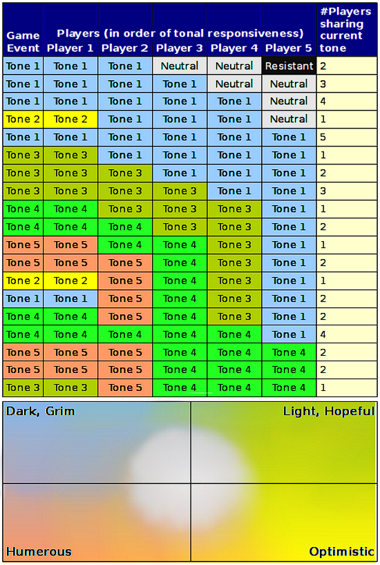
In this situation, the GM is taking his cues from player 1, and to a lesser extent, player 2. Quick changes of mood, hopes raised and dashed with lightning speed, brief diversions into humor… it’s all too much for players 3 and 4, and player 5 can barely be motivated to try and keep up because the initial sense of doom and gloom is not to his liking, even though only 5 of the 19 game events fall into that category. Eventually, he does get into the swing of things but then persists in being a pessimistic sourpuss for the rest of the game (and, hopefully, having enormous fun in the process, and serving as a foil for players one and two – though that may be optimistic to aim for). The player who really misses out and can’t keep up is player 4, who starts off grim and dark (quite correctly) but who, after a while, finds it impossible to take the adventure seriously, getting stuck in position half-way between optimistic and pessimistic, and always filling the game with inappropriate humor that interferes with player 3 getting into mood.
Ideally, at any given time, 3 or more out of the 5 players would either be responding correctly to the tone of events, or getting into the correct tone. The first quarter of the adventure fits this profile, with a brief humorous interruption that falls flat for most of them – but it then goes completely downhill in the second quarter, and only begins to recover in the third, before falling apart again in the run-up to the conclusion. That’s usually a sign of the GM trying to do too much in one adventure – simply transitioning from one piece of bad news to another until finally a slim ray of hope is revealed, perhaps with the occasional humorous interlude, would be enough.
With just one player, the situation is entirely different. Because everything is targeted at the one player/PC combination, the “player one” pattern, or at worst, the “player two” pattern, is achieved virtually every time.
– Tonal Objective –
Finally, it’s worth noting that the Tonal Objective in a single-player campaign is a lot simpler than that of a multiplayer campaign. Instead of trying to manufacture a consensus of tone and response in such a way that everyone’s happy to enjoy the ride and work within the tonal parameters that you have established, you have only one player to satisfy.
In fact, another way to look at single-player campaigns is to consider them “no compromise” campaigns. It’s not quite true – in fact there are still massive compromises between desire and practicality – but it’s often a lot closer to the truth than any other sort of campaign.
The Tonal Dissonance Problem
Having just suggested that solo games be considered “no compromise” campaigns, it’s time to mandate an element of compromise – one that has less impact on multiplayer games.
A single player means that there will be Less tolerance for disliked gameplay situations, less room for compromise on the part of the player. Well, if the player won’t bend (not having to do so in order to keep other players happy and give them their share of the spotlight), then it’s up to the GM to yield.
But the GM can only bend so far; the needs of plot and verisimilitude in NPC reactions to events can force him into Tonal Dissonance, i.e. adopting a tone that doesn’t fit the prevalent tone at the table, or that the player is unhappy with. The results can be akin to forcing someone to sing and dance on stage for the first time when they don’t really want to, or public speaking.
– The Hand-wave solution –
Fortunately, there is a solution, at least some of the time, and quite a simple one: Consider hand-waving those parts of play that the player dislikes, leaving an NPC ally to supervise if necessary. Why tolerate tedium when you don’t have to?
If the pacing is critical, so that you don’t want to simply skip over the intervening period of game play, add a subplot to occupy the player while the hand-waved activity is taking place.
GMs do this sort of thing regularly, anyway – we hand-wave dialogue if we’re having trouble getting into character, for example, or if it’s likely to exclude large parts of the table for any length of time. I have a rule of thumb that no dialogue scene that doesn’t involve two or more players should go on for more than 6 minutes in total, and should be subdivided if necessary into blocks of 2 or 3 minutes each – and then touch base with at least one other player and what their PC is doing. Anything more than this gets handwaved, or summarized at the very least, unless it’s absolutely plot-critical.
Well, that’s not so much of an issue in a single-player game, for obvious reasons, but the principle can be employed to solve the problem of tonal dissonance instead – again, unless it’s absolutely plot-critical that the PC be involved first-hand.
The effect on game pace, and the problem of the combat monster
One side-effect of hand-waving game-play is an acceleration of the pace of that gameplay. Or, more accurately, a further acceleration, since game pace is already quickened by the deemphasis on combat.
And that brings me to one final element in terms of tone. Every player wants something different from an RPG. Some like problem-solving, some like interaction with NPCs, some want a gosh-wow-awesome, some want great stories and plotlines, some want the limelight, some enjoy putting on their character’s shoes and being someone else for a while – and some like the vicarious thrill of combat.
The last type pose a serious problem for a solo campaign. Combat is necessarily de-emphasized, and the trend is for the GM to hand-wave anything else that the player doesn’t like – and in the case of the combat monster, that’s just about everything. The player might as well not bother turning up, if that’s all they’re looking for.
That last “if” is vital. An answer in the affirmative means that you would both be better off playing a board game or a computer game; a solo campaign is simply not suited to giving this type of player what they want.
Game Pace
Before I got side-tracked, I was discussing Game Pace. The two phenomena mentioned so far are not the only ones to affect this aspect of play.
There are No side Discussions between players. There’s a greater focus on the adventures. There’s less time between (player) idea and implementation because they don’t have to explain it to the other players and persuade them to go along with it. There’s less need for coordination between several plot threads and layers of story. You only have to explain things until one player understands them, instead of continuing until the player who is slowest to understand whatever has caught up.
All of these accelerate game pace massively.
Let’s say that hand-waving combat saves about 25% of seat-time in any given adventure, and that each of these other factors reduces playing time by ten percent. If that’s the case, then an adventure takes 0.75 x 0.9 ^ 6 = 39.86% of it’s usual playing time. Or, to put it another way, you get two-and-a-half times as much game play into any given game session.
Those numbers are quite fuzzy. Combat can be 10% of an adventure, or 50%. Each factor might save 20% in one adventure and 5% in the next. The number given is very much a rough guideline only.
The most extreme result: 0.5 x 0.8 ^ 6 = 13.11%, or 7.63 times as much adventure played in a given time span. The least extreme result: 0.9 x 0.95 ^ 6 = 66.16%, or 1.5 times as much gameplay in a given time span.
But the factors listed aren’t the only ones. There are some that can slow the game – on occasion.
Single-player games can stall more easily. There’s only one player to achieve an understanding, no-one for them to collaborate with besides the GM, no outside inspiration to draw upon. A team that’s not working at cross-purposes is always more functionally effective than one person on their own. And, in general, individual Player strengths and weaknesses are magnified relative to a group situation.
– Playing Time Estimates –
After you’ve run a solo game a couple of times, you will start to get an idea of roughly how long things are likely to take, but it’s an estimate that is very sensitive to slight variations. I divided Dr Who adventure #3 into six roughly-equal parts. By my first estimate, it was going to take about 10 hours to play. My second estimate increased the amount of hand-waving in encounters and decreased the allowances I was making for the above problems, reasoning that while a delay might come up at any point, it was unlikely that there would be more than one or two such delays – and that they would take only ten minutes to resolve, not twenty. That gave me a worst-case scenario of 8 hours play required, and a best case of six – plus a break for lunch, and a possible break for dinner, pushing the whole thing back out to the ten hours mark.
But it’s always tricky making those estimates before you’ve finished writing the adventure, tying up loose ends, etc. I notified the player accordingly, and we decided to start an hour earlier than usual, eliminating the loss of time due to a lunch break, and see how things went. The night before we played, I reviewed the adventure from start to finish, as I usually do, and ended with a result of between 30 minutes and an hour for each of the six parts – an average of 45 minutes each, which totaled 4.5 hours, plus 30 minutes for incidentals and side-chatter between us and set-up and so on. Plus an hour for lunch.
In actual play, one “episode” took 30 minutes to play, one took an hour, lunch only took about 45 minutes, and so did each of the other “episodes” – we started an hour early and finished within shouting distance of our usual time. The final total was about 5 1/4 hours from arrival to completion – 5.5 would have been bang on our usual finishing time. The player and I had freed up our early evenings “just in case” unnecessarily. But I will warn the player once more, if the same thing ever looks like happening, just in case.
Oh, and the actual ratio of game play on that occasion: I estimated that it would be 3-4 sessions of 4.5 hours each, to play the same adventure with the entire Zenith-3 group participating. The five-minute teaser alone, multiplied by 5-7 for the number of PCs/Pseudo-PCs, and perhaps taking an extra five minutes each, would have cost up to an hour. Playing the combat out would EASILY have added another 4-5 hours. Final total would have been 13.5 – 18 hrs, call it about 16 hrs on average. Heck, three lunch breaks would have cost at least 2.5 hours! We got it done, without rushing, in 5.5 hours – a ratio of 2.9 to 1.
You can take it as a given that you’re going to need more adventure than you would normally provide. The only question is, how much more? As a rule of thumb, double-plus is not far off the mark, but rules of thumb deserve to be notorious in this area of game planning.
Intensity Of Play
If you run the pads of your fingers slowly and lightly over a piece of coarse sandpaper, it seems that you can feel each individual grain that is attached, and the sensation is not all that intense. Do it at three times the speed, and you’ll definitely find the intensity to be at least three times as intense, even painful. Increasing the pressure exerted against the sandpaper by pressing more firmly, and there will be another increase again, and definitely be painful, possibly even harmful.
Similarly, you can slowly slide across gravel without injury, but fall off a bike on a gravel road without protection and gravel rash is the minimum that you can expect (Everyone skins their knee when learning to ride). Add mechanical speeds to the mix, and you can achieve severe abrasions – which is why motorcycle leathers are so much thicker and heavier than ordinary clothing. Do the same thing with a heavy load – a backpack, for example, or the bike landing on top of you in the case of a motorcycle – and the effect will, once again, be far more severe.
In an RPG, game pace is the equivalent of speed in these illustrations, and simply increasing the speed increases the intensity of the game. Plot and deliberate intensity resulting from it are equivalent to pressing down with greater pressure or weight.
With more players, this weight is more distributed, so it has less effect than in a single-player game, which has only a point of contact. You can see this for yourself, by analogy: sharpen a piece of 5mm dowel to a point, while smoothing the other end flat (Use a soft wood, it shouldn’t be too difficult). Heck, you can buy this sort of thing for use with toffee apples! Slide the blunt end across a piece of coarse sandpaper two or three times, putting a fair amount of weight on it. While there will be some erosion of the stick – perhaps as much as half a millimeter – it won’t be anywhere near as much as if you repeat the experiment with the sharpened end, where you may well lose two or three millimeters.
Intensity of play is increased by the (relatively) high tempo of the game, and tends to over-respond to any ramping up that takes place as a result of plot and the events within it, and these increases tend to be felt more keenly because there is only a single point of contact taking the full brunt of the effect – at each end of the “stick”, this affects both player and GM.
At the same time, familiarity breeds contempt; you get used to the greater intensity to at least some extent, so there is a threshold of increase due to non-pace factors that must be overcome before any increase is noticed.
All of which takes some getting used to in play, and more getting used to in order to be able to gauge how strongly events within the plot will be felt at the time of writing the adventure.
– Still more intensity-boosting factors –
On top of all that, you need to remember that one player is devoting all his attention to the game, not several, and that you are targeting that character more precisely instead of accommodating a group. There are fewer distractions, and a much greater focus on game events as a result.
These also boost the intensity of the gaming session; in combination with the other factors, to the point where no group session can possibly match it except on the very rarest of perfect storms.
Rest
Greater intensity is more exhausting. When you’re tired, you get sloppy and make mistakes. It follows that there is a greater need for breaks within sessions.
I’ve mentioned Australian Public Service guidelines before. In a nutshell, for any computer-intensive duty or task that requires high levels of concentration, the guideline is – or was, anyway – at least 10 minutes in at most two hours. To ensure that every employee had the capacity to work for two hours straight without a break and without violating these OH&S guidelines, the policy when I worked on processing the Census was ten minutes every hour.
Now, playing and running an RPG is fun, no matter how intense it gets – in some ways, the more intense, the more fun it is. So smaller, less frequent breaks are needed. But it is still a mentally-intensive and tiring task which demands high levels of concentration – while multitasking to an extent that most OH&S officers would baulk at; so some breaks are necessary. I basically halve the Public Service requirement – at least five minutes every hour – for solo games. For group games, there’s often a cue to use the facilities etc, so I halve it the other way – ten minutes or more every two hours of play (or so).
Some GMs and players don’t like taking breaks during play. Some even penalize players who do, by making decisions for the characters while the player is away from the table and forcing the player to abide by them. I don’t agree with those practices in general, and certainly not for solo games.
Downtime
Downtime is something different from a break, because it happens in-game; it’s a deliberate slowing of the pace and easing of the intensity for a while. When designing adventures for solo play, ensure you build some downtime into each game session. The pace can be so frantic and intense that different flavors of scene have a tendency to blend together, after a while; deliberately altering the mood or tone and intensity, even if just for a minute or two, can firewall one type of scene from another.
The problem with building in downtime is the unanswerable question of how much is enough – and how much is too much. The answer changes with every adventure and every game session, and once again the problem of Tone Lag manifests itself. The best answer is to base the amount required on your own needs, since the GM arguably has the most stressful job at the game table, and then to note whether or not this is enough for the players.
Oh, and note that going “Downtime – Break – Whatever” doesn’t work. If Downtime is enough to carry you through to the point where you would normally call a break, finish the downtime sequence and start the active sequence that follows, using it as a cliff-hanger if necessary.
– More On Pace Control –
I’ll have more to say on the subject of controlling the pace, and therefore the intensity, of the game in a few minutes. But first, we need to come at the game from a whole different angle.
Roleplay
Contradictions abound when you start looking into single-player games, because some established elements of RPG theory get tossed on their head while others don’t. There are a mass of influences pulling game content in all sorts of unusual directions.
The Dice Do More Talking
By definition, in a solo game, there is a greater reliance on one central character and one player. This means that any differences between the capabilities of the two are emphasized even more than in a group game, where this is always an ongoing problem. As usual, skill rolls are used to plug the gap – make the roll, and the GM informs the player of what his character knows, and he doesn’t. Or, at least, what the character thinks he knows.
The Dice Do Less Talking
At the same time, there is more hand-waving by the GM of things that he might require a roll for. This is because the game pace has a momentum all its own and both player and GM tend to feel that momentum as a source of excitement – an excitement that goes away if there are too many interruptions.
As a general rule, unless there’s a critical timing element, or it’s a straight up-and-down yes-or-no answer, it can be assumed that the character will succeed eventually in making the roll. So why bother making the player roll? At most, one roll is justified, giving the GM some basis for estimating how long it will take the player to succeed. You then roleplay the character thinking hard (or other appropriate behavior) until either the indicated time is achieved – or the player gets tired of beating his head against a brick wall and looks for an alternative solution. Either way, play never comes to a shuddering halt, and while the momentum of play may be reduced temporarily, it never comes to a shuddering halt.
Controlling the Pace
These two factors combine to provide a tool for controlling the game pace, at least somewhat. You can use die rolls to slow the action down when necessary, and use hand-waving to speed things up when that’s desirable. As an added bonus, because a large part of the increased intensity of the game results from the pace of play, this also gives the GM a tool by which he can manipulate the intensity – if the pace is manipulated properly.
– Controlling Intensity using Pace –
There are two tricks that can be employed to manipulate intensity by means of game pace alteration.
The first is to slow things right down when you get to the scenes that you want to have higher intensity. Going into slow-motion mode, where each tiny slice of the usual pace with which things are done, and the focus is on each tiny detail, implies (subconsciously if not consciously) that those details are especially important, and therefore the scene is of maximum importance. And, when you resume “normal time”, it feels faster and more intense than it is – so use that for the climax of the scene. Then drop back into “Bullet Time” if you need to. (The mention of Bullet Time is very important, because this is exactly how it was used – slow the action right down, change orientation or perspective, focus tightly on the details, then WHAM! action – then slow it down again. It works in the movies, it works on TV, and it will work in an RPG. I’m not so sure about in a book…)
The second is to speed the pace up momentarily immediately prior to a scene that you want to underplay or to have low intensity, then slow it down as though the world beyond the scene has stopped in it’s tracks. Romantic interludes, quiet conversations of deep significance, stunned silences after revelations, anything in that line can benefit from this technique. The speed-up is the equivalent of a long, sweeping camera-crane move that then focuses in on the characters in a tight shot – a technique that’s been used in Hollywood since the 1930s or 40s.
Puzzles & Mysteries
This is a point that I know I’ve made in the previous article, because it was a hard-earned lesson at the time. Whenever you present a Puzzle or a Mystery that needs to be solved, you strike trouble in the solo campaign. Because you have only one mind trying to find a solution, and because these are always plot-critical and shouldn’t be handwaved, gameplay can come to a screeching halt while the lone player grapples with the conundrum you have set before him.
On rare occasions, the player will get the right answer immediately. It happened in Dr Who Adventure #2, and sliced the best part of an hour out of the gameplay. Fortunately, I was able to pad subsequent events enough that it wasn’t all that obvious to the player.
But more often, these are intended to be difficult and they succeed in fulfilling that intention.
There are only two solutions, really.
– Option One: Deemphasis –
Much as you might be tempted, save your puzzles and mysteries for the times when they are genuinely interesting and plot-significant. Anything less than that, and you either don’t incorporate it into the plot, or have the solution come up even if the player operates on autopilot.
– Option Two: Breadcrumbs –
Which implies that there are still going to be times when a Puzzle or Mystery can’t be avoided, or shouldn’t be. When this happens, the only alternative available is to deliberately lay a trail of breadcrumbs that will eventually lead the player to the solution. The fun isn’t about trying to solve the puzzle, it’s about the shape of the puzzle when it is solved. This is usually a relatively minor adjustment to the normal plotting style of an adventure.
– Pacing and Puzzles –
Either way, Puzzles are going to have a substantial impact on pacing when they occur, and an unpredictable one. I’ve seen players solve problems in a few seconds that should have consumed hours of play and investigation of bread-crumbed clues; and I’ve seen players struggle for hours on something that should have taken minutes.
I intend to start incorporating an optional subplot into my adventure designs if they feature a mystery or puzzle that needs solution, to be invoked if the player gets to the solution too quickly, from now on.
The consequences for Pacing of Puzzles and Mysteries once again forms the perfect lead-in to part three of this series, in which Plots and Adventure design (in isolation from Campaign considerations) within the solo campaign are the focus…

Discover more from Campaign Mastery
Subscribe to get the latest posts sent to your email.
Comments Off on A Singular Performance: Roleplay and General Principles in one-player games