Ladybug And Cat Noir: Lessons In Cast Management
I steal inspiration and technique from anywhere that I can find it, but I’m always careful to credit my sources (especially when the application is a bit left-of-field). In the past that has given me articles such as Growing The Perfect Family Tree (Part 1, Part 2), The Ashes: Understanding Brit and Aussie Characters, and Lessons From The West Wing V: Bilateral Political Incorrectness for RPGs, amongst many others.
Miraculous: Tales Of Ladybug & Cat Noir is an animated superhero TV series aimed at teens but with enough cleverness of plot and richness of canon that it’s quite watchable for adults, too. I find it quite reminiscent of early issues of Spider-man in some respects.
In particular, the approach take to relationships between characters is noteworthy for GMs.
An Introduction to the Premise & Canon of M:ToLaCN*
* the full title is quite a mouthful, and abbreviating it doesn’t help much, so from here on, I’ll simply call it Ladybug & Cat Noir, okay?

The Season Two set is also available from Amazon – click the thumbnail (another small commission).
The title characters of Ladybug & Cat Noir are superheros who get their powers from pieces of jewelry called a “Miraculous”. Cat Noir’s is a ring, while Ladybug’s is a pair of earrings. These jewels become empowered through a magical being called a Kwami – they each have one.
The enemy who they continually battle is initially named Hawkmoth. He also has a Miraculous with a Kwami who is forced to obey his instructions because he wears the Miraculous. Hawkmoth’s power is to transform people experiencing strong negative emotions into super-villains by means of moths infused with dark energy of some sort; this process is called “Akumatizing” them.
In season 2, Hawkmoth is joined by “Mayura,” who uses a damaged Miraculous – that of the peacock – to create ‘sentimonsters’, strange life-forms that have to obey whoever their creator assigns them to, and which function as assistants, enhancers, and/or protectors of the villains created by Hawkmoth. Because the Miraculous is damaged, it slowly damages the user. In season four, Hawkmoth repairs the damaged Miraculous and gains both sets of powers, renaming himself Shadowmoth.
Hawkmoth/Shadowmoth stays in the shadows, creating super-villains and monsters to bedevil Paris, demanding that his creations capture the Miraculous of Ladybug and Cat Noir. Ladybug’s is the power of creation, while Cat Noir’s is the power of destruction; if one person ever holds both, they can be used to reshape reality, but at a cost equal to the change made.
To prevent this, Ladybug and Cat Noir can never know each other’s secret identities, so that if one is captured, they cannot be forced to put the other in danger.
There are other Miraculous and other Kwamis; from time to time, starting in Season 2, Ladybug uses them to create allies. At the end of Season 3, Ladybug becomes the new Guardian of the Miracle Box, which contains the Miraculous and is the extra-dimensional residence of the Kwamis.
The Core
The relationships of the central characters are the pivot around which everything revolves.
- Cat Noir falls in love with Ladybug.
- Ladybug considers Cat Noir a slightly-annoying friend and ally, nothing more.
- Cat Noir’s true identity is Adrien Agreste, a teenaged fashion model.
- Ladybug’s true identity is Marionette Dupain-Cheng (pronounced ‘du Penchain’), who falls in love with Adrien, not knowing that he is Cat Noir. She is in the process of becoming a fashion/art designer of note.
- Adrien considers Marionette a friend, nothing more.
This love quadrangle is at the heart of the series, and fuels plenty of teen angst – which is the element that reminds me so much of those early issues of Spider-man.
Surrounding this core is a second layer of characters:
- Tikki and Plagg are the Kwamis of Ladybug and Cat Noir, respectively. These are characters that can only interact with the holders of the Miraculous when they are not transformed into their superhero identities.
- Unknown to both Marionette and Adrien, Hawkmoth’s true identity is Adrien’s father, Gabriel Agreste. Nor does Hawkmoth/Shadowmoth know who Ladybug and Cat Noir really are.
- Emilie (Agreste) is Gabriel’s wife. She is comatose or dead, preserved in some sort of life-support container, and so never interacts with the other characters. It is not stated outright, but the clear implication of Season II is that she died from using the damaged Peacock Miraculous. Gabriel wants the Miraculouses of Creation and Destruction to rewrite history and return her to life, not knowing or caring that this means that someone else will have to die to achieve this (and possibly someone of equal significance to Gabriel, i.e. Adrien. As such, her ‘absence’ is an ever-present shadow cast over the Series.
- Gabriel’s assistant is Nathalie Sancoeur (I don’t remember her surname ever being used in the show, however), who uses the damaged peacock Miraculous to become Mayura, and becomes bedridden as the damage takes hold. Gabriel seems to genuinely care for Nathalie, and she practically worships him in an obvious case of unrequited love.
- “The Gorilla” (a nickname bestowed on him by Adrien’s friends) is Adrien’s bodyguard. He rarely speaks beyond grunts and gestures, but is a regular presence in the series and seems to genuinely care for his protectee, even to the point of going against the wishes of his employer (Gabriel) to give Adrien some respite from Gabriel’s domineering emotional abuse.
- Marionette’s father and mother are Tom Duplain and Sabine Cheng, respectively. Tom is the best Patisserie in Paris, assisted by Sabine. The two are emotional supports for Marionette and the gateway to Marionette’s other relatives, but their role in the series is relatively limited.
Surrounding these are a group of school-friends of both Adrien and Marionette. These are frequently involved in one of three ways: Akumatized into villains, lent a Miraculous to enable them to serve as superhero assistants to Ladybug and Cat Noir, or simply participating in the daily life of the two principle characters. Significantly, each has a defined relationship with the other classmates, and these evolve over time.
Some of these characters are more significant than others – in fact, some of them are more significant than Marionette’s parents, for all that those parents are more frequent participants than any one member of the social circle save, perhaps, Alya.
Members of this circle include:
- Alya Cesaire – Marionette’s best friend and (eventually) Ladybug’s chief assistant and confidante, who joins the cast in episode 1 of season 1.
- Non Lahiffe – Adrien’s best friend and (eventually) Alya’s boyfriend and superheroic partner.
- Chloe Bourgeois – “selfish, overzealous, and spoiled” according to Wikipedia, but that understates all three elements. Sometimes a hero (despite these character flaws), sometimes a villain, and frequently a catalyst, causing the negative emotions in her classmates that permit them to be akumatized.
- Lila Rossi – deliberately created to be spiteful and unlovable, she is evil where Chloe is simply malicious and selfish. A superlative liar who delights in manipulating others.
- Kagami Tsurugi – A Japanese girl who joins Adrien’s fencing class and becomes friends with Marionette. Sheltered by an overprotective and dominating mother, she briefly sets her sights on Adrien romantically, but the relationship fails.
- Luka Couffaine – brother of another of the classmates and a musician like his parents, Luka loves Marionette but is content to simply be her friend if it enables her to pursue her own happiness.
- Kim Ature, Max Kante, Mylene Haprele, Ivan Bruel, Sabrina Raincomprix, Julia Couffaine, Rose Lavillant, Aurore Beureal, Nathaniel Kurtzberg, Mac Anciel and Zoe Lee – other classmates of Marionette and Adrien.
And, outside this ring are other relatives of some of these characters and other recurring characters, such as Mayor Bourgeois, staff at the school attended by Marionette and Adrien, and so on.
If you were to map these relationships topographically, it would appear as a cluster of characters surrounding the principle roles, some linked with one of them and some with the other, with a set of further clusters, some linked with one of the two and some linked with both. And each of the members of a cluster is often at the center of a small cluster of their own.
Introductions
Characters are generally introduced one at a time, though they may be present in a number of episodes before we learn who they are. Quite often, when a character is introduced, he or she becomes the akumatized victim of Hawkmoth/Shadowmoth for that episode, but this is not always the case.
The structure of the character relationships is such that normal interactions between characters permits their surrounding cluster to be introduced organically. Usually, we are talking about the parents or siblings of one of the inner cluster of classmates or relatives. Sometimes, these characters make only a single appearance, on other occasions they may recur a number of times, or simply be present in the background when those more centrally-connected to Marionette / Adrien are interacted with.
Featured Relationship
Only one relationship is generally featured in a given episode, though others may be present in the background. This keeps the complexities of this vast supporting cast from overwhelming the viewer.
Relationship Evolution
No character is featured without their relationship with someone in the cast evolving or advancing in some way. Quite often, the other partner in this relationship is one of the title characters, but this is not always the case, as when Alya and Nino become boyfriend/girlfriend despite initially disliking each other.
If the relationship with the principle character does not directly advance/evolve, there are almost always ripple effects to these relationship developments that do impact on one of the principle characters.
In addition, those ripple effects can also affect the relationship between the principle characters. For example, Cat Noir can sometimes exhibit mild jealousy when Ladybug calls upon another of her allies to solve the problem of the episode, but he is also aware of this and tries to overcome it, usually successfully. He often attempts to charm other heroines when they appear, but this is mostly an act, and an attempt to create jealousy on the part of Ladybug; he desists when it is obviously not succeeding..
In RPGs – the minimalist approach
Obviously, it is desirable in most campaigns to have a similarly rich and interactive supporting cast of NPCs. This is often more easily said than done, however.
As a result, most GMs tend to establish relationships with those supporting cast and then leave them static and unchanging unless the change is clearly mandated by the NPCs presence within the events of the adventure.
For most campaigns, this approach is at least adequate, and it is relatively easy to manage. All you need is a list of the NPCs which describes who they are and any noteworthy relationships they may have; if this is a text document on a computer, it becomes searchable and can be updated as necessary.
Hardcopy versions may be more accessible, and easier to read or skim, but lose these benefits.
This is the approach generally used in the Adventurer’s Club campaign because the campaign and it’s major NPCs were created by my Co-GM.
The Hero System approach
In the hero system, characters get to list Dependent NPCs, Enemies and so on, and get character points for these. The problem is that this doesn’t just fix those relationships in place, it freezes them solid, and any changes can require wholesale changes to the PC and to any NPC connected to the one being changed.
What’s more, unless the NPC happens to fit one of those predetermined categories, there is no system for tracking them. For almost as long as I have been GMing Champions (since 1982, in fact), I’ve been trying to formulate a broader approach.
In RPGs – failed evolving approaches
Those attempts have been less than resounding successes, I’m the first to admit. The problem is that the various methods attempted have been too paperwork-intensive, and this has led to them being neglected, letting them slowly become out-of-date, and eventually leading to them being ignored or abandoned.
The most successful of these approaches (in the Zenith-3 campaign) was a contact list in which NPCs were assigned a positive or negative value which was added or subtracted from the XP award for an adventure when the NPC played a significant role. The more helpful the NPC was, the more it reduced the points payout earned in the course of the adventure.
In and of itself, this was not a bad concept; it meant that PCs did their best to solve problems on their own, only calling for assistance when it was really necessary. This kept the spotlight where it belonged, on the PCs. My previous attempt had failed to achieve this, which is one reason it was replaced.
But the resulting mechanics became onerous – the calculation of point values, the assessment of how helpful characters could expect to be, and so on – and this led to the relationships being even more rigidly fixed, and the sub-system being ignored more often than it was referenced.
I tried simplifying it by having a master list of relationships with the team instead of requiring each individual to list every NPC encountered, but this wasn’t enough.
The Ideal Solution
I’ve long realized that the best solution would be to design and implement a simple relational database for each campaign. The structure of this database would have a hierarchy something like this:
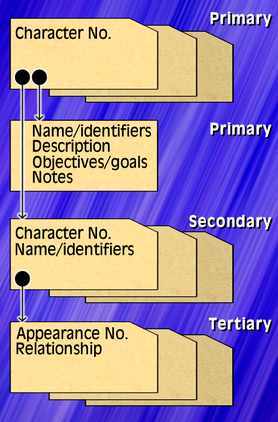
- Everything is indexed by character number.
- Information about the character.
- For each character, there is a secondary record for all other characters in the database, and a link to their database entry that extracts their name..
- Each secondary record has a tertiary record that contains a record of each time they have appeared in an adventure and what their relationship is to the primary character after that appearance.
For example, we might have:
- 01
- Dr Murko
- Somewhat-deranged scientist, his experiments have a tendency to blow up in his face
- To understand the source and parameters of Zed-Zero Energy
- Won’t willingly break the law to achieve goals but often does so through thoughtlessness
- 02 Lady Sage
- Appearance 1
- Creator of experimental subject on the run
- 03 Blaster
- Appearance 1
- Creator of experimental subject, released to hunt Lady Sage
- 02
- Lady Sage
- Experimental subject of Dr Murko who has escaped
- Wants to avoid recapture
- Can’t resist helping / protecting others
- 01 Dr Murko
- Appearance 1
- Obsessed scientist whose experiments pose a threat to himself and others
- 03 Blaster
- Appearance 1
- Creation of Dr Murko sent to hunt down Lady Sage but who let her escape, recognizing her as kindred
…. and so on.
This example is a small database of just three entries – two NPCs and a PC. The first character, Dr Murko, is an NPC; he was testing Zed-Zero energy, giving his test subject (Lady Sage) paranormal abilities, which she used to escape. He then created a second subject, Blaster, to hunt her down and recapture her before his (illegal?) experiments were revealed. Blaster found and confronted Lady Sage but recognized that they were alike, and let her escape; but returned to Dr Murko in hopes that Murko would undo what he had done to him.
Clearly, there is a complicated relationship between Blaster and Lady Sage that is likely to evolve with every appearance of the character.
If I were running this as a campaign, the second adventure would have nothing to do with Dr Murko or Blaster, it would introduce some new characters to Lady Sage’s new life, giving her a place to live/hide and establishing her personality beyond a mere drive for survival and liberty.
Why this is impractical
There are three reasons why I consider this solution theoretically ideal, to be impractical.
- Most Relational Database software is complicated and/or expensive.
- The number of records would grow geometrically with each new character.
- After a little while, maintaining the database would be a full-time job.
Consider the situation with 3 PCs and 20 NPCs, who have appeared an average of three times each in a campaign, eliminating all redundant records (no ‘self’ secondary record, for example) and all relationships over which the GM has no control (those between PCs):
23 primary records, three of which have 20 secondary records and 20 of which have 19 secondary records, each of which has an average of 3 tertiary records: 23 + 4 × (3×20 + 20×19) = 23 + 4 × (60 + 380) = 23 + 4 × (440) = 23 + 1760 = 1783 records.
Adding another NPC:= 1783 + 1 + 3 + 20 + 1 = 1808 records after just a single appearance.
The main driver of record count is (NPCs) × (NPCs -1). 2 NPCs = 2 records per appearance. 3 NPCs = 6 records per appearance. 20 NPCs = 380 records per appearance. 31 NPCs = 930 records per appearance…
Not practical.
Simplification
The easiest and most obvious method of simplifying this structure is to restrict the documentation to recording relationships between PCs and NPCs, ignoring relationships between NPCs, except possibly for notes regarding specific relationships of significance.
The next step of simplification would be to take the tertiary records away completely, and simply include a growing list of appearances and relationships in the secondary records. This actually complicates the internal structure of the database, because the records can no longer be fixed-length, but that’s a headache for the designer of the software, not you, and is generally a solved issue.
The total number of records thereby becomes # PCs × # NPCs.
This would also reduce the functionality of the resulting database, but it would be a lot more practical.
Practical Implementation
In fact, it’s so practical that it could easily be implemented as a single text file – no database required at all.
Create a section in your document for the group, and then a section for each PC. Each NPC gets a line to describe the relationship – all you need is the name.
You then have two choices: either over-typing the existing line when the relationship evolves, or inserting a new line for the new entry.
The first keeps the document instantly relevant, and makes it easier to find the current information that you need for the NPCs next appearance, the latter preserves a history that can be vital in identifying trends in the relationships. Both have their advantages and limitations, so this is very much a personal choice for the GM – which set of shortcomings is he willing to live with?
Evolving A Relationship
Each game session, one NPC should be selected as the feature relationship. The GM decides how he would like the relationship to progress – it could go forward, backward, or sideways – and then inserts into the planned gameplay of the day events that will prompt that change in the relationship.
Complications arise in multi-PC groups where you have to be careful not to develop one PCs relationships more frequently than others – this is akin to a spotlight-sharing problem, so it should be amenable to similar solutions.
Depending on how many PCs you have, you might be able to advance one relationship per PC, for example. Note that introducing a new NPC with a particular relationship to a specific PC counts! If you have too many PCs, this might consume too much game time on a ‘per game session’ schedule, but a ‘per adventure’ schedule would remain practical for much larger groups.
Above maybe half-a-dozen PCs, even this might begin to feel forced, or might consume so much game time that you don’t get to the main adventure for a whole game session; neither is desirable. It then becomes necessary to subdivide the group for this purpose and alternate between divisions, or introduce a rotating schedule of some kind.
Either will work, and with groups of this size, this is likely to be the very least of your problems!
Evolutionary Anatomy
So what does evolution of a relationship look like?
In general, it can be divided into:
- Event
- Engagement
- Reaction
- Action
- Response
- Checkpoint
1. Event
Something happens that involves or invokes the relationship between the characters. This could be a social occasion, a professional engagement, or even a chance encounter. It may or may not involve a third party. The first of the characters that it happens to (PC or NPC) is considered the primary participant.
2. Engagement
The primary participant decides how they will respond to the event. This may or may not directly involve the other participant in the relationship (the secondary participant).
3. Reaction
The secondary participant learns of the engagement (if they did not know already), and reacts to the combination of event and engagement. The primary participant may or may not know of the reaction.
4. Action
One or both participants undertake an action in response to the event, as directed by the engagement and/or reaction..
5. Response
The primary participant responds to the actions or reaction of the secondary participant, while the secondary participant responds to the actions or engagement of the primary participant. This completes the narrative elements of the development.
6. Checkpoint
Any lingering consequences on the relationship, and how it will impact on the characters in the future, need to be documented before the GM’s work is done, however.
So, let’s look at an example:
Sally decides to act to further her claim to superiority over Louanne by inviting Peter but not Louanne to her birthday party. (the event)
Peter, being clueless about such things, accepts, and even mentions the invitation to Louanne. (the engagement)
Louanne, who considers Peter a friend, suspects that Sally is simply using him to get at her (a correct assessment). She is angry at Sally as a result. (the reaction)
Louanne decides to take action, telling Peter what she suspects Sally is doing. (Action)
Peter decides to attend the party anyway, but is forewarned by Louanne, who he trusts more than he does Sally. At the party, Sally all but ignores Peter but spends a lot of time running Louanne down in his hearing. Peter tells her off and leaves the party very publicly, humiliating Sally. (The Response)
Peter misinterprets Louanne’s involvement, deciding that maybe she cares more for him than she has admitted and than he has hitherto suspected. Sally will remain angry at both Peter (and Louanne, who she correctly blames) until she finds an opportunity for revenge. (The Checkpoint)
There are three relationships affected by this development, and all three of them change somewhat as a result.
- Sally is more openly hostile toward Louanne and will treat Peter as an enemy for the first time.
- Peter will have to decide how to respond to Louanne’s ‘advances’, creating awkwardness between them, and will be cold toward Sally until she apologizes.
- Louanne is blissfully ignorant of the changed relationship with Peter, and may well make things worse by feeding into his misinterpretation. She will be even more wary of Sally in future.
Where might this go in the future? The obvious development would be for Peter to ask Louanne out, or try to force Sally to apologize to Louanne, or both. But a more subtle, and interesting, development might be for some unrelated event to impact all three of their lives. Some tangible manifestation of the rivalry between Sally and Louanne, perhaps, or something that forces them to work together.
Conclusion
The same process can be used to evolve any relationship. In a D&D campaign, a hidden antagonist might approach one of the retainers of the PCs and blackmail them into spying for him, or baiting a trap for the PCs, or otherwise betraying the PCs.
Any relationship, any event, it works.
Not only does this stimulate the GM into creating subplots that have meaning for the PCs, and hence engagement for the Players, but – little by little – it makes the campaign world a richer place for the PCs to adventure within. Evolving relationships is easy – once you’re aware of the need to do so, and a way to make it happen that’s practical.
And for that, you can thank Ladybug & Cat Noir.
Miraculous!

Discover more from Campaign Mastery
Subscribe to get the latest posts sent to your email.
Comments Off on Ladybug And Cat Noir: Lessons In Cast Management