Ask The GMs – Up Hill and Down Dale: RPG Travel Laid Bare
|
Once again I’m daring to tackle a topic without the counsel of my friends and fellow GMs, largely because I had a clear answer in mind. |
|
 |
“Hey, I was about to start up a campaign that would ultimately take characters to all ends of the world. I was wondering, what is a good way of handling travel? I was thinking of having an Elder Scrolls-style system, where once they discover a location, they can “fast-travel” on future visits. This would of course be overruled by ambushes and trailing enemies. But they must find the way to their destination first. For me, it would give role-playing opportunities as well as ways to give plot hooks outside of cities. Maybe they find the lost temple on their own while on their way to the Elven capital. Maybe the Old Road that connects the three human kingdoms, usually protected and open, is being held by highwaymen. What would you guys suggest for handling long-distance travel?” |
|
Travel inevitably gets faster as characters gain in levels or power, depending on whether we’re talking D&D / Pathfinder or some other game system. Not only are there fewer creatures that will make them break stride, but they have access to rapid-transit magics – whether that be a flying carpet, a flight spell, a friendly dragon, or Teleportation. Jason’s solution is just another variation on this well-worn procedure, and so would work perfectly well. But, (and it’s a big but), there is still that initial journey, and in fact, any travels undertaken while the characters are still low-level. I always use these as opportunities to establish the framework of the campaign, the ground rules as it were. I will deliberately design supposedly “random” encounters to highlight any house rules that demand such recognition, for example. I’ll make sure that the players encounter people from a variety of the religious, social, and cultural backgrounds in the campaign, because dry words on the page are one thing, actually encountering something “in-game” is far more real to the players. Beyond that, though, once these metagame considerations are dealt with, what then? To a surprisingly large extent, it doesn’t matter what the game genre is, or how the PCs are getting around – the determining factor is travel time, and greater distances in some campaigns merely mean that the speeds are greater. I treat a week aboard an FTL starship the same way that I treat a week spent on horseback, or on foot, or on a sailing vessel, or handling a big rig. |
|
Travel in RPGs
Travel is one of the trickier campaign elements to get right. Most of it can be hand-waved, but if you hand-wave the entire journey, characters will have no perception of the scale of the distances that they travel, and that can lead them into errors of judgment tactically. Hand-wave too little, and it can be desperately boring. The balance between these two contradictions can be tricky to manage.
The Problem
Much of the problem results from the fact that Travel is 90% GM Monologuing, and there is a limit to how much Narrative is acceptable in a big block, or even a succession of Moderately-sized blocks. That can be hard enough to manage on it’s own, but it’s far from the only headache; the limits of what are acceptable and what is sufficient are not fixed. In fact, there can be quite a lot of variation, from group to group, game session to game session.
Just some of the factors that can be involved are:
- Length of Narrative,
- Type of content,
- Predictability of content,
- Repetitiveness of content,
- Monotony of content,
- Quality of delivery,
- Expectations,
- Interval since the last narrative block,
- The Length, Nature, Subject, Content, Quality and Reception of that previous narrative block,
- Storytelling priority relative to interaction priority on the part of the GM,
- Storytelling priority relative to interaction priority on the part of the Players,
- Player psychology,
- PC psychology,
- Calls to action blocked by narrative,
- Any sense of railroading of plot, (right or wrong), and
- Any sense of bias against the players/PCs on the part of the GM (right or wrong).
You would need to be a mind-reader to assess all these factors with any accuracy – and many of them will be different from one player to the next. What’s the standard to aim for? Is it the lowest common denominator, is it the minimum that will get the job done from a functional perspective, is it a medium value that is still within the tolerance range of the least-tolerant player in this respect, or should you aim to satisfy everyone at the table while not going farther than any find tolerable? That last is obviously the theoretical ideal, but is it practical in the real world?
If everything aligns against the GM, he can even discover that the minimum non-handwaved travel in order to properly abstract the passage of time is more than the maximum tolerable amount of game time to be allocated to the cause – a gap that can only be bridged through strenuous efforts to change the base factors of one or both ranges, increasing tolerances as much as possible while lowering demands.

If you find yourself dealing with cases 4 and 5, there’s no problem. Most of the time, however, cases 1, 2, or 3 will be the reality, and the challenge for the GM is to change the factors that he can control to altar these conditions to something more acceptable.
In other words, how to bring the journey to sufficient life while increasing substantially the players tolerance for the journey?
Well, the place to start is with that improbably long list of factors, and what the GM can do to shade each of them in his favor.
Length of Narrative
There is an art to being able to compress narrative without loss of detail, nuance, and emotional resonance. It’s by no means easy, and yet it’s one of the fastest ways of improving the ability to write. That’s why (in addition to reasons of practicality) so many writing workshops focus on stories with very restrictive word limits.
Still, it’s not difficult – it just takes an effort, one that grows less as you learn the skill. I’ve devoted an entire series (The Secrets Of Stylish Narrative) to the subject and the techniques, plus a few tips and tricks shared along the way.
Type of content
Some things are more interesting than others to hear about. Focus on those things and hand-wave the rest.
Repetitiveness of content
If you’re merely repeating yourself, collapse the information into a single narrative statement, and consider hand-waving it if that still results in repetition. Kill repetition stone cold dead.
This:
Day 23: Becalmed
Day 24: Slow Progress
Day 25: Slow Progress
Day 26: Becalmed
Day 27: Slow Progress
Day 28: Slow Progress
Day 29: Slow Progress
Day 30: (Something interesting happens)
Day 31: Slow Progress
Day 32: Slow Progress
Day 33: Becalmed
Day 34: Becalmed
Day 35: Slow Progress
Day 37: (Something else interesting happens)
becomes:
For a week, the prevailing winds are against you, resulting in slow progress, sometimes none at all. But the monotony is interrupted on the 30th day of your voyage when…
(Something Interesting Happens)
Almost a week later…
(Something else interesting happens)
Note that a further occurrence of “Almost a week later” or anything too similar is also repetition and prohibited. Find another way of phrasing it, or even ignore it altogether: “The next break in the dull routine takes place [N] days later…”
Predictability of content
If the players already know that their ship’s sails are not built for sailing into the wind, don’t tell them again. It’s predictable, it’s another repetition, even though it may be the first time in this journey that it gets mentioned. If the season is changing from Autumn through into mid-winter, don’t tell them that the days are getting shorter, and don’t give daily weather reports; use your narrative to make it clear that the season has changed and leave it to the players’ intelligence and general knowledge to tell them that the days are getting shorter – if they even have some way of keeping precise track of time.
If the players know that they are sailing in a northern latitude in winter, don’t bother mentioning snowfalls, or ordinary levels of sleet or storms. Compress and hand-wave: “The Cambulian Sea is notorious for its winter storms, making your passage to Port Tuffnarkle an exercise in misery.”
Monotony of content
“In the mid-afternoon, the wind shifts again…” Kill it.
Some modes of travel lend themselves to narrative differentiation due to the changes in the landscape, while others do not. Compare the following two passages:
“Over the course of the next week the foothills grow steadily steeper and taller, and you begin catching glimpses of the Dragontooth Mountains when the weather is clear. The winds grow chill, especially at night, and your journey is becoming a real race against the changing of the seasons – it seems Winter is coming early this year.”
“Over the course of the next week the waves grow slightly and increase the force with which they crash into the ship, especially when the winds shift in the afternoons.”
The first is great; it gives a sense of the many leagues of travel implied in a journey of that duration and implies that the world is moving on about its business while the PCs are going from point A to point B. It even threatens something interesting in the near future and lays the foundations for difficulties resulting from picking up the pace.
The second is barely tolerable. It could be improved – “the waves crash with greater force against the hull in the afternoons, when the wind shifts” – but even then, it doesn’t say much more than “time passes, the sea grows more agitated,” which is pretty ho-hum. Save it for the narrative when you introduce something more interesting going on – “Over the last week the waves have grown more violent, and the ship pitches and wallows ever more violently. Today, as the horizon rose over the side of the ship, Kalton saw…”
Quality of delivery
Some people are better at oration than others. The rest of us have to work on it, and do so again and again, because it’s easy to fall into bad habits. The more adverse the gaming environment, the more you are constrained in this department. Do whatever you can to improve your skills.
Over the last century or so, Oratory has gone from an art form to at least semi-scientific. There are all sorts of principles and techniques that can be used to enhance the style in which content is verbally arranged for best delivery.
Too many GMs take their narrative style from the delivery of actors and voice-over men in movies and TV shows. They get to deliver their lines in sound studios and often to do it over and over until they get it exactly right. Even worse, when some people read text they sound like they are reading text. You can tell.
Probably the easiest quick improvement that can be made in this respect is to read everything you have written in advance aloud at least once, at something approaching the volume levels that you will need at the time. Rehearse. Better still, if you can, record it and listen back to it at least once.
At the very least, this will point out passages where you have to take an awkward breath, or where your delivery becomes flat and monotone, or where you have pronunciation problems. Rewriting to avoid the first and third and adding reminder notes regarding your delivery will do wonders. And watch out for sentences running together.
Expectations
Some expectations need to be confounded, and other embraced. If the PCs are expecting a harrowing journey through danger, deliver. If the PCs are expecting a dull, routine, trip, liven it up at least once, and hand-wave the rest.
Interval since the last narrative block
As you’ll see when I get into travel narrative content, later in this article, an interval consists of player interactions with someone or something. No matter how interesting the content is, narrative blocks come in just two lengths: Too-long, and Not-Too-Long. The same is true of the intervals that separate one block from another.
There isn’t a lot of information out there on the specifics that distinguish Too-Long from Not-Too-Long. But I do have a rule of thumb that I employ: subtract the length of the interval from the length of the preceding narrative block, in terms of delivery time, and then consider the combination as though it were one larger narrative block. If the result is a narrative block that is too long, something needs to be done about it – either you need more content in the interval, or you need to shorten one or more narrative blocks still more, or you need an additional interval to be inserted somewhere.
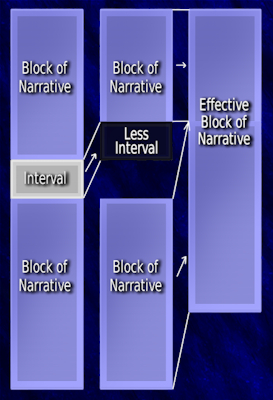
The reality is more complicated than that:
- if the two narrative blocks are on the same subject, the interval is only 75% effective at separating them.
- The same is true if the second block can be considered a continuation of the first – 75% of 75%, or about 50% effective.
- There is also a compounding narrative length factor: every subsequent block of narrative after the second is effectively 25% longer than it seems, cumulative – so (roughly) +0%, +25%, +50%, x2, x2.5, x3, x4. The only way that isn’t the case is if the total of the intervals on either side of such a narrative block are at least as long, in playing time/reading time, as the unmodified block of text, which resets the pattern at +0%.
Let’s apply those “more complicated” principles to an abstract example:
- Narrative Block 1: 3 minutes
- Interval 2: 0.5 minutes (estimated)
- Narrative Block 2: 2 minutes
- Interval 3: 1 minute (estimated)
- Narrative Block 3: 3 minutes
- Interval 4: 2 minutes (estimated)
- Narrative Block 4: 5 minutes
- Interval 5: 0.5 minutes (estimated)
- Narrative Block 5: 3 minutes
- Interval 6: 30 minutes (estimated)
Becomes, step by step:
- Interval 1 is a die roll which is intended to be rhetorical. The PCs should succeed easily. Therefore:
- Narrative Block 2 is effectively a continuation of Block 1, so Interval 1 (a PC die roll) is effectively half length: 0.5 minutes becomes about 15 seconds.
- Narrative Block 1+2: 3+2 minutes-15 seconds = 4 minutes 45 seconds.
- Interval 3: 1 minute (estimated) – a brief conversation and a decision. Narrative Block 3 is on the same subject but isn’t a direct continuation because of the decision point, so it is 75% effective, or about 45 seconds, effectively.
- Narrative Block 3 is effectively +10% in size: approx 3 minutes 20 seconds.
- Narrative Block 1+2+3: 4’30” + 3’20” – 0’45” = 7’5″.
- Interval 4: 2 minutes (estimated) – a conversation of greater substance, and maybe a die roll at the end of it. Therefore Block 4 is not a direct continuation of Block 3 but is on the same subject, so the interval has an effective value of 75% of its length, or 1’30”.
- Narrative Block 4 is effectively +25% in length, so 5 minutes becomes 6′ 15″.
- Narrative Block 1+2+3+4: 7’5″ + 6′ 15″ – 0’45” = 13’20” – 0’45” = 12’35”.
- Interval 5: 0.5 minutes (estimated) – perhaps a simple yes/no decision. Effectively 75% long, or about 25″ long.
- Narrative Block 5 is effectively +50% in length, becoming 4’30”.
- Narrative Block 1+2+3+4+5: 12’35” + 4’30” – 0’25” = 16’40”.
- Interval 6: 30 minutes (estimated) – a minor combat or substantial roleplaying encounter. Since this is vastly more than the cumulative effective narrative total of 16’40”, and since the other side is “before play” (effectively an infinite interval), this breaks the pattern of increasing narrative length. Narrative Block 6 will therefore be a fresh start.
As a general rule of thumb, a 2:1 play-to-narrative total is tolerable to most players, provided that the initial narrative isn’t too long. This example seems more or less right – the narrative is a little longer than half the estimated length of the combat/conversation, but battles/conversations are easy things to underestimate, and the narrative has been broken up with GM-party interactions and decisions.
Note that I don’t normally calculate things out in this fashion – I do it by eye, feel, and instinct, and then pay as much attention as I can to the response of the players at the table. Perhaps that attention isn’t enough at times, but it’s the best that I can do.
Oh, and one more hint: you can use breaks to extend intervals, but not AS intervals in their own right. Taking a break after the players get to do something is fine, but making them wait to do something is not.
The Length, Nature, Subject, Content, Quality and Reception of the previous narrative block
The above already deals with this in a fairly substantial way; there’s not a lot more to say.
Storytelling priority relative to interaction priority on the part of the GM
We all have different levels of emphasis on storytelling as opposed to the PCs interacting with the game world and its inhabitants. The former promoted chunky narrative blocks, the latter breaks them up. By way of example, compare the very interactive outline used as an example above with:
- Narrative Block 1: 16’40”.
- Interval 1: 30 minutes (estimated)
Even though the Narrative Block is the same length as the effective combination of the individual blocks, given the intervals in between, this is a horse of an entirely different complexion. The GM drones on for more than 15 minutes before the players get to do anything. There are GMs who focus VERY strongly on storytelling who might consider this acceptable; I consider it extremely marginal, and I have a strong storytelling emphasis in my campaigns. Most GMs would consider it unacceptable, even if the players were content to listen to it.
Sidebar: The reality of storytelling priority
Actually, while we’re on the subject: the very concept that GMs have a single tolerance/desire level to narrative is a myth. In reality, it varies depending on where you are in the adventure. During the set-up phase, when there’s a lot of information to impart to the players, it can be fairly high; as the adventure gets underway, it declines to a mid-range sort of level; and as the adventure approaches a climax, it should plummet.
Or, at least, that’s the GMing style that I employ, which is all about my getting the PCs into an interesting situation and letting them find their own way out of it; the consequences then forming part of the initial conditions for subsequent adventures.
Other GMs have different approaches; my former partner here at Campaign Mastery recently discussed his own approach (I’d provide a link but I’m not sure it’s available online yet), which is to always start the session with some action. He and I would probably be a poor fit for each other’s campaigns – I’d be wanting to talk story and character development while he was reaching for dice, and vice-versa. Nothing wrong with either approach, or with some other pattern that suits you and your players.
The same is true of just about every metric defining GMing or Campaign Style that I’ve ever seen – whether it be continuity, or emphasis on combat vs roleplaying, or whatever. At best, they are a starting point for a conversation about style, not an adequate definition.
Storytelling priority relative to interaction priority on the part of the Players
What the GM considers acceptable may not be the same thing as what the players consider acceptable. And each player will have a different tolerance level. And it can vary from one campaign genre to another. One mistake that some GMs make repeatedly is writing to the PCs intelligence and not that of the players – addressing all the information blocks to the most intelligent character, for example, as though the less-intelligent fighter was irrelevant.
I try to treat all PCs as having situational intelligence and pitching party information in terms of that situational intelligence. If I’m giving the tactical situation, I will point the information towards the Fighter. If we’re talking about Magic, I’ll write to make the narrative accessible by the player with the Mage. If it’s about puzzles or security, a rogue gets the focus of that part of my briefing, and so on. Every PC should have their own focus where they are the expert, and the narrative should be pitched from their perspective. And I never short-change one to make room for another to receive additional information.
Player psychology
Or, to be more precise, player emotional and psychological state. There are days where you just want to hit something – hard – even if you aren’t a fighter. Bazorting something with a fireball can be a tolerable substitute if that’s the way your character rolls. If the player wants a fight and you’ve planned political dances, you’re in trouble.
The best approach is to have something for everyone and let the players decide who wants to do what – and NOT based on character abilities; the trick is to read these prevailing winds in advance and tailor the content so that what appeals to the player this week is suited to the character he runs. The impregnability of fortresses can vary enormously depending on who wants to penetrate it – if the fighter is feeling relaxed and comfortable but the thief craves action, a frontal assault may miraculously become impossible between the time we sit down at the gaming table and the time the PCs approach the fortress, tower, or whatever, while some flaw in the defenses might equally-miraculously materialize at the same time. Maybe there’s a bling spot where a climbing rogue would not be noticed, enabling him to undo whatever is making a direct assault impossible…
PC psychology
Some players tend to get as deep inside the heads of their characters as possible, wrapping themselves in their PC’s persona like a cloak. Others seem incapable of relating to their characters except from a distance and through what the game mechanics permit them to do in any given situation. Some of a GM’s biggest headaches arise when the mechanics and the character are in conflict. I don’t want to get deeply into the metagaming that can result, or we’ll be here all day.
Suffice it to say that the more deeply a player role-plays, the more you need to aim information at the personality and capabilities of the character and not of the player, and that for most, you need to take both into account.
On top of that, every character has certain ‘buttons’ that you can push to provoke a particular response. The psychology of the individual character is something that the GM always needs to be mindful of – whether that is because it defines the abilities that the player will apply to a situation (the deep roleplayers) or because the player has more trouble than most thinking “in-character”.
Tolerance for narrative can vary enormously depending on whether or not the content of that narrative accords with the psychological profile of the player-PC gestalt. To some extent, this lies beyond the capabilities of the GM; to some extent, it can be manipulable. Doing something to put the PC-player combination in a good mood can directly impact their tolerances. I know one player who has a great deal of difficulty making decisions when he is responsible for what a character does, but who is perfectly capable of making excellent and insightful suggestions when they are only kibitzing. In the former mode, he is capable of tolerating enormous amounts of narrative, even demanding as much information as possible to help them reach a decision, while their instincts outside that framework are far more direct and interactive in nature.
Calls to action blocked by narrative
It happens to all of us at times – you’re mid-paragraph, haven’t finished describing the situation confronting the PCs, when one of them wants to interrupt to ask a question (often one that you were about to answer) or to take action on the situation as they perceive it.
Action:
There is little more frustrating to a player than wanting to do something right now while the GM wants to continue with the briefing.
Whenever this happens to me, the first question that goes through my mind is whether or not the remaining information can be repackaged to result from the action being proposed by the character. If yes, problem solved.
If not, is there a way for the character to initiate the action they have described only to pull up short as the additional facts come to light? Again, if yes, then no problem; the player has simply inserted an additional interval into the narrative block, signaling that there should have been one there, all along.
Again, if not, is there any way to rescue the situation from reckless, perhaps precipitous action? If so, then no problem, let the player go ahead. If not, I will usually ask the player if they are really sure, which is polite table code for “you’re about to make a colossal mistake, you fudgeknuckle”. This is effectively asking the player to expound on his character’s thinking, giving the GM an opportunity to reassess the earlier yes/no questions, and the chance to initiate discussion of the desired action if nothing changes as a result. But if they say “yes,” then let the chips fall where they may.
Persuading a player that their decision is the wrong one when it’s the only one that they can think of may be frustrating to the player, but that won’t last if the reason they can’t see any alternative is because they didn’t yet have all the information that they needed, or because they were making a flawed assumption.
Question:
Is the question one that the briefing will answer in due course? If so, is it possible to preempt that passage and answer the question? A yes to this combination solves the problem – answer the question and then continue with the briefing. A ‘yes’ and ‘no’ respectively and I’ll just tell the player to hold his horses, I’m getting to that.
If no to both of these questions, is the question a fair and valid one? And is it one that the character, or some other character present might/would think of? A double-yes earns the character a brownie point in the form of a bonus point of experience – about 100-300xp on the D&D scale – and some quick thinking on the part of the GM. If I can’t give an answer pretty much right off the bat, I’ll take a couple of minutes break to think about the problem, usually having to rethink the internal logic of the whole adventure. It doesn’t happen often.
But, if not, then it’s my job to explain why not – sometimes the player will accept that, and sometimes they will offer a counter-argument that I will accept, leading to a reassessment.
Ultimately, most players will deliberately ignore a genuine plot hole if you acknowledge that you’ve included one by mistake, letting the adventure play out – and, any number of times, one of the people at the table will come up with something to wallpaper over that plot hole eventually.
Any sense of railroading of plot
Nasssty, Nassssty, we hates it, we hates it! The only time this is tolerable is when it is an agree-upon mechanism for the GM enabling the character to go somewhere, plot- or character-wise, that they have already agreed to go. In other words, a plot train is perfectly acceptable if there’s a player at the wheel and his character is the only one affected. Under any other circumstance, tread with extreme caution. And derail the plot train at your first opportunity.
There is a big difference between a plot railroad and shaping circumstances to lead to a specific outcome, however. If something happens despite the players’ best efforts, that can be fine (though the next point might apply). That said, I never like imposing a situation in which there is nothing that the PCs can do about a situation; they can try and fail, that’s fine, but there has to be some chance (and one beyond a mere die roll) to steer events – eventually. They might have to endure a situation for a while before an opportunity presents itself to them!
This is relevant because any block of narrative is essentially describing the outcome of decisions already made by the PCs, or that the GM assumes they will make. And that last is where things can come unstuck – that, and assuming that when things start diverging from their wishful thinking that the PCs won’t do something to change their decision.
Compressing narrative is never an excuse for taking decisions out of the PCs hands. That’s why there are intervals.
Any sense of bias against the players/PCs on the part of the GM
It’s human for a player to feel like the GM is picking on them from time to time. It’s also human for the GM to want to rub salt into wounds. I work very hard when writing narrative to guard against the first, and to resist any urge toward the second. I may not always succeed, but I always make the effort.
I always seek refuge in the “Yes, but…”, or the “You can, but…”, or “That won’t work because…”, or even, “That won’t do it unless…”.
Of course, it’s not bias against the players/PCs for a super-smart opponent to have anticipated an action and prepared a countermeasure. Doing so is one of the easiest ways for those of us who are mere mortals to simulate the super-genius. But the NPC needs to have already been described as a super-genius to the players, or they are entitled to find out the hard way.
There have been times when I’ve wanted to simulate not a super-genius plotter, but a crafty individual, or a someone who is just a little smarter than the PCs – which I do by letting them come up with a plan while I think of something that could be done to stop it, with word of that piece having been moved onto place on the metaphoric chessboard just as the PCs are about to put their plan into motion, signaling that their enemy has only thought of it a short time before they did, or that he took a long time to come up with a countermeasure.
The players should never feel like you are making up their minds for them. Constraining their decisions is fine. Adopting the role of someone in a battle of wits with them is fine – even cheating a little to make up for the fact that it’s X players against one, or to simulate the villain having had a lot of time to think about things and prepare accordingly.
Ultimately, I prefer to ensure that there is always a fatal flaw in the most brilliant of schemes simply so that I know what the solution that the players ultimately find should be, and can steer them gently in that direction if necessary. Players are not their characters, and each has limitations and advantages that the other lacks; players can often see the big picture more readily than characters who are swept up in the moment, for example.
Another point that’s relevant in this context is that NPCs can and will lie their heads off if so inclined, but anything delivered ex-cathedra is gospel as the players understand the situation to be. If something happens to contradict that understanding, I make sure to highlight it.
Narrative must always be honest.
Narrative Travel Content
Confession time: when I first blocked out this article, what follows is all there was after the numbered list at the start of the article. Everything you have already read was an afterthought, expounding on the items in that long list.
So here’s where we’re at: Travel is best handwaved into narrative passages interrupted by passages of interaction. What should be contained in those narrative passages, and what should those interruptions to the narrative be?
Well, the basic assumption is that the narrative will describe the journey being undertaken by the PCs up to the point where something interesting happens. Quite often, a narrative passage will naturally lead to some form of interaction; at other times, you need to break a large block of narrative up into digestible chunks.
Narrative passages essentially consist of two parts: Summation of otherwise boring/mundane events and introductions to an interaction that interrupts the narrative long enough for the players to have input into the situation, to make decisions, or to otherwise interact with the GM, with an NPC, with a situation, or with the game mechanics.
Every trip starts as a blank slate. Here’s what should go into that vacant space:
- Environmental Transitions
- Awesome scenery
- Noteworthy locations
- Noteworthy events
- Notable Weather Events
- Peculiar Events
- Encounters – trivial
- Encounters – non-hostile interactions
- Encounters – hostile interactions
- Mini-adventures
Environmental Transitions
If the terrain changes, the PCs should get a description of that change. “Over the next few hours, the bracken part before you like a stick parts the sand, but ahead of you now stands the Darkflame Forest, the very stuff of nightmare, or so legend would have it.”
“You forge the icy stream and crest the pass. A valley of reds and golds, forever autumn, stands before you, and a wash of warm air envelopes you in the scent of honeysuckle and roses.”
Awesome scenery
You would have to be blind not to recognize that there is fantastic beauty in every country on Earth, be it the breathtaking pyramids of Giza rising out of the sand dunes or the waterfalls of South America. People have been going out of their way to look at such sights for centuries; whenever possible, roads pass within view of them, and when not, side-roads and paths lead to amazing sights – side-roads and . paths that may be sufficiently unofficial that they do not appear on any map.
Placing such a natural wonder in the path of the PCs and ensuring that there is something distinctive and memorable about it forever transforms an otherwise forgettable road between obscure townships. No longer is it the road between Farns-something and Junomacallit, it’s the Road of Giant Idols or the cliff-side forest or whatever.
What’s more, because these are natural sights of attraction, places to break a journey, the odds are far greater that a fellow-traveler will be encountered at such locations, affording an opportunity to break the narrative with a bit of roleplay.
Noteworthy locations
Sometimes the location might not have natural beauty but may have deep significance historically or culturally. This is not only a chance to bring some of that campaign background to the fore, it’s a chance to directly connect one or two PCs to it. “Mid-afternoon, you reach the Humbolt Crossroads, where three armies once clashed in battle, slaughtering each other to the last man. With a start, you realize that the forest of sticks stabbing skywards are actually grave markers that go on for as far as the eye can see. Bruclaw, you’ve heard of this place and its story all your life; your Great-Uncle is amongst those buried here.”
If you forgo the personal connection, it becomes just another passage of narrative, another brick in the wall of perception of the journey; adding that connection gives an opportunity for some roleplay. If your players are reluctant to take the hint, you can get more direct, asking if, for example, Bruclaw is stopping to pay his respects to the fallen, or suggesting to the cleric that some words of prayer might be appropriate.
Noteworthy events
Some events are sufficiently noteworthy that the narrative should inform and then pause for the characters to investigate. “As you watch, the stream running alongside the path turns blood red for a moment before clearing.” “In the distance you hear an anguished scream.” “The horses panic as two dragons flash overhead, eye a potential lunch, and decide it isn’t worth the price of collection.”
Notable Weather Events
One of the things that I specify for every region that I create is the risk of an unusual weather event at different times of year. This risk is usually expressed as such-and-such a percentage per day spent in the area. I then do a calculation to tell me how many hours are needed for the cumulative chance to reach 10%, 25%, 50%, or 75%. This reduces the die rolls required to check for such phenomena to just a couple, and makes it practical to skip results or roll additional dice if the PCs pause for whatever reason.
An ordinary storm would be mentioned only in passing during the narrative, as would an ordinary wind. This is reserved for the really unusual and noteworthy weather events. As a further rule of thumb, unless the plot has something funky going on with the weather, there is a limit of one such event per month, no matter what the roll might be.
For example, a once-every-four-years winter event would have a chance as follows: One day in four years, divided by 4 seasons in a year, is one in 365 x 4 / 4 = one in 365, which is about 0.275% per day.
10% is therefore 10/0.275 = 36.5 days.
25% is 91 days.
50% is a bit more complicated, because a season is only going to be about 91 days long. 50 divided by 0.275 = 182 days – so if there wasn’t one last year, the odds of one happening this year are doubled to get the same net percentage chance. So 50% is two years, or 0.55% per day if it didn’t happen last year.
Similarly, 75% becomes 25% if there was one two years ago, and 50% over the entire 90-day season if the last was longer.
Note that these are not accurate calculations in terms of the probability; they are rough numbers that give a near-enough description of the situation, and are fairly simple to work with.
If it is going to take the PCs a week to cross the region, it’s a simple answer to make seven rolls against the daily total. If it’s going to take longer – thirty days, say – that becomes impractical. But if 10% chance is 36.5 days, then 30 days is 10 x 30 x 36.5 = 8% chance.
Once I know that there will be an event, the question becomes how serious? The base that I use is always once every four years, because 91 is close to 100, making for convenient calculations. (I will usually define a season as 100 days with some overlap between them, just for the convenience, to be honest).
Roll one d6 for each year. If any of them come up a six then it is worse than a once-in-four-years event, it’s a once-in-eight years. If two come up six, then it’s a once in sixteen years, and so on. For every two additional years, roll an additional d6; a six again doubles the numbers from 1-every-16 to one-every-32 to one-every-64 to one every 128. I don’t go beyond that 128 years is “never in living memory”.
Once I know how bad it is, I can plan the event accordingly, write the narrative that goes with it, and so on.
Peculiar Events
Sometimes, inexplicable things happen. Other characters are out there having adventures, and sometimes there’s a spillover. I use these when my imagination produces one. “The horizon lights up with eldrich fire; the display persists for a little more than an hour before vanishing.”
Encounters – trivial
Trivial encounters are something noteworthy but that don’t involve any PC interaction or combat. A pod of dolphins swimming alongside a ship qualifies. These don’t even rate a mention in the narrative unless they are unusual – so including one by definition makes it a notable event. A two-headed owl? Yes. A small lizard which runs through the air from snowflake to snowflake? Yes. The largest herd of buffalo that you’ve ever seen, more than 1,000 head? Probably. A dozen brown bears sitting around a campfire in some standing stones? Very definitely.
Most of these will simple get mentioned in passing. I place a limit of two of these per month of travel unless the PCs go somewhere where everything is new and strange, in which case I will have it at two or three a day for the first week and once a day for the rest of the month.
Encounters – non-hostile interactions
A non-hostile interaction is one in which there is a potential danger but no actual combat unless the PCs are foolish enough to start it. Those dragons flying overhead? They would qualify. A strange footprint in the mud? That would qualify. A passerby who hails the party and wants to chat about something? That definitely qualifies. I will use these as often as they seem appropriate when I need an interruption to the narrative.
But these can’t be filler. All right, one can be. The rest have to be significant in some way – either conveying news of something that will affect the journey, or that might affect the PCs on arrival. They are story groundwork.
Encounters – hostile interactions
Quite obviously, if someone has hostile intent, the encounter escalates to this category. I only use these when I need to reset the narrative clock unless the PCs are somewhere known to be dangerous.
Mini-adventures
I define a mini-adventure as anything that will take less than an hour to resolve. It could be five minutes, or it could be fifty-five minutes. Unless it is going to be shared by the entire party, the length is divided by the number of players and each of them needs to get one somewhere in the course of the journey; in truth, I always try to have at least two taking place for different PCs at the same time, just so that the other players at the table have a variety of things that they can get mixed up in, even though it’s not strictly any business of theirs.
I also permit players whose characters aren’t involved in a mini-adventure to kibitz. If I can involve them in some other way, that’s good too.
For example, in one of my campaigns, Dopplegangers need only have physical contact with someone to be able to replicate their appearance and mannerisms. In that campaign, at one point, a PC in a mini-adventure encountered one of the other PCs, even thought that second PC was last mentioned as staying put in the Inn where the characters were staying. The two went on to share the mini-adventure. At the very end of it, I handed the second player a note that said, “the character who has been adventuring with Thessald Brasstacks is a Doppleganger. Your ‘character’ should make an excuse to leave. When he returns to the inn, you will have no knowledge of any of the events of the evening, and won’t have gone anywhere all evening. Pull this off and you get full XP for the mini-adventure.”
Note that I have changed the name of the second PC. The first PC asked no questions and still has no idea that the encounter he had wasn’t with his friend…
The Principles of Compilation
I start by laying out a rough draft of the narrative. It might be as simple as “Depart Z’Lessig; Fields of Miphrew; Crossing the River Hellspan; Forest of Gressel; Summer -> Autumn; First Glimpse of Monbark; Arrival during an uproar.”
Some of these will suggest natural intervals in the Narrative where some interaction is clearly likely to happen or at least possible. There may be inadvertant gaps – in the example there is no mention of exiting the Forest of Gressel, the trees of which would make it hard to catch a glimpse of anything other than more trees until you were right on top of it. Always, each item is accumpanied by the unspoken question, “Why is this significant?”; the question might be implied, but the answer will not be.
Once I have rough-drafted the results, I can look at the length of the existing narrative blocks relative to the intervals already assigned and decide whether or not to subdivide the narrative block, bearing in mind that doing so will require the insertion not only of the interaction details but the inclusion of the introductory narrative to that interruption. If your narrative is twice as long as you think you want, divide it in three!
Once I know what the intervals will be, and I have allocated the ones that are logical outgrowths of the narrative block, it’s time to decide what goes in the others from the palette of choices described earlier in the article. Rough-draft them, estimate how long it will take to resolve, and then read it through from start to finish looking for issues of poor narrative flow from one section to the next. The more distinct each passage of narrative is, the better.
Then it’s a matter of polishing, adding detail and color and tonality. Simple, really.
Some rules of thumb:
- A week’s journey should take up no more than half a page unless there’s a roleplayed encounter involved, in which case I’ll let it stretch to 3/4 of a page.
- Between a week and a month should be less than a page.
- More than a month but less than three months should be no more than a page and a half.
- Up to a year should be disposed of in two pages -with full narrative flavor text and interruptions.
- Between one and five years, three pages, at least one of which is used by one or two interactions.
- Between five and twenty years, six pages.
- Longer, seven pages.
(All with 10-point text).
These are absolute maximums. I typically try to achieve half this – or, to put it another way, that’s the length of the rough draft of my narrative before I compress and polish it.
As a rough rule of thumb, it takes me five to seven-and-a-half minutes to read an A4 page of narrative aloud. Letter-sized pages are a little smaller – call it four to six minutes (3/4 inch margins).
In the next ATGMs: Shared Worlds and Co-GMs!

Discover more from Campaign Mastery
Subscribe to get the latest posts sent to your email.
Comments Off on Ask The GMs – Up Hill and Down Dale: RPG Travel Laid Bare