Footprints of Fools and Wanderers: The vagaries of Marching Order

Whose feet will fill these boots, and why?
Image courtesy freeimages.com / Dani Simmonds
Why should the GM care about Marching Order?
After all, it’s purely in the hands of the players what order their characters are in.
Well, as usual, it’s not quite that simple. First, if you can anticipate the marching order, you can plan encounters either to take advantage of it, or to share the spotlight around. Planning encounters based on the marching order is not about benefiting the GM or handicapping the PCs, it’s a case of manifesting the consequences of the PCs choice.
You see, there is a – somewhat vague – logic to who goes where in the marching order. Smart enemies should recognize that and employ tactics accordingly.
The whole concept is utterly fair if the GM makes his assumptions and preps his “counter-order” in advance of knowing what the marching order will be.
Another reason is to understand why the marching order chosen by the players is what it is, enabling the GM to adjudicate encounters more quickly and accurately.
Finally, using these criteria when creating a party of NPC adventurers constitutes a logical arrangement of that group.
1. Who’s in Front?
If only it were that simple! There are several different positions within the marching order that can be defined logically, starting with the character who is out in front, but there are multiple criteria that can be applied to each of these. When it comes to the leading character in the PC train, there are lots of major reasons for placing a character in that position.
Sensory
The Number one reason is often the character’s sensory capabilities. A few extra minutes of warning can make a big difference in combat, and a character who can detect traps and secret ways without triggering them is an obvious asset to the group.
Power
The second major reason why a character might front up is because he is the best in a fight. This is a preferred arrangement when you are expecting a fight.
Skill
There are times when you need to put a specialist up-front. This is usually a mage or a cleric, but there have been times when archers in the front row can take the sting out of an encounter – especially when there’s enough room for them to stop and fire while other characters move past them.
Stealth
It’s really difficult to be sneaky when you’re in the middle of a herd of metal-wearing elephants, and that’s what most characters are in comparison to a rogue. Sure, the mage is unlikely to do too much clinking and clanking, but he’s far more likely to be busy wheezing and gasping; Constitution is rarely a priority when creating such characters. So you put the rogue out front, scouting some distance ahead of the rest of the party, effectively making the number two your front line.
The fact that such characters can also tick some of the sensory boxes listed earlier and do something about anything they detect in the way of traps or hidden paths. In particular, Elves in this role work well up front, because they also bring other senses to the mix.
Speed
The penultimate reason for putting a character up front is because he is mobile. That gives you a lot of tactical flexibility, because the character can swing off to the side to clear a path for the number two character in line, or take point, depending on the circumstances. By comparison, putting a slower character up front can bottle the fast-moving characters up, denying them – and hence the party – of the maneuverability that speed offers.
Cultural Knowledge
There are occasions when a character has specialized cultural knowledge or racial relationships that can be exploited (or that won’t be denied). In Dwarven Tunnels, putting a Dwarf up front can be a sound tactical decision; in an Elven Forest, the same is true of an Elf; and in Drow Infested locations, most groups of adventurers would be hard-pressed to keep Elves from pushing through to the front, regardless of what the smarter tactical decision might be.
Analysis
While any one of these can be the decisive factor that puts a character up front, as a general rule of thumb, the more of these boxes that any given character ticks, the more likely he is to be an asset in the front line.
2. Who’s at the Rear?
Once you have your front line chosen, the next most important decision is usually the character who is bringing up the rear.
Force
Attacking from behind can confer a winning tactical advantage, and so it’s not at all uncommon for your second-best fighter to adopt the rearward position.
Resilience
It can be argued, however, that resilience is an even more important trait. The character with the most hit points can anchor the party, can effectively become an adequate front-line in the event that a retreat is required, and can hang about in combat long enough for the rest of the party to reorient themselves tactically in the event of an attack on the party’s rear.
Mobility
The final criteria makes the choice based on tactical flexibility – the capacity to serve as the party’s rearward shield or move forwards or to reach anywhere else on the battlefield as necessary.
Consider that if your front-line character moves at 30′, your second-line character moves at 40′ (and is 10′ further back), and your rearward character moves at 60′ (and is another 10′ further removed from the front), the characters have enough movement that all three of them can reach and attack a single target in one move.
Analysis
Ruling out the character already allocated to the front row, picking the character who ticks two of these boxes (if not all three) makes for a compelling choice.
There is also one negative trait that is worth considering: if the character at the rear of the party has the worst initiative, it effectively means that everyone in front of him has time to get out of the way before he gets to act. While this doesn’t render this trait an asset, it does minimize the downside that it creates.
3. Who’s in Second?
With the two extreme ends resolved, the next most important position is second-in-line, especially given some of the criteria for the front-line. Depending on the choice made, the second-in-line may in fact be the front-line fighter, or if the front-line fighter falls, this is the natural stand-in – whether the character likes it or not.
Firepower
That means that the character should be a combat effective – either the best such in the outfit (should that character not already be positioned) or the next best – all else being equal.
Mobility
All else is rarely equal. If you go with a mobility option for position one, you may need a second row that can retrieve or back up that character if he gets into trouble. At other times, your front-line character may need to head right while your second-line character holds ’em off to the left (and vice-versa).
Sensory
The other choice that should be given high priority, especially if the senses are different to those of character 1. You can never tell what clues to what is coming up will be revealed by looking over the front-line character’s shoulder..
Analysis
There are ultimately two schools of thought as to who should be number two in line – either someone who can back up, and (in a pinch) substitute for, the character in the lead; or someone whose abilities compliment the character who is up front. And sometimes, the most clever players will choose between those options depending on the situation they find themselves in.
4. Who’s on Third?
It might seem that the positions to be filled have grown less important or less significant as we’ve worked down the list, and while there is some truth to that impression, it’s far from the whole story. Think of an RPG party as a palette of paint – for any given picture, three or four pigments will be dominant, but you can’t complete the picture without the rest of them.
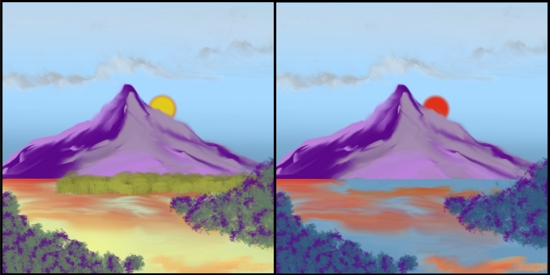
I threw this together to illustrate the point. The picture on the left is comprised of mixtures of five pigments: red, blue, white, black, and yellow. The picture on the right has all the yellow layers removed and looks completely different.
Which brings me to the character in third place in the line. This is a character who has to be flexible, though there may be priority requirements even then:
Expertise
Top priority is often some particular expertise or skill. That generally puts a mage or cleric at the top of the list, but not so fast; there is a lot to be said, given their relatively low hit points, for placing the rogue in this position when heading into known danger.
Utility
As I said a few minutes ago, flexibility is often the highest priority in this position. Some parties feel that the combat expertise of the Cleric coupled with the professional expertise and spell-casting capabilities of the class makes it the perfect choice for third in line, especially if the front two are a rogue and the main combat specialist..

The Pivot Model of Character Placement
Centrality
Another way of looking at this position is as the pivot around which the rest of the group rotates, as shown to the left. Think about that for a moment.
This concept treats each of the other positions as a vacancy into which specialists rotate according to the current tactical situation and anticipated need. At the center is the pivot character, who is often tasked with the burden of selecting the current occupants of the other positions. If, for example, the ruby spot is a scout and the yellow a fighter, he would rotate a fighter into the green position. If the scout returns with a warning about hostile forces, the primary fighter rotates into the ruby position while the scout drops back to safety, and the second-best fighter moves into green from purple or aqua, and so on.
This model works fine so long as there is room to make the positional changes, and it defines the central position as the one fixed element. More complex arrangements are also possible, for example, there might be a separate rotational option linking yellow, purple, and aqua, or even yellow, purple, aqua, and the central brown position, and/or a tertiary loop connecting yellow and green.
Adopting this model or one of the variations mentioned is fundamentally about defining the criteria of selection for the central position and the tactical advantages and needs to be filled by the other positions.
Mobility
Finally, since this position is normally in the middle of the group, having a character in the slot who can move forwards or back as needed can be a sensible choice. The primary benefit for the party is healing – I have seen very effective parties who place a mobile character in that position equipped with a wand of Cure Light Wounds.
Analysis
The central position can be the defining position, or it can be defined by the choices made for the positions forward of it. It should only ever be assigned by default if there are four or less party members; the rest of the time it should be a deliberate choice grounded in logic..
5. Stuck In The Middle with You and You and You
Some groups think that once the four primary positions are filled, the rest are pretty interchangeable. I never think that way; if the leading position is a scout, it will effectively be empty whenever the scout is out fulfilling his tactical function, leaving the fourth position in line as de-facto the third. The same thing happens if the front-line fighter gets taken down, something that is more likely to happen just because he is the front-line fighter. And, of course, the combination of circumstances is also valid, elevating the fourth position into an effective second-row. So, even if there are no other considerations, combat ability is a differentiator. The same is true of the second-last position and the fighter in back, and this is arguably an even more sensitive choice. Trying to settle that debate is the sort of thing that gives tacticians gray hairs!
So this is definitely not a trivial choice; rather it is one that needs to be made based on just how effective the other positions are likely to be when needed – how vulnerable one is, relative to the other, and how likely it is that the party will be put under pressure in that direction.
But, on top of that, there are a few other considerations.
Mobility
And the first of these, as discussed earlier, is mobility. The arrowhead arrangement is all well and good for dealing with narrow corridors, or moving as a compact group, but it’s not all that relevant when the group needs to fan out or achieve multiple objectives in different sub-locations at the same time. When that happens, having additional mobility in the forward positions always increases tactical flexibility.
As I’ve indicated before, you can do worse than sequence the characters in marching order from front to back in descending order of mobility.
Wide vs Narrow
The problem is that characters with high mobility are often not as effective at being a spearhead; they are fast but fragile. That leads to alternate formations being considered, and tactical maneuvers to take advantage of them. One of the big considerations is area of effectiveness.
Archers have a very wide area of effectiveness, but are very pin-point; they can only really be effective in one direction at a time. Melee specialists have a relatively small area of effectiveness, but can attack anyone or anything located within that zone. Characters with area-effect spells are somewhere in-between (at low-to-moderate levels) to extremely wide (at higher levels) areas of effectiveness, and affect the entire area in question equally. That means that positioning those characters to confer maximum effectiveness and protecting them from distracting enemy attackers are primary tactical goals – especially since these characters are usually the physically least-resilient amongst the party.
In a number of the old TSR computer-based games based on AD&D, I had good success pairing a mage with an archer – the mage did the heavy hitting, while the archer was used to keep enemies off the mage’s back. This enabled me to send the pair wide of the main group of combatants to give maximum opportunities for tactical spell-based support, or keep them in close at the heart of a hemispherical grouping, as shown below.
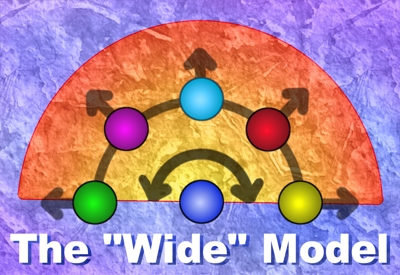
The wide model has one (protected) central character around which all the others face outward either in a circle or semi-circle, meaning that the character in front can rotate like a gear in machinery around the pivot and be ANY of the other characters as fits the needs of the moment.
This approach assumes that everyone except the spell-caster is at least reasonably competent at melee combat in their own way, at least sufficiently so to serve as a “Meat Shield” between the mage and harm. Again, there is a variant in which one of the PCs drops out of the “front line” (causing a redistribution of the remaining 4) and takes up a place next to the mage. This could be a rogue/scout with archery skills (precision point-defense for the mage, in other words), or it could be a cleric, who is this in a position to support the remainder of the front line with healing.
The “Narrow” Model, in comparison, can be best described as a triangular or diamond formation with the vulnerable members packed inside. You have one character at the front, another at the rear, and two flankers who are usually adept at, and equipped for, ranged combat, but who are not as vulnerable as a mage. A rogue may be one of the flankers, but usually flanks the rearmost character, a “loose” character who can sneak off whenever the group engages an enemy, only to reengage from an unexpected direction.
Vulnerability
Both the Wide and Narrow Models are indicative of another consideration that may be the decision-maker for some parties at times: the notion of shielding or protecting the most vulnerable as the number one priority. The vulnerability concept posits that the collective party is only as strong as its most vulnerable member, which is an implicit implication of the notion that all members of the party make an equal contribution to its success and well-being in the longer term. The latter is clearly something that GMs strive to achieve, so the concept appears to be on solid footing, even though the notion of equating a plate-mail-clad fighter with a mage in silken robes in terms of vulnerability seems initially absurd on its face.
Analysis
If nothing else, this section should have dispelled any notion that the fourth and fifth positions is not every bit a subject for serious thought as the others discussed. In fact, for the entire marching order, ideally, you should be able to point to any single character and explain exactly why that character has been positioned in that location. In fact, there are times when the decisive positioning criteria relate to the character’s unsuitability to be anywhere else.
Conclusion
Deciding a party’s marching order and tactical positioning when maneuvering as a group is a far more complex issue than it appears at first glance. In theory, a group with any sort of rational order of march will eat an identical group without such sensible positioning for breakfast, every time, and that’s even before terrain advantages are taken into account. Certainly, if the GM hands the players a rousing defeat with a lower-level party purely because their tactics are superior, the players will bellyache for a while but will also pay close attention.
As this article has shown, there can be many different considerations at play when choosing such a tactical formation, and the “right” one can vary with great regularity. Ultimately, that puts a combination of resilience and flexibility high on the list of default configurations.
If the game world was real, intelligent parties would, upon encountering an enemy group, always ask four critical questions:
- What is the enemy group’s tactical configuration?
- Why are they in that formation?
- How can they take advantage of that formation to achieve tactical superiority?
- How can we take advantage of that formation in the event that they are hostile?<>li>
Experience shows, however, that most parties and most GMs do not give this question anywhere near enough thought, giving rise to an unfortunate fifth question – “Why aren’t we in a matching tactical configuration?”
If you want to empower your players to take control of their lives and the world around them, a necessary first step has to be forcing them to confront inefficiencies and inadequacies in the way they currently do things. The lessons learned may be painful, but the players themselves will be empowered as a consequence – and the first time they are the ones to achieve victory over a superior force by virtue of superior tactics, the pain will all be worth it to them.
Most GMs like to encourage their players to think about their game. This is an oft-neglected aspect of that game, and remedying this shortsightedness benefits both players and GM alike. It makes the game more fun for everyone, and that’s the ultimate reward!

Discover more from Campaign Mastery
Subscribe to get the latest posts sent to your email.




December 24th, 2017 at 10:24 am
There is a very interesting followup article at Marching Order, Battle Order, and Scouting for those who found this to be worth reading.
And thanks to JT over at Ravenous RPG for being the go-between :)
Mike Bourke recently posted..An Unfriendly Little Cyberwar: A Subversive Campaign Concept