An Unfriendly Little Cyberwar: A Subversive Campaign Concept

This evocative image is credited to TheDigitalArtist and was sourced from pixabay.com
There’s a documentary series that airs on Australian TV sourced from an American Cable channel, or maybe an Internet platform, called Cyberwar. As part of the advertising for the series, one of the people interviewed offers the statement, “The next war will be cyber.” And that got me thinking: what if there was a global war and no-one outside of the combatants knew about it because it was all taking place behind the scenes, online?
To the outside world, all that would be visible would be one egregious hacking incident after another, a long succession of cyber-security scares, and a measurable increase in the unreliability of technology due to the underlying infrastructure being compromised. Of course, the occasional misdeed would also have to be attributable to one or two unfriendly nation-states, and people would have to warn of the coming Cyberwar – because not talking about those things would be a huge tip-off as to what was really happening. That’s right – this is exactly the world that we appear to live in, right now.
That’s the power of this concept: it takes the world around us, with all its source material, and reinterprets it through a prism of paranoia laced with this particular conspiracy theory, and yet the internet touches us all so often and in so many different ways that everything is reshaped by this perspective.
It could work in a couple of different ways. First, you could use the idea in a campaign where something else was the primary adventure focus and the PCs had to piece together the cause of the world around them slowly falling apart before they could graduate from tail-chasing. There would naturally be four, or perhaps five, phases to such a campaign: (1) Ignorance & Paranoia (2) Suspicion and Conspiracies (3) Revelation, Recruitment, and Retraining (4) Defending The Faith and (5) Combat in the Digital Zone.
It would be necessary to detail the political situation and present to the players in such a way that they don’t know when you are spelling out sides in the War. That suggests a plotline at the Beginning that’s based around the United Nations. The nature of this adventure will spell out the genre of the campaign, bearing in mind that you want the PCs to play a pivotal role in the big picture when the ShadowWar is finally revealed to them.
A James-Bond style adventure campaign, or an Agents Of S.H.I.E.L.D. – based campaign in which the PCs are agents from a country not entrusted with the secret of the ShadowWar. In the background, with each adventure, alliances in the ShadowWar will shift this way and that, triggering other missions for the PCs.
This would give the PCs a chance to undertake adventures in a world that is constantly evolving, seemingly without rhyme or reason – and yet, there would be a thread of coherence running throughout it. Cyberwar attacks would have ‘real-world’ consequences and ramifications, and a number of adventures would have strategic implications in terms of the Cyberwar. Every mission would have two objectives – and the PCs would only know about one of them!
A former enemy experiences an oil field fire and comes to the US to negotiate a new trade deal for skilled technicians who can repair the damage. Were they a secret ally in the ShadowWar, with this visit a consequence of that relationship? Or were they an enemy that the PCs government have crippled, and who are now suing for peace? The ShadowWar introduces an entirely new level of diplomacy and diplomatic relations, and nations can be overt enemies in one and allies – reluctant or earnest – in the other at the same time. Every adventure would inherently have multiple layers of plot:
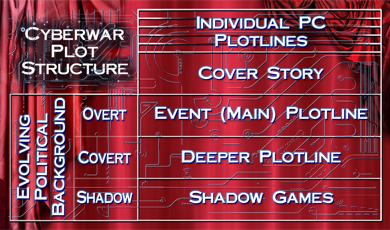
- Individual PCs should always have their own little plotlines, stories that make them individuals, usually driven by whatever the players want to do.
- “Cover Stories” are what the PCs are supposed to be able to “claim” to be doing while on missions. Sometimes there won’t be one, but Cover stories so often conflict with true motives and objectives in ways that can generate drama, humor, or both, that this should be the exception rather than the rule. True Lies (the movie) and a recent season or two of NCIS: LA will give you all the grounding you need to do this.
- “Event (Main) Plotline” is whatever the actual mission objectives are, outside of the cyberworld. This is the relatively “episodic” component of the campaign, and deals only with the immediate situation, whatever it may be. It could be providing protection to a dignitary or target, investigation of criminal activities (murder or grand theft in particular), surveillance, counterintelligence, a raid, subversion or counter-subversion, anti-terrorism, getting mixed up in someone else’s case because there is a connection to your official jurisdiction, rescue, courier or escort duties, or intelligence gathering in nature – assuming that more extreme missions like assassinations are done off the books! Enemies can be official or rogue, foreign or domestic, criminal or sanctioned, sane or insane, political or apolitical, secular or religious, supposed or official “allies”, true allies, or avowed enemies. It’s a rich field to choose from!
- The main plotline usually has to be placed in the context of the evolving political situation as the public perceives it, and so it has been coupled with the overt politics of the day. Overt Politics is what you can read in the papers or view on CNN.
- The “Deeper Plotline” contains the usual inter-connective broader plotlines that tie the campaign’s main plotlines together into a bigger picture. While this usually provides a second layer of context to the main plotline, it rarely has a direct impact on the current immediate mission objectives.
- Coupled with the “Deeper Plotline” are the more Covert and Clandestine aspects of the Evolving Political Background. Covert political developments are normally classified, and deal in hidden agendas, brinkmanship, statesmanship, and all the other things that only the intelligence communities are aware of. Overt political developments frequently have their roots in Covert activities.
- The “Shadow Games” are the Cyberwar, a hidden layer that not even the PCs are initially aware of. Ruthlessly pragmatic considerations can cause overt or even covert enemies to cooperate at this level, while staunch allies in the more accessible worlds function at complete cross-purposes. Half the time, you are dealing with faceless state-sanctioned (but strictly unofficial) enemies and the other half are subject to the whims and vagaries of individuals. “Shadow Games” manifest as cyber-intrusions, hacks, covert secrets being exposed or used as currency, infrastructure breakdowns, and so on, and most of these HAVE to remain totally secret or the public would lose trust in the infrastructure of their society. At it’s simplest level, the ShadowWar is a series of ongoing conflicts for control over the truth itself. Shadow Game players manipulate deeper plotlines and covert politics. And, for (almost) every move in a Shadow Game, there is a necessary response: investigate, analyze, contain, neutralize, infiltrate, spread misinformation, expose, counter, retaliate, negotiate.
- This necessarily and obviously ties into the Shadow Political Background. Politics that can never be publicly acknowledged or condoned, or the authorities would be ousted because they run contrary to what the public expect those authorities to be doing. There are no rules, only unwritten guidelines, and you need a scorecard to keep track of who’s who. Situations change fast, and the only overt impact might be someone resigning from office or some domestic political crisis or opportunity. Not even the intelligence services are privy to this level of diplomatic maneuvering, and even most of the participants only have access to strictly compartmentalized need-to-know information. Only a few shadowy figures on each side have access to the whole picture; they are the grand strategists, the players of the Shadow Games.
Similarly, every character – PC or NPC – should be an onion. Cover identities should be designed to let them go various places and do various things, “official” identities give them an overt role within the intelligence community, “unofficial” identities made up of relationships within their own and related intelligence communities, and – most deeply-buried of them all – the real person, his values and ambitions. Sandwiching each of these layers would be a sub-layer of education and training and another of personal history, occasionally real but often completely fictitious. Maintaining these activities would be a full-time job if you actually had to do all the things that you are supposed to be doing.
And, of course, at each of these levels, characters can have secrets, be living double-lives. “Alejandro” may be a minor Argentinian diplomat, spying on the British on behalf of the British, but secretly a Chinese mole into MI5, who has been suborned into fighting the Shadow War against a Japanese Tycoon or Russian General by a North Korean Spymaster. Oh yes, and he’s having an affair with the Spanish Ambassador’s wife.
I think by now you can begin to see the extraordinary layers of fun that you can have with this concept, as these various lives and identities and functions come into conflict.
But it doesn’t stop there! It’s easy to recast the whole ShadowWar as a secret conflict between religious doctrines, or between Heaven and Hell, or to control Magic, or between Humanity and Alien Pod-people, or between Humanity and Cthulhoid Greeblies from Beyond space and
time, or between modern Humanity and their fallen Atlantean masters. There are a great many variations possible – one for just about any genre you can imagine!
You could run a Fantasy-based campaign using D&D / Pathfinder; or a superhero campaign oriented around Agents Of T.H.U.N.D.E.R., or a Call Of Cthulhu campaign, or….
Ultimately, the Shadow War is a means by which the overt in-game “players” can be recast and the world turned upside down whenever it amuses the GM, but in a controlled way that maintains a logical consistency – once you know the real story. At first, it may seem like a government in crisis and a society in a state of near-anarchy, but slowly that underlying connection between cause and effect will get noticed by the players and they will begin to sense the underlying consistency of which I spoke. And that’s when they become dangerous, and in real danger. When that happens, you have only two options: eliminate or recruit. If they are at all competent, the latter would be the favored option.
That bespectacled 14-year old who you knew in High School that spends all his time playing video-games and being totally socially isolated, voted most likely to perpetrate a mass shooting incident, is secretly a General in the Cyberwar, and the last best hope for the survival of… well, who can say?
Don’t expect the Truth in this game to set you free. It won’t. But it might just keep you alive long enough to become a player in the Shadow Games yourself…

Discover more from Campaign Mastery
Subscribe to get the latest posts sent to your email.
Comments Off on An Unfriendly Little Cyberwar: A Subversive Campaign Concept