The Klein Wand: October 2026 Blog Carnival
For the Oct 2026 Blog Carnival, hosted by Vulcan Stev, I offer the Klein Wand, drawing inspiration from… non-traditional sources.
I couldn’t find a good image of a Klein bottle, so here’s an impossible torus instead. Image by The world captured by Pixabay. Artists thank you from Pixabay.
I took this month’s subject to be a challenge, one to which I wasn’t initially going to respond – while magic items tend to be around in many of my campaigns, they tend to be relatively mundane and not in the spirit of the subject, “Magic Items, the Weirdest and Best”.
But I was suddenly inspired, and before I knew it, I had something to contribute. Is it the best? I don’t think so – but it’s definitely interesting as a concept, and right out there as a magic item.
Klein Bottles
A Klein bottle is a strange object – which you can buy in real life – in which the inside is also the outside. There is no beginning or end, and anything put into one comes back out, eventually. You can read more about them here.
The Klein Wand
On the surface, it’s a wand of fireballs that does 2d6 +1 per character level of the caster. If your system doesn’t have levels, estimate this based on where the caster stands relative to the great powers of the world, remembering that most character levels represent a geometric increase in power levels, usually around the 1.25 mark.
That’s a surface that hides the truth – because if there wasn’t something deeper, no-one would use it. The wand gets recharged by casting a fireball into it, so effectively it makes the character immune to fireballs; it gets one charge to a maximum of 50 for every three dice of fireball sent its way. That alone can make it worthwhile in some instances.
But the real power and weirdness of the item lies in the triggering sequence, which is different every time and loops until complete.
The Casting Sequence
Before you can use the wand, you have to specify the target square or a target creature. If the latter, the targeting matches the subsequent movement of the creature (or lack thereof it it becomes dead).
1. Point the wand
2. Gesture with the wand
3. Say the activation phrase
4. Touch something flammable (not consumed)
5. Command the wand to fire
6. The wand goes off, targeting the spot indicated by the user.
Once started, the sequence cannot be stopped or aborted. Each turn, the user rolls a d6. If the step is one that they have performed before, they can choose either to repeat it or to immediately roll again (but they have to keep the second roll).
Each step adds 2 to the number of dice in the fireball and consumes an extra charge from the wand. It also increases the area affected. If the wand runs out of charges, it defaults to a roll of ‘6’ no matter what the die might indicate (so most don’t bother rolling).
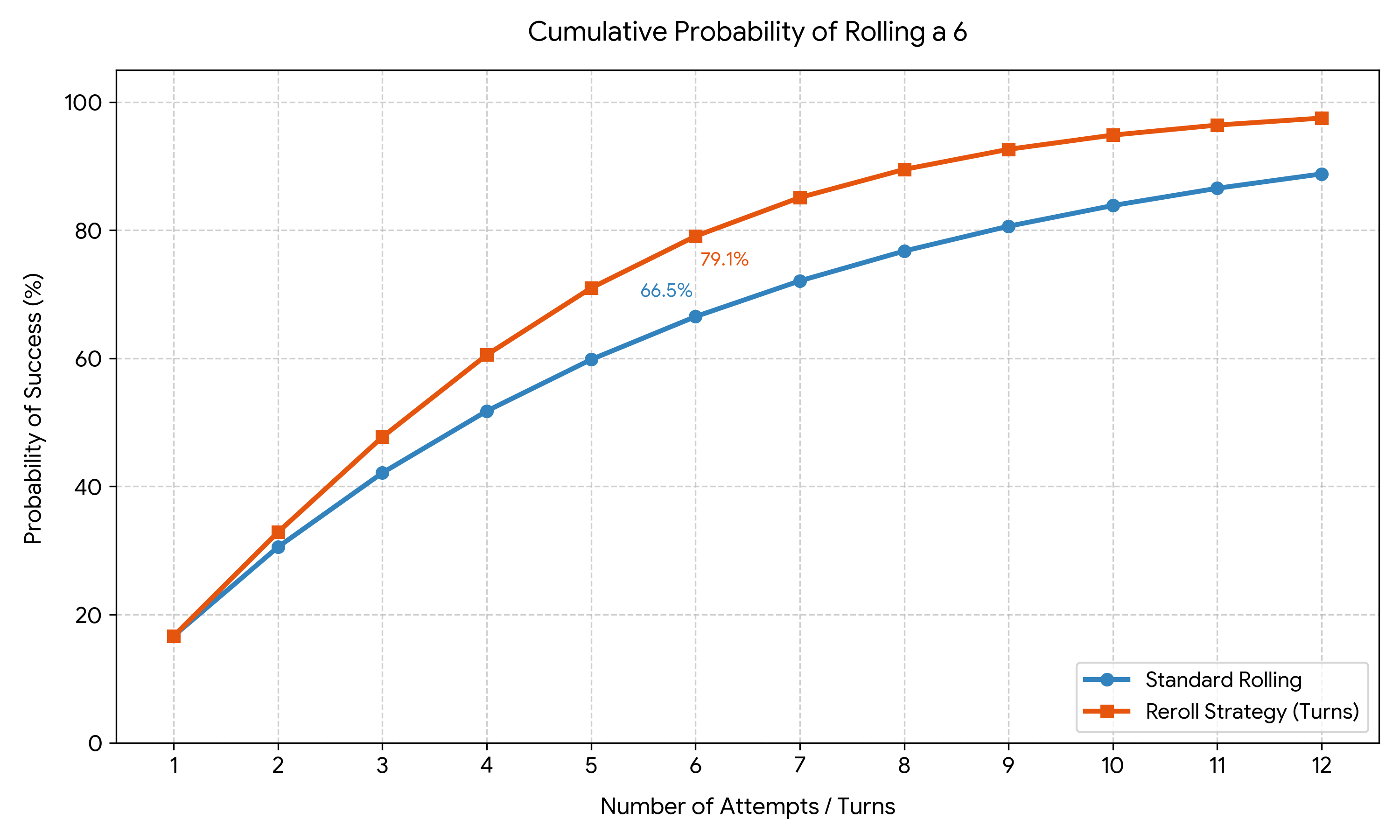
On average, it will take 6 rolls to see a six; if the character chooses to re-roll, that drops to 4.42. That’s up to +12d6 in fireball strength and range. That makes the weapon potent enough to carry around!
Click on the thumbnail for a larger version in a new tab,
But it’s not out of the question for it to take 10 rolls, doing +20d6 – and to more potential targets as well, possibly including allies! Or, it could go off immediately – but do a trivial amount of damage.
It’s really hard to anticipate where a moving target will end up – or what will be in range at the time it goes off, should you target a space – especially since you don’t know how long it’s going to be before it goes off. Other characters can recognize what’s going on and attempt to ‘steer’ enemies toward the blast point, foregoing one point of damage successfully done for every foot (or two points damage on a miss per foot) – but those creatures still get to move when it’s their turn. So combat becomes a ballet of unpredictable duration.
At the same time, once it becomes known that a particular PC has this weapon, they become the focal point of attacks – so the tactics change, and the PCs tactics have to evolve in response.
Things become even more interesting if the enemies recognize the wand; they will attempt to steer their foes into the target zone while getting away from it themselves, using the same ‘steering’ mechanism.
The Wash-up
Using the wand has negative impacts, taking the user out of the fight for a period of time; the longer this is, the more they come back with a bang. As soon as one is introduced, the game becomes instantly a lot more tactical. Do you steer an opponent or inflict damage, or both? What are the enemy’s movements going to be? What should your movements be? In an uncertain and changing environment? For an indeterminate duration?
Bonus Idea
In the same vein of adding tactical diversity without being overwhelming:
Non-magical spells serve as Shields of rating -1 (they aren’t a good idea). Magical scrolls act as Shields of rating equal to the unmodified spell level.
The first strike that would have hit regardless of this bonus destroys the scroll as a spell unless the owner has already started to cast it.
Casting the spell removes any utility as a shield – the magic is gone.
At the end of the combat (GM determination), the scroll becomes withered and useless, spell and all, even if it has not been cast.
On a completely unrelated note, someone who’s been a friend of mine for a long time, Roberto Micheri, has just released his first RPG, that also fits the Halloween theme. It’s free and it’s a mini-game, so you have no good excuse not to check it out.
Survival: A Mini-Game of the Zombie Apocalypse

Discover more from Campaign Mastery
Subscribe to get the latest posts sent to your email.



Leave a Reply