A Tale of Australian Weather
Weather is ubiquitous. Anything that can be done to make it easier for the GM to apply HAS to be explored.
Today’s subject is one that I know well from having lived it for decades. In many ways, it covers ground already covered in these articles, but it does so with two purposes: the less important is that I have thought of a different way of presenting it that should make it easier for those outside these regions to understand, but the more important one is that the technique itself teaches a truth and methodology that can be applied to all campaigns and game systems.
A Few Home Truths
Let’s start with the basic realities of the situation:
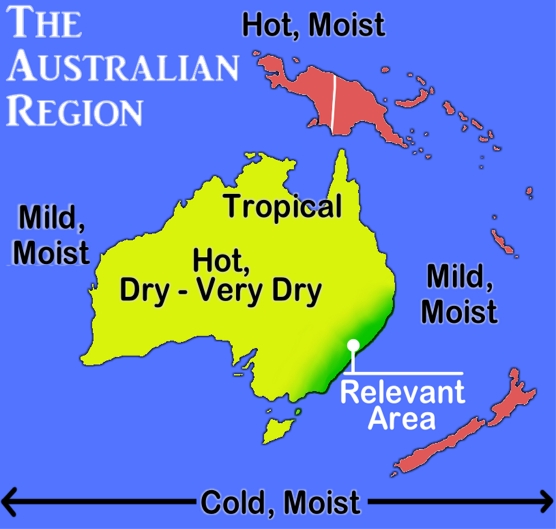
In terms of weather, Australia is a very dry place surrounded by wet air. Up north, that wind is relatively hot; down south, it’s frigid most of the time. Any moisture invading the continent gets quickly sucked out of the air as soon as it crosses the coast. Maybe not literally, but that’s the way it feels. Groundwater is rare to find and fairly precious. And there’s a long ridge of mountains down the eastern coast.
Size is the thing a lot of Americans seem to have the most trouble wrapping their heads around. To get from the Eastern side, say Sydney, to the extreme western side, Perth, you have to cross three states – and they equate that to the mainland US states and think that it will only take an hour or two.
No, no, no, no, no, not so fast! Our states are a LOT bigger than those of the USA, and the whole continent is roughly the size of the mainland US. It will take at least 2-3 days and probably closer to a week to drive across it – and for much of that trip, your car will house the only sentient life for a hundred kilometers or more (60+ miles).
There are two major consequences. The first is that the population tends to hug the coast because there IS water there. 90% of Australians live within 50km of the beach, and 70% of them in within about half that.
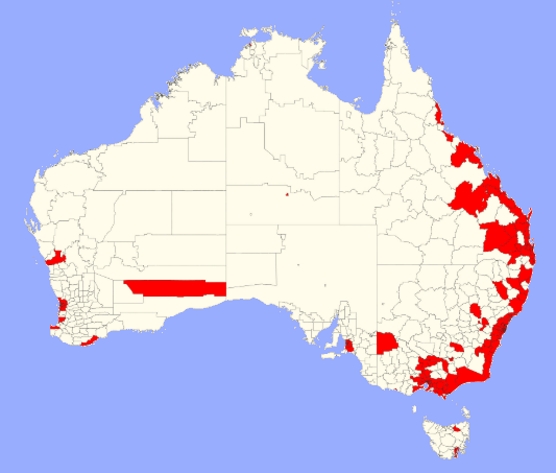
In fact, 90% of Australia’s population live in the red zones. Image provided by ZarlokX, CC0, via Wikimedia Commons. Information from the Australian Bureau Of Statistics in 2024.
And second, it means the weather isn’t as short and simple as you might think, too – compare the weathers of Florida, Kansas, California, and Maine, and that’s an indication of how much variation you can expect in the weather.
So this article isn’t about the whole thing. It can’t be, that’s too big for this. It’s about one spot in the middle of the darker green region shown in the first map above, and it’s broadly applicable to that general section of the coast – warmer up north and colder down south.
What Makes This Post Different
It may be redundant, a last-minute clarification insert, but better to be unneeded than to be needed and absent: while I was in the hospital, I thought about many things and one of them was the way in which the weather that I experience is a series of simple falling dominoes, each combining with the landscape to trigger the next. What made it useful to readers of CM is that ALL weather can be broken down this way – cut away the details (except when they are useful) and spell out the logical chain of events.
ALL weather, even if it’s on Middle Earth or Karnus or Tattooine.
The place it starts is by simplifying. and that’s done by restricting the area that’s affected – in this case, the coast is more or less a straight line at a particular angle relative to the sea, bounded by (relatively low and old) mountains to the West. It loses relevance when the coast wraps to be more East-West than North-South, or when the water gets hot enough to drive a variation in the climate.
It’s bound and limited by topography. So that’s where you need to start, too. From that beginning, it’s a simple chain of ‘What happens next? What’s the logical consequence?’. And that makes it useful in gaming – not specifically as a climate, but as a way of establishing principles.
Methodology
This methodology breaks the weather patterns into two intermittent sequences of simple and logical events that collectively describe all the non-sunny weather patterns that I regularly encounter. The first is the shorter of the two, at 6 stages; the latter requires one more.
Each stage will consist of an illustrative panel and a section of text explaining them. I’ll put separators between each section so that the association between these two elements becomes clear.
Applicability
The first pattern is an east-coast phenomenon that affects New South Wales most clearly, as shown.
The general topology is key – a heavily populated fringe around the coast, a line of (relatively old and worn) mountains down the coast, and a large and relatively arid interior. The more inland you go, the more pattern #1 dominates; the more south you go, the more pattern #2 dominates.
In a fictional / gaming sense, that’s why its so important to have two patterns – so that no matter where you go in the affected regions, you have a unique combination.
The fact is that 80% of Australians (some say 90%) live within 50km of a very long coastline, as shown above.
The more you move away from these boundaries, the more things change. Queensland weather becomes more and more tropical as you head North, for example, and is dominated by a more Easterly version of pattern #2 – with higher humidity and stronger storms as a result. They even get tropical cyclones now and then. WA is completely different because it’s on the opposite coast – my understanding is that it’s a mirror image of pattern #2 but that’s obviously incomplete as there are no mountains there. This is a starting point and an approach, nothing more.

Pattern #1
1
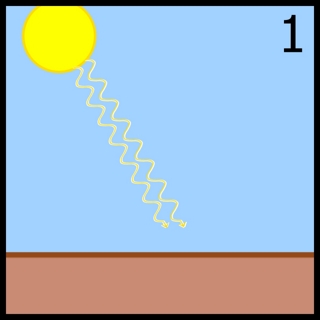
Pattern #1 starts with the sun beating down on the interior of the country. It gets very hot there as a result, but it’s a very dry heat. I should know, I come from a small town just west of the desert line, Nyngan.
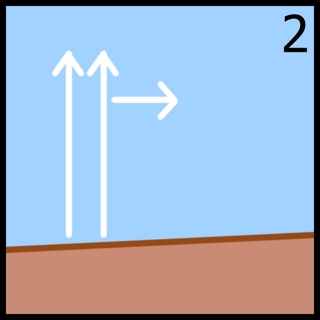
2
As the air heats up, it rises. The rotation of the Earth also carries it eastwards. As it travels, the ground slowly rises a little – there are hills and valleys – but the overall trend is clear. That means that the hot air gets pushed even higher, relative to the original ground level.
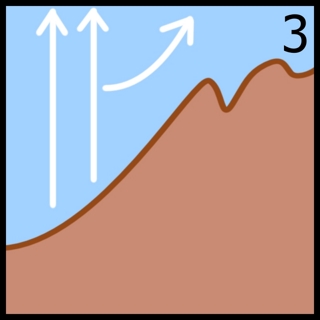
3
Eventually, the ground slopes up into mountains. The trend to rise vertically is exacerbated by the eastward flow being also forced upwards.
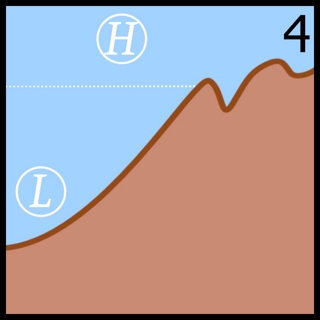
4
The net effect is to push more air from low altitudes to high altitudes, with somewhere near the tops of the mountains forming a boundary line. Because the interior is dry, generally, there isn’t a lot of humidity in either zone, but that can change as you approach the mountains on occasion, creating storms. Most of the time, that doesn’t happen.
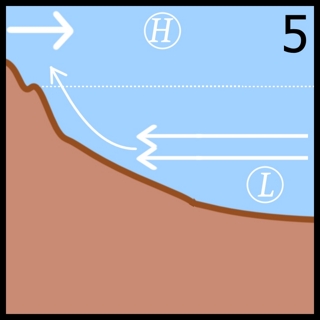
5
On the other side of the mountains, the low pressure low down sucks moist air from the ocean. This gets pushed up by the sides of the mountain until it meets the hot air coming Eastward. Because the coastline is angled north-east south-west, the predominant direction is from the south, becoming more westerly as you move inland. As a result, distance from the ocean to the south can be a critical factor in the daily weather – where I am now is a little further inland than where I was and the southern influence is somewhat moderated as a result.
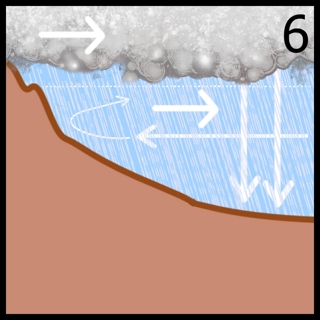
6
The moist air creates clouds, and if the low pressure is strong enough, these will produce rain. That’s the big secret behind living so close to the coast: that’s where the water is.
Sydney gets clouds almost every night as a result. It’s relatively rare for these to amount to any moisture, but it does happen. In summer especially, when the driving force that creates the low-pressure zone is at its strongest, we tend to get a lot of sunny days and hot nights punctuated occasionally by afternoon storms or overnight rain. In winter, there isn’t the heat to drive the humidity up or create the low pressure zones as strongly, so rain becomes more likely than storms. There’s also a period at the changeover where hail becomes more likely in storms – a combination of the heat being strong enough to create the low-pressure zones but not enough to keep the rain molten. This persists for 2-4 weeks, and no-one who has worked insurance counters can miss it.
So that’s pattern #1. One simple event at a time, the picture builds up until there’s an inevitability about it – this is what can be thought of as normal, most of the time.
But you may have noticed that there is a contradiction: cloud is common, but rain events are not, and are fairly weak when they DO happen – but the coast is where there’s water. Resolving that contradiction leads us to pattern #2.
Pattern #2
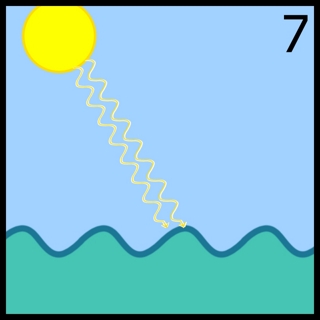
7
Pattern #2 starts with the same sunlight beating down on the sea.
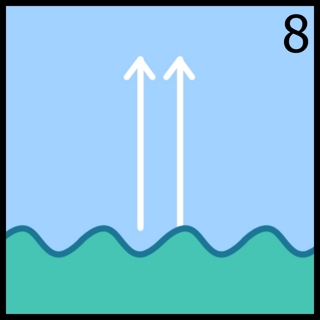
8
This causes evaporation – and there’s lots of water to evaporate.
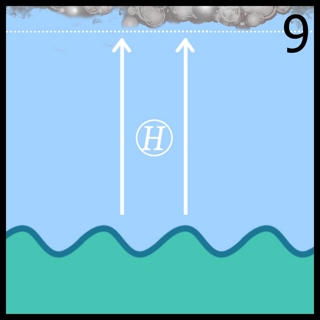
9
As usual, the heat raises the temperature and pressure, creating a high. This pushes the moist air high enough to encounter the cooler air above, which creates clouds.
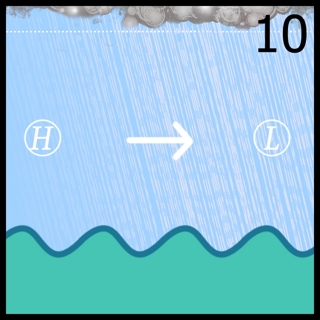
10
This is the obvious source of the moist air referred to in 5, but that’s nowhere near enough to dissipate all of it – not even 10% of it. Some of it falls as rain to sea – maybe another 10-20%. The rest gets held back by the rotation of the earth and simply banks up – in summer, for 3-7 days, in winter 14-25 days.
But the cloud and rain cools the air and lowers the pressure, so there’s a natural wind blowing out to sea of a day.
All this means that the cloud – and the lows and highs – tend to form natural waves or bands of alternating highs and lows.
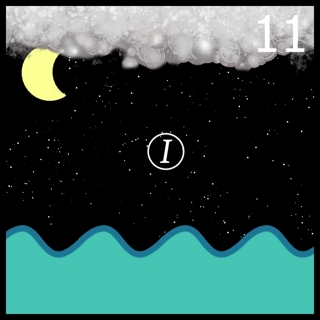
11
At night, everything cools down. This pulls any cloud that’s there down and creates what I have labeled as a zone of Intermediate air pressure.
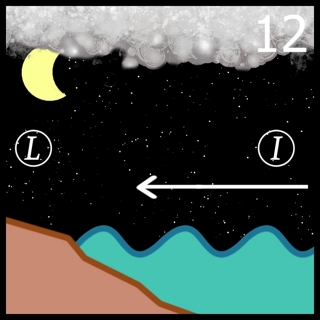
12
Water is a very good store of heat compared to land, so the water stays warmer than the land at night. This means that even if the Intermediate zone is less air pressure than high, it is considerably higher than that over land – so at night, the wind comes from the ocean despite the rotation of the earth.
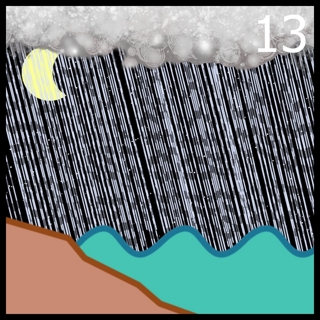
13
Most of the time, its just cloud cover, but occasionally, it gets cool enough that there’s overnight rain. Even more rarely, this will bank up against the mountains and get thrust up high enough to create a (relatively dry) overnight storm – we get 2 or 3 of those a year.
It’s not unheard of for a region to cop a single weather event by day, have it move out to sea in the course of the day, only for it to return in the afternoon and evening, and then to visit a third time in the wee small hours overnight.
Putting It All Together
Simple patterns, each step the logical consequence of what was happening in the step prior – but the compound of these 13 events is a rich and complicated climate. There are nuances – pattern #1 comes mostly from the west, the inland, while pattern #2 is more from the south or south-east – but those are refinements, useful for looking at the sky and deciding whether or not you need your umbrella.
The Point
That’s the point, really. Complex and dynamic systems are simpler single steps, each logical. You can simulate the weather for anywhere in this way – sometimes, you may need fewer steps sometimes more, but that’s a legacy of the breakdown process.
You don’t want to lecture your players. So hit the highlights – “It’s mostly sunny with rain every now and then and infrequent storms. There’s cloud almost every morning.” That’s all you need to tell them, at least at first. Then drop snippets in every now and then as casual conversation.
Don’t be so crass as to start “As you know” or anything like that – just mention the weather, have them react to it, and then have an NPC add a piece to the puzzle of why. Don’t do them in order, either – have them be relevant. Mention the morning clouds. The PC asks the more experienced local if he thinks it will rain? The local replies, “Nah, that’ll burn off soon enough.” End of sequence, and move on to something else.
Once explained in this way, and lived in a few times, it becomes hard to forget, at least in the short term – it feels real. But the real value lies in looking at just what such an exchange achieves. It adds to the local lore, it shows that you’ve thought about these things, it reinforces that the local knows conditions around here, it educates the player a little, and it feels like a natural exchange. That’s not bad for three sentences of work.
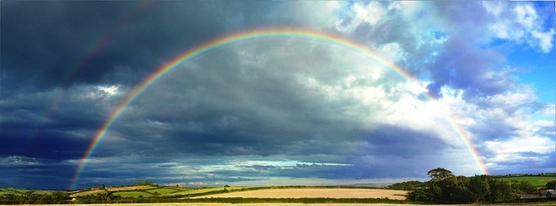
Image by PublicDomainPictures from Pixabay
A Metagame Twist
In promoting this post, I’ve often referred to weather as something that is often ignored. Sometimes, it’s because it’s too complicated, or in the too-hard basket; hopefully, this post has gone some way to dispelling that as a choice motivator. But sometimes the reasons are more subtle and less easily set aside.
Because the game focus is always on the PCs, and weather is often something that has to be endured and not fought back against, it can seem – to players, to GM, to both – that weather is an excuse for the GM to pick on the PCs. Some players go out of their way to acquire magical artifacts that let them ignore the weather, simply to take this tool out of the GM’s arsenal.
There are two ways to look at the weather, and either of them correctly applied dispel this source of angst and can even lead to players questioning that approach. First, you can look at the weather as an adversary or encounter in its own right – in which case, you should earn XP for doing so, and maybe even the odd trinket every now and then – gifts that are forsaken if rings etc are used to avoid it.
Or, second, you can view the weather as an environment within which an encounter can take place, in which case it should hinder / affect both sides equally. And sometimes, the preponderance of benefit should be to the PCs – though as a metagaming principle, the GM can also add an extra level of difficulty to the encounter to compensate and make sure that the encounter is a challenge. Either way, the weather should be included in considerations when doling out the XP, and the GM should verbally do so in the calculations. And, of course, those rings would again forego the benefits – and would not have any effect on any benefits received by a side that doesn’t have them.
Suddenly, Rings Of Free Action – or their equivalents – are going to be seen in a whole different light. But so is the weather.
And there is a critical benefit for the GM that this prevents him from losing – we all know the weather, we’ve all experienced it, and different weather is not as extreme a divergence as no weather at all. The critical benefit is by tying those experiences, and the believability that they carry, back into the campaign, making it as a whole, fee; more real and credible to the players.
Many GMs don’t seem to realize all this; I know of one case in which the GM encouraged the acquisition of such devices purely to lighten his workload, giving up all hope of using the weather to set the atmosphere, the mood, or enhance the credibility. I think it’s too great a price to pay – and that it generally results from treating the weather as an inconvenience.
I suggest choosing a little more carefully, the next time the question arises.

Discover more from Campaign Mastery
Subscribe to get the latest posts sent to your email.




Leave a Reply