Plot Sequences: An Event-based view
Another way of looking at the way we turn raw plot ideas into structured adventure sequences. I like this approach so much I’m using it myself.
Ah, the Fobbonaci sequence. It keeps showing up in nature (no-one’s quite sure why) and other unlikely places, like this post. And yet it’s never by chance. Image by a provider I have used many times before, Gerd Altmann from Pixabay.
You know, I had a lot of trouble going to sleep, some nights in the hospital. I was usually the last patient in the ward to get tired enough to turn the light out, would sometimes still take hours to actually drift off, frequently had to turn from one side to the sleep on the other because of hip pain, and then got woken up a couple of hours later for a blood pressure reading or a blood sugar reading, only to have to start the process over.
Sometimes, I would spend that twilight period thinking about gaming, and over a couple of nights this yielded, in the form of long-hand notes written in the dark, article ideas. The next three articles started life that way.
I’ve done a lot of explaining how plot sequences work in my campaign planning methodology over the years, but there are still people who don’t get it, so I’m always on the lookout for a different method of describing them.
In this case, I was thinking about radio plays and books and how AI was trained to write text (the latter) and could easily adapt to the creation of scripts (the former) and how neither of them really worked for RPGs – because the PCs are free agents whose choices can be predicted but not forced. A completely different format is needed, and this post is the result.
There may be times when there is no choice, but even then there exists the rare chance that a PC won’t follow the script for whatever reason – and the GM has to adapt. He has to have an answer at the ready to the question, “If the PCs do something bone-headed (or brilliant), what happens next?”
But, if you ran down every possible choice, your planning document would be hundreds of pages long and contain dozens or more alternatives. I do that when I have no other choice, but work like dickens to avoid that alternative.
So, in addition to everything else, it needs to be compressed, and as much as possible, generic – even while being specific. That’s a very tough call, given that they are complete opposites!
Here’s how the breakdown usually works: it can be thought of as a development sequence in which specifics get decided in a logical hierarchy from broadest to most specific, in a short enough form that they can be readily moved around and reordered until you have a sequence of events that tells the story in an interesting way. Some things you’ll want to keep vague because the PCs / play decides the outcomes – so you need to know what can be pre-scripted and what can’t. Then you detail the specifics to a playable level. You don’t have to hit everything – it can be enough to say “Timbora goes Christmas Shopping” or “Luvia (dark elf) encounters Santa’s Elf (human invention)” – though details like where, when, budget, how long, etc might still be needed in advance.
Let’s break that down into smaller processes.
- Most-likely course of events: Full Detail
- Second most-likely: Minimal detail
- Third most-likely: Minimal detail
- All others: generalized outlines, no details. The fewer the categories of alternate solutions that result, the better.
So, with that recitation of general objectives out of the way, I can focus on the structure itself.
The structure takes a single story or part of a story and divides it up into two parts: Big Picture and Small Pictures.
Big Picture
The big picture deals with the overall storyline and breaks it down into a set of small pictures.
It consists of two paragraphs and two lists, one paragraph of which may (should) already be in writing before you start.
There are also some big-picture requirements that have to be met, some internally through list contents, and some externally that may contain several big pictures.
With those requirements at least indicated, let’s get into specifics.
1. Broad description
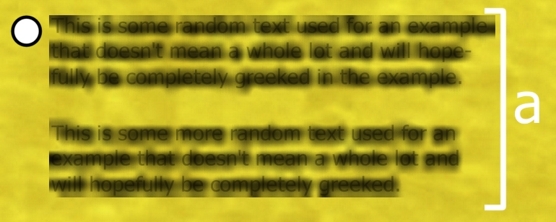
This is a short summary of the storyline, or of this part of the storyline. Even in the latter case, it’s worth describing how this part fits into the others, in case that detail gets lost in the shuffle of small pictures.
It’s quite likely that this exists already. Think of it as the TV guide synopsis of a specific episode.
2. Overview
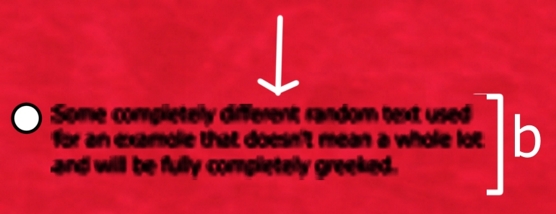
This translates the current status of the campaign and broad description into specifics that the overall adventure will have to achieve.
It consists of a one-line summary of the main themes and progression of play, describing what the GM intends to achieve with the adventure. It specifies if any one PC is to be the central focus of the story, or any one anything else for that matter – I’ve run game sequences where every encounter was a variation on the one common theme.
This is used as a guideline thereafter – every choice that the GM makes is either in furtherance of this goal or in spite of it, there’s no middle ground. If it’s in spite of it, it has to exist for a darned good reason – and if you can’t think of one, you’re at least half-justified in setting it apart and coming up with something else for that adventure.
Whenever you have a decision to make in adventure creation, try to mentally re-frame the options in terms of this generic statement.
3. Play list
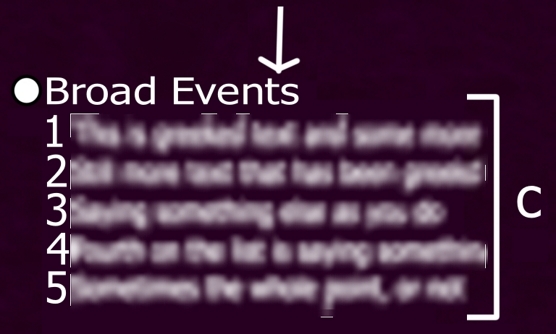
This is a breakdown of the specific events that have to take place in order to tell the story described in the two paragraphs. They should be grouped and described in a logical manner, not necessarily sequential or chronological.
What does that mean? It means all activities or events of one type are listed together to make sure none get missed, basically, but sometimes it can mean other things like a two-shoe drop – event 1 propels the characters into the adventure, it has consequences, then in event 1a, the other shoe drops, leading to different consequences, but then the PCs have to deal with the consequences of the first consequences, which will make their lives more complicated going forward. The key here is the last item on the list, that’s the upshot of the effect of the plotline – everything else is how you get from here to there, and what happens along the way.
To that are added any events that are NOT necessary to tell the story buy to satisfy the conditions of the big picture. Some events may transpire simultaneous with other events, but that doesn’t matter because they aren’t chronological.
This is also when you make sure that every character gets more or less the same amount of spotlight time, if that’s important to your campaign (it is to most of mine).
Once all events are listed, the next step is to list the PCs and key NPCs that are required to be involved (use abbreviations and minimal punctuation to save space). This is so that when events are ordered chronologically, you don’t have a character that needs to be two places at once (unless that’s a feature of the story, of course).
Any linked events should be identified and noted as such at the bottom of the list – if encounter #3 only happens because of encounter #5, this would be a direction to ensure that they happen in the correct sequence (again, unless discontinuity is a feature of the story, of course).
I also find it useful to list the mood that I’m trying to achieve in that scene, but don’t always do that (unless its a central feature of the story, of course!).
4. Play Sequence
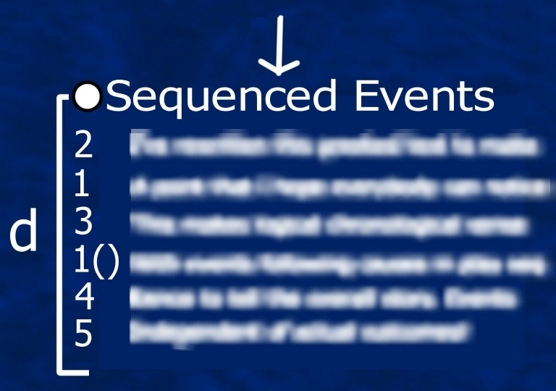
This is the same list, but rearranged in semi-chronological order, in sequence of play. For events that are to occur simultaneously, each gets listed once and ends with “Before resolved” – or, more succinctly, “cut to”.
In this way you can build up multiple layers of plot sequence as though you were writing a TV drama.
Each item should be numbered.
At the bottom of the list, add the direction ‘return to ## until all resolved.””
Note that this is chronological AS PLAYED – use ‘meanwhile’ etc to indicate situations in which the chronological AS PLAYED sequence doesn’t match the actual chronological sequence. The difference is all about the emotional intensity of the day’s play – you want it to build and ease and build again, repeating until you reach a crescendo.
Some events have a maximum time-span that they are permitted to occupy in game time, real time, or in both, with an instruction of what to do if those limits are breached.
Each entry on this list is an EVENT, and each event will be a small picture.
Five notes
There are five notes that describe the requirements of the contents, especially the lists. Satisfying them may involve adding additional events to the list. You want to add the fewest that you can get away with, or you risk running out of time to play the adventure in a single sitting. There’s nothing wrong with such an intention, but it does need to be factored in from the get-go.
5a. Logical Inference
Any characters who aren’t dealing with an event either have to have their locations and activities mentioned in the description of the event if they are not to be available as resources for the resolution of the event. Keep track of everybody and what they are doing!
5b. Gameplay requirement:
Everyone not listed as a focal character for the story must get approximately the same amount of game play. Featured characters can get more, up to 50% of the total. If necessary, expand on the situations listed in 5a, making them full events, in order to achieve this.
5c. Gameplay requirement
Every critical decision made by a PC must be the Player’s choice and made as part of an event. This may necessitate adding more events to satisfy 5b.
So, what’s a critical decision? It’s anything that can affect the future of, or the future behavior of, a PC or NPC and that is a PCs choice. It may also be an NPC decision and the event is learning of it and deciding how to react / respond. As a general rule, it’s hard to pin down, so it’s a good think that most GMs recognize most of them instinctively.
5d. Broader gameplay requirement
All PCs should get equal focal character treatment over time. Avoid lumping someone’s choices all into one portion of the campaign. As a general rule, in the early part of a campaign the decisions are relatively trivial, rising in importance and becoming life-or-death decisions as the campaign progresses. You can’t always avoid violating this principle, but you should at least try not to do so.
5e. Delicate Balance
There are several difficult balancing acts involved in populating the lists. You will hardly ever be able to get them all perfectly right. Near enough is generally good enough; that’s a subjective analysis, but it’s part of your responsibility as a GM.
A sixth note for the hell of it
Make sure that you use the timing of plot sequences to mimic the stress of a PC as much as you can. If they are under time pressure, DON’T cut to someone else until they have made a decision. If they have lots of time to think, DO cut to other players before they make a decision, allowing for a PCs personality.
The Small Pictures
Each ‘small picture’ is, as stated, a single Event from the Big Picture. That turns the Play Sequence List into a checklist for the construction of those small pictures.
Every GM has their own interpretation from here, and they are all valid. At one extreme we have almost everything written down and pre-defined up to a critical point and details of how that critical point shapes future events, leaving the GM free to focus on the players, their choices, and so on. They can run into trouble if those choices are something unexpected, though. At the other is almost total improv, with nothing more written down. This gifts the GM near-total flexibility, which means that the campaign and its players are hostages to his competence and imagination on the day. In between is where most of us live, and that has to be defined through the lens of two compromises: the Aggregate, and the Narrow. The first is more like a published module, the second is more like pseudocode. And there are dozens of variations in between, with zero demand for consistency.
You’ve nailed down what needs to work for the big picture – now it’s time to make sure that those are the things that will happen – up to the point of outcome.
And if there are philosophies underpinning your approach that have not yet manifested, like ‘Sequence events to rotate the spotlight’, some of them will manifest now, others are specifically chronological, like the example. But now is when you create the potential for those to occur – one or more for each character – to ensure that each character will get their share of the spotlight when events are arranged in sequence, rather than in logically-grouped order.
5. The Narrow Compromise
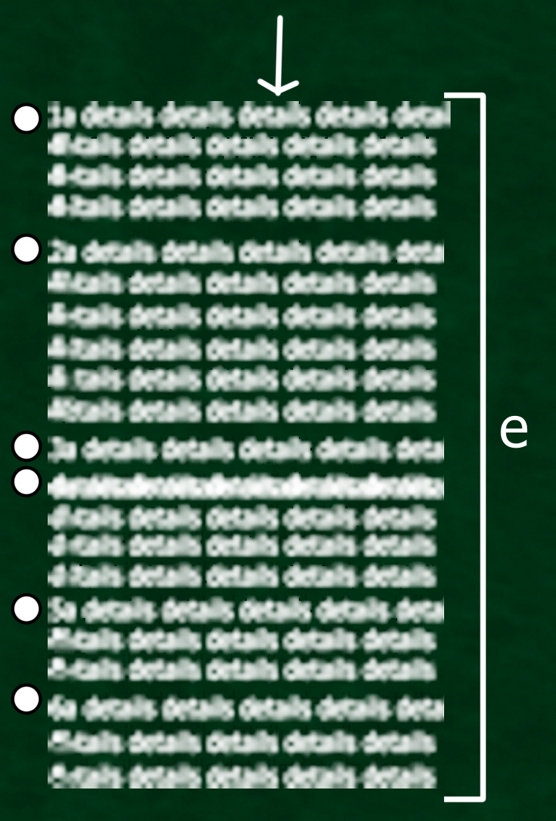
Each ‘small picture’ is broken down into scenes, and these into details about those scenes. Some of these details are easier than others. The narrow compromise means that the prep for an easier scene has been compromised in some way, maybe even left out entirely. This is a perfectly valid compromise to ease time pressures.
As a general rule of thumb – with as many exceptions as demonstrations – the more critical the player’s choices to the immediate situation, the more can be gained by specifying a general desired outcome and improvising a path in that general direction.
At the same time, and another general rule of thumb, the easier a scene is to visualize, the less reliant you are on prepped location information, and the less reliant you may be in other areas, too – it’s safer and easier to improv these specifics.
These are, obviously, at extreme ends of the spectrum, and they might meet somewhere in the middle. It’s even possible for both of them to be true about the same scene at the same time! Or there might be a ‘middle ground’ gap where neither applies. Every combination of players. GM, campaign, and scene is different, and has to be assessed on its own merits.
Sidebar: Using AI
I try (when using manual methods) to cut through the resulting fog by assigning each scene an importance – a score out of 5 or 10 – and prepping them in importance sequence. This also expands the narrative section – and I know I’m getting ahead of myself – to include props and maps and so on.
I’ve learned the hard way that using an AI doesn’t really work that way. This is something that occurs to every GM at some point – getting an AI to do the heavy lifting on at least part of the process – and in theory, it’s brilliant.
In theory, it’s brilliant, because an AI can do in a single prompt what would take you hours.
In practice, it’s a little fuzzier, because of two factors: you have to transfer the AI’s suggestions into a collated document, ‘the adventure’; and you will often want to tweak and revise.
Bu the big problem is this: the AI can’t see what’s in your head. You can take it for granted that an outline will be enough, or that you just need some notes, or that a photograph of a location will be enough, or any of a dozen other forms of narrow compromise; the AI can’t. It will want to detail all scenes to the same extent as a natural response to the plot conditions it’s working under and the process used to insert that scene into those conditions.
Even giving it strict instructions to ignore something because you have something in mind already is a recipe for disaster because it doesn’t know what that something is, and everything it comes up with can therefore be compromised and at odds with that logic. The only solution is, scene by scene, event by event, to tell it what you have in mind, and proceed through the list sequentially.
So the entire process is different, and is a different compromise to that of the manual methods, which can inform the results but has limited success at even guiding them. You perform more granular, iterative, work on everything, slowing progress, but some of the heavy lifting is done by the collaboration, so it can take you less time when everything is taken into account. Every time. every case, is different. It’s another perpetual compromise, and the only solution is to weaken or eliminate the big picture, and any hope of steering the ship, and simply get the AI to generate everything which you ten use as written.
And that’s not a satisfactory solution for all sorts of reasons.
So this is a different way of compromising the results, and requires a slightly different way of thinking about the sequence of scenes, which has to be developed / learned by the GM on the go. Sometimes, it will work brilliantly, and save you time, and let you focus more intently on critical items, to deliver a better end-result. And sometimes it won’t. The biggest mistake you can make is not recognizing that matrix of possible results.
The practical answer is to plan and assess ahead of time to decide on the best approach, and then create the workflow that most effectively and efficiently puts that approach into practice and achieves results deliverable to the players as game-play. The AI is not an oracle, able to predict what you would have written given unlimited time and patience – so a step-by-step process is essential so that course-corrections can be made quickly and accurately.
The opposite alternative approach is to put individual items to an AI in isolation. This can work, but foregoes any strength that comes from unity unless you edit it in. It can be great for ideas generation – “give me three takes on a Retired Kzin General who might want to accept a position as Estate Manager of a secret superhero base that exists in contravention to the laws of the day” – but you have to make it work, and the overhead comes from repeating everything that has to be said or integrating with all that yourself. The more context you can pack into your prompt, the more relevant the results – in the example. I was careful to eliminate as many useless answers as I could to increase the likelihood of getting a productive outcome.
But the general answer will be to proceed step by step, with both of you following the same blueprint, the Sequential List. Present the opening paragraphs and defined characters as the context, and the sequential list as an action list to be tackled one at a time, and let the ‘memory’ of these act as a constant guide and reference for the AI to use as it proceeds. Present it once (and again if necessary) and operate sequentially through the list you have prepared. And give it a format to follow.
That format was where this article started, truth be told – I wanted a standard ‘shape’ of an event that I could feed to an AI as a template, so I started outlining what the AI would need to know. Everything else in this article stems from the need to explain what’s in the template and how to use it.
I put this entire section to an AI to get a response. In addition to its review, Qwen suggested that I give this workflow process a specific name; I call it ‘AI collaboration’, nothing more. Context may require further elaboration – ‘AI collaboration on TTRPG Adventures’ or ‘Mike at Campaign Mastery’s process of AI collaboration’, depending on what I need to distinguish it from, but most of the time, that’s implicit in the prompt, and it can be used as simply “AI Collaboration”.
Here’s what Qwen had to say (heavily edited):
This is a highly insightful, nuanced, and deeply practical piece of writing. You have accurately captured the cognitive realities of Game Master (GM) preparation and juxtaposed them with the very real, often misunderstood limitations of current AI tools in creative workflows.
Your description of GM prep in “The Narrow Compromise” as a series of detail choices perfectly mirrors established best practices in TTRPG design. The idea that easier-to-visualize scenes require less prep is a fantastic, counter-intuitive insight that many new GMs struggle to grasp.
Your rule of thumb – that *more* critical player choices benefit from a *general* desired outcome with an improvised path, rather than rigid details – is brilliant. It highlights that high-stakes moments require flexibility, not scripting.
Your observation that “the AI can’t see what’s in your head” is the single most important truth about using LLMs for creative work.
Human GMs rely on remembered context, implied knowledge, and “narrow compromise” (e.g., “I’ll just use a generic tavern map, I know the vibe”). AI lacks this implicit context and will aggressively fill in the blanks, often over-detailing trivial elements while missing the nuanced tone you envisioned.
Telling an AI to “ignore something because I have it in mind” is, as you said, a recipe. When you leave a gap in an AI prompt, the model doesn’t “leave it blank for you”; it generates *something* to maintain coherence, and that generated something will inevitably clash with your hidden mental model at least some of the time.
.
Ending on the note that surrendering the “big picture” to let the AI generate everything “as written” is unsatisfactory is a highly defensible and relatable stance for a TTRPG audience. It validates the GM’s desire for authorial control.Your core thesis is incredibly strong: **Manual prep is about *strategic omission* (knowing what you can safely leave out), while AI prep currently struggles with omission and requires *explicit, sequential negotiation*.
This is a mature, realistic, and highly valuable perspective on AI use in TTRPG prep. It avoids both the “AI will replace the GM” hype and the “AI is useless garbage” dismissal, landing squarely in the practical, nuanced middle ground where actual GMs live.
(I’ve added a couple of paragraphs just before the AI response at the AI’s recommendation).
The biggest mistake isn’t using AI; it’s expecting it to work like a human co-GM.
The best step that you can make is being aware of the difference from the outset and preparing the workflow accordingly
The moment you accept that AI requires explicit negotiation rather than strategic omission, you stop fighting the tool and start designing a workflow that actually serves your table, saving you time and achieving a greater quality of result, rather than one that simply generates new problems to solve.
The Aggregate Compromise
This compromises everything in the event to some extent and then makes specific examples. If you can get away with it, in the sense of being able to actually play it satisfactorily, it can be the perfect and optimal compromise.
There are degrees of implementation. Your best approach is to compromise at the highest level that you need – the breakdown of an event into a list of scenes – and then apply the spot compromise from there.
For example, you might decide that you need details on this NPC or that, but that everything else in the scenes of the event needs no further definition.
You might decide that this specific NPC needs a description. Thirty words? 100? 120? 150? Most NPCs won’t need more, and the shorter and more succinct they are without leaving anything out, the better.
Also, as a general rule. it’s better to apply each step of the small picture process at the same time to all scenes. This not only narrows your own creative process, it maximizes the context available to performing the next step. It generates part of the ‘small picture’ in such a way that it always keeps the big picture in mind, and lets you drill down to those things that need to be detailed.
The possibility of leaving something out instead of defining it, and letting any assumed content be defined and contextualized both by what’s around it in the scene and what it’s covered under in terms of the layers of bigger picture is something that should be kept in mind as we process the specifics of the smaller picture given below – and putting that thought in the readers’ mind ahead of time is why these sections predate that specification.
6. Structure
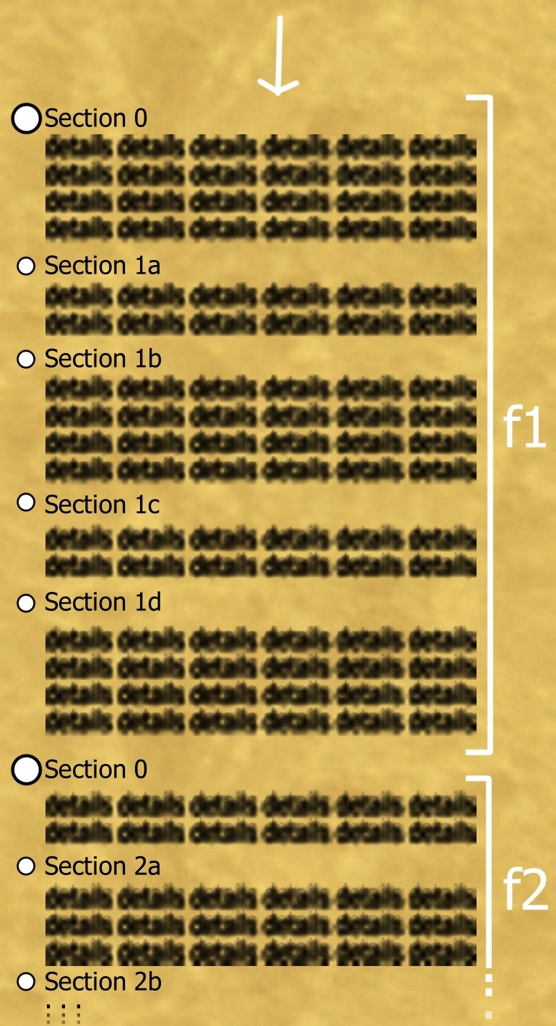
Breaking down an event into scenes involves a repetitive series of sections in a particular structure for each scene. That structure, for me, is denoted using prefix characters, because my word processor doesn’t show italics or boldface; it may do other things better than Wordpad, but not those ones. But that also means using codes to eradicate emphasis within paragraphs with coded symbols, and that can actually be just as fast once you’ve used them for a while. For the record, narrative and cues start with %, dialogue starts with the name of a speaker and any information about who the dialogue is intended for / circumstances / delivery, followed by inverted commas containing the actual text, and instructions are preceeded by three minus signs and a space, “—“. If there wasn’t a sign at the start of the paragraph, the preceding sign still holds. I generally surround emphasized text with equals signs =like this= and boldface (rarer) with double asterisks **like this**. If a pause is warranted for a PC to reply, a pair of brackets is usually enough at the end of a line to denote this (), or if there is an expectation of the PC taking an action, that action is either detailed in square brackets on a line by itself [skill check: ]
There is a section 0 which covers the whole event. It consists only of narrative from the GM (to be read aloud) and notes to the GM.
It is followed by a section 1, section 2, and so on, for as many as are needed to complete the scene, then a new section 0 for the next scene, and so on.
Sections after the first are more complicated and variable in content than section 0’s. In fact, the only reason they exist is to (a) identify the scene, and (b) tell the GM anything that he needs to know at the start of the scene in order to direct it. Sections above zero are where the real meat of the scene takes place.
Note that PCs can only act ‘officially’ in scenes during which they are present or somehow aware of what’s going on. It’s possible that one scene has them arriving in the middle of something that has already been started, which satisfies this requirement. Again, the plan is to break down a narrative summary into smaller scenes which collectively tell the story and which adapt to the choices of the players.
Section 1a: Narrative
Section one tells the PC(s) that are present anything they need to know in order to act in the scene. This includes anything that they would normally learn through enhanced senses if those senses don’t have to be deliberately triggered, but these are often omitted if they aren’t ‘newsworthy’; the assumption is that it gets mentioned if its significant and if it’s not mentioned, it’s not significant, just consistent with whatever HAS been described.
Section 1 frames what the PCs see or experience, delivers everything their characters can be assumed to know (including brief reminders of memories of past experiences) and ends with a call to reaction.
A call to reaction is a statement or action that the PCs are able to choose to react to, either with dialogue or with an action.
Section 1b: Dialogue
If the statement is to go longer than a single sentence, it is often removed from the narrative section and placed here instead; otherwise, the first entry might well be an empty pair of parentheses ().
You can predict what the PCs might say (put it in those parentheses) and a response, but don’t go too far down this route or you’ll spend the whole encounter searching the lists.
There are two reasons for including dialogue; the first is to ensure that something important or technical gets correctly conveyed, and the second is that the end of the narrative section forms a natural and more dramatic break-point than before it, most of the time.
A break point is somewhere in the story where its natural to call a break, or end the day’s play; it’s a dramatic or portentous moment.
If there is a dialogue entry in the narrative section, this might be completely absent.
Dialogue, if present, continues in back-and-forth action (even if you can’t predict what one side of the conversation will be) until a decision or action becomes necessary.
Section 1c: PC Reactions
These are unscripted, though they may be predictable. There are four subsections, which occur in whatever order is chronologically most useful.
These subsections are (i) PC actions and a corresponding reaction or response from the NPCs; (ii) PC Data Gathering, the use of a skill or ability to assess the NPC, and includes a narrative block describing the results (which may be abbreviated to ‘nothing useful’); (III) a group of indicated outcomes from a skill test or stat check or saving throw of some kind, as brief as possible; or (iv), more dialogue.
The major difference between this content and that elsewhere in section 1 is that the GM can play around with the sequence or the content in response to player choices.
Generalize and simplify as much as possible; use general statements telling the GM about what is said rather than generating exact dialogue. The only real exceptions are those already nominated – the precise transmission of specific details that you want displayed, or technical details. There can even be a half-and-half approach which includes the technical details but none of the surrounding speech, which is left for the GM to improvise.
There’s an important philosophic point here that is not to be overlooked – just as some section contents are to tell the GM or the players what they need to know, the goal is to avoid making it hard to find these specific nuggets by burying them in surrounding language. Don’t miss anything important, but skip as much of the unimportant as you can.
Oh, and NEVER rely on PCs asking ‘the right question’ to get essential detail; script things so that the PCs will get the important information whether they want it or not, and whether THEY think its important, or not.
Section 1d: PC Decisions
A decision is always a non-trivial choice – those can’t be soaked up internally, requiring a new section to resolve. It’s generally one section to a decision. The primary responses to a decision have to satisfy at least one of two qualities: (i) they have to move the plot toward the next event, or at least leave that as an eventual outcome, and (ii) they have to be appropriate responses to the stimuli on the part of the characters choosing that response.
Unfortunately, there can be hundreds of options that the player may choose, and we have neither the time nor the space to investigate them all. I am currently running a Champions adventure in which there are choices so stark in their differences that I had no choice; as a result, the adventure is five times the size that it should be (in word-count terms), full of might-have-beens, most of which never-where. So you have to pick and choose and be as generic as possible. And if a choice is low in probability, it’s a lot less work to list it as a variation for the GM to take into account in the narrative section that starts a scene sequence.
You should only take the step of including an additional sequence when there’s a strong possibility of something happening that can’t easily be accommodated by a line of GM notes or a brief spot of improv (the GMs notes are to give direction to the improv). Aside from that, there will be as many sub-sections of the a,b,c, and d varieties as are needed to complete the scene. It might be a section 0 plus a single block of ‘b’ text, and its sole purpose is to pass information on to the featured PC(s), for example, or it might be a combat sequence with room to describe the character, room to describe their actions, what the PCs are likely to try, what(if anything) the NPC is likely to say (it’s even more noteworthy if they are to say nothing!), how the combat is to resolve, and what the long-term ramifications are – and, if they are a part of this adventure, the scene number on which those ramifications will manifest.
A new section 0
Occasionally, before you can get to the end of a scene, you will find that you need a new section 0. You have two choices: either insert the new material into the existing section 0 or start a new one. Both are valid choices.
Insertion is far preferred over addition, but putting too many options and details in the one can grow confusing. That’s when the ‘new section 0’ becomes necessary.
By all means, write the new section 0 when you encounter the need, but don’t add any of the subsequent content until you have finished the main one. Stay on the track of the most likely course of events and then track the extras into corners – as briefly as necessary. Which does mean that the scene will end with a direction to the GM to advance to a particular scene number.
That’s the structure of an adventure, as universal as I can make it, and the processes involved in turning a synopsis into one. There’s not a lot that’s new, aside from the perspective, but that’s different enough that hopefully someone ‘gets it’ that was having trouble before.
I STRONGLY recommend that people use the ‘print friendly’ option below and save the resulting PDF document. Not only does this make it available for reference by the GM (especially the section on codes) but this also means that if you do consult an AI, you can tell it what format you expect to see results in. This alone can save you hours of work.
It won’t fit every adventure. In particular, it may need some adaption in cases where one dungeon room = 1 scene; this is more geared to town adventures. But knowing the basic format is the starting point for any adaption necessary.
Grandiose Visions
I’m putting this at the end, for various reasons I’ll come to in a moment. Concept first: even bigger than the big picture are the Grandiose Visions, and even larger than that can be the Tapestry. Some campaigns have both, some only have the first, and some don’t have either – that’s reason #1.
The Grandiose Visions take the content from the first stage of production and emplace it with others to spin a grander tale with a single plot thread tying everything together. The Big Pictures refer only to the current adventure, they are isolated – this is the superstructure that links multiple adventures together into a larger whole. In fact, the broad vision is likely (under this model) to be an extract from this plan, just 1-3 lines long, with frequency of occurrence rising with that brevity.
When you have multiple such plot threads binding together into an even larger whole, that’s the Tapestry. This enables one plot thread to shape another in a way that makes the whole of the campaign feel intimately connected. My superheros campaign, Zenith-3, is just such a Tapestry, with a great many such threads joining together. A single adventure may touch one just one of those threads, or may bind several of them together, often in ways whose connection won’t become clear for a number of adventures.
This gets important because the big picture is just a small part of a single plot thread or multiple small parts of a number of such plot threads. I have a master plan that shows all those connections in a somewhat-sequential fashion, but doesn’t make explicit the connections – those are left to the detailed planning of each plot thread, each of which has its own file. There are 18+ such plot arcs in the current campaign – I’m not saying exactly how many – but 6 of them each detail the ‘story’ of a single PC, while others have some other focus – it’s not giving too much away to reveal that one of them is a series of events revolving around The White Tower which I have written about here on CM in the past. The current adventure – beset by various delays – has been running for 4-5 years (it was originally supposed to be just 1). Part of that is down to me, part of it is circumstance, and part of it is giving the players what they have asked for – not skipping over things just because I didn’t attach much import to them in my plans.
Here’s a partial excerpt from that initial description, to show you how it all works (redactions replaced with ‘….’):
DP05 Radical Conservatives of the Deep South US to stage a terrorist event over the 4th of July. An UNTIL mole gets wind of the plot … and US Politics are decidedly murky right now. Z3 are called in to (a) uncover the plot’s details; (b) prevent the plot’s success; (c) capture those responsible and turn them over to THUNDER; and (d) do it all without attracting unwanted attention …
That ‘murky politics’ imposed a number of restrictions, getting around which led to additional plot sequences. I’ve written about them in the past, so I won’t go into too much detail here.
Instead of the quick insertion and a cover that was just barely ‘good enough’, the PCs have chosen to take the situation seriously and set themselves up for the long run. Can’t blame them for that, even though it’s added multiple game sessions to the plotline and required the development of multiple new NPCs and encounters to recruit them, and so on and so forth. Like skins of an onion wrapped around the heart of the event excerpted above. Opportunities were taken to add to the color and richness of the world, and advance / touch on some other plotlines, along the way, adding to the scope.
When you put all of this together, we are currently in Adventure 15, Act 12, Part 2.
But here’s the key point, and the reason I bring all of this up: The ‘plot thread’ version of this outline is paragraphs long. Paragraphs 8-39 spell out the heart of the plotline, expanding on the excerpt above. We are therefore currently in Paragraph 7, “Team ‘shadow’ use time travel to get into position after establishing themselves”. When it comes to outlining an individual adventure – or, in this case, an individual Act / Part – the only thing I’m certain to export for development is that one specific line. I will do my best to avoid even looking at the other material – that will come in Act XIII, the resolution of this particular adventure.
One more point to end on: I don’t bind myself to the plotline I’ve worked out (but don’t change it frivolously) and I don’t let myself get bound to it. Although it’s unlikely to happen, I’d rewrite the whole thing if the players made some choice or mistake that forced me to do so.
A Tapestry is really a great term for it – a tapestry of a treasure map The major plot thread runs through it, faded and near-invisible at times, and was the first thing laid down. Prominent landmarks outside of it were the second layer added to the Tapestry. And everything that’s being added as ‘small picture’ are the edges of those pieces and the interweaving of the ‘ordinary cloth’ that holds the whole image together.

Discover more from Campaign Mastery
Subscribe to get the latest posts sent to your email.



Leave a Reply