The Face Of Money: Blog Carnival Sept 2026
Campaign Mastery is hosting the Sept 2026 Blog Carnival, and the chosen subject is “The Face Of Money”.
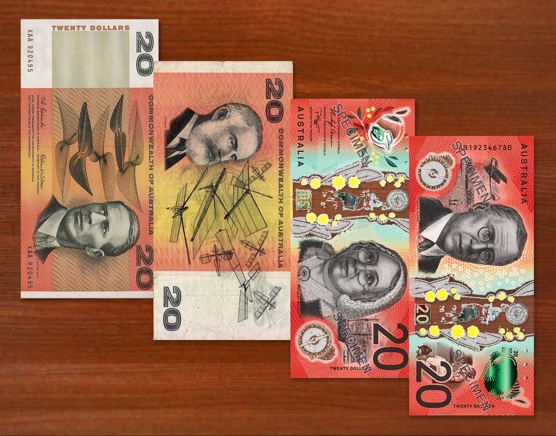
The Australian $20 has evolved from the classic banknote used until 1993 and the polymer designs used since, the latest version of which is shown above. The current bill features holograms, clear panels, micro-engraving, raised dots the say $20 in braille, and many other security features. Images courtesy Wikimedia Commons, originally either scans of actual banknotes or images released by the Australian Treasury. I have simulated the transparency in this collage image.

AN UPDATE: No posts for a while due to sudden hospitalization (stroke) – posts and a round-up will appear eventually but they may be delayed/late.
Next month sees Campaign Mastery host the Blog Carnival once again. The topic I’ve chosen is “The Face Of Money”.
The faces on coins and banknotes are a great way to sneak snippets of game lore and background into the players’ head space. Tales of valor, tests of wit and piety, challenges of popularity, masterstrokes of PR and hype, and assertions of authority – the faces of the issuing nobles (coinage) and commemorations (banknotes) can tell them all.
Quite often, the depictions will contradict the true story – the beatific the visage on a coin, the more likely the real persona was that of a ruthless authoritarian.
And on the opposite side there is usually a national symbol of some sort – an opportunity to spread those narrative wings even further.
So the first question: What’s depicted on your coinage and banknotes and what are the stories behind those depictions?
But, if you don’t feel like doing that one: Australian currency is notable world-wide for the intensity and vibrancy of its colors and the attention to microscopic detail in the designs. Every time you think you’ve reached the end of the list of tiny little details, you find that there’s another layer, another level, somewhere else – that goes even deeper. All in the name of defeating counterfeiters, of course.
So, the second question: What makes the currency of your game world distinctive, and what impact does that have?
And the third alternative: What unique challenges does your game world face in fighting counterfeiting, and how are the nations in your game world attempting to meet those challenges?
And the fourth: What is the single most valuable object or artifact in your game world, and why does it have such a high value?
And the fifth: What is the biggest financial or economic scandal ever to rock your game world, and what have been the lasting impacts of the event?
Sci-fi GMs shouldn’t feel left out, even if their game “worlds” have left currency behind in favor of something more generic , like the credit. There would still be institutions devoted to holding and expending those on your behalf, and they would produce something to permit that – a debit card, essentially. There would almost certainly be stiff competition to be the one YOU trust with your hard-earned non-currency – every ‘bank’ would have it’s own PR angle, and those would be reflected in the graphics on those cards. This one promises lower fees, that one a friendlier customer service, the other promises (somewhat vaguely) to be ‘on your side’. Who are the major issuers and what do their cards look like? What are their reputations, and what are they really like?
In other words, the sixth and final alternative: Tell me about the money of your world, and the structure of the economy.
And, for anyone who has never put any thought into Sci-Fi “credit”-based economies, here’s a thought that often isn’t mentioned about such: On our Earth, ‘credit’ usually means spending money you don’t yet have (hence ‘credit cards’). If you can only spend what’s in your account already, that’s a debit card or debit account. Unless there’s been some reversal in the terms over the millennia, that means that the economy of any world / campaign that uses ‘credits’ as their currency means payment in advance. On the face of it, this makes sense – you pay a builder in advance and he uses that money to buy the materials and employ the workmen who will actually construct the house or bridge or whatever. The problem is that this assumes everyone you buy something from is going to give satisfactory service. Our modern system is a bit of a hybrid – purchasing most material goods is based on this system, with guarantees of satisfaction or your money back. But when it comes to contracted work, it usually runs the other way at least in part – a portion of the total paid up-front and the balance either paid in regular installments, or installments due at certain project milestones, or a final payment upon satisfactory completion of the work. Parts of this work to protect the purchaser, and parts work to benefit the contracted worker – and neither are perfect at performing those roles. So, having taken that on board, have a deep think about the economic structure of your game world and the implications of that decision.
As usual, leave a link to your post in the comments below, and in due course, there will be a roundup.
My responses
I’m never one to shy away from a little world-building. On Earth-Regency in the Zenith-3 campaign, the British Empire never fell (it stumbles from time to time). While each nation is permitted its own currency, the British Pound is legal tender throughout the Western world.
The currency is unusual in that it doesn’t depict the issuing monarch except on the coins; instead, a prominent historical monarch is depicted, emphasizing the continuity of the royal family. Since the current game date there is 2050, this includes the contemporary monarch in our world, King Charles, who stunned the world by abdicating in 2030 (allegedly for health reasons). These monarchs are depicted on the backs of the bills, not the front, and shown against a backdrop depicting in line art one of their notable achievements. On the front are famous events from history plus a depiction of an object or person considered essential to any narrative describing the event depicted.
Denominations are £500, £200, £100, £50, £20, £10, £5, £2, for eight in total. In addition, a special edition currency was released in 2015 to commemorate the 800th anniversary of the Magna Carta, considered the foundation of modern society. It was, appropriately, £800 in value, and only issued for that year. Security features on all notes deserve special mention, but I’ll put those in a separate section below.
Coins all have the issuing monarch on the back, but showing different moods and activities. The fronts show iconic images from member states of what is now an Imperial Commonwealth (hence the title ‘King’ applied to the Monarch and not ‘Emperor’). The front images change every 5 years. Denominations are £1, 50¢, 20¢, 10¢, and 5¢. Security features once again in a separate section.
Banknote Details:
- Color: Simulated Vellum (back) and parchment (front).
- Depicted Monarch: King John
- Front Scene: Signing of the Magna Carta
- Color: Imperial Purple
- Depicted Monarch: Queen Elizabeth II, with the first Commonwealth Conference in line art, showing her at the podium.
- Front Scene: Neil Armstrong, Saturn-5 rocket launching on one side, Apollo 11 Lunar Lander on the other, and his boot-print after that.
- Color: Sovereign Gold
- Depicted Monarch: Queen Victoria. Backdrop: The Crystal Palace / Great Exhibition of 1851.
- Front Scene: World War II – Victory in Europe, 1945 Winston Churchill and his V-for-Victory hand-sign, a radar tower, and a spitfire flying.
- Color: Emerald Green.
- Depicted Monarch: Elizabeth I – Backdrop: The defeat of the Spanish Armada, tiny ships in line art.
- Front Scene: First Powered Flight, 1903, The Wright Brothers, A Douglas DC-3, a Boeing 747, and an Airbus Nistral (2048) – a complete history of aviation in the one scene.
- Color: Britannia Red
- Depicted Monarch: Henry VIII. Backdrop: The launching of the Mary Rose / founding of the Royal Navy.
- Front Scene: Fall of the Berlin Wall, 1989, Mikhail Gorbachev, and a sledgehammer breaking concrete.
- Color: Sapphire Blue.
- Depicted Monarch: Henry V. Backdrop: The Battle of Agincourt, longbowmen in silhouette.
- Front Scene: The Industrial Revolution – A steam engine, James Watt, an early railroad locomotive on tracks, and an early steam-powered ship, the SS Great Britain, the first iron-hulled, screw-propeller-driven steamship to cross the Atlantic, effectively rendering wooden paddle-wheelers obsolete.
- Color: Sunset Orange.
- Depicted Monarch: Richard I (The Lionheart). Backdrop: The Siege of Acre, his banner over the walls.
- Front Scene: Abolition of Slavery in the Empire in 1833 featuring a slave-trading block, William Wilberforce, broken chains, and Francis Williams (Early 1700s), the first Black person to earn a degree from Cambridge University. This achievement was the beginning of the end for Slavery.
- Color: Turquoise.
- Depicted Monarch: Charles III. Backdrop: The 2028 Commonwealth Green Charter signing – his last great act before abdication . A portrait of Queen Elizabeth II (his mother) is depicted on the wall even though no such portrait was present at the scene; it symbolizes the way his mother’s achievements perpetually overshadowed Charles III’s reign.
- Front Scene: The discovery of Penicillin in 1928; Alexander Fleming; a petri dish; a syringe; a DNA Helix; and a Caduceus, the winged symbol for Medicine, even though it’s use as such was a historical mistake – the true symbol was the Rod of Asciepius, which has only one snake and no wings.
- Color: Fuchsia.
- Depicted Monarch: King William V (the current in-game monarch). Backdrop: The Artemis Luna Permanent Base, 2034 – first royal charter off-world. Reinforces the perception he has tried to build as “The People’s King” – literally small change, but everywhere. Also depicted is a stylized chat screen, symbolizing his being the first Monarch to communicate directly with individual members of the public through social media. The only legible text is his famous sign-off, “- W”, used to indicate that he personally had written the response.
- Front Scene: Invention of the World Wide Web, 1990, Tim Berners-Lee, the @ symbol, and a famous map of the internet by Martin Vargic under his studio name, Halcyon Maps.
£800
£500
£200
£100
£50
£20
£10
£5
£2
Coin Details (2050 issue):
- Color: Gold coin with a Navy Blue enamel insert.
- Monarch Activity: The sportsman – playing tennis, depicted in mid-serve, a prominent grin.
- Front Scene: The Great Pyramids of Giza – the Empire’s oldest holding.
- Color: Silver Coin with a metallic gold inlaid ring.
- Monarch Activity: The traditionalist, riding a horse, full Household Cavalry uniform, a serious expression.
- Front Scene: The Taj Mahal – jewel of the Raj.
- Color: Silver with Royal Purple Enamel Ring.
- Monarch Activity: The Statesman – posing for a formal portrait, hand on a globe, a crown and scepter visible on a cushion. Combines his “everyday person” persona with formality and a visual reminder of his power as Monarch.
- Front Scene: Mount Rushmore, showing that the Empire is capable of celebrating the achievements of its constituent Nation-states.
- Color: Silver with Emerald Green central dot.
- Monarch Activity: The Strategist – playing chess, leaning over the board, and reaching for a Rook.
- Front Scene: The Sydney Opera House, symbolic of Culture in general and a reminder of the breadth of the Empire.
- Color: Silver with a Sky Blue enamel ring.
- Monarch Activity: Defender of the nation – a paratroop landing, recognizing the military service all English Monarchs in recent years have performed.
- Front Scene: Christ the Redeemer, Rio, symbolic of Religion within the Empire in general, and an acknowledgment that the Church Of England is not a state religion.
£1
50¢
20¢
10¢
5¢
Banknote Security Features
this is not a closed list – there are more security features than those listed. These are just the ones that most people know about.
There are alternate depictions of the scenes that are only visible under black light, micro-engraving, clear panels, the denomination spelt out in braille through raised dots in one corner, and polymer construction.
There’s even a UV hologram, completely transparent in ordinary light, visible under UV, that changes as the note moves under the UV light. Good luck copying THAT with a scanner or photocopier.
There is a second serial number known as the Windsor Protocol, mathematically related to the first, that is embedded in a digital metallic strip, but completely invisible to any light-based sensor – be it eyes or scanners. If the two don’t correlate, you have a top-end forgery. The mathematical formula connecting the two numbers is both top-secret and changed every year or two, without notice – but the year of issue is embedded within the visible serial number AND known to be part of that mathematical expression, telling the evaluative systems what formula should have been used.
Street-level fakes fail the braille / clear panel test – the physical construction.
Better fakes fail the overt UV tests.
Very Good fakes fail the more subtle UV fakes and the micro-engraving.
A top-end forgery can get the paper right, the clear window right, even fake the UV hologram with lenticular foil – but if they just make up a second number, or clone a strip from another note, the correlation fails instantly.
Any business with credit card tap-and-go facilities can detect the presence or absence of the Windsor Protocol Strip (commonly nicknamed the Windsor Knot after the necktie fashion), but can’t read the code.
The Windsor Protocol faced an early challenge when a top-level counterfeiter tried extracting the strips from 5-pound notes and putting them in fake 20s. These instantly failed when automatically scanned at the bank, which has more sophisticated scanners. These report both serial numbers through a high-security internet service run by the government and instantly detects any mismatch.
And it has the added benefit – if the printed serial number can’t be read cleanly, the bill has to be provisionally ‘clean’ but has sufficient wear and tear that it should be withdrawn from circulation. An empirical test to replace or supplement a teller’s visual inspection. The ink on the serial number is DESIGNED to wear out faster than the rest of the printing – which is counter-intuitive, but works logically.
This IS actually another security feature – forgers can’t artificially age banknotes to make them more convincing, because doing so enough to make a difference either damages the serial number too much (detects as fake) or doesn’t degrade it enough – if the serial number ‘pops’ visually, the note comes under instant suspicion.
Furthermore, PART of the visible serial number is printed in magnetically-readable ink, providing another method of reading that serial number – but there are also magnetic fibers in the polymer that CHANGE some of the serial number when it is read in this way, but in a systematic way – this serial number ALSO has to pass the Windsor Protocol. This raises the difficulty of generating false codes to something akin to that of breaking high-security encryption.
And there’s a hidden layer to the Windsor Protocol that few people know about – the shop-based scanners don’t get real-time validation of the ghost serial number, but they do log and report it to the banking service issuing the reader in an encrypted format. As a result, once a forgery IS discovered, it can be automatically tracked to its point of initial disbursement, regardless of how many hands it may have passed through along the way. Treasury agents will be all over that point, usually within 24 hours of the forgery being ‘passed’.
Overall, the security features are designed to discourage attempts to forge banknotes, increase the cost of doing so, mandate the acquisition of restricted elements, make it easier to find anyone foolish enough to try counterfeiting, and ensure public confidence that their money is safe. They also reinforce a subtle message of the durability of the institutions and an overarching political message about the continuity of the Empire.
If a note fails – it sometimes happens – and gets broken into two parts, the part containing the Windsor Protocol and serial number are considered to be ‘The banknote’ while the remainder is scrap plastic. The note will be withdrawn from circulation, sent to the Treasury through the Bank Of England, and a replacement put into circulation. If the tear damages the printed serial number, it has to be taped back together, and is treated as genuine if it passes the Windsor Protocol Testing. No member of the public should ever be deprived of their wealth by a failure of the banknote.
Coin Security Features
These are relatively minimal. Images are designed to use the entire surface of the coin face, even penetrating enamel rings. This makes it harder to counterfeit, and much harder to grind away edges to make counterfeit.
The alloy is slightly different in each denomination, giving each coin a slightly different hue in the metallic portions. The difference is subtle, but close inspection by naked eye can easily pick out one forgery amongst real coins, further preventing the recasting of low-denomination coins as more valuable ones.
There is micro-engraving. somewhere on the coin, but the location varies – one of the parachute lines in the 5¢ piece is actually King William V’s military regiment and service number, but you need something better than a magnifying glass to see it.
There are perpetual suggestions that the enameled surfaces conceal an RFID device, but no-one has found one – and it’s illegal to cut up coins or otherwise deface the currency (5-10 years per £ defaced), so few have tried (an exception carved out in the legislation permits the drilling of holes for the conversion of coins to Jewelry).
JUST REPEATING THE UPDATE FROM THE TOP OF THE POST: No posts for a while due to sudden hospitalization (stroke) – posts and a round-up will appear eventually but they may be delayed/late.

Discover more from Campaign Mastery
Subscribe to get the latest posts sent to your email.



September 16th, 2026 at 12:22 am
[…] September RPG Blog Carnival topic really caught me by surprise! Not only that I obviously didn’t know what it was going to be ahead […]
September 16th, 2026 at 3:12 am
Good afternoon! Ive gone ahead and completed a post for your Blog Carnival, hope you enjoy it as I found your world’s cash fascinating in its detail! I am a big nerd for historical money so I was super excited by your premise for the month, hopefully it lives up to your great example! https://dungeonsandpossums.com/2026/09/september-rpg-blog-carnival-the-face-of-money/
September 16th, 2026 at 7:07 pm
Thank you, Dungeons & Possums! I am only just home from the Hospital so this was welcome news. Glad you found the topic exciting!!
September 20th, 2026 at 3:58 am
[…] Blog Carnival which is hosted this month by Campaign Mastery with this month’s theme being The Face of Money, what does money say about those who issue […]
September 21st, 2026 at 1:53 am
Thank you, Sean! I am recovering – not as quickly as I might like, but getting there a bit at a time, appreciate the thought. Looking forward to seeing what you have for me to read :)
September 20th, 2026 at 4:00 am
Hope you are recovering well.
Here is my contributions on the coins and currency of the Sea of Stars:
https://seaofstarsrpg.wordpress.com/2026/09/19/coins-and-currency-of-the-sea-of-stars-rpg-blog-carnival/
September 22nd, 2026 at 1:11 am
Mike, just saw about your hospitalization. Praying for a swift recovery.
Here’s my contribution.
https://vulcanstev.blog/2026/09/21/post-apocalyptic-currency/
September 22nd, 2026 at 2:00 am
Getting better, thanks, Steve, so your prayers have been largely successful. Taking it easy and giving myself every chance at a full recuperation, but so far it’s going well. Thanks for your contribution, I look forward to reading it!
October 13th, 2026 at 12:00 am
[…] Link to my submission: The Face Of Money: Blog Carnival Sept 2026 […]