Trends and other tricks in Campaign Design
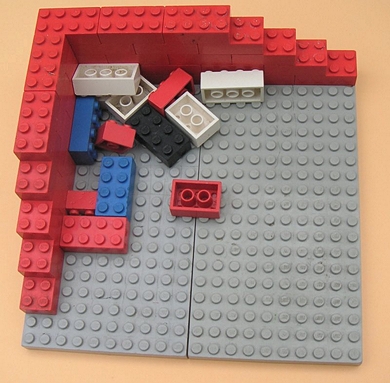
Image By Priwo (photo taken by de:Benutzer:Priwo) [Public domain], via Wikimedia Commons
This weekend’s session of the Zenith-3 campaign was a great success, and one of the big reasons for that was the real sense that the PCs were fully integrated elements within the game world. This article is going to look at some of the major reasons for that so that you can do it in your games, too.
Trends
In a nutshell, I didn’t create static statuses within the campaign. When the PCs first encountered or learned of a situation or group, whatever impression they got of that group or situation was, at best, a freeze-frame of the dynamic processes already acting to evolve the subject.
What’s The Difference?
A status is a fixed statement of the way things are. It’s static and unchanging unless directly acted upon by the PCs (and sometimes even then, when it shouldn’t be).
A Trend defines not only the current status but what it is already on the way to becoming if no intervention takes place, together with some sort of time-frame for that change and how other groups will react to the change.
For example, a government might currently be formal and rigid, but be heading in the direction of practical and flexible, driven by public exasperation with what is seen as excessive inflexibility.
There are three possible subtexts to such a Trend: either the status is a legacy that the current government are trying to change, or the change is an opposition position to an unpopular government, or the change is being driven by public protests, marches, etc.
There will almost always be one or two incidents in the recent past that can be held up as “poster children” for the need for the Trend, and it’s often helpful to specify these in at least general terms. A popular celebrity dying after being turned away from medical treatment because their paperwork wasn’t in order, for example.
Each of the different subtexts has a different time-frame. The first is based on the remaining lifetime of the current government, which may be more than one term if they are still popular enough. The second is the next election plus however long the honeymoon period is – after that, the public would expect to see at least some shifts in policy. The third option is the most open-ended, with a time-frame that largely depends on how repressive the government in question is. The more dictatorial, the more likely that nothing short of revolution will achieve the reforms demanded, and the more subversive and secretive the activities of supporters will need to be. The more flexible and open and democratic the system of government, the greater its capacity to respond to demands for change.
What’s The Impact?
As soon as the PCs came to the attention of some other group, their presence began to influence and shape the already existing dynamic forces as the group began to work out whether the PCs were allies or enemies, and how best to use the fact of their existence or involvement to further their own agendas.
Because the PCs were receiving only the “polarioid moment” of the way things were now, a lot of relationships and plans were able to mature in the background.
This session, for the first time, all these seemingly-isolated events were connected and the relationships between them defined to the PCs for the first time. In other words, patterns within the isolated events began to become apparent to them, revealing a Bigger Picture that had been there all along.
To a certain extent, these were all logical developments of the situations that the PCs were already aware of, and so there was a manifest sense of inevitability to each shoe dropping.
Secondary Impacts
Every character will have some opinion on the subject. The Trend itself, as defined, will generally dictate the majority position, but acceptance of the Trend might be reluctant or eager. Conservatives might have a different position on the subject to Liberals, certain businesses will have positions based on the impact on their vested interests, and every position should have an intelligent opposition – something that I alluded to in Influences, Styles, Trends, and Oscillations.
In the case of the example Trend: Financial markets love stability and hate instability. The proposal would inevitably trade predictability for flexibility, and so the expectation would be that financial markets would fall in value, corporations would pay smaller dividends, and interest rates might need to be lowered to stimulate the economy and buffer against these effects, which would further depress the dividends paid by banks (because they would make less money on loan interest). That would reduce the value of the currency relative to other nations, so importers would need to pay more for their goods, costs that would be passed on to consumers, generating inflation. On the other hand, exporters would make more money from sales.
Already, then, you have some groups who would be opposed, and some who would be concerned about the proposed changes. “Anarchy and Depression,” they would forecast – as loudly as possible.
Another tack that would almost certainly manifest is that flexibility inevitably increases the risk of it being abused; rigidity might be unfair, but it’s equally unfair to everyone. So there would be a middle group on both sides of politics who agreed with the need for change but were concerned over the strength of the proposed safeguards against abuse. “They want to open the door to Corruption” would be a soundbite issuing forth from those opposed, and “Fix the system – don’t tear it down” would be another.
The farther such ripples can spread – no matter how much hyperbole and exaggeration and outright distortion may be involved in creating them – the more people will find a reason to take a stand, and the less clear-cut the whole thing becomes. Which is another way of saying, the more interesting it becomes, and the more susceptible to influence by the PCs. And the more enemies and allies they will make as a result.
The other thing that should be obvious from the example is how much more vibrant and dynamic the political environment becomes as a result.
Of course, the trend might not be so directly political. Equality is an issue that periodically manifests itself as a social dynamic, and we appear to be entering such a phase at the current time, at least in terms of the media and women’s rights. In the past, it might have taken six months or more for tangible manifestations of this stance to begin impacting the opinions of ordinary people and hence society at large, which made change slower and more measured; but we live in a world of Social Media and Mass Communications, much of it unfiltered (or with the filters/bias overwhelmed by the strength and voracity of the movement), so change will be faster and more likely to go too far, too fast – producing an eventual reaction.
Lest readers think that it is impossible for that to happen, we’ve had this situation with regard to the teaching profession for decades now, in which the mere accusation of misdeeds is enough to destroy careers, and there have been some cases of false accusation over the years, but – as yet – there has not been any cause celebre to trigger tightening of evidentiary standards. At the same time, of course, protection of children must be the paramount consideration; what is needed is some way of reconciling the conflicting demands that result. That’s far more easily said than done.
Shown, Not Told
“Show, Don’t Tell” has been a writer’s maxim for a very long time. To a very great extent, the ‘Trends’ technique is a manifestation of this principle, a technique for achieving it.
By making the group aware of a reaction to some past action in which they were involved, and then explaining it in the broader context, I was quite literally showing the PCs what was going on and how the world around them was evolving in response to their presence within it.
For example, through the context of a game show (more on that in a separate post to follow at a later time), I was able to bring back one of the bad guys from very early in the campaign, when the PCs accused him of hiring an assassination team to deal with a political enemy. While the Assassins were stopped, the PCs failed to locate proof of this politician’s involvement – so one of them leaked their suspicions anonymously to the internet, expecting that it would derail the political career of the total sleazeball in question.
His attempts to redeem his reputation in the course of the game show have failed miserably so far, but he was able to establish a political trend towards greater accountability for law-enforcement agencies and operatives, including the PCs, and that this was an election year.
Later, a message from something of an ally (I’ll get to that in a moment) made the PCs aware that because they were seen as allied to the current government, but too highly respected (and too popular) to attack directly, the opposition party would have no alternative but to try and utilize the PCs’ fame for their own political ends, even as they sought to take control of their activities.
This put into context multiple encounters with politicians – some seemingly supportive, some hostile – that had taken place in the past. It revealed a pattern – but not just a static pattern, a dynamic one.
If there is a burning issue of some kind – which is usually the case when there is a significant Trend – everything that is said and done will be interpreted through that filter, forcibly if necessary. That includes anything that the PCs said before they became aware that there was a Trend.
What’s
more, the PCs may well have opinions on the subject of their own – which may or may not match those of the players. That’s when Roleplaying becomes more challenging.
On top of that, if the PCs have been recognized as growing in stature, status, popularity, power, or fame, their very existence will begin having an impact; as they become a factor that could influence a Trend, groups who oppose the perceived direction of that influence will begin to perceive the PCs as political enemies and/or rivals.
Many Threads Winding Together
Many other plot threads formed part of the same picture. For some time, the bureaucrats of the civil service have been inflicting make-work and time-fillers on the party – their own means of taking control of the PCs. At the same time, the Crown Prince has been actively supporting the PCs – but using their association to enhance his own prestige and authority.
Both of these patterns – which the PCs had already recognized – were explained and expanded by this new context. But, even more importantly, they were also rendered parts of a dynamic, evolving picture, whereas in isolation they had seemed to be constants, static Polaroid moments.
Rich Characterization
Another aspect of these revelations was that none of the participating NPCs were cardboard cutouts. “Allies” had dark corners, and “Enemies” had bright spots, even if these had not been apparent at the time the PCs encountered them. In fact, the only outright villain to appear in this entire game session was that corrupt politician.
In an awful lot of cases, people (NPCs, of course) were going to seek to control or restrict the PCs because they genuinely consider that to be the best thing for the nation/Kingdom/empire or whatever.
Of course, they will also win allies, and that can be an even greater problem, because they may well do or say things that the PCs disagree with, or perform actions they can’t sanction in the name of the cause with which the PCs have been linked.
One of the major side-issues to be aired (both sides of the debate) in the course of the game-show related to the social responsibility of the famous – not just to be an example, and therefore held to a stricter code of conduct than that of mainstream society, but whether or not they have an obligation to speak up on social issues. At first, it might have seemed that this was simple color for the campaign; but later roleplay revealed that the PCs were famous, and so the entire question becomes a debate about whether or not the PCs have an obligation to speak up on social issues (something they have done their best to avoid doing, so far). Ultimately, this became a debate in-game over the right to privacy of the famous – and the PC participating was unable to avoid being painted as supporting that right over the obligation to use their fame responsibly.
Established Foundations
Since the campaign started, I’ve been laying foundations for later adventures. To the players, these frozen snapshots of the way things were at the time were undoubtedly taken to be static statuses. The other thing that I’ve been doing is (indirectly, most of the time) forcing the PCs to define the values that they would be perceived by the public as representing, i.e. defining the shape of the influence they would be inadvertently having on the existing Trends, and how the relationships would change as a consequence of these influences.
Suddenly, a whole bunch of unrelated events and relationships have been revealed to be part of a common narrative thread that’s been gestating under their noses the whole time I’ve been putting these building blocks in place.
Of course – and I’m not revealing anything that my players won’t be expecting at this point – this is only the beginning. The current situation is, itself, just a building block that will lead to new and different adventures.
The Core Design Principle
When you put all of this together, you start to realize that the game world as the PCs initially found it to be is not the game world that I “required” or “designed” to be the platform for their adventures in this campaign; instead, I created a game world that could become that platform in the course of play, shaped by decisions made by the players – sometimes in response to direct questions (the media make great mouthpieces), but more often as side-issues to whatever the action was.
For example, the PCs have established a policy of doing what they perceive to be “the right thing” (or “the lesser evil”) whether it conflicts with the law or not. They have sought out and received funding from a known drug dealer in order to secure a contract with the most-wanted freelance espionage operative on the planet.
If that situation had been posed to the players on play-day one, or even ten, the players would not have countenanced it. It took time to establish the trustworthiness of the drug-dealer in question (and that he really wasn’t all that bad a guy) in their minds, and to place limits on the relationship that gave the PCs the confidence to seek him out under these particular circumstances (for that matter, at that point in time, it would have been utterly unrealistic for him to trust them, either). It took time to build up awareness of just how bad the particular crisis was going to be, and to establish the credentials of the espionage operative in question.
But, with that groundwork all laid, I was completely confident of what the PCs would decide to do under the circumstances, and make it the undercoat of a much bigger picture. If you were to define the campaign as having a beginning, middle, and end, they are now transitioning from Beginning to Middle. That’s actually something of a misleading simplification, because I have multiple plotlines taking place concurrently, and more that have not yet started. But, for the first time, that bigger picture is starting to take shape for them.
The orchestra have finished tuning up, it’s time for the dancing to start…

Discover more from Campaign Mastery
Subscribe to get the latest posts sent to your email.



January 30th, 2018 at 6:10 am
Mike
Thanks for this. This is up there with your best articles, methinks. Deep, very deep [simple concept when explained but boy, this one looks like a rabbit hole if you’re not careful – brilliant too]
January 30th, 2018 at 2:45 pm
Thanks, Gazza! I almost didn’t write this one, it was so difficult to articulate the concepts and why they worked (adding the examples at the 11th hour helped tremendously). Ultimately, I found a way because I couldn’t think of any other topic to write about that fitted the time available! So I’m glad that your comment indicates that I succeeded in explaining the notion clearly enough for you (and hopefully my other readers) to grasp, and appreciate your taking the time to comment! As for that rabbit hole – who cares if it’s fun?
But seriously, the more powerful the tool, the more damage it can cause if mishandled. You should always take appropriate care!