A Fairy Colony In Zenith-3
What is a Fairy Colony, and why should you never annoy one? Or attack one? I didn’t want to go full “Fey” so I came up with something different…
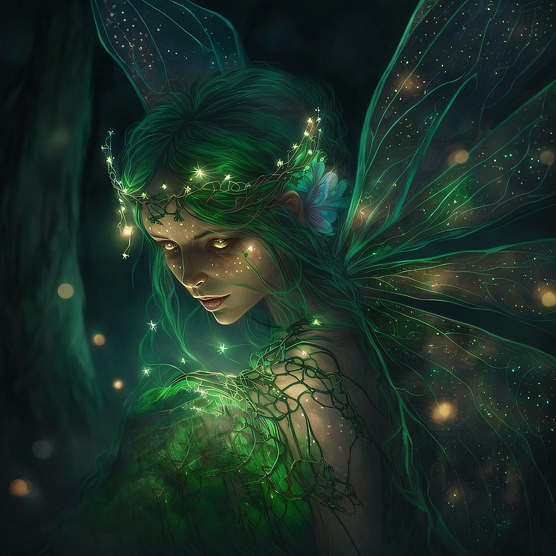
Image by Stéphanie MENARD from Pixabay

In the Zenith-3 superhero campaign, there’s a Fairy Colony at the bottom of their back yard. It was placed there years ago (real time) but until late last year, no details had ever been worked out. heck, there wasn’t even a functional definition of a fairy, let alone a Fairy Colony! But, with play set to resume next week, that had to change; so I wrote up some concepts, and then added to them, and added to those, and so on. None of my players have seen this yet (and the details in that specific campaign’s version are slightly different, anyway). That’s because I’ve adapted this to work with D&D/Pathfinder, even though it remains a concept for use with Hero Games, fundamentally.
Fairy Physical Structure
Fairies average 6-12 inches (15.24-30.48 cm) in height.
They trend towards being slightly built, though a few are stockier. The average weight is 40-320 g. Stockier examples x 1.45
Their wingspan is typically 2.4 x their height (each wing = x1.2 height), and resemble those of a dragonfly. They fly at peak speeds of up to 6″ 25mph (72 km/h) 12″ 65mph (105 km/h). Divide these by the 1.45^0.5 = 1.204 for stockier builds.
Cruising speed is 6″ 20-25 mph (32.2 – 40.2 km/h) to 12″ 30-.35 mph (48.2 – 56.3 km/h).
They have three fingers and a thumb on each hand. As a result, they tend to number things in base-8.
1=1
10=8 (two hands)
20=16 (four hands)
100=64. (a great hand)
etc.
At 12 inches tall, a fairy is effectively a small, sentient projectile. Flying at 65 mph, an impact would be significant – carrying about the same kinetic energy as a professional pitcher’s 100mph fastball.
Wearing a pointed helmet or using a pole arm, they become the equivalent of a living AP round (at relatively low velocity relative to a gun, but still…)
The wingspan of the larger fairies handicaps them in forest and indoor settings. They dominate the open skies. The smaller fairies are far more maneuverable and dominate tighter spaces. As a species, they take advantage of these facts – short fairies are melee fighters while taller fairies use javelins and bows..
Because of the high speeds and small size, these fairies would likely have an incredibly high metabolism, requiring constant intake of high-energy foods (nectar, fats, or sugars) to fuel their flight muscles. They magically concentrate food daily. They will eat once when the moon rises, twice more at four-hour intervals, and have a half-meal when it sets (to give them an energy reserve to call upon if attacked in the night). Their preferred diet is tree sap (especially of the maple variety), leaves, and fruit. Most flowers do not produce enough nectar to do more than add flavoring, but they prize them for that function. Especially brave or hungry fairy colonies may raid a beehive.
Fairy Social Structure:
They consider themselves a single clan or “colony”. When their numbers grow too large, the colony will split and have a big fight to see who gets to stay and who has to look elsewhere. Normally, about 2/3 will refuse to fight, either choosing after the outcome is decided which group they will affiliate with, or volunteering to relocate, regardless.
How many is too many? The real number is somewhere between 500 and 1000 adults, but most Kings pick a number between 100 and 500 with which they are comfortable. Beyond a few hundred, you stop knowing everyone as individuals very well, and past about 500, you start losing track of individuals completely – and social cohesion and relationships are essential to a Fairy.
Fairies hold grudges for decades, if not longer, as hot and passionate at the end as when the incident is fresh. They are easily placated, however, if this is done sincerely. For the most part, they simply want to be left alone. And party. And celebrate nature. And socialize. And gossip about each other (usually in a friendly way).
Then, too, in every generation there are a few really mean and nasty individuals – bullies and the like. If the colony is small in size, there won’t be many of these, and they will be easily quelled and controlled by the society at large; once numbers become more significant, society begins to splinter into subcultures, and these louts can become a gang, sparking difficulty with those living around the colony as well as internal strife. They can become a significant problem for the colony.
Four times a year, on the second full moon of the season, the Fairies have a celebration with an outsider as guest of honor. This outsider is chosen by a process called the Fabrinelle, a kind of treasure hunt through the surrounding lands. To be chosen, the person must be a true lover of nature. At the end of the night of wild celebrations, the guest is given a gift of some sort and an honored role in Fairy Society; he or she may call upon the Colony to aid them in some struggle or task that is beyond them. This power, once used, is lost forever.
On rare occasions, a guest may wish to remain with the fairies permanently. It is up to the King to determine if this is possible, and to make any arrangements necessary, but his primary task is to ensure the security of the Colony; there are times when this makes the request impossible. Some Kings, especially those without the guidance of a Queen, have made poor choices in this regard, such as replacing the child with a simulacrum, a changeling, who will fall ill and seem to ‘die’ over the next month or so.
Of secondary importance is that the request must not create conflict between the family of the guest and the colony.
Those who are permitted to remain are transformed permanently into fairies and become members of the colony like any other.
Fairy Political Structure:
On paper, it’s a Monarchy, but Fairies don’t use paper. Kingship rotates through the male population on a weekly basis. The Kings from the previous two weeks and the one who will assume the throne next week form a council of advisors, providing some semblance of continuity. If a King is wed, the she becomes Queen. The role of the Queen is to provide a conduit between the rest of the colony and the throne. She is also in charge of the recreation activities of the colony, some one-in-all-in social occasion.
It is when a King is unwed that things can get messier. The King has the authority to choose as his consort any unwed female who will have him, and she will then act as Queen for the remainder of the King’s Reign, but she has no training or authority to organize events, so the King does that himself – usually more masculine activities like hunts.
Fairy Activity Orientation:
As a general rule, fairies are neither nocturnal nor diurnal – they rise with the moon and set with it. But they can function outside these hours at need. To human observers, their daily cycles drift by about 50 minutes later every earth day; one week they are active at midnight; two weeks later, they are active at noon.
During the New Moon phase, the fairies rise and set almost exactly with the Sun. This is likely their most stressful time – they are active when the “Big People” (humans) and daylight predators are most active, and they lack the cover of night.
Clothing and Equipment:
Fairy clothing is generally made of leaves that has been treated with tree-saps to stiffen them and bind layers together, then magically hardened. Their very best armors are as protective as those used by human SWAT teams.
They carve many implements from wood and then preserve them with lacquers. Because of their small size, these can possess incredible delicacy and detail.
They forge metal through (magical) transmutation and melt/cast/smith it using magical fires. A single “blacksmith” might be one artisan and 15 or 31 others generating the heat. 256 fairies casting in unison can produce brief bursts of plasma-cutter temperatures.

Domiciles & Structures
Edible tree sap isn’t the only type that Fairies use. They dry sap out into flat planes, usually sandwiched between two leaves, building up layers which they treat magically to make them more resistant and resilient, at least as hard as granite, depending on the number of layers. These are then assembled and joined to construct homes and other structures.
The most common practice is to suspend these from tree branches, but every Colony has a different approach. The most grandiose structures may be suspended from multiple sides enabling a much larger construction – these can be full-on medieval palaces in miniature. But most structures are smaller and more humble.
The simplest structures are round, like beehives.
By far the favorite place to reside if one isn’t entitled to a ‘palace’ or ‘castle’ is in the hollow of a tree. These can be extensively and elaborately carved internally while little or nothing is visible from the outside save some internal illumination through windows.
They can sharpen sticks by coating them in resin, wrapping a leaf around it, and transforming it in the same way. A ‘forest’ of 3-6 inch spikes surrounding a colony for a couple of feet – with gaps big enough for the feet of any human(oid) visitors – is enough to discourage most predators; these spikes are needle-sharp and capable of penetrating the hardest hooves. If they have been attacked in the past, other refinements may be added to inflict poisons or diseases on hostile entities. This is also how they make their javelins and arrows.
This often makes a colony in a relatively safe environment confident enough to build dwellings on the ground as well as aloft, though only the lowest social classes would live there.
Fairy Magic
This is generally more elementary than that of a human mage, and more elemental, but it is capable of great subtlety, and backed by enormous power, because the whole clan participates in the casting. They may only have 1 mana point each, but 500 or 600 fairies cast spells more powerful than most human mages can even contemplate.
They recover that 1 Mana point almost instantly – it actually takes 5 or six seconds.
Fairy Spells tend to blow some aspect of the spell out to extremes.
Base area is proportionate to their size, so about 6 non-game inches to a hex.
In practical terms:
log [Area (square feet) x 12 / 6] / log(2) = area modifier.
So double the area (or less) for +1 modifier. or half area for -1 modifier.
EG: 10 sqr feet: 10×12/6 = 20; log(20)/log(2) = 4.3 so this is a +5 modifier.
Note that you don’t need a calculator. 2; 4; 8; 16; 32. 32 is more than 20, so we stop doubling. Count the number of doublings: 5. So 20 sqr ft = +5 – and so is anything from 17-32 square feet.
- 1 square foot = +1. This is the area to affect a human-sized individual.
- 10 sqr ft area is x20, so +5.
- 20 sqr ft area is x40 = +6.
- 100 sqr ft is x200 = +8.
- 1000 sqr ft is x2000 = +11.
- 10,000 sqr ft is x20,000 = +15 (a large stadium).
- 1 square km = 1.55e+9 sqr inches = x1.55e+9 / 6 = x258,333,333.3 = +30.
- 1 sqr mile = 4.01451e+9 sqr inches = x 4.01451e+9 / 6 = x669,085,000 = +30 (both fall within the same power of two).
- 25 sqr km (5km x 5km) (a moderate city) = x6,458,333,333.3 = +33
- 22.7 sqr miles (Manhattan island)= x15,188,229,500 = +34
- 100 sqr miles (a larger city) = x66,908,500,000 = +36.
- 12,367 sqr km (Greater Sydney) = x3,194,808,333,333.3 = +42
- 30-40,000 sqr km (small Western European Country) = x7,750,000,000,000 – x10,333,333,333,333.3 = +43 to +44
- 100,000 sqr km (average Western European Country) = 25,833,333,333,333.3 = +45
- 540,000 sqr km (France) = x139,500,000,000,000 = 1.395e+14 = +47 (barely)
- 7,660,000 sqr km (continental US) = x1.978833e+15 = +51
- 255 million sqr km (Earth Hemisphere) = x6.5875e+16 = +56
- 510 million sqr km (Earth) = x1.3175e+17 = +57
Duration: the base is instant (+0), then 1 second (+1), as usual. The calculation is the same, as you will observe below.
- 1 minute = 60 sec = x60 = 1+log(60)/log(2) = +7.
- 5 mins = 300 sec = x300 = 1+8.2 = +10.
- 30 mins = 1800 sec = x1800 = +12.
- 1 hr = 3600 sec = x3600 = +13.
- 1 great-hand of minutes = 64×60=3840 sec = x3840 = +13.
- 1 hand of life = 4 great-hands of minutes = x3840x4 = x15360 = +15
- 6 hrs = 21,600 sec = x 21,600 = +16.
- 1 sky-cycle (lunar rise to lunar set) = approx. 12 hrs 43 min = 45780 sec = x45780 = +17
- 1 long-day (max lunar rise to set, occurs every 18.6 years) = 18.5 hrs (max) = x66600 = +18. Most will be +17.
- 1 day = x24x60x60 = x86400 = +18.
- 1 Fairy-day = x(86400+50) = x86450 = +18
- 1 Fairy-week = x7x86450 = x605,150 = +21
- 2 hands of fairy days = 1 half-cycle = x8x86450 = x691600 = +21
- 1 hand of hands of fairy days = 1 cycle = x1,383,200 = +22
- “15” cycles = 13 cycles = 1 season = x13x1,383,200 = x17,981,600 = +26
- 1 hand of seasons (1 year) = x4x17,981,600 = x71,926,400 = +28
- 1 hand of years (4 years) = x4x71,926,400 = x287,705,600 = +30
- 2 hands of years (8 years) = x2x287,705,600 = x575,411,200 = +31
- 2 hands of hands of years = 32 years = 1 Fairy generation = 2x4x4x287,705,600 = x9,206,579,200 = +35
- 1 great-hand of years = 2 Fairy Generations = 1/4 of an age = 1.841316e+10 = +36
- 1 hand of great-hands of years = 8 Fairy Generations = 1/2 an age = x4x1.841316e+10 = x7.365264e+10 = +38
- 2 hands of great-hands of years = 16 Fairy Generations = an age = x2x7.365264e+10 = x1.4730528e+11 = +39
- 1 great-hand of great hands of years = 4096 years = an ‘eternity’ = x4096x71,926,400 = x2.946e+11 = +40
Difficulty in breaking spells:
- Caster level required +1 = +1
Adapting to D&D Spells:
Colony Size / (Spell Level* +1) = total pluses (round down).
Area Pluses + Duration pluses + Difficulty-in-breaking pluses = total pluses
* includes any additional caster levels to achieve desired effect level.
Kings can choose to cast with lower total pluses, the above sets maximum levels.

A Fairy Queen. Image by Jim Cooper from Pixabay, cropped by Mike
As a general rule, choose the spell effect that you want and then select the spell that best fits. “Bless” and “Curse” are frequent choices.
EG “May it rain on you, wherever you roam, regardless of cover, for an entire season.”
Curse, 1st level spell. Human sized individual. Colony of 85 faeries.
85 / (1+1) = 42.5, rounds to 42. So an individual could be cursed for more than 4096 years. But let’s play it safe (for the colony) and limit the curse to a season (+26). And let’s spend +10 adding to the caster level requirement of any mage or cleric who attempts to lift the curse, for a total of 1 (area) + 26 (duration) + 10 = 37. This leaves 5 unallocated.
Casting Consequences
A colony casting a spell is literally doing so with their life-force. It’s not done trivially.
(30 x actual total pluses / maximum total pluses) + spell level + 10 = % of colony half-killed = 2 x % of colony killed (round both down).
% colony killed can be reduced by X% by increasing the % half-killed by 2 x X% and reducing the number of pluses AFTER the above calculation by 0.5 x X.
EG Continued: 30 x 37/42 = 26%. 26+1+10=37% half-killed and 18% killed. We can use the 5 pluses remaining to reduce the death penalty by 10 to 8%. This adds +16% to the number half-killed, for totals of 8% killed and 53% half-killed.
Not a trivial exercise at all; this curse is right at the limits of what a colony this small can do.
Comparison example: Colony of 170 (twice the size): “May it rain on you, wherever you roam, regardless of cover, for an entire YEAR.”
Curse, 1st level spell. Human sized individual.
170 / (1+1) = 85. Duration: 1 year (+28). +20 caster level requirement of any mage or cleric who attempts to lift the curse, for a total of 1 (area) + 28 (duration) + 20 = 49. This leaves 36 unallocated.
30 x 49/85 = 17% half killed, 8% killed. Reduce the 8% to 0: uses 4 additional pluses, plenty in reserve. Totals: 0% killed, 17+16=33% half hit points (recovered at 1 per day as usual).
Not only is this a nastier spell (it lasts a year and is harder to dispel), the colony is able to cast it with relative impunity.
Let’s nasty it up a little more, so that it not only affects the individual but anyone physically close to them.
Comparison example: Colony of 170 (twice the size): “May it rain on you and any who approach you, wherever you roam, regardless of cover, for an entire DECADE.”
Curse, 1st level spell. Human sized individual + surrounds = 5′ x 5′ area.
170 / (1+1) = 85.
Area: 5′ x 5′ = 25 sqr ft. log(25)/log(2) = 4.64, so +5.
Duration: A decade isn’t on the list, but 8 years is – value of +31. So a decade will be +32.
+23 caster level requirement of any mage or cleric who attempts to lift the curse.
Total of 5 + 32 + 23 = 60. This leaves 25 unallocated.
30 x 60/85 = 21% half killed, 10% killed. Reduce the 10% to 0: uses 5 additional pluses, still plenty left over. Totals: 0% killed, 21+20=41% half hit points (recovered at 1 per day as usual).
Half-killing almost half the colony is about as far as it’s reasonable to go; anything more risks the colony’s survival, should a predator find them.
One more example:
“May every building you enter burn to the ground for the rest of your natural life” (man, the King must really be pissed off at the target!)
Colony Size 400.
Spell: Fireball (3d6), Level 3 spell, plus 2 caster levels to get 3d6 = level 5.
Max Bonuses = 400 / (5+1) = 66.
Area: 20′ x 20′ = +6.
Duration: +37.
Dispel Difficulty =+7
Total = 6+37+7=50, leaves 16.
30 x 50 / 66 = 22% half-killed, 11% killed. Protect the 11% = +6 levels, 10 in reserve.
Net cost: 22+22=44% half hit points, no fatalities.
Note that this is right on the edge for a colony of this size, which is close to as big as they come. Maybe they colony could have afforded another +5 dispel difficulty. But most spell-casters would be disinclined to help if the practice of consulting them burned down their houses, so maybe that’s not necessary.
Personal Magic
In addition to the major castings above, which always involve a ritual and a whole colony, most fairies are capable of smaller, more temporary ‘personal magic’ – making vines and tree limbs light up with glowing ‘fairy light’, shrinking visitors to enable them into homes, etc. No such magic effect can last for more than a day and most for less. It is ten times more efficient to sustain an existing spell than it is to cast it anew.
Fairy Personalities
Fairies are generally lighthearted and friendly, though some have nasty senses of humor. A few – generally marked for greatness within their society as a result – are capable of being more serious, more judgmental, and exhibit gravitas that far outweighs their stature. Relatively few are the sly, cunning, scheming types; they are more happy-go-lucky and take life one day at a time as it comes to them.
These moods and attitudes vanish instantly when the colony feels under threat. Fairies are capable of an anger that has to be seen to be believed, and can sustain it for generations. Hillbilly fueders have nothing on these folks when someone earns their enmity. Entire colonies have uprooted and moved simply to be in a better position to harass someone the Fairies think worthy of that level of enmity – though it is more common for a colony to split over such an issue.
One of the fastest ways to earn such enmity is a failure to respect nature. Fairies have no theology as such, but they are fiercely protective of the environment around them. As the land on which they abide sickens or is befouled, so the fairies succumb to ill-health, so this is not all that surprising; they are bound to the life of the nature which surrounds them, and they guard and protect it as fiercely as they guard and protect themselves.
Dishonesty and misrepresentation are the second fastest ways to arouse a Fairie’s ire. A Fairy’s word is inviolable; it would die before breaking it, sacrifice their entire family if need be. And they don’t care about ‘the letter of the law’; they operate on the intention of the principle as spelled out in the original agreement. They never forget the exact wording of an agreement reached and never forget, ignore, or obfuscate the intention behind it; if an agreement is no longer fit to serve that purpose because circumstances have changed, or if the intended purpose becomes out of date, the whole agreement needs to be renegotiated, it cannot be amended. At the same time, Fairies have no equivalent of the human sense of Honor, because that implies dishonor which is unthinkable in a Fairy. They are natural seekers of Justice.
Educated Fairies
Fairies with natural Gravitas are natural leaders, and are groomed for that role. About 1% of the population are natural geniuses (by Fairy standards), with two or even sometimes three times the intelligence of the smartest ‘typical’ fairy. it is very common for these to get initial education by listening outside the windows of human institutions, becoming fascinated by words, stories, and higher learning. When recognized, if it is socially acceptable to the culture outside the colony, these may even be sent to study at a more advanced institution or at the feet of a non-Fairy master of some sort. Eventually, these ‘expatriates’ return to the colony and learn to apply what they have learned – be it the cultivation of food stuffs, new construction techniques, new science, or whatever. They frequently become advisors to the crown – whoever happens to be wearing it this week.
Note that they adapt the knowledge they have gained to Fairy Society and its benefit, and not the other way around. Anything learned that requires a change in social structures or patterns has to be put to the colony as a whole, and may not be implemented until all not only understand it but approve of the change. Anything that can’t be used within this structure is discarded.

Discover more from Campaign Mastery
Subscribe to get the latest posts sent to your email.



February 28th, 2026 at 6:10 pm
This concept of a fairy colony in Zenith-3 is so imaginative! I love how it blends
fantasy elements with a unique world-building twist. It really sparks curiosity about the society, culture, and daily life of these fairies. I often explore creative writing and fantasy ideas online , and posts like this really fuel my own storytelling ideas. Can’t wait to read more about Zenith-3!
February 28th, 2026 at 10:59 pm
Thank you, Saba! There’s a reason I tick the “inspiration” tag so often when posting, and you have just justified the practice!
March 23rd, 2026 at 4:53 pm
This is such a creative concept—Mike Bourke’s approach to designing a unique fairy colony in Zenith-3 is a great example of worldbuilding that balances originality with familiar fantasy elements. I love the idea of creating rules and behaviors for a magical society without relying on standard “Fey” tropes.
I’ve come across similar inventive RPG and worldbuilding ideas on piesametros.mx, which really inspire thinking outside the box when designing NPCs, creatures, and entire societies. Definitely a fun read for anyone crafting immersive game worlds!
March 24th, 2026 at 4:49 am
Thank you, Patrick. Glad you enjoyed it!
May 10th, 2026 at 3:07 am
This sounds like a fascinating fantasy concept—there’s something really engaging about hidden worlds like a fairy colony set in a place like Zenith-3. Stories like this often work best when they mix rich world-building with small, human-like details that make the fantasy feel believable and alive.