The Search For Lost Treasure and other Mysteries

Map image by Free-Photos from Pixabay, crop and spot sharpening by Mike
One of the oldest plots in the RPG canon is the search for a lost treasure, guided either by a map or trail of clues. This, like any other puzzle, gets solved like a detective novel or TV show – a mystery to be divined, one clue or step at a time.
But there are some significant differences, too, and the wise GM will be cognizant of them and of the additional hurdles that they impose.
When all a clue solved gets you is another clue to be solved, one breadcrumb after another, it’s easy to feel like you’re standing still.
Markers Of Progress
Probably the most important difference is the easiest to state: mysteries in forms other than an RPG have visible markers of progress.
If we’re talking about a mystery novel, every chapter, every page, takes us visibly closer to the end of the book – and, assuming that the author is playing fair as promised by not explicitly stating otherwise in the title or on the cover, to the solution. It might be on the last page, or the second-last page, or even in the second-last chapter – I’ve seen all three employed – but the writer gets there before the end of the book.
If we’re talking about a TV show, time is measured in minutes and acts by ad breaks, but the same principle holds – unless it’s a two-parter, or a serial, the solution can be expected by the end of the hour. If it’s a serial, then it can be expected by the end of the season, so it’s the same thing, just on a different scale.
Movies, because of their relative flexibility in running times, are slightly more uncertain in their timing, but only slightly – you know before you sit down that this movie is either self-contained or a part of a larger structure, and – either way – have some expectation of how much progress will be made in the story-line by feature’s end.
Comparing Apples and Elephants
Contrast those examples with your typical RPG.
Minutes of in-game time bear no resemblance to minutes in real time, and there is no consistency to the relationship between the two – sometimes, it may take hours to resolve a few minutes of action (in combat, for example), while at other times there is something more like a one-to-one relationship, and at still other times, hand-waving of time compresses many hours or days of game time into a few seconds of real time.
The same variability to a slightly lesser extent also exists with respect to pages of material.
A single adventure may be one, two, three, or more game sessions in length; and game sessions are almost certainly also not entirely predictable in start time, length, or end time, for that matter. Depending on the campaign’s style, adventure length might also include a fraction of a game session.
Furthermore, the continuity implicit in the concept of a ‘campaign’ implies that there is no certainty that a mystery will be solved within the confines of any given single adventure, except perhaps the last one. Factor in the concept of a sequel campaign (2-part article), and you take away even that exception.
The net effect is that, even while it might be possible to check off another step forward toward the solution, you can never know how many such steps remain between the game ‘now’ and the answer to the questions posed.
It can be argued that this is a more realistic depiction of real life, in which one can never tell when or even if a mystery will be solved in any given day, week, month, or year. And that’s true enough, but it’s not necessarily a good thing.
Verisimilitude As Capital
A lack of progress creates frustration, and frustration – unless used and manipulated very carefully by the GM and resolved in good time – is anathema to the primary purpose of any RPG, entertainment. It’s my opinion that this particular realism is one that a campaign simply cannot afford.
You don’t have to read very many articles here at Campaign Mastery before you learn that I work extremely hard in my campaigns at achieving Verisimilitude, and strongly, strongly, strongly recommend others do the same.
A google search for the analogous terms “Verisimilitude”, “believability”, “believable”, “realism” or “realistic” finds 330 results. The tag “Plausibility” shows that there are 161 posts explicitly relevant to the subject. That’s about 15% of the articles here, or about half of the articles that mention the subject! One of the reasons for this obsession on my part is to build up Verisimilitude “Capital” that I can spend when I need to. In other words, by being heavy on the realism and believability and the suspension of disbelief in other areas, I gain tolerance of those areas in which I need or want to be intentionally un-realistic.
Ticks Of The Clock
It’s my contention that the GM needs to insert deliberate “ticks of the clock”, markers and signposts that create a definitive impression on the part of the players that solving part of a mystery or puzzle carries them that much closer to a solution. Even setbacks should, by ruling possible solutions out of contention, create this impression.
Emotional intensity within RPGs is a complex subject, which is why I’ve devoted an entire series of articles to it (Swell and Lull – another 2-part article). I’m about to complicate it even more for you.
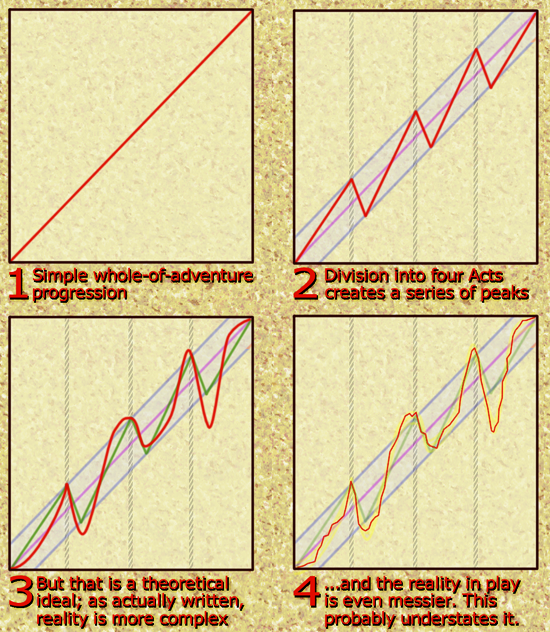
Often, correctly-judging the emotional pacing needed will signpost an imminent climax to the story-line, and that will usually result from or lead to the solution. It’s normally the case that this intensity derives from the hints and cues that things are coming to a head, but it is possible to invert the cause-and-effect relationship. This article is going to show you some ways of doing just that.
The idea is that if you can create situations in which it feels like things are heading for a climax, getting more dangerous, or more exciting, the players will interpret that as climbing the intensity curve, and therefore getting closer to the solution. They will feel as though they are making progress even if they have simply followed one clue to be unraveled to another.
The reality is more complicated, of course. You have to do some of the work with pacing, plot, and language – the tools of the novelist – but you can get the players to assume that more has been done through some quite simple tricks that aren’t all that different to what you would have been doing, anyway.
Climbing The Ladder
Let’s start with the most obvious one. If each victory brings a new target into view, one higher up the “food chain” of the enemy hierarchy, it becomes inevitable that eventually the protagonists will reach the top, and confront the head of the operation. How many steps are there in this particular ladder?
As a general rule of thumb, no matter what answer came to mind in response to the previous question, the best answer I’ve ever seen is “one too many”. Why? Because the size of the organization dictates the resources they can throw at a situation, and that dictates the scale of their realistic ambitions.
The only way a small group can dream of overthrowing the current political leadership, for example, is by absorbing whole the infrastructure dedicated to supporting that political leadership. Anything else will require a larger organization with that small group as its head.
Let’s try this exercise: Each major town has a sub-leader. Each sub-leader. has a dozen flunkies, some at hand, and others in smaller towns. Ten sub-leaders report to a regional commander. Each regional commander reports to the villain’s lieutenant and proxy. The villain’s lieutenant reports to the leader, as does the leader’s spymaster. The spymaster has a network of two agents in each major town, and half-a-dozen agents scattered in key positions around smaller towns. Every 5 individuals requires one administrative staff-person. Every 10 individuals requires 1 recruiter, who has two assistants. Every person to whom more than 10 people report also has 1 security guard per ten people reporting to them, times four shifts. How large an organization are we talking about? Any guesses?
Well, it’s going to depend on the number of major towns. Depending on definitions and terrain, there could be anything from 20 of them to about 500. Let’s pick 100 as some sort of “unreasonable average”.
100 sub-leaders. 100×12 flunkies=1300 total. 10 regional commanders. 1 lieutenant. 1 chief villain. 1 spymaster. 100×2 spies in major towns, plus 100×6 spies elsewhere, totals another 800. 1 admin person for each sub-leader. 1 admin person for each regional commander. 1 head of admin. 800/5=160 admin people working the spy network. total so far = 1300 + 10 + 3 + 800 + 100 + 10 + 1 + 160 = 2384. So that requires a team of 2384/10 = 239 recruiters, and 478 assistant recruiters, or another 717. But they need another 717/5=143 admin people, and a chief recruiter. Plus 100 security guards for the sub-leaders and 10 for the regional commanders and 10 for the major town spies, and 60 for the smaller town spies, plus 24 for the recruiters, and 31 for the admin section, all times 4 shifts. Plus one head of security. Total: 4186. Wait – with 940 security, we will need more recruiters and assistants (94×3), and more admin for the total (1222/5=245), and more security for the additional admin (245/10=25) and more recruiters and guards… I get 4745. I might be off by a couple.
Wait – there are no security forces assigned to the leadership. And there’s no paymaster and no means of disbursing payments to this absolutely massive conspiracy. And where is the money coming from? And how about some accountants? And guards for the money? Before you know it, you’re at the 10000-15000 people mark – to take over 100 towns.
And how about cities? A one-to-25 ratio seems about right – so 100 major towns requires about 4 cities. But it might be better stated as 3-5. Am I really suggesting that such a well-organized coup would ignore the cities? Would ignore the Capital? Sure, there aren’t as many of these, but they have a lot more people in them, and represent a lot more power and cloak-and-dagger. By now, our coup is getting up toward the 30,000 mark, and represents a significant (hidden) industry within the nation in question.
How many ladder-steps – adventures – should be devoted to smashing this organization? Well, assuming that this isn’t the whole thrust of the campaign, the minimum is probably going to be 5 – detection/small town, large town, regional command, security, capital/command.
But – “one too many”. That says that we should conflate two of these. Detection/small town + large town would work. Or regional command + security. Or even security + command. The result is a far more taut adventure chain, in which visible progress occurs at each step up the hierarchy.
Rankings as Rungs
D&D has “character levels”. Some other games have similar measures. In Hero Games, (XP spent – 100)/5 gives a rough equivalent in a low-xp campaign (halve it for a high-xp campaign). The exact mechanism doesn’t matter, which is why I’m employing the more generic term “Rankings”.
- Adventure #1: half-a-dozen rank 2 enemies (easy pickings).
- Adventure #2: half-a-dozen rank 4 enemies (more difficult).
- Adventure #3: four rank 6 enemies (about the same), plus a dozen rank 2 enemies.
- Adventure #4: two rank 8 enemies plus half-a-dozen rank 4 enemies (getting difficult now).
- Adventure #5: one rank 12 enemies plus two rank 8 enemies plus four rank 6 enemies and a dozen rank 2 enemies (maybe we’ve bitten off more than we can chew…)
This is an example of using rankings as Rungs – because you can see the opposition becoming more significant, and more central to each adventure with each step up the ladder, the excitement level builds, and the expectation is that Adventure#4 or Adventure #5 will be the top – depending on whether or not you have a plot twist and a hidden power and a much larger conspiracy to be revealed after the PCs think they’ve swept all before them in adventure #4.
The difficulty posed by the opposition provides a very subjective set of “rungs” that can be utilized not only to signify progress, but also to build emotional intensity over a multi-adventure arc – or even within an adventure.
Rewards as Rungs
A truism of most D&D-type games is that the more potent the opposition, the more experience is garnered from overcoming them. This provides a secondary mechanism by which Rankings can be translated into rungs as the PCs climb the ladder.
Most GMs will have recognized this, but not as many will realize that even in the absence of Rankings-as-rungs, rewards can be used to signal progress.
Let’s imagine that the PCs are about to explore a dungeon. They aren’t the first to go down there, but they hope to be the first to plumb the deepest levels and return. Sounds fairly typical so far, doesn’t it?
So, on the first level, they find few remains and few rewards of any note. On the second level, they start finding remains of past adventurers more regularly, but they have been stripped of almost everything of value – someone in the past has clearly had the same idea. Most rewards have been looted.
On the third level, they find remains about as frequently as before, but these still have items of low value or low-value-relative-to-their-bulk-or-weight. Since pickings have been relatively thin, to date, even these poor rewards have value – but the inconvenience factor outweighs the value for the most part. Some supplies can be replenished, however, and there might even be one or two items of moderate value that have been overlooked. Most rewards have been looted but some goodies remain.
On the fourth level, they find remains relatively infrequently, and many of them still have mid-level rewards in place. However, the best goodies have been looted – not by fellow adventurers, half the time, but by enemies who will turn them against the PCs. Effectively, the opposition have been taken up a rung, but the rewards are getting more noteworthy. What they do still have on them are many of the supplies and low-level rewards that were taken off corpses in the upper levels. Many of the caches of rewards that have collected here have NOT been looted significantly.
On the fifth level, there are only one or two sets of remains – but they are reasonably well-equipped, and probably as well-prepared for what they found as the party are. The fact that they did not survive whatever they encountered increases the sense of threat to the PCs. Most of the caches of rewards are intact. If anything, rewards might seem disproportionately high, just as those previous were disproportionately low. But if they succeed in clearing this level and get out alive, they will not only earn bragging rights – they will reclaim most of the rewards carried below by their predecessors.
In effect, there has been a flow of valuables from upper levels to lower, with dead adventurers as the vehicles of migration.
Whenever you contemplate emplacing a reward, think about what is likely to have happened to it since – then relocate anything worthwhile downwards. If there has been trade between the different groups, this furnishes a secondary mechanism in which migration of rewards can occur in both directions – so significant treasure in the hands of the residents of an upper level should signal to the players that such trade has occurred.
This approach to designing the dungeon can apply a veneer of realism to even the most randomly-generated residence of fiends and critters – or, at least, remove one of the less obvious and rarely considered failures of realism, making the suspension of disbelief that much easier. Throw in some thinking about the ecology, and how the creatures would have not only survived but prospered, and how they would alter the spaces they control, and an astonishing level of verisimilitude can be achieved.
More importantly, from the perspective of this article, there is an obvious progression that signals to the players that they are approaching the completion of their quest. There are visible signs of progress.
A quick side-note: When setting up relations between the societies you emplace beneath the surface, don’t make them all friends and allies. Every alliance should tick off someone else – whether they can do anything about it, or not.
This takes some events that would have otherwise been mere combat opportunities, the same as the one before and the one to come afterwards, and makes roleplaying opportunities out of them – while ensuring that diplomacy will not solve ALL the PC’s problems.
PC should encounter artisans, and potential friends, and enemies, and plots, and con-men – the full gamut of human existence should be twisted to fit this microcosm. This not only makes the dungeon seem more like a real (and realistic) place, it makes the encounters more interesting, too. And if the PCs get an easy ride through part of one level as a result, that only means that a lower level will be out for their blood that much more passionately.
Who’s paying attention?
I think the point is pretty much proved by now, so I’ll present just one more example.
Using a hierarchy of those monitoring the PCs also creates the impression that their endeavors represent noteworthy progress even when there is no such impression to be derived from the events themselves – provided there is some mechanism of interaction between the PCs and those supervising.
You can use this principle in all sorts of situations where the other mechanisms don’t work or don’t apply.
For example: You are a spy ring, operating in enemy territory. At first, your reports go to a minor functionary who seems mostly bored. Then he starts to show signs of interest, and then fascination. Then someone more senior, with a higher rank, starts taking their reports – and is obviously engaged with those reports. Next, that person starts issuing missions to the team rather than leaving them to their own devices. Some of these assignments fail, some succeed. The next thing the PCs know, they are reporting to that individual’s superior, and are being given specific information to obtain and high-level contacts. A few more successes on these assignments and they get reassigned to a General who begins sending them on rescue and sabotage missions…
There’s a clear progression up the ladder of who their orders are coming from and who they are reporting to. Even if their operations seem isolated and to have no lasting effect, from the on-the-ground perspective, this creates the impression that high command can see impacts that are not visible to the players – diversion of resources, heads rolling within the enemy command, and the like. The clock is clearly ticking it’s way toward a victory of some sort by the side represented by the PCs.
Or maybe it’s solving a mystery – the PCs start by interacting with a street-level constable, then a detective, then a sergeant of detectives, and ultimately with the captain of the detective squad – and maybe even then directly with the chief of police. These interactions start out with the PCs being opposed by the official forces of the law, then are grudgingly respectful, then eager and friendly and cooperative.
Once again, realism sells the validity of the ‘clock’, the ‘clock’ creates the impression of progress, and progress implies and is reflected in, emotional intensity. The campaign grows more and more exciting and feels more and more like it’s coming to a head.
On a bigger scale
Using combinations of elevations in the stakes, alliances, enemies, etc, I employ these techniques regularly within larger campaigns to signal progress towards a conclusion. Consequences may spin off into a sequel campaign, or into a new set of plot threads. There are dozens of ways that the PCs can interact with the universe around them at both an in-game and a meta level, and each is a lever that can be adjusted to slowly elevate the campaign in intensity, with natural variations along the way.
These techniques scale – though the level of detail and depth that you need to employ will vary with that scaling. I tend to think of it in terms of adding rungs to the ladder – if you have 5 steps between “A” and “B”, progress will be a lot more obvious than if you have 50 – and “B” would need to be more significantly different from “A”, to boot.
Detective Breadcrumbs
So these are good management techniques to employ at any time, in any campaign or adventure. But it’s when you have inflicted a mystery on the PCs that it becomes absolutely critical, because one breadcrumb looks exactly like another when you project them out of the in-game realm, through the meta-realm, and into the real world that is inhabited by the players and GM.
We aren’t talking about the characters feeling like they are making progress, but about the players feeling that their characters are making progress. That’s a subtle but very important distinction.
A defined list of suspects, and a series of clues each of which, when correctly investigated and unpacked, crosses a name off that list, fills the requirement. It’s not the only solution, but it’s one that works.
When planning an adventure or a campaign, you need to actively look for the opportunities that what you have planned provides you in terms of clock-ticks. This sort of thing doesn’t happen by accident.
A Real-world example
Take the current adventure in my Zenith-3 campaign. Act 1 was set in what has become ‘home’ for the PCs – not a single scene took place outside it. Act 2 brought them back to the primary Earth of the campaign setting, from which three-quarters of the PCs derive and spelled out the rest of the adventure’s “clock ticks”. They know that Act III will be in Brazil, Act IV will be in Central America and Mexico, Act V will be within the US as they set up a base of operations, and Act VI will deal with the 4th of July and a plot to detonate a nuclear device – somewhere, and will be the climax of this particular adventure.
Visible progress is made with each Act. Which means that shortening the Acts, in terms of game time required, will automatically escalate tension. Acts I and II were whole-session; Acts III and IV will be half-session in length (a couple of hours); Act V will probably be a full-session, more because of player input than anything I prepare, which will be a deep breath before we take the plunge into the high-speed action of Act VI, which might last one or even two game sessions.
This sense of progress will be critical, because none of these intermediate acts will advance the main plot of the adventure much if at all; they are more about traveling to the location where that main plot can be engaged. This is a logical step – before you can solve a mystery, you need to travel to where the mystery is – but that doesn’t mean that this travel feels like progress. In a different campaign, or even at a different time in this one, I would even contemplate hand-waving the travel; but there’s too much game-relevant material that is incidental only to the main plot of the adventure for that to be a viable option.
That’s what I mean about looking for the opportunities.
If it’s ever your intention just to frustrate the players – and there are times when that can be useful – then ensure that there are no clock-ticks, no progress markers – lots of sound and fury but nothing that will feel very significant, activity without apparent purpose. Why might you want to frustrate players? Because when that pent-up frustration is released, the sense of progress, of achievement, can be amplified – if it is done properly.
Like emotional intensity, progress markers are not just an end in themselves, but are a tool that can be used in various ways to elevate and accentuate your strengths as a GM. They bring so many side-benefits that it’s easy to justify their inclusion.
But, most of the time, it won’t happen by accident. And even if it does, if the game system has built something that can be used as a progress marker into the game-play, it can still be enhanced, nuanced, and manipulated through intelligent application. It won’t happen by accident – but if you are aware of the potential, and of the options open to you, you’ll discover that (over time), it will happen.

Discover more from Campaign Mastery
Subscribe to get the latest posts sent to your email.
Comments Off on The Search For Lost Treasure and other Mysteries