All Spiders (And Snakes) Are Not Alike
Snakes & Spiders in RPGs tend to one-size-fits-all construction. Use reality to make them exceptional!

Image by Alan Couch, CC BY 2.0, via Wikimedia Commons
I got curious this morning.
Australia is well-known around the world for the number and variety of deadly fauna we live alongside.
The likelihood of your home being robbed drops by a ratio of between 100-1000 times if you live above the ground floor, to the point that if you are not away for an extended period (more than a day) and have no neighbors on the same level, it’s perfectly safe to leave your front door unlocked for a few hours – while you go shopping, for example (doing so freaks a lot of urban dwellers out, though – it’s far more comfortable for those coming from relative security like a small country town).
So I suddenly wondered, “How much do Sydney Funnelweb Spiders like to climb? What are the rates of reported bites taking place on any above-ground level higher than the ground floor?”
I wasn’t able to answer the second because it’s not a statistic that is routinely recorded, but was able to get an answer to the first, based on the behavioral traits of the spiders in question. And that answer got me to thinking about Spiders and Snakes in RPGs.
Funnelweb Spiders
These are, perhaps, the most deadly spider in Australia. Nevertheless, there have been few if any fatal attacks since the anti-venom was developed.
Sydney Funnelweb Spiders (Atrax Robustus) are generally terrestrial (ground-dwelling), but they are capable of climbing under specific circumstances.
Sydney Funnelweb Spiders are primarily known for building their silk-lined tubular burrows in sheltered, moist, cool habitats, usually under logs, rocks, or in suburban gardens. The females are especially sedentary and rarely leave their burrows.
The most common encounters occur with wandering males during the warmer months (especially November to April), particularly after rain, as they search for mates. This wandering behavior often leads them into backyards, garages, and houses, or they fall into swimming pools.
The species is overwhelmingly terrestrial (ground-dwelling). Their burrows are in the soil, under rocks, or in logs. The only ones that typically leave the burrow are the wandering males looking for a mate.
When males wander, they move across the ground and seek shelter at dawn. They are most often found entering homes by crawling under doors or sometimes through other ground-level openings.
They generally CANNOT climb smooth surfaces like clean glass, plastic, or very smooth painted walls due to a lack of specialized adhesive pads (like those found on many other spiders). This is common lore among experts.
They CAN climb textured or rough surfaces like rough brick, steps, or rough-barked trees, as their claws can find purchase. In fact, some related species, like the Northern Tree-dwelling Funnelweb (Hadronyche Formidabilis), are known to live meters above the ground in tree bark.
So, while they prefer to stay at ground level, a Sydney Funnelweb Spiders could potentially climb a textured wall or staircase to reach an above-ground level, but this is not their typical, preferred mode of movement or habitat.
By far the most likely source of an above-ground attack is from a Spider being carried up on furniture or boxes being moved (carried up by a human) or an accidentally journey in a lift – by definition, unnoticed by the user of that lift.
Bio-security Barrier
Living on an above-ground level in an apartment building significantly reduces your risk of encounter.
You can treat living above the ground floor as a form of “bio-security” against Funnelwebs (and many other ground-dwelling risks) that is analogous to the security drop in crime mentioned.
Comparison: Huntsman Spiders
Huntsmen are climbers; they like to live high up on walls and on ceilings. Most varieties (maybe all) don’t build webs at all. They are incredibly fast and often very large (bigger than an open hand with the fingers splayed out as far as they will go). They are also adept at squeezing themselves through gaps that are much smaller than their bodies.
While most Australians don’t welcome the intrusion of a Huntsman into the home, it’s rarely a cause for panic. They are actually fairly shy creatures – just getting close to one and staring at it for a few minutes can be enough to get them to leave on their own when you then leave the immediate vicinity and don’t look at them – they treat this as coming across a predator that isn’t hungry enough to have them for lunch, a lucky escape, ‘now let’s get the hell out of here before it comes back!’
Huntsmen live on cockroaches, flies, and other far more annoying insects, so there are exceptions to that general rule. For the most part, in Australia, if you leave them alone, they will earn their keep.
But for the especially arachnophobic, that’s not an option, and there’s always the risk of a visitor freaking out, so it’s common practice to remove them gently and release them outside. Again, this is viewed as a predator ‘toying’ with them cruelly before letting them go – the last place they are likely to go is where they were removed from.
They have been known to scuttle inside cars and can even work their way through the door-seals of a closed door or a window that’s only opened a crack – 1/4 of an inch is more than enough. That’s why you’ll often see videos on the internet of spiders inside cars or on windscreens, and sometimes the braver souls will catch them, open the door, and release them. No Aussie questions the validity of these videos, they are far too plausible for that.
Huntsmen CAN climb smooth surfaces like glass, and can cling to a windscreen at highway speeds. They may not like the experience, though – I can’t attest to that, either way.
The largest one I’ve ever seen was the size of a dinner-plate. I think they can grow a little larger than that, but not much. But size alone makes them terrifying to some.
Snakes
The same is true of the most venomous snake varieties here, provided there is no access for them to get into the ceiling of the ground floor space.
Australia’s most medically significant snakes (like Eastern Brown Snakes or Tiger Snakes) are also strongly terrestrial. While they can climb surprisingly well, they are not naturally adapted to navigate the smooth, high, sheer walls and stairwells of a multi-story building.
Awareness of the ground-floor ceiling / roof void is key. If a snake gets into the space above the ground floor (by climbing a vine, tree, or rough surface to the roof-line and entering through a small gap), it is primarily a risk to the ground-floor residents. If you live on the first floor or higher, this risk is eliminated unless there is some opening in that crawlspace upwards that the snake is small enough to take advantage of – heating ducts or something, perhaps.
There is an evolutionary rationale for this: Because they are principally terrestrial, they are more likely to encounter predators, and so are more likely to develop defenses against those predators. So the general rule is, the less a snake likes to climb, the more likely it is to be dangerous.
Carpet Pythons
Carpet Pythons, and constrictors in general, are far stronger and better able to climb. They can be viewed as the Snake-world’s equivalent of Huntsmen. Their preferred attack mode is to leap / fall on prey from above or from the side and wrap themselves around it, squeezing it until it dies, then swallowing it whole.
The Second Bio-security Barrier
Even the climbing species tend to stay close to where the food is, and that’s closer to the ground. While they can climb higher than the first floor above ground level, there is little advantage to them in doing so, so there is, effectively, an equivalent ‘bio-security barrier’ that’s just one floor above the first. Encounter incidence drops dramatically at such heights. Part of it might be that while robust, strong, climbing snakes and spiders can survive a one-story drop completely unharmed, there is far greater risk when falling two or more stories. Just like people, extreme heights are not what they are built for, and are therefore scary (to some, they are thrilling to others – I wonder if that’s true in the Animal kingdom as well?)
Spiders In RPGs
While there can be exceptions of small-but-deadly spiders taken from the real world – Black Widows, Tarantulas, and so on – for the most part, RPGs treat Spiders as “one stat block does all”. They are all venomous, all climbers, all web-spinners, all generic except for size. At most, there might be cosmetic variations.
Simply dividing the world of spiders into two – terrestrial types vs climbers – and applying the difference to determine capabilities – is a direct infusion of verisimilitude into spider encounters. Go back and read the spider encounter in The Hobbit again, and this time don’t let yourself get distracted by the conversations and “Attercop”, and you will find that the encounter has a greater level of credibility because the behavior of the spiders feels realistic. There are species whose venom doesn’t kill right away, and who surround their prey in webbing and leave it hanging to die on its own, because it’s harder to tear flesh from bone when it hasn’t started to rot.
Snakes In RPGs
These fare somewhat better, but the same truth can ultimately be found here in an awful lot of cases. It might be, in part, due to varieties of deadly snake being recognized culturally with greater frequency – the cobras with their flaring necks, rattlesnakes with their rattles, and so on. When these get super-sized, some of their traits – those known to the referee – tend to go along for the ride. Many systems explicitly detail a “Giant Boa” or other constrictor.
But, past a certain point, the same truth is there – all snakes past a certain size are venomous, have similar behaviors and attitudes, and behave the same way – and can benefit in the same way by a little differentiation.
Example: Giant Swampy Tree-snakes
You don’t have to ground your ideas in reality, the mere fact that they are different from the ‘norm’ gives them instant credibility and interest. As an example, let me present to you the Giant Swampy Tree-snake, better known as the Green-backed Swamp Viper.
My chain of thinking:
- I don’t know what the defining characteristics of a Viper are, but the name sounds cool.
- These snakes cannot swim. In a swampy environment, that’s the key point of distinction, from which everything else will flow.
- To cross small rivers and streams, they learned to climb one tree, head out along its branches until it was above another tree’s branches, then drop down into it.
- Evolution favored smaller, lighter specimens, but required the retention of above-average strength relative to their size.
- After a while, they learned how to wrap their tails around the end of a tree-limb and swing, greatly increasing their chances of traversing terrain. This favors a longer, thinner body.
- Their eyesight grew more acute and their reactions faster in order to better target neighboring tree-limbs.
- Once you have a locomotive ability that doesn’t require descending to ground level, there is a survival benefit to not doing so most of the time. The only reason to drop to ground level is to attack prey, and once it’s in your mouth and on its way to being digested, you would head straight for the nearest tree and climb.
- Minimizing the time spent on the ground naturally demands a quicker-acting venom. Smaller body sizes give this snake a lower metabolic demand, so smaller prey, less frequently, becomes sufficient. The improved eyesight aids in the resulting development path. So the snake has fewer doses of its venom but it’s more potent.
- Take all of the above changes and repeat them because they are not just a change, they are a trend.
- Swinging from tree-limb to tree-limb imposes a natural length limit of average height above ground plus enough length to firmly grasp the tree-limb – two or three coils around, so if the tree-limb is 1/2 an inch in diameter, that would be 6 pi 1/2 = 3 pi = 9.4 inches.
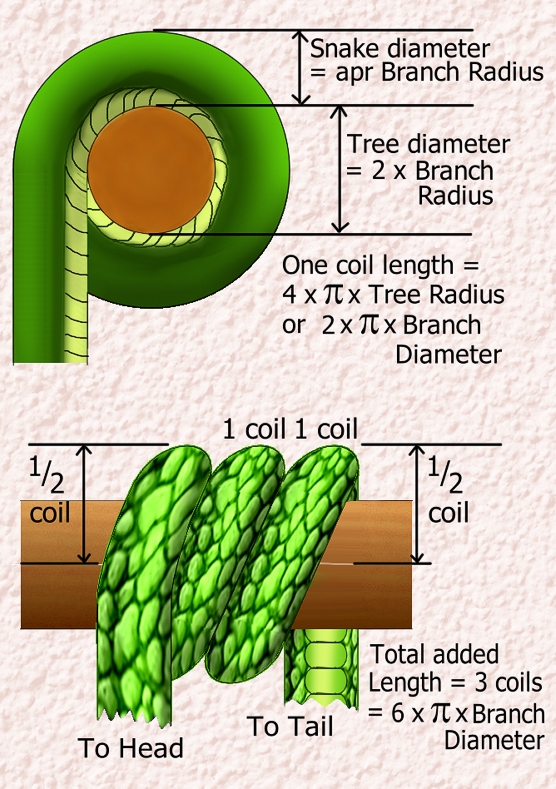
In reality, this looks a little cumbersome in terms of the snake releasing it’s grasp at the end of its’ swing – if it wants to leap from one tree to another, I’d probably take one coil out and make the added length 4 pi 1/2 = 6.3 inches.
Put all of these changes into an appropriate stat block, and you have something unique, interesting, unexpected, fantastic – and yet, it has a ring of authenticity.
Snakes that live in trees tend to evolve to have a diameter 1/2 the diameter of the branch, at most. If they stay in close to the trunk, they can be enormous in size; if they head for the outer branches, they shrink – fast. And maximum length, as said, tends to be height above ground in the average tree-limb plus a few inches.
Final Tips
Hunting Vs Defense: A creature’s venom can have either purpose or both.
If it’s for hunting, the quantity will be enough to bring down its usual prey quickly. Every second that a snake or spider is waiting for its prey to konk out (dead or unconscious) is another second that the spider or snake itself can be attacked.
If it’s for defense, the quantity and deadliness will follow the same logic with reference to whatever it usually has to defend itself from.
If both, half-way adaptions become likely – smaller venom amounts but the speed for multiple attacks, for example – so that venom is not wasted on prey when it might be needed for defense.
The same logic still applies when you scale these creatures up.
Before you go, I have a couple of announcements.
Monday Deadlines Erased (well, lightly scuffed)
I (or Johnn) have been publishing Campaign Mastery every Monday at around Midnight my local time since 2008 with just one extended break (not of my choice). Back then, we followed the usual formula of 1-2000 words to a post. For the first ten years, we published twice a week, Mondays and Thursdays.
As of this post, that changes. When I started, I could knock out a post in one day – I often didn’t start writing until the Monday Morning, though I liked to have time up my sleeve by writing the next post early.
I had a set routine – Monday, CM; Tuesday, Pulp; Wednesday, the real world; Thursday, CM; Friday, prep the next campaign to be played on the monthly rotation cycle; Saturday, play; Sunday, personal time.
Then the posts started getting longer and more complicated. First Sundays and then Saturday Nights and then Tuesday Nights all got added to the CM schedule, one at a time. Lately, it’s been Thursday, Saturday, Sunday, Monday – more than half the week – and that often hasn’t been enough.
A number of times, a post has been almost but not quite ready completable before deadline, come Sunday / Monday, and I would have to set it aside and throw something together at the last minute, when another day or two would have seen it good to go.
So, as of this post, there’s a new publishing schedule here at CM:
Something New Every Week.
Where possible, I’ll stick to the old deadline, but when something’s not quite ready to go, I’ll give it the extra time that it needs and publish when it’s ready. If I get to Thursday and it’s still not ready, I’ll do the ‘something quick’ trick – and aim for the delayed post to appear the following week.
Partial Posts
When it’s a major series, like Trade In Fantasy, I’m going to pull a new trick out of my hat, the Partial Post. In a nutshell, come Monday or Thursday, I’ll publish whatever’s ready to go, no matter how minimal it might seem. The following week, I’ll publish everything done since the last post as “Part 5b” or whatever, but I will also update the incomplete post with the new content.
Like I said above, something new every week. I’ll even take my usual Time Out breaks in the middle of working on the larger post instead of waiting until it’s complete.
The “Part 5b”-style posts will be minimal – no updated TOC, a repetition of the same feature image, no commentary – just straight ahead from where I left off, with only a single text panel at the top with a link back to the main post.
When one of these drops, it will also signify that there may have been retroactive amendments to the content of preceding parts – these will be Works In Progress, not complete until the main post is complete.
And, on that main post, there will be a similar text panel which will keep track of the status of that post.
Right now, I’m working on Chapter 5 part 5. So the first part of it will get uploaded and published as “Chapter 5 Part 5 (Incomplete)”.
It will be followed by “Chapter 5 part 5a”, with the date and text saying “partial post, click here to read the more complete version” in a panel at the top. And, when it drops, the content will be integrated with the old “Chapter 5 part 5”, the end-of-post blurb will be updated to indicate whether or not Part 5 is complete or will continue, and a text panel will appear at the start, showing the date, and “Integrated part 5a”.
How well this will work remains to be seen, but the theory is sound, and hopefully readers will stick around.
What’s that? Why post separately at all? There are a number subscribers who get Campaign Mastery delivered by email who won’t get the updated version of “Part X”. Posting the additional text means that they will still get the new parts.
Taking Time
I have a number of major projects on the go right now.
- I’m illustrating a complex machine for the Warcry campaign – so far, it consists of more than 1800 layers.
- When it’s finished, I have to write description and narrative around it in the adventure for which it’s written.
- Then I have to finish the adventure – and I have a hard deadline of early January for this task. So far, it’s 41,200 words long and about 80% complete. It contains 97 original images and 7 sound effects (so far)!
- Meanwhile, there’s a Pulp adventure that’s almost complete but needs some finishing touches. It has meant creating an 88-page offline website with 500 images, not counting ones that haven’t actually been used, and more than 129,000 words of text. I have one last page of the website to finish of this and then it’s done. The entire (still incomplete) “Value Of Material Things” series is a spinoff of the work put into this website. The adventure itself is is 16,100 words, is about 95% complete, and also contains about 60 illustrations.
- But before I can finish it, I need to complete work on another article for CM that currently stands at about 90% complete and is almost 9000 words long (there will be some compression in editing and many of those words are HTML, so it won’t be that long when it’s published).
- After that, there’s another Pulp adventure that’s 80% complete, maybe 90%, but it needs a complicated illustration that I’ve barely been able to start. It needs to be complete by May 2026. So far, it has 184 illustrations (some originals, many hand-edited) and is 24,300 words long.
- And then there’s my Superhero campaign. The next adventure is more or less complete at 7200 words and 28 illustrations, most of them original, but I have a growing itch to go back and add to it. But I also have to find time for the adventure that’s to follow it, and I haven’t even started on that beyond basic notes. It’s likely to run to 10-15,000 words.
- And, meanwhile, the current Dr Who adventure currently stands at more than 56,000 words and is only 22% complete. 7200 words of that total have already been played (one full session), so this is turning out to be a monster. So far, it has 33 original illustrations and (in another first for me) 5 animations. Because play has already started, this has been a high priority for me. And the rest of that adventure needs to be illustrated – that’s probably another 67 or so images, maybe more, to be sourced. Most of those won’t be originals, though – I just have to find the ones I need on the internet.
Put all that together.
- 718 illustrations, most of them original, with 2 more major ones in progress and 78 more to be sourced.
- 7 sound effects. And 5 animated short movies.
- 10 documents & 1 88-page website.
- 282,800 words. That’s approaching three full-length novels.
- With 67200 still to write by February. And another 160,400 to follow later in the year.
That’s doable, but it means stealing back some of the time that Campaign Mastery posts have soaked up in recent times (hence the Partial Post concept). So, in addition to the measures stated above, more time is going to be diverted away from writing longer blog posts for the next few months. And, on top of that, I will be taking a two-week vacation covering Christmas and New Years Day.
There’s a lot to do, so I’d better get on with it!

Discover more from Campaign Mastery
Subscribe to get the latest posts sent to your email.




Leave a Reply