The Curse Of Excess Prep Time
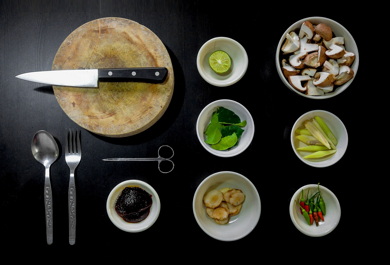
In cooking, the equivalent of RPG prep time is known by the French term, Mise En Place (pronounced ‘me-son-plus’). Image by pop picnic from Pixabay
There’s a little-known curse that sometimes afflicts GMs. It reads, “may you have far more prep time than you need.”
It’s not a situation that is encountered very often; more frequently, the converse is the norm, and almost every GM would give a good d20 for an extra hour a day. Or even an hour a week.
Covid-19 has turned the RPG Hobby on its’ head in the same way that it has done so for so many other activities.
Before the virus took hold, I had three campaigns operating – one with two players, one with four, and one with five and a co-GM.
Several of us, including myself, are in higher-risk categories so the Pandemic forced a shut-down of all three of them.
As my state and my country have gotten on top of the virus and reopened, one by one I’ve been able to restart these campaigns (with the exception of the last).
The two-player campaign was the first to resume, recommencing as soon as restrictions on gathering were eased. A month later (and some careful measurement) later, and I found that there was just enough room around my table for the second to restart. I can’t quite space people 2m apart, which was the requirement here, but I can give each a 4-square-meter bubble, which was the underlying requirement.
The last remains on hold, and may have to stay that way until there is a vaccine and it is widely distributed here. 2020 is out, and 2021 is therefore in serious doubt; the expectation is that even when a vaccine is proven both safe and effective, it will take a year to manufacture enough doses, and there will need to be a carefully controlled phased release – Doctors, nurses, and other front-line healthcare workers, then the elderly and those in the highest-mortality categories, and so on down. That puts me about third in line, but some of my players will be towards the back end of the queue.
And we still don’t know how long an immune response will stay active. The Vaccine could be good for anywhere from a lifetime to a handful of months, with the smart money on 1-3 years, 5 if we’re lucky.
I reached out to the youngest of those players last month to wish him a Happy Birthday, and he commented that at least I had plenty of prep time (as though this were a good thing) as a result of the fact that we weren’t playing.
If only life was that easy….
Unlimited prep: past experiences
This isn’t the first time that I’ve effectively had unlimited prep time at my disposal.
My first job was working for a bank in the Australian Snowfields. Once a month or so, I would get a rostered day off, and combining those with Public Holidays meant that every 6 weeks or so I could spend half a day traveling back to Sydney, a couple of days playing, and then half a day traveling back to my residence again. Arrangements were made a couple of weeks in advance, no more, and I had no TV – so there was nothing to do outside of work but read and perform game prep and – occasionally – socialize.
What prevented me from falling too deeply into any of the traps described later in this article was the desire to actually game – I worked toward the available playing time, so there was an ongoing impetus to keep moving forward instead of getting bogged down..
When my career plans within the bank were frustrated by changes in policy, and that job went away, I immediately laid plans to move back to Sydney, choosing accommodations recommended by one of my friends from Gaming (made on one of these excursions).
There was a time, subsequently, when I moved out of Sydney (where my game is played) to my home town, hundreds of miles away. I didn’t let that stop me from gaming, though – I saved what I could and 3 or 4 times a year, I was able to travel to Sydney for a week. This was a longer trip – 14 hours or more – but I usually booked a sleeper compartment and traveled overnight. While in Sydney, we played almost every day, my players taking their annual leave to coincide with the trips – and full use was made of public holidays to boost the available gaming time. It wasn’t unusual to get through 12-15 adventures in a trip.
The need to prepare so much in advance kept me from falling too deeply into any of the traps, though I got bruised by one or two along the way.
More than a decade later there was the third occasion: For many years, I’d been thinking about running another D&D campaign, and accumulating ideas (it took me that long to find players who were willing). The resulting depth showed in the campaign – though a lot of the ideas I’d had were tossed aside as not dovetailing well with each other. In fact, there was enough leftover material that I could turn it into a second campaign.
In that decade-plus, I had plenty of brushes with the dangers of unlimited prep, but having another campaign running prevented me from focusing too intently on what I was doing – and then I started to rewrite/update the rules to my Superhero campaign, which took almost all the free time that I had outside of immediate game prep, so development of the D&D campaign was set aside.
Besides, it’s not the same thing – unlimited prep time in the middle of an ongoing campaign is altogether different from unlimited prep background development time.
The final occasion was when I took a year to update the background of the Superhero campaign, turning what had seemed like a final epic event (Ragnarok) into a new Beginning. Once again, the fact that I was recapping past adventures kept things moving forward with regularity, preventing many of the traps from biting.
So it’s fair to say that I had never been presented with quite the same situation as this lengthy period of forced non-gaming.
The Dangers Of Excessive Prep Time
There are seven reasons why excessive prep time can be (and usually is) a problem. It’s rare for a GM to be susceptible to more than one of them at a time, but far from uncommon to find that one of them takes the place of another.
“Improving” Descriptions
One of the most overt problems is expanding descriptions in the guise of “improving” them. This can refer to descriptions of actions, situations, settings, and/or individuals.
What usually happens is that the descriptive language becomes more Flowery & Verbose, and a lot more opaque and difficult to decipher for players.
It may well be the case that initial expansions are, in fact, improvements – but the line can be hard to find and is easy to cross.
Over-complicated Plots
A bigger danger is that a GM will revise his plotlines, taking advantage of the opportunity to increase the number of moving parts that the GM (and the players) have to keep track of. Again, initial changes may be improvements – dotting I’s and crossing T’s and cleaning up loose ends – but it’s easy to cross the line.
One of the hardest tricks to master is having plot depth while keeping plot focus to a manageable degree. The best way to master this is by watching TV that manages it – but there aren’t a lot of shows where that’s the case. You need a series that is not especially episodic, but which nevertheless focuses on only a few elements, or one or two particular plotlines amongst the several that they have running at the same time, leaving the rest to fade (temporarily) into the background.
In many areas, Babylon-5 is my gold standard, but not in this case; instead, the accolades go to the middle seasons of Stargate SG-1. Say, seasons four through eight.
Plot Trains
One of the dangers of ‘enhancing’ a plotline is that you can fall in love with your own vision of how it will play out, and then become defensive towards it when things transpire differently. Predicting what a player will say and do, given the situation that you have presented to them, is never easy, but sometimes you can call it exactly right for a whole game session, producing tremendous satisfaction on the part of the GM, because it means that his prep focus was also spot-on – and that in turn means that he has wrung every last drop of entertainment out of his game. Such sessions are often personal favorites of the players too – everyone enjoys a good friendly challenge and competition is stimulating.
The results of obsessive focus on one possible outcome path through an adventure is commonly known as a plot train, and they have been the enemy of Good GMing for as long as I can remember.
It’s one thing to focus on the most likely course of events; it’s quite another to force the players to follow that course by denying alternative answers
Mental Rust
Perhaps the most insidious problem is this: every day that you aren’t GMing, your skills are atrophying and mental rust is developing. The most successful GMing happens when you are at your sharpest.
It takes time to get back into mental gear. I know from the period when I was only able to game three or four times a year in concentrated marathons that I was not as good a GM in the first such session as I was in the last.
Clumsy responses, vague statements, miscommunications, and a greater tendency to ‘stick to the script’ are the results.
The longer you go without gaming, the thicker this mental rust becomes, and the longer it will take you to buff it away.
Perfection Never Comes
Another problem is that you can focus so much on getting one part of the adventure “just right’ that you neglect the subsequent ones. News Flash, folks: it will never be perfect, there are simply too many variables. There may be times when it seems perfect, but that just means that reactions have matched anticipation (see above). While that can be gratifying – strike that, it IS gratifying – it doesn’t mean prep was perfect, or can ever be perfect.
Tinkering
Unlimited prep time means that you finally have the time to put together that critical hits table that you’ve always wanted to do – or the new magic system, or the ranged combat system that truly takes ballistic motion into account, or to rewrite everyone’s basic concept of Elves, or whatever.
All this falls under the general heading of tinkering.
“Tinkering” implies that you are puttering around without a specific purpose in mind – and that means that you have no specific criteria on which to objectively judge whether or not it’s an improvement on the existing rules or content.
Without that, you can transform a playable game system / campaign into something unplayable and unrecognizable, sometimes without thinking.
If there is some clear deficiency in the rules as they apply to your campaign, that’s one thing. Trying something because it sounds ‘cool’ is something quite different.
The problem is that you have a lot more time to come up with ‘cool’ ideas when you have unlimited prep time available. When you have another game session perpetually on the horizon, you have no choice but to focus on the essential needs.
Reinventing The Wheel
The last danger is to fall into the trap of doing make-work – reinventing wheels endlessly simply to fill the time.
Having careful notes of past sessions can help avoid this problem, at least in one of its manifestations. I’m really terrible at making such notes, so do as I say and not as I do! As a result, there was one occasion when I inadvertently introduced three different explanations for the same past event, all of them incompatible with each other, and all of them supposedly canon within the campaign – I had simply forgotten that there had been a previous explanation!
I got out of it that time by having an NPC enemy of the NPC enemy spreading misinformation and dropping in a time loop in which the PC faked the third explanation to delay and hold back a third enemy with a deliberate deception. Taken as read was that the PC at the time wasn’t taken in completely by either, but played along to give whoever was responsible enough rope to hang themselves – but I don’t think that would work a second time!
But most of the time, this is a rules-oriented problem, stemming from a vague desire to make something “better” – quite often, succeeding (but making something else intolerably worse). In particular, attempts to correct perceived flaws in “game balance” quite often fall into this category.
Good ways of using extra prep time
If you’re really desperate to do something useful with your extra prep time, I thought I would throw in some suggestions. These are just off the top of my head, there are undoubtedly others.
Polished and Compressed Narrative
You could go over your narrative elements (I listed them at the start of the equivalent section, above) and polish them, tighten them up and compress them. I showed how in a multipart series some time back – Polished Loquacity: The Secrets of Stylish Narrative (link is to part 1, there are links to the rest of the series at the foot of that part).
I usually aim for about 1/2 to 2/3 compression and then claim some of the gains back by adding additional descriptive or characterization elements. But 1/4 or even 1/5th the original length of text is quite achievable if you work hard at it.
One word of warning – compacting narrative means that it takes less time to read. You can find that you need more adventure than you thought – maybe a lot more!
One way of achieving this is to incorporate a safety net – an optional plot complication that exists for no other reason than to pad out the adventure by an hour or so. Put a couple of those in succession, and you’re prepared no matter how quickly you get through your primary material.
Flexible Options
Most GMs are pretty good at attempting to anticipate player choices and prepping accordingly. This can be a good opportunity to look for alternatives and prep for them, too – doing so is never wasted effort, even if they don’t get used it’s good practice and “keeps your hand in”.
It’s not enough to think about how you will handle it if the players do something different. How will the antagonists respond? Will there be anyone else who will muddy the waters? Will any of the PCs’ allies do something foolish?
Bear in mind the potential for short-sighted opportunism and miscommunications amongst the ranks of the enemy, too!
Deep Plots
Think back over the last year or two of the campaign (assuming that it’s been running that long). Were there any plots in which the antagonists’ goals were (in hindsight) too simplistic, or even outright stupid?
It’s usually the case that early plotlines in a campaign are relatively simple, even incongruously so – that’s because everyone is still getting used to the game setting and maybe to the rules, too.
Now’s your chance to devise a fix.
Start by assuming that what (historically) happened was what the villain wanted the PCs to think had happened, or maybe it’s what (historically) they appeared to want to achieve. Then brainstorm until you find a more fitting goal that they could have actually achieved while maintaining this deception, or even as a consequence of the deception – no-one looks for the master villain amongst the ranks of those already defeated!
Once you have a more sophisticated vision, you need only do two things: update their progress to allow for the in-game time that has passed, and work out how all this will start to come to the PCs’ attention. If you’re feeling generous, or have still more time on your hands, you can work out what the PCs can do about it, just to prep for that.
Patch any continuity holes while you’re at it!
Core Refocus
This is also a rare opportunity to reflect on the campaign and recognize that it’s probably drifted away from the core of your initial vision. That happens to all campaigns, part of the to-and-fro between players and GM. This is an opportunity for a subtle reset in your mindset, a refocusing on that core, even if it’s in the form of a single adventure that does little more than highlight how far things have evolved.
Both players and GM can sometimes get too close to the trees to see the forest. Often, this can give the impression that the PCs have had no substantive impact on the game world (maybe because they haven’t) – this is a golden chance to gain / offer some perspective.
Needed Refurbishment
Are any of the campaign elements feeling tired, over-used, or just plain hokey? Now’s your chance to do something about it – or to revel in that, if you want. Change things up, replace that aging Mentor, trash that boring base of operations, dress up that old enemy.
Deeper Understanding
Part of what I did with my Covid-induced downtime was to revise and revitalize the underpinning in-game concepts that describe how magic works in my superhero campaign so that they were more reflective of the current evolution of the game mechanics. I’ve described the results and the process elsewhere – see The Meta-Physics Of Magic and Creating a Campaign Physics for details.
Enhancements on the side
Have you always wanted to paint that particular Mini? Now’s your chance. Are there any game processes that are a little clunky? Now’s you chance to slipstream the process, maybe by simply reformatting a table into an easier-to-use format. Look ahead – are there any game props that you know you are going to need? Now’s your chance to prep them with as much time as you need to do the task well.
What I Did in my Covid Shutdown
I did very little of the above, either good or bad, and that was intentional. The past experience that I described earlier made me aware of the traps, and I didn’t want to fuel any frustration over not being able to use my efforts right away – and I didn’t feel any pressing need to fill the game prep ‘void’.
What I did do was:
- Thought about my campaigns.
- Did some re-engineering of the background narratives and concepts for magic.
- Solved a plot problem that had been holding me back.
- Took time away from the campaigns to recharge (putting off burnout for an unknown period of time). Instead, I wrote up some solo-play championship rules for Formula De and started a Lockdown Championship, writing up post-game reports – extremely lengthy ones! – and posting them to board-games group’s Facebook page.
Once it was confirmed that a campaign was restarting, of course, I resumed the normal prep schedule for that campaign.
A timely warning?
Europe is heading back into Lockdown. The US should already be in Lockdown – depending on the outcome of this week’s election there, it might be in Lockdown by this time next week.
For the time being, at least, the virus has been suppressed in Australia – but that could change at any time. We were pretty close to suppression a few months back, but then two breaches of quarantine happened, and led to what was – in some respects – a huge cluster of thousands of infections and 800 dead.
So no-one here is fooling themselves – the virus is still out there, prodding at our defenses on all fronts to see if it can find a chink in our armor. There are those, as there are elsewhere, who feel that the economic impact of a shutdown is more important than the health outcome. Personally, I think most people would prefer to be unemployed than dead.
At any time, then. we might all find ourselves faced with the prospect of effectively unlimited prep time.
It might be that I should have written this article back in February/March. I thought its contents fairly self-evident. Perhaps I should have known better – but it’s better late than never.
PS: One More Thing
I got a message through Campaign Mastery from Anthony Schilling
Hey guys! I’ve been on a Cthulhu kick lately and enjoyed reading through your site. I actually launched a Kickstarter to share a bunch of Call of Cthulhu themed models I made on my 3D printer! My project reached its goal, but I figured you guys might enjoy taking a look and it might be something your other readers will enjoy!
Anthony is being a little modest in his message. As I write this, there are still 31 days remaining in the kickstarter campaign, and it passed its target on or about the day it launched. It’s on track with no further support to achieve its first and maybe its second stretch goals at a canter. The figures look tremendous. Anyone with a 3D printer should check the project out, if you haven’t done so already!
But what if you don’t have a 3D printer? Anthony has thought of that, too, and has a backer’s tier just for those who want him to print and mail the figures.
Plus, at the common support level ($29 US), you get access to tutorials for printing, finishing, and painting the figures.
If you need a project with which to fill your Covid-enforced prep time, you could do a lot worse – which, at the end of the day, is what this article has been all about!
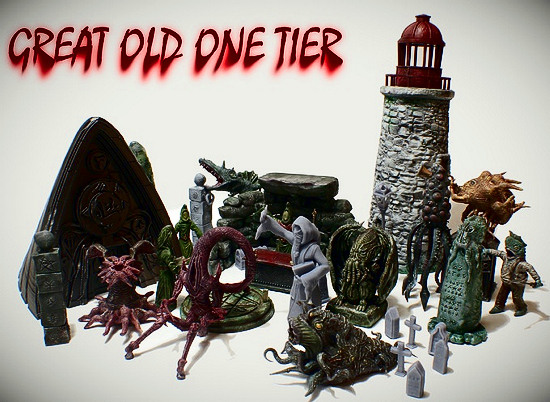
The ‘Great Old One’ Tier at various stages of painting. Click the image to go to the Kickstarter.

Discover more from Campaign Mastery
Subscribe to get the latest posts sent to your email.
Comments Off on The Curse Of Excess Prep Time