Fabricating Fabulous Treasure Tales
In the current Adventurer’s Club plotline, my co-GM and I needed to create a fabulous gem to be at the heart of the story-line, the Kalhoolie Diamond. To go with this fabulous gemstone, and lend authenticity to the fabled gemstone, we needed to create a history for it. Today’s article will examine the legend of the Kalhoolie Diamond and the decision-making processes that went into the fabrication of that legend, because there are lessons there for campaigns and adventures from multiple genres – in fact, anytime there is some fabulous treasure involved, whether that be a mythic sword in D&D or a sliver mine in the old west, Dilithium Crystals in Star Trek or a particularly hopped-up bit of illegal military-grade cyberware in a superhero or cyberpunk campaign.

This illustration combines diamond-1857733, image by Biju Toha from Pixabay with a modified excerpt from texture-1289287 (blue velvet), Image by Al Buettner from Pixabay.
The Difference In Campaign Treatment
I want to start by noting that the way the gemstone has been treated in story terms was very much a function of the campaign in which it was to appear. Because Adventurer’s Club’s plotlines are largely self-contained (though with connecting threads to other self-contained stories), we introduced the gem with a minimum of foreshadowing – the players were made aware of its existence and the fact that it was going on public display almost as an afterthought; a warning that the increased security that was being arranged, and the expected crowds of tourists, might inconvenience them, nothing more – and this happened about 1/4 of the way through the current adventure, when every PC already had something to occupy their interest. In fact, the primary thrust of the adventure at this point appeared to be an alleged hidden “extra floor” in the Chrysler Building (New York City) and a number of unscrupulous businesses that occupied the premises.
If this were my Superhero campaign, which has far stronger continuity, I would have introduced the gem in a quiet moment of a previous adventure, had the PCs consulted on the extra security in an adventure following that, let things lie fallow for an adventure to give anticipation a chance to build, and then had the real plotline commence.
In one of my Fantasy Games, which was so strongly continuous that it was sometimes hard to tell where one adventure finished and the next started – though you could always recognize that the tone and subject had changed once you were into the new adventure – I would not have given the PCs much of the history at all – at first glance, just the knowledge that there was a history there that might prove enlightening. And I would have made far greater use of the plot hooks provided by the backstory – more on that towards the end of this article – by having those with an interest in owning (or re-acquiring) the gem begin to intrude into the PCs lives. To say nothing of immediately doubling the lethality of all accidents and conflicts, as though fate were attempting to add another bloody page to the already blood-soaked history.
All of which only goes to show that the campaign structure that you are using can have a profound impact on how you use various tools – like the ones being presented here today. It’s not my job to tell you how to use the advice I provide, only to give you the choice of adding something to your repertoire.
The Gemstone
So, let’s talk about this fabulous gemstone, the Kalhoolie Diamond, the third-largest uncut diamond in the world.
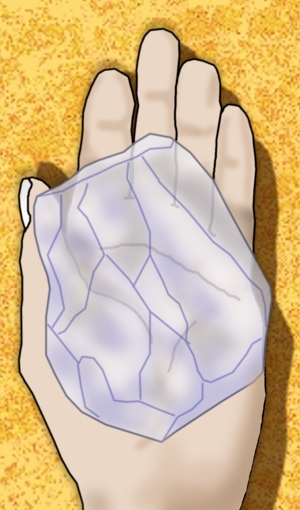
Artist’s Impression of the Kalhoolie Diamond (by Mike)
Why A Diamond?
We considered making it a ruby or an emerald. But, as fabulous gemstones go, there’s nothing more valuable – or as seductive – as a Diamond. In a different time and place, that might not be the case.
Why Uncut?
Once a gem has been cut, there’s little more that you can do with it. If you re-cut it, breaking it up further, you actually diminish its value, because there is a certain cache to rarity, and larger gems are much more rare than smaller ones. If the gem is uncut, the threat is always there of cutting it – so there is at least one more thing that can be done with it.
But that’s a metagame argument, not one that explains why the gem remains uncut within the game. The solution came to us from the title of the adventure, which was “The Hidden Floor” for reasons that should be obvious from preceding paragraphs. Changing it to “The Hidden Flaw” but only reading the title aloud to the players, gave us both titles for the price of one. Because so many things can be flawed, in some way, this in turn inspired all the lead-in material which was – eventually – to connect with the hidden 13th floor of the Chrysler Building and motivate the PCs to look into the mystery. (Oh, as an aside, we also had worked out a very careful history of the Chrysler Building – mostly factual – to explain the existence of that 13th floor!)
So, we postulated that the diamond contains a flaw not visible to the naked eye, but one that ensures that the value, if cut, was less than if the stone were retained intact. Or was close enough to that value that no owner would be willing to take the chance of something going wrong in an undoubtedly tricky procedure.
Why the name?
To be honest, the name was a placeholder when drafting the adventure.
There’s a town in Australia called Kalgoorlie, famous for it’s goldfields. When I originally came up with the bare bones of the plotline, It was “The Kalgoorlie Diamond”; my thought was that since diamonds and gold rarely coexist, the improbability would make the diamond more valuable. My co-GM thought that this was stretching credibility too far, and that the diamond should come from a region already known for its diamond mines. That made the name a misnomer, but one that we continued to use during planning (minus the “r”, a common misspelling), until one day I accidentally hit the “h” key instead of the “g” – and the “Kalhoolie” Diamond was born. And the name stuck because we couldn’t find anything better to meet our requirements. Those were that the name have no discernible nationality, be unique enough to be memorable, and be easy to pronounce.
The name works more functionally with Australian players, because it is still reminiscent of “Kalgoorlie”, and it’s association with valuables. Without such an association in the player’s backgrounds, does the exotic nature of the name enhance its usage, or does it damage the credibility of the diamond find? Or both? I don’t know – but this is an example of tailoring your game content for your particular players that is worth noting.
What’s it’s value?
Ooh, a difficult question! How much were uncut diamonds worth back in the 1910s? In British Pounds? It’s incredibly hard to find out. How does gem size alter the value per carat of uncut diamonds? Even harder to determine.
We started by estimating the volume of the diamond, used the density of diamond to estimate the weight in grams, then converted that to carats – 1320 of them. Next, we researched the questions posed above, finding that some guesstimation was required, but at least giving us a basis for those guesstimates. We ended up with a USD (1910s) $3788 value per carat; from memory, that’s about 3 times the actual ‘raw’ value, taking into account the fame of the Diamond. That puts the whole stone at around $5 million at the time of its discovery – or more than $60m in modern US dollars, even without any further increase in value for rarity and notoriety. We could easily see it doubling or quadrupling in value with those factors applied (plus an increase in the number of people who could afford to buy something so fabulously valuable, which would increase the bidding at auction).
Call it a nice, round US$200m+. A respectable little nest egg!
The Plot
I have to be a little circumspect here. Suffice it to say that this fabulous gem has been stolen, in dramatic fashion; and that artificial diamonds are somehow involved, and a once-respectable policeman whose medical bills have ground away that respectability in his second career as a security guard (having been wounded in the line of duty).
The History
Unless you have some specific plot need to address, or are trying to overcome writer’s block, the best place to start is often the beginning. After some research, we decided that this was an African diamond, because it placed it close to Europe, and because the conditions involved enabled us to begin a history steeped in blood and misfortune the “right way”.
Of course, history is replete with examples of the discoverers of wealth failing to benefit from their discoveries, being conned or swindled out of their fortunes, and we wanted an element of that to be part of the early story of the Diamond.
Discovery
The Kalhoolie Diamond was discovered in the Belgian Congo on July 30, 1914, but it took 3 days for the news to reach the court of Albert I of Belgium, at which time the government was distracted in deciding how to respond to Germany’s demand for its troops to have free passage through the Belgian territories. On the fourth, Albert refused the German demand and the Bosch invaded, so the court continued to be “distracted”.
The last thing that we wanted was for the stone to be declared a National Treasure and locked up somewhere, which was the fate of many fabulous gems discovered in the 19th and early 20th centuries.
The discoverer, Emile Kalhoolie, traded the gemstone for the riverboat (pic 70) “Roi Des Belges” (‘King Of Belgium’) with which to establish regular trade between his upriver village and the westernized Congo.
Fabulous Gems are often named for the place of their discovery (“The Star Of India”) or their discoverer, though there are exceptions. And we needed the “Kalhoolie” name to come from somewhere. So we decided to make it Belgian Congolese, one the basis that none of the players would be able to dispute its’ validity. This was our last chance to change the name; we should probably have made it a bit more French in style, but we didn’t think of it.
An Ill-fated Gem
Okay, so the discoverer sold it for a relative pittance, a fraction of its value – but, by doing so quickly, he was able to avoid the nastier possibilities. Fabulous gems always have blood-soaked histories – but it was important to us that there be a believable human motivation at the root of the misfortunes that would befall the owners of the gem through the years, even if it was only by implication. We also considered that most gemologists of the time would have had difficulty in appraising such a fabulous gem – which said to us that the gem should pass through several hands before it’s full value was recognized.
First Owners
The new owner, Pierre Verrone, was mugged on the way to the appraisal office to have his new possession valued, but the would-be thieves were driven off by the timely arrival of a policeman. Pierre died of his injuries a day later in Kinshasa Hospital, never having had his find valued.
Pierre’s son inherited the gem, and after probate of the estate, a few days later, sold it un-valued to cover his father’s funeral expenses.
Changes Once Appraised
The history of a fabulous treasure can be divided into four phases:
- Getting it into the hands of someone who can have it valued. Until that happens, it’s a pretty bauble that might be worth a lot of money, nothing more.
- Getting knowledge of the Valued Item to permeate those who deal in such treasures, and then (perhaps) the general public. In this phase, the object is appreciated for it’s monetary value.
- People start to think of the item in terms of what they could do with it, or with the wealth that it represents.
- The value from non-monetary considerations like fame come to equal or outweigh the purely monetary valuation – value that can easily be lost or diminished if the object is damaged or broken up in some fashion, but that can be enhanced and increased by the proper activities that increase the fame of the valuable.
The history of the object should reflect these phases. With the sale of the Diamond by someone in reasonably dire financial straits to an opportunist, we were transitioning from Phase I to Phase II.
Middle Owners
The buyer was Malcolm Borland, a British trader out of Portsmouth. Borland returned to his home port in October of 1914 and had the 1320-carat stone valued at ~£2.5 million. He then returned to his home to discover that he was part of the first intake of men drafted to fight the war. He died, a wealthy man, in the Trenches of World War I.
There’s a distinct sense of Karmic Justice in this outcome – or perhaps you can look upon it as a stroke of good fortune being counterbalanced by a stroke of ill-fortune, ‘just plain Karma’.
Borland had no direct heirs, so the gem became the possession of Lionel Bond, an unscrupulous half-brother, who lost it in a card game in Monte Carlo while showing off his newfound fortune. The lucky prize-winner was an uncouth South Australian, Stevie Dickinson.
A lot of people that come into money spend foolishly, and we wanted someone in the gem’s history to completely lose their heads to their newfound wealth. It’s also worth noting that we had sought out a rogue’s gallery of disreputable-looking characters to be the “owners” of the fabulous gem.
The Professional Dealers
With the transition complete, it was time to engage those who deal in such commodities for a living, stir in some more tragedy, and deal with the elephant in the room – you can’t do anything in diamonds without at least mentioning deBeers. The first step was to get the stone back into their sphere of influence – South Africa. We also wanted to show that the “curse” had a heart of stone, as capable of destroying a sympathetic figure as the most unscrupulous rogue. Finally, I had come across some really powerful descriptions of the conditions in the South African mines of the time that we wanted to incorporate into the narrative, through the personal knowledge of a PC with experience as a miner, named Steffan. The report offered is roughly 9/10ths truth and 1/10th imagination, and derives from three or four separate Wikipedia pages.
deBeers Involvement
Dickinson set out to return to the Ballarat goldfields from whence his family’s first fortune derived, only to be murdered en route and thrown overboard as the ship neared the Cape Of Good Hope.
Note the implication that the family had already blown one fortune!
The killer, a South African servant named Mbango, left the ship at Capetown with the diamond and attempted to use to buy the freedom of several of his relatives indentured to the diamond mines of the deBeers family.
Steffan knows all too well the hellish conditions in those mines, though there is little awareness of the problems outside of the ranks of miners themselves. Temperatures at such depths exceed 49??C (120??F). The atmospheric pressure approaches 1 1/2 times normal. The dust is known to cause lung diseases, so the rocks are sprayed constantly with water, producing almost 100% humidity. The work is back-breaking manual labor, which causes miners to sweat profusely, but the humidity reduces the cooling effectiveness of sweat. Shifts are 10-12 hours in length, 6 days a week. What’s more, the belief has emerged from the coal miners of England that drinking too much water in such conditions can lead to a condition known as water poisoning; only a single mouthful is typically consumed per hour. Workers frequently erupt into convulsions or suffer with cramping exacerbated by the cramped conditions. Nourishment is minimal, and the average age of the workers indentured into the mines is 15 years of age. Only 1 in 100 workers of that age will live to see their 20th birthday. DeBeers is known for mandatory dental checks of its workers – first, to see that minimal working time is lost due to ill health, and second, to ensure that the workers do not attempt to smuggle uncut gems out in their cheeks. Pay rates are poor at best, even for experienced workers, and the company deducts the expense of food, water, accommodation, and medical care. Workers are also charged for the “protection” of deBeers’ crack security forces, who suppress any form of violence or revolt. It was common practice for deBeers to buy up unpaid debts to forcibly recruit additional workers. Anyone with relatives incarcerated in the mines is known to be willing to do almost anything to get them out!
Deciding that Mbango could not be legally entitled to the stone, they referred him to the Authorities; he was arrested and jailed, and the stone seized. DeBeers expected that the stone would be auctioned after the trial and that they could so obtain it for a fraction of the value demanded by the African thief.
Time for another dose of Karmic Justice, don’t you think?
Legend Established – the Third Phase Of Ownership
I don’t know if anyone’s been keeping count – but the South African government is the “lucky” 8th possessor, and every one of them has either sold a fortune for a pittance or come to a sticky end. We thought it was about time to change that. At the same time, we didn’t want the Diamond locked up in the deBeers Vaults; we wanted it out in the world, creating mischief and growing its legend. MBango’s possession of the stone also represented the transition Phase II of Ownership to Phase III.
So we knew someone was going to outbid the diamond merchants in a plot twist these NPCs wouldn’t see coming, but that the players would enjoy vicariously – that “Karmic Justice” thing again. The question was, who? At this point, we started working backwards, making content decisions and notes without extending the narrative.
The Current Owner – preliminaries
The current owner had to have some means of support, but those funds were running out. That forces him to do something with the gem – either sell it immediately, or make money from it somehow – and that creates the opportunity for it to be stolen. Until now, it wasn’t known that he possessed it, and there might even be some suspicion about his ownership. That all fitted the narrative of someone fleeing Europe before the coming conflict – the campaign is set in the 1930s, remember. Those who fled early were frequently able to bring possessions with them, or liquidate them for capital before the move; those who left it until it was almost too late frequently had only what they could carry, and sometimes less.
That means that the current owner must be Eastern European – Polish, Slavic or Jewish or something like that. The question then becomes, how would such a person come into possession of the stone? And how could we connect whoever he got it from to the resources needed to obtain the Diamond from the South African Government after the trial of Mbango? Would one pair of hands be enough, or did we need some intervening owners?
Filling In The Gaps I: Co-mingling History and Imagination
To fill in the gaps, we knew that we would have to revise history somewhat, but the best alternate histories are solidly grounded on authority. It was thinking about the status of the gem’s legend – Phase III of ownership – that led us to he solution. We were discussing what you could do with that much money, and Blair (my co-GM) suggested (amongst other things) that you could buy yourself an army. And who would want an Army and didn’t already have one?
Filling In The Gaps II: Signs Of The Times
The answer to that question came from looking at World History for the range of years in which the change of ownership could take place, following up on anything that looked interesting, that we hadn’t used before, and that might answer the question that ends the previous section.
The Rest Of The Story
To recap: DeBeers expected that the stone would be auctioned after the trial and that they could so obtain it for a fraction of the value demanded by the African thief.
They were surprised when they were outbid by the Mahariji Victor Albert Jay Duleep Singh, heir to the title of the last Prince of the Sikh Empire. He had been born in England after his father was driven into exile, and had been raised to be his father’s son and apprentice to the many schemes by which the older Mahariji attempted to reclaim dominion in India, including an attempt to persuade the Tsars of Russia to invade India from the north and reinstate him as ruler. Victor Singh sought the same goals and intended to use the diamond as a bribe to anyone who would assist him.
He began by attempting to enlist the Anti-Bolshevik remnants within the Military following Russia’s withdrawal from World War I, promising them wealth, places of honor, the recognition of the English Throne (because his family was on good terms with the British Monarchy), and a base of operations in India’s North from which to reclaim their own homeland. At the same time, and unknown to these potential rebels, he secretly courted the Bolsheviks, suggesting that having those members of their military that they deemed politically unreliable die in an Indian campaign would be preferable to a politically-motivated purge that would attract international condemnation.
One of our players did a face-palm at “he secretly courted the Bolsheviks”. That was the moment that I knew our history of the Diamond had succeeded in sucking the players into the story.
This scheme to invade India might have radically changed world history during the 1920s, but for a Bolshevik spy within the ranks of the Anti-Bolsheviks who reported the duplicitous approaches of the Maharajah to Lenin personally. Victor was imprisoned by the Bolsheviks and died in 1928 in Gulag Sovolki in Southwestern Russia. The gem vanished from history for a time.
What is not publicly known….
….is still not publicly known. Sorry, this paragraph has to be redacted, because the players haven’t discovered the missing chapter of the stone’s history yet!
In 1923 a White Russian refugee from southwestern Russia near the Ukraine styling himself Count Viktor Alipondorov fled to Austria. He contemplated traveling further but the Beer Hall Putsch, even though it failed, convinced him that Germany was too unstable a regime to risk traveling through. When the Nazis came to power in 1929, Count Alipondorov smelt the political winds and abandoned his new estates in Austria for the safety of the US. Since arriving, he has been living on what hard currency he was able to smuggle out with him, but that has begun to run out, forcing him to reveal the existence of the largest single asset which he had smuggled out of Eastern Europe with him – the lost Kalhoolie Diamond, which had been thought to have been broken up by the Bolsheviks. To raise funds, he will eventually have to sell the Diamond, but in the meantime he has arranged for it to be publicly displayed in order to enhance it’s mystique and hence its value.
It’s All About Authenticity
There’s a lot of invention in the history of the Kalhoolie Diamond (not the least being the existence of the gem in the first place) – but all those flights of fancy are built around reality. The source of the fictitious Diamond: completely real. The assorted fates of various owners along the way: all modeled on real stories of fabulous treasures and the disasters that befell their owners. The reprehensible behavior of our mythical deBeers: all based on unproven but persistent rumors of underhanded deeds aimed at maintaining their domination over the Diamond Trade. The conditions in their mines were certainly accurate. And the Sikh and his family really were driven out in the manner suggested, and became personal friends with Queen Victoria and Prince Consort. While his aims (thwarted on a number of occasions by the British Government or the East India Trading Company) were merely to return to India, a rather more sedate ambition than the militant recapture of his homeland, there’s still a thematic connection between the two. In reality, he died peacefully in Paris at the age of 55. Nor was his son involved in any such wild ventures, though he struggled with gambling and made a number of bad investments that led him into bankruptcy in 1902, and died in Monte Carlo in 1918, so – once again – there is a thematic thread connecting reality to fantasy.
Someone once wrote that a lie should be 2/3 truth to every deception. The same is true of invented history – and every fabulous treasure should have an invented history.
Character Rubs Off
There’s a concept that I’ve never seen expounded that’s an undeniable part of the history of the Kalhoolie Diamond: Notoriety By Association. Or perhaps you would prefer the formulation, “You lie down with dogs, you’re expected to get up with fleas”.
By wrapping notorious characters and events around the Diamond, no matter how peripherally, some of that “dark stain” rubs off to make their joint possession notorious, too. Picture how much a medical instrument once used by Jack The Ripper would sell for at auction – from notoriety alone. Similarly, personal possessions of people who were anointed to sainthood tends to fetch disproportionately high values.
This is a transference of celebrity; Al Capone’s signature is worth a lot (US$60-70,000), not because he was a criminal, but because he was a famous one – but you can’t help but be reminded of his notoriety by the collectible, and so there is a “rubbing off” effect that can’t be denied. I have seen this arising a number of times on Pawn Stars, for example.
Backstory Generates Plot Hooks
The final observation that is worth making is that the backstory of the Diamond has generated a number of plot hooks that could apply if the PCs came into possession of the Treasure – the Russians, Bolshevik-oriented political groups, Indians, deBeers, and (on general principles) the Nazis would all lay claim to it – or, more probably (in a pulp environment) attempt to take it back directly.
It’s not too difficult to arrange for the PCs to come into possession of a fabulous treasure that four or five different groups want to get their hands on, all for different purposes, and all willing to employ force to achieve exclusivity. One might attempt to bribe the PCs, another to blackmail them, one to kidnap them, and a fourth to assassinate them. Maybe not all at the same time – it would take time for the news to filter through to the different groups – but possession of the item might be the central fact of several substantial encounters or even whole adventures.
Because where fabulous treasures go, trouble is sure to follow…
Because I’ll be away for most of the next 7 days at my niece’s wedding, there may not be any post next week. If not, I’ll be back 14 days from now :)

Discover more from Campaign Mastery
Subscribe to get the latest posts sent to your email.
Comments Off on Fabricating Fabulous Treasure Tales